The art of Vojtech Preissig, 1873–1944

preissig19.jpg

Self-portrait.

There are times when one of my searches for work by an unfamiliar artist turns up results that are much more varied than I anticipated. Vojtech Preissig is one such artist, a Czech graphic designer, printmaker and typographer whose name I’d only registered in the past via digital revivals of his type designs. Preissig’s career follows a similar trajectory to that of his contemporary František Kupka: both artists started out working their own variations on fin-de-siècle art—Symbolism in Kupka’s case, Art Nouveau design in Preissig’s—before finding their way to abstraction in the 1930s. Both artists also worked for a time with Alphonse Mucha in Paris, until Preissig moved to the USA where he spent a number of years teaching.

preissig03.jpg

When reading about European artists of this generation there’s always the question of how they fared during the Second World War. Preissig was among the less fortunate. After his return to Prague he spent his last few years putting his print skills to the service of the Czech Resistance. He ended his days in the concentration camp at Dachau.

A monograph, Vojtech Preissig by Lucie Vlckova, was published in 2012.

preissig05.jpg

Day (1899).

preissig04.jpg

Night (1899).

preissig01.jpg

Dreaming (1899).

Continue reading “The art of Vojtech Preissig, 1873–1944”

Weekend links 728

wadsworth.jpg

Composition: Cones and Spirals (1929) by Edward Alexander Wadsworth.

• “Repeating items over and over, called maintenance rehearsal, is not the most effective strategy for remembering. Instead, actors engage in elaborative rehearsal, focusing their attention on the meaning of the material and associating it with information they already know.” John Seamon on the vicissitudes of memory, and how actors remember their lines.

• “Mary McCarthy described it as ‘Fabergé gem, a clockwork toy, a chess problem, an infernal machine, a trap to catch reviewers, a cat-and-mouse game, and do-it-yourself novel’, among other things.” Mary Gaitskill on the pleasures and difficulties of Nabokov’s greatest novel, Pale Fire. Also a reminder that I ought to read it again.

• New music: Movement, Before All Flowers by Max Richter; A Thread, Silvered And Trembling by Drew McDowall; Unspeakable Visions by Michel Banabila.

• Among the new titles at Standard Ebooks, the home of free, high-quality, public-domain texts: Ulysses by James Joyce.

• The latest cartographical design from Herb Lester Associates is Facts Concerning HP Lovecraft and His Environs.

• At the Daily Heller: A look back at the craze for poster stamps.

• Mix of the week: A tuning mix for The Wire by Tashi Wada.

• At Dennis Cooper’s: Michael Lonsdale Day.

Annie Hogan’s favourite music.

Clockworks (1975) by Laurie Spiegel | Tin Toy Clockwork Train (1985) by The Dukes Of Stratosphear | Clockwork Horoscope (2008) by Belbury Poly

Weekend links 727

maar.jpg

Untitled (Hand-Shell) (1934) by Dora Maar.

• “The Secret Public…reads like the book he was born to write…and speaks to the taboo around homosexuality which the bravest pop stars did their best to dispel.” Alex Needham reviewing The Secret Public: How LGBTQ Resistance Shaped Popular Culture (1955–1979) by Jon Savage. Anyone buying the book should also find themselves a copy of Savage’s Queer Noises compilation.

• At Dangerous Minds: Richard Metzger advises everyone to seek out Sion Sono’s 237-minute Love Exposure (2008), “Japan’s eroto-theosophical answer to the allegorical journeys of Alejandro Jodorowsky”.

Prince – Sign O’ The Times (Live at Paisley Park 12/31/87). Pro-shot video of the last performance of the Sign O’ The Times tour, with a unique contribution from Miles Davis.

• Old music: Camembert Electrique by Gong. A rocking riposte to the stereotype of the group as a bunch of whimsical hippies.

• New music: Lambda by ZULI. This is another release on the Subtext label which I designed.

• The Devil in the Flesh: Patrick Clarke on David Sylvian’s Red Guitar at 40.

Milky Way photographer of the year 2024.

The Strange World of…Gastr del Sol.

Jungle Guitar (1961) by The Palatons | Lunatic Guitar (1980) by Ippu-Do | Naive Guitar (1982) by Adrian Belew

Weekend links 726

ferriss.jpg

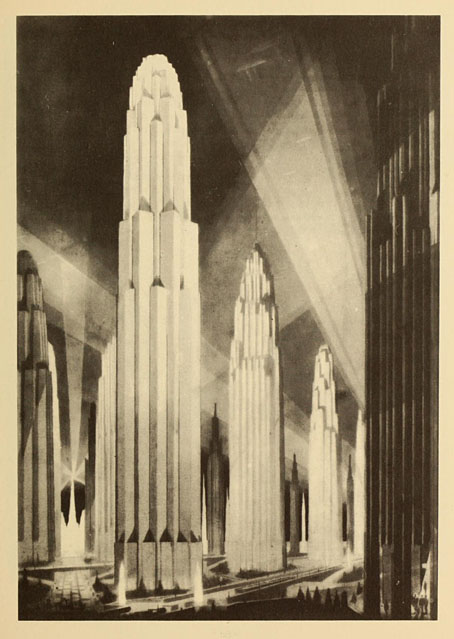
Verticals on Wide Avenues from The Metropolis of Tomorrow (1929) by Hugh Ferriss.

Megalopolis, the futuristic epic written and directed by Francis Ford Coppola, now has a trailer and a handful of mixed reviews. I recall Coppola saying years ago that he was the kind of director who would happily make films in any genre, science fiction included. I’ve wondered ever since what a full-on Coppola SF film might look like. (Captain EO and Peggy Sue Got Married don’t count). Now it seems we’re about to find out. Given his previous missteps I remain sceptical yet curious about this one. I’ve avoided his output since Bram Stoker’s Dracula but I’m still happy to see him being so ambitious while retaining his independence.

• And RIP Roger Corman who Coppola remembered as “my first boss, task-master, teacher, mentor, and role model. There is nothing about the practical matter of making movies I didn’t learn by being his assistant.” Related: It rained on the Sunday: a career interview with Roger Corman by Matthew Thrift.

• At Retro-Forteana: Fortean-themed music, from opera to metal. A difficult subject for a such short post, as the author admits. I’m amused to see one of my Hawkwind album covers in the list although the album itself doesn’t seem very Fortean to me.

• “Did you know that, if things had gone differently, the Pompidou Centre could have been an egg?” Oliver Wainwright on architecture that might have been.

• At Cartoon Brew: A closer look at great animated title sequences. I deplore the omission of Richard Williams’ titles for The Charge of the Light Brigade (1968).

• At Public Domain Review: Love Spells and Deadly Shrieks: Illustrations of Mandrakes (ca. 650–1927).

• At Wormwoodiana: “That Strange Little Book”: Ding Dong Bell by Walter de la Mare.

• At Unquiet Things: The latest collection of Intermittent Eyeball Fodder.

• Mix of the week: DreamScenes – May 2024 by Ambientblog.

Mandrake Root (1968) by Deep Purple | Mandrake (1975) by Gong | The Mandrake’s Hymn (2019) by Earth

The Atropine Tree

atropine.jpg

My latest piece of cover art is for Doug Murano’s new imprint, Bad Hand Books. I designed the cover for the Behold! collection that Doug edited a few years ago, a book which included the author of the present tale of Gothic horror, Sarah Read:

Aldane Manor is an ancient home of low-beamed ceilings, crumbling walls, poison gardens, and deadly secrets. When Alrick Aldane returns to his family’s house, he expects to simply inherit his father’s land and title. Instead, he discovers that he is also heir to the property’s disturbing history—one full of witchcraft—and a ghostly mystery that could condemn him to a fate worse than death.

The cover for this one had a specific brief which required a family tree presented as two flowering stalks of Atropa belladonna or Deadly Nightshade, with both stalks growing out of a blue-glass poison bottle. Other details follow from the author’s mood board samples: hollow-eyed ghost children and loops of hair. The medical tone of these elements sent me looking at old pharmacy labels which is what I’ve used as a basis for the general design. Old pharmacy labels and medical documents were often just as fancy as any other 19th-century print designs so all the fine details around the title lettering are what printers referred to as “combination ornaments”, tiny typographic embellishments that form detailed patterns when pieced together. The ones seen here have been copied by hand from an old page design. You can scan these things from books, or try working up a vector shape from an Internet Archive scan, but the results are never as sharp or as clear as those you create yourself. For anyone who runs across this post hoping to find a good collection of combination ornaments, the MacKellar, Smiths & Jordan type catalogue of 1892 is a favourite of mine.

The Atropine Tree will be published in July 2024.

Previously on { feuilleton }
BEHOLD! Oddities, Curiosities and Undefinable Wonders