Weekend links 122

jackson.jpg

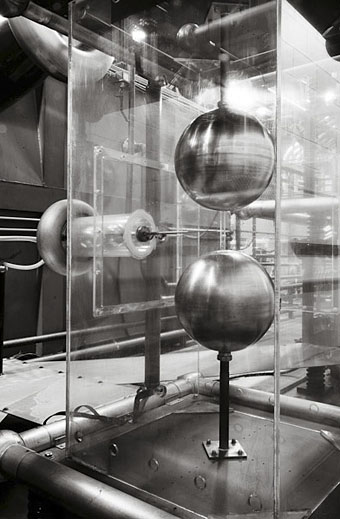
Transmitter Crowbar Discharge Unit, Bates Linear Accelerator. Photo by Daniel Jackson from his Dark Machines series.

The language we use for writing about art is oddly pornographic: We know it when we see it. No one would deny its distinctiveness. Yet efforts to define it inevitably produce squeamishness, as if describing the object too precisely might reveal one’s particular, perhaps peculiar, investments in it. Let us now break that unspoken rule and describe the linguistic features of IAE in some detail.

IAE has a distinctive lexicon: aporia, radically, space, proposition, biopolitical, tension, transversal, autonomy. An artist’s work inevitably interrogates, questions, encodes, transforms, subverts, imbricates, displaces—though often it doesn’t do these things so much as it serves to, functions to, or seems to (or might seem to) do these things. IAE rebukes English for its lack of nouns: Visual becomes visuality, global becomes globality, potential becomes potentiality, experience becomes…experiencability. […] Whatever the content, the aim is to sound to the art world like someone worth listening to, by adopting an approximation of its elite language.

International Art English by Alix Rule & David Levine

For years I’ve been calling it Artspeak: the frequently disingenuous, misleading or merely confused jargon that passes for descriptive writing in the art world. Alix Rule and David Levine apply the more neutral label of International Art English. In a lengthy essay at Triplecanopy they reveal the origins of IAE’s terminology and show why the stuff has spread like semantic kudzu.

• “What a bizarre focal point Anish Kapoor’s spiral callipers are: a Laocoönian observation platform strangled in red steel at a cost of many millions, while electricity pylons, with their austere elegance, once hymned by the poets of the 1930s, have been removed, at enormous cost, from the same site to be buried in the radioactive tilth of landfill dumps and industrial detritus.” Iain Sinclair reports on the Olympics.

Alfred Kubin in…Nottingham! The Other Side, an exhibition of “haunting drawings of death, trauma and fantastical creatures inhabiting imaginary worlds”, running to the end of September.

Francis Ford Coppola and Stewart Copeland discuss the making of Rumble Fish (1982). Over at The Rumpus there’s Coppola talking about his career and his latest film, TWIXT.

Eraserhead: The Making of a Cult Classic. In the 1980s Kenneth George Godwin interviewed everyone responsible for making David Lynch’s film. Fascinating reading.

Skin Job, the debut poetry collection by Evan J. Peterson, is twenty-one poems about monsters, horror, and science fiction. Evan made a trailer.

• Wood, brass and “the latest advances in nanotechnology”: Teka, an OLED lamp by Aldo Cibic and Tommaso Corà.

Tonite Let’s All Make Love in London (1967): Peter Whitehead’s film of the capital at its swinging height.

“Beam Us Up, Mr. Scott!”: Why Misquotations Catch On by Maria Konnikova.

Hari Kunzru‘s ten favourite books about underground London.

The Periodic Table of Heavy Metals.

Alan Garner: A life in books.

Fuck yeah, manuscripts!

• (HR) Giger Counter.

• This week was all about Vangelis in the 1970s: Creation du Monde (1973) | Spiral (1977) | Himalaya / Summit (1979).
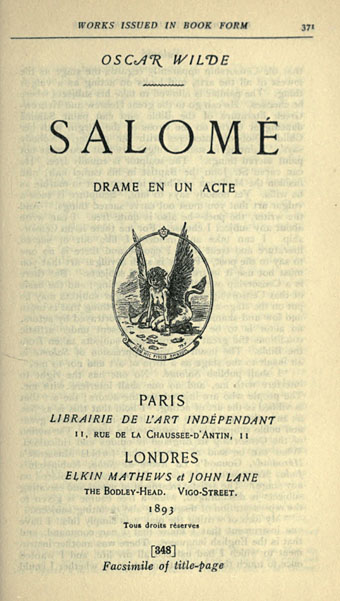
Wildeana 7

wilde1.jpg

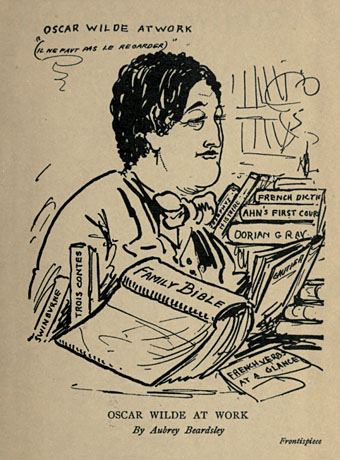
Continuing an occasional series. The drawing above is frequently credited to Aubrey Beardsley in books about Oscar Wilde but receives an “anonymous” attribution in books of Beardsley’s work. The copy here, and the pages below, are from Bibliography of Oscar Wilde (1914) by Stuart Mason.

Last November it was announced that Wilde’s lipstick-blotched tomb in Père Lachaise cemetery is to be cleaned (again) then shielded from the persistent kissers and graffiti writers by a glass screen. Flickr has a collection of photos showing the earlier condition of the tomb and its embellishments.

wilde2.jpg

• Maria Bustillos in The Vexed Posthumous Life of Oscar Wilde chronicles the story of the blue plaque on Wilde’s former home in Tite Street, London.

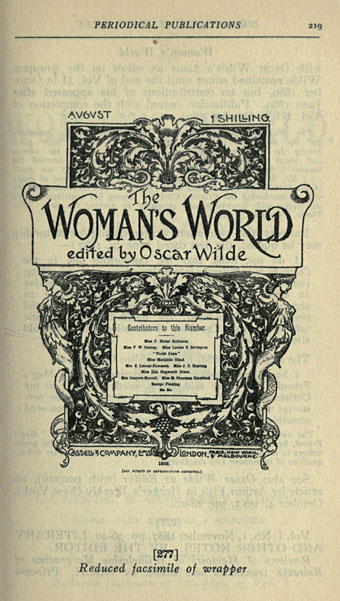
• “A hundred and twenty five years ago, Oscar Wilde edited a fashion magazine, his first and only office job. We have yet to learn from the experience.” Wilde in the Office by Kaya Genç.

wilde3.jpg

Elsewhere on { feuilleton }
The Oscar Wilde archive

H.P. Lovecraft: The Complete Fiction

lovecraft1.jpg

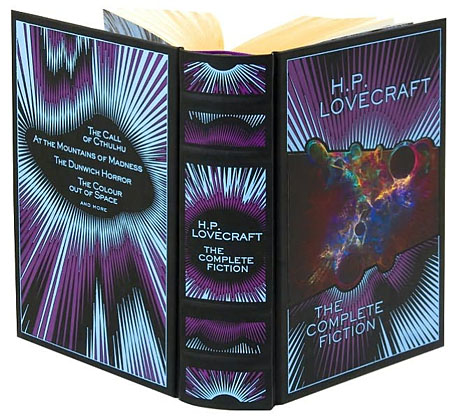
Illustration by Sven Geier, design by Jo Obarowski and Rebecca Lysen.

HP Lovecraft would have been as surprised as anyone if he could have witnessed the tremendous posthumous triumph he and his work have achieved.

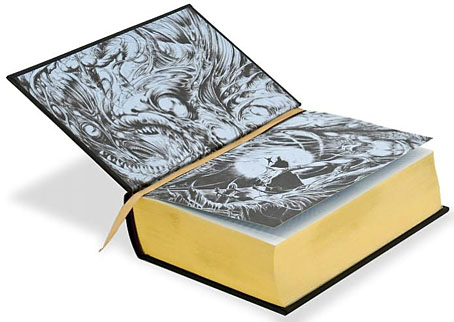
Thus leading Lovecraft biographer and scholar ST Joshi in the introduction to this suitably monstrous book. H.P. Lovecraft: The Complete Fiction was published in a new edition last year after first appearing in 2008 as part of Barnes & Noble’s Leatherbound Classics Series. My drawing of Dagon from 1999 adorns the silvered endpapers, and the reason for this belated mention is because I was only sent copies this week after moaning about not having seen a copy in a Tor.com post about the series. In truth the oversight was partly my own fault: one hazard of this line of work is that artwork is requested months (or even years) in advance of publication, so if the work in question is a reprint it’s easy to forget all about it as you get involved with other things.

lovecraft2.jpg

So anyway, this is a handsome volume of over a thousand pages, not quite leather, it’s more of a leatherette with the design blocked into it. Sven Geier’s cosmic illustration has been given an iridescent finish, and the copies I was sent have metallic silver on the edges as well as a purple ribbon which makes a better match with the colour scheme. The contents comprise all of Lovecraft’s solo fiction (no collaborations, in other words) from the juvenilia through to the non-fiction of his Supernatural Horror in Literature essay. In addition to the introduction there’s a short note from ST Joshi for each story. Needless to say, I’m very pleased to be associated with Lovecraft’s work in this way.

Anyone considered buying a copy should note that the book is currently cheaper at B&N than at Amazon. Also, complaints about typos would appear to apply to the earlier edition although I’ve not had a chance to read any of the stories.

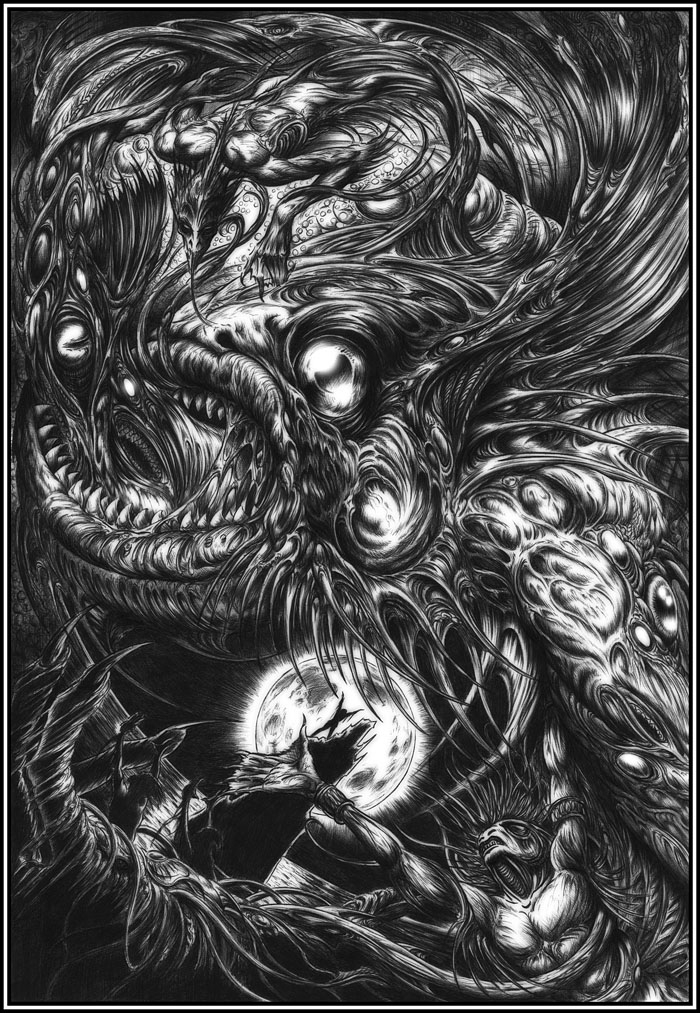
My Dagon picture below appears here larger than it has done before. The drawing was done with a Biro pen, something I’ve always liked using, then tweaked slightly in Photoshop to blur the lines a little and bring out the highlights. I’m not sure now the tweaking was necessary so I may dig out the original at some point to see how it compares.

dagon.jpg

Dagon (1999) by John Coulthart.

Elsewhere on { feuilleton }
The Lovecraft archive

Books Borges never wrote

borges2.jpg

Design by Hector Haralambous.

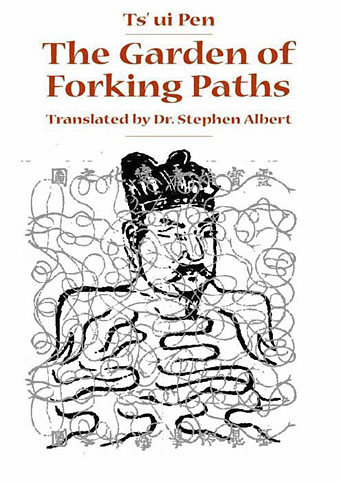
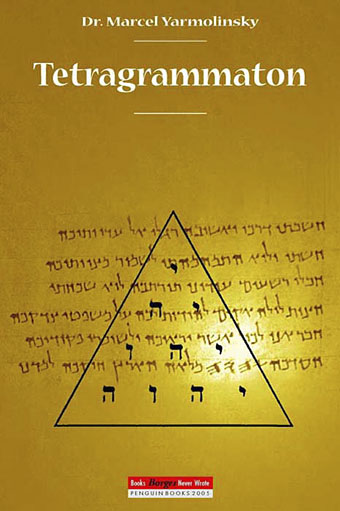
The composition of vast books is a laborious and impoverishing extravagance. To go on for five hundred pages developing an idea whose perfect oral exposition is possible in a few minutes! A better course of procedure is to pretend that these books already exist, and then to offer a resume, a commentary… More reasonable, more inept, more indolent, I have preferred to write notes upon imaginary books.

Jorge Luis Borges

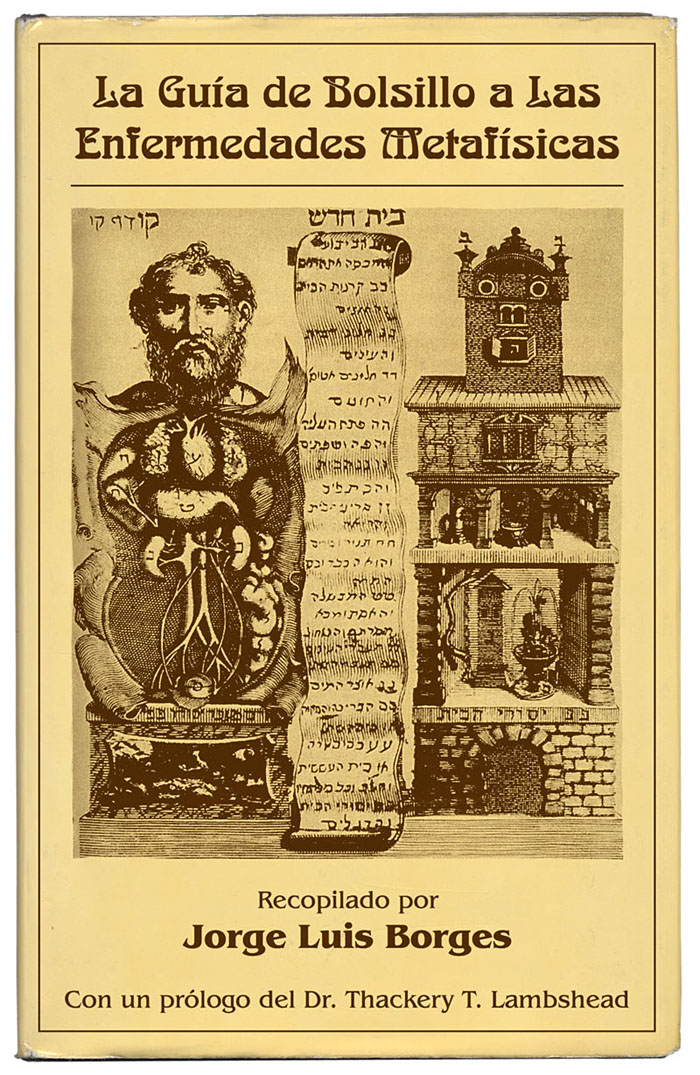
Borges was true to his intention in scattering invented volumes throughout his work, a number of the ficciones either have invented books as their subjects or use them to propel the narrative. Tlön, Uqbar, Orbis Tertius is perhaps the most elaborate example, the story in which Borges invents an encyclopedia which is itself being invented to prove a philosophical point. My favourite Borges site at The Modern Word has a page detailing some of the imaginary volumes. Invented books naturally suggest invented book covers. Several years ago another Borges site took up the challenge for the latter which is where the examples above and below originate. The site is now defunct but its pages can be seen mostly intact thanks to the Internet Archive. The book covers are here and here. The designs for the most part could have been better, although they don’t look any worse than some of the poorly-designed covers for genuine books now flooding the web thanks to print-on-demand and electronic publishing.

borges3.jpg

Design by George Kranitis.

ttl7.jpg

The Spanish language edition of the Thackery T Lambshead Pocket Guide to Invented and Discredited Diseases (1977).

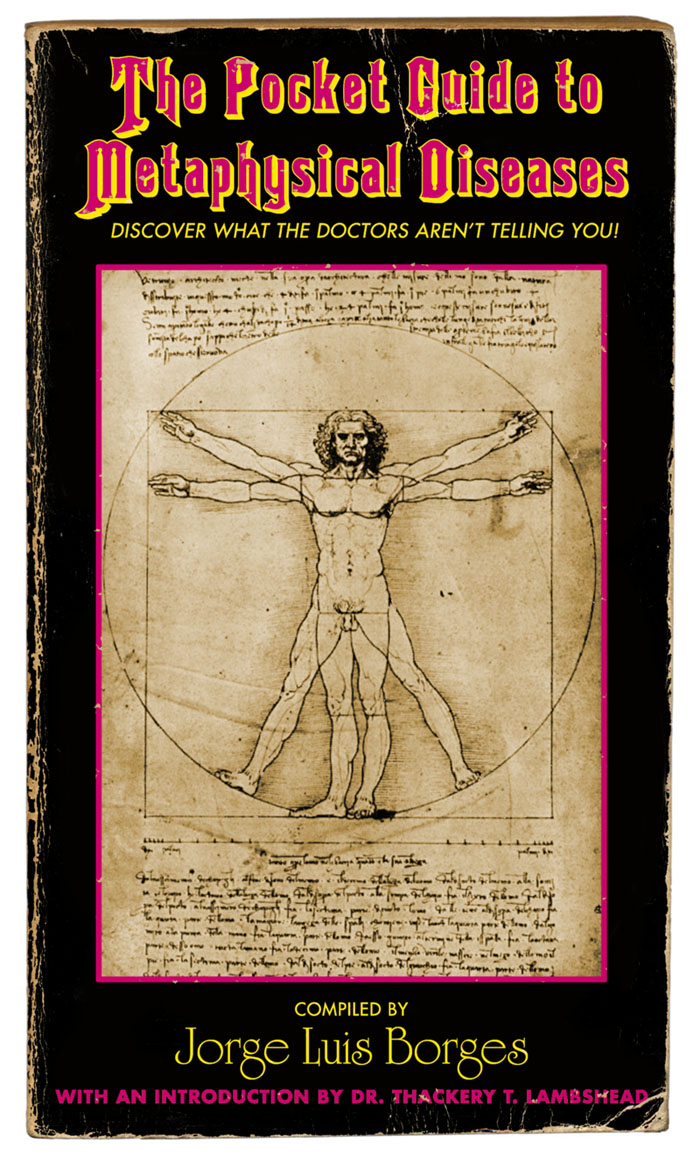
All of which reminded me of my own fake Borges covers from 2003, supposedly Borges’ own compilations of The Thackery T Lambshead Pocket Guide to Invented and Discredited Diseases, the fake disease guide edited by Jeff VanderMeer and Mark Roberts. These were created in colour but printed in black-and-white. Since they’ve appeared here before I’ve included links this time to larger copies. In a detail that Borges might have appreciated the idea for the disease guide came about after Modern Word editor Allen B. Ruch, who often manifests as The Great Quail, remarked to Jeff VanderMeer that “I think I have contracted Mad Quail Disease”. You have to be cautious with casual quips to writers, you never know where they might lead.

ttl8.jpg

An English paperback reprint of the Borges edition (1979).

Update: While we’re on the subject… Remember the Fake Books from The Royal Tenenbaums? Here They Are!

Elsewhere on { feuilleton }
The book covers archive

Previously on { feuilleton }
Borges and I
Recovering Viriconium
Forbidden volumes
Pasticheur’s Addiction

Borges and I

borges.jpg

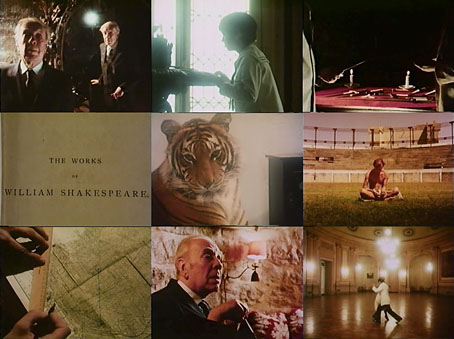
Another piece of revenant television to tick off the “When will I see this?” list. I mentioned David Wheatley’s film Borges and I back in January in a post about the director’s dramatisation of the life and work of René Magritte. Wheatley’s student film secured for him a job as a BBC director at a time when the Arena arts series was one of the best things being produced by the corporation. Borges and I was filmed in 1982 and broadcast a year later, an event I managed to miss to my considerable regret. Once again Ubuweb has turned up the goods with a copy from an American video tape. It’s not ideal—all the Spanish sequences would have been subtitled in the original broadcast—but I’m not going to complain. This 80-minute film is not only the best Anglophone documentary I’ve seen on Borges, it was produced in collaboration with the author who for much of the running time discusses his life and work in English. The tape copy also frustratingly lacks credits but the unseen American interviewer and narrator would appear to be translator and collaborator Norman Thomas di Giovanni, a writer who later found himself and his work marginalised by the Borges estate. Between the interviews and readings there are dramatised sequences from The Meeting, Funes, the Memorious, The South, The Circular Ruins, Death and the Compass, and The Sartorial Revolution, one of the collaborations with Adolfo Bioy Casares. Plus, of course, the expected complement of mirrors, tigers and a duel with knives. The budget must have been generous: scenes were shot in Argentina and Uruguay, and we also see Borges at his favourite lodging in Paris: L’Hôtel in the Rue des Beaux-Arts, a building which now bears plaques celebrating the visits of Borges and another famous literary resident, Oscar Wilde.

Previously on { feuilleton }
René Magritte by David Wheatley
L’Hôtel, Paris
Borges documentary
Borges in Performance