Title pages

title1.jpg

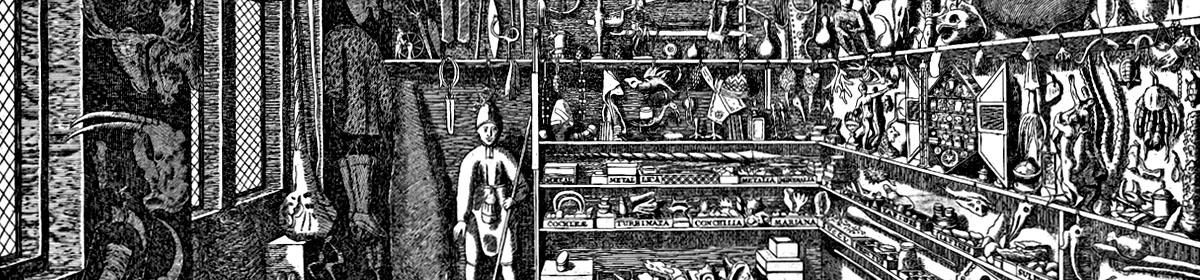
Ghost Stories and Phantom Fancies (1858) by James Hain Friswell.

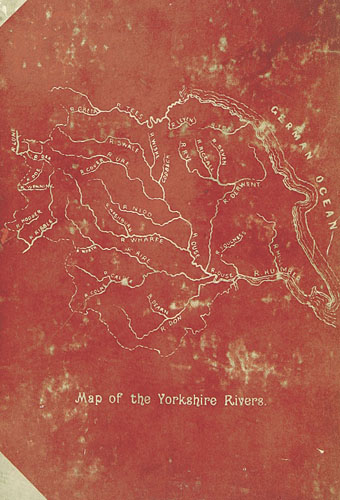
The vast repository of copyright-free images from the British Library is still being sifted into Flickr sets. These are a few examples from a set of 786 title pages which range from elegant book plates to Dime Westerns and Penny Dreadfuls. A Plunge into Space is a science-fiction novel about a journey to the planet Mars in a spaceship called The Steel Globe. Robert Cromie was also the author of A New Messiah (1901), and The Crack of Doom (1895). The latter—which has some great chapter titles: The Universe A Mistake!, The Murder Club, A Telepathic Telegram—may be read here.

title5.jpg

Vom Amazonas und Madeira (1874) by Franz Keller-Leuzinger.

title2.jpg

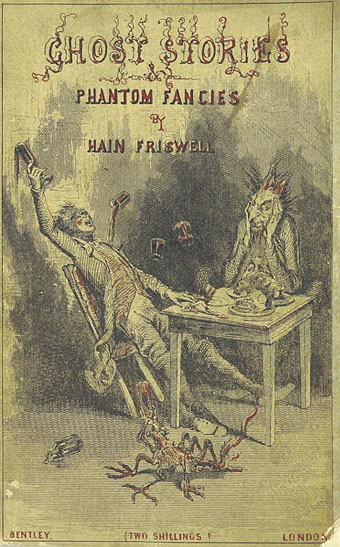
Yorkshire Rivers. Reproduced from The Yorkshire Weekly Post (1890) by Tom Bradley.

title3.jpg

A Plunge into Space (1890) by Robert Cromie.

title4.jpg

Idylls of the King (1898) by Alfred Tennyson. Illustrated by George and Louis Rhead.

Previously on { feuilleton }
A Trip to Mars

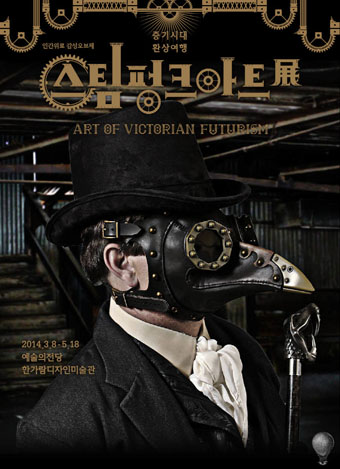
Steampunk: The Art of Victorian Futurism

steampunk.jpg

Those who were wishing a few years ago that steampunk would crawl into a hole and quietly die must be gnashing their teeth at the way the sub-genre continues to flourish. (See Pinterest for examples from the increasingly wild world of steampunk fashion.) If anyone reading this is visiting Seoul in the next couple of months—or even living there—then they’ll find some of my book covers on display at Artcenter IDA. Steampunk: The Art of Victorian Futurism is a look at the wide range of steampunk aesthetics, from graphic works to three-dimensional constructions, clothing, and so on. I’d like to credit the promotional design above but I’m not sure who’s responsible. Good type design whoever it was.

jeter.jpg

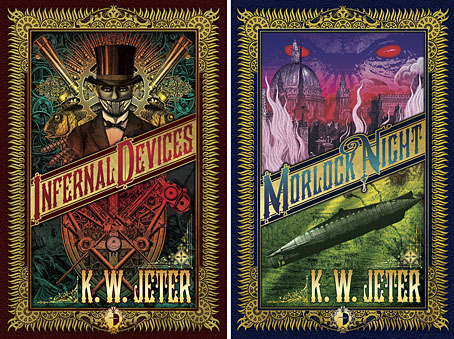
Five of my covers are on display, including the three I’ve done for KW Jeter’s novels. Mr Jeter, as mentioned before, is the man who first coined the term “steampunk” in the 1980s. This isn’t the first time my artwork has appeared in South Korea—when I was painting cards for Magic: The Gathering in the 1990s there were Korean editions printed—but it is the first time anything of mine has been exhibited there. The exhibition runs to mid-May.

Previously on { feuilleton }
Steampunk Calendar
Words and pictures
Nathanial Krill at the Time Node
Fiendish Schemes
Ghosts in Gaslight, Monsters in Steam
Steampunk Revolution
The Bookman Histories
Aether Cola
Crafting steampunk illustrations
SteamPunk Magazine
Morlocks, airships and curious cabinets
The Steampunk Bible
Steampunk Reloaded
Steampunk overloaded!
More Steampunk and the Crawling Chaos
Steampunk Redux
Steampunk framed
Steampunk Horror Shortcuts

Weekend links 202

carrington.jpg

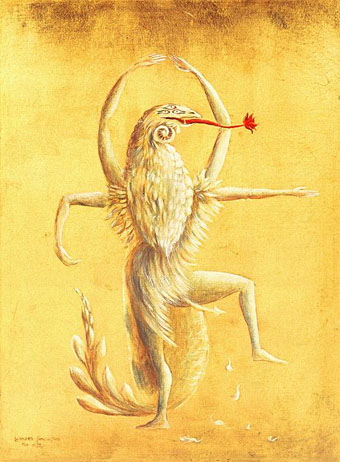
Figuras Miticas: Bailarin II (1954) by Leonora Carrington.

• The 26th Annual Lambda Literary Award Finalists have been announced. Ghosts in Gaslight, Monsters in Steam; Gay City: Volume 5 made the LGBT Anthology list, so congratulations to editors Evan J. Peterson & Vincent Kovar, and everyone else involved. I illustrated and designed the cover of that volume which also contains a piece of my fiction, Study in Blue, Green, and Gold.

Music in School (1969), episode 4: “A New Sound”. Amazing BBC TV programme for schools showing children playing avant-garde compositions using bowed metal sheets, tape loops, and primitive electronic equipment. I was at school then, and can’t help but feel a little jealous. Related: Delia Derbyshire Day approaches.

Voices Of Haiti (1953), recorded during ceremonials near Croix Des Missions and Petionville in Haiti by Maya Deren.

These days it’s hard to remember that Whistler’s Symphony in White, No. 1: The White Girl caused a bigger uproar at the Salon des Refusés of 1863 than Manet’s Déjeuner sur l’herbe, or that Monet was more influenced by Whistler than vice-versa. The delicacy of Whistler’s perceptions and his willingness to sacrifice everything for the sake of harmony make for an art less bracing than that of Degas or Pissarro. And yet how much life there is in his little Thames riverscapes. Perhaps we need another major exhibition—there hasn’t been one for twenty years—to re-evaluate him.

Whistler’s Battles by Barry Schwabsky

• Mix of the week (and a very good one it is): Abandoned Edwardian Schoolhouse by The Geography Trip.

Morton Subotnick tells Alfred Hickling how recording Silver Apples of the Moon blew his mind.

• The fantasy artwork of Ian Miller. A new book, The Art of Ian Miller, is published next month.

Queen for a Day by Alison Fensterstock. A look at the Mardi Gras Queens of New Orleans.

Tex Avery (1988): A 50-minute BBC documentary about the great animation director.

• The Gentle Revolutionary: Peter Tatchell talks to Joseph Burnett about Derek Jarman.

The Soaring and Nearly Forgotten Arches of New York City.

Dennis Hopper‘s photos of American artists in the 1960s.

Vodun at Pinterest.

Litanie Des Saints (1992) by Dr. John | Dim Carcosa (2001) by Ancient Rites | Far From Any Road (2003) by The Handsome Family

Heliotropic

heliotropic9.jpg

Arriving in the post this week was a catalogue for a Maison & Objet exposition of design and decoration which includes one of my paintings among the listed “Inspirations“. The event was held in Paris at the end of January but I’ve been so busy for the past few of months I forgot to see when it was on. Not that I could have said much about it since this is a showcase event you have to attend rather than experience remotely.

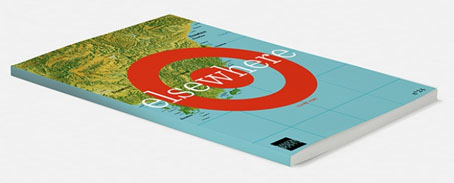
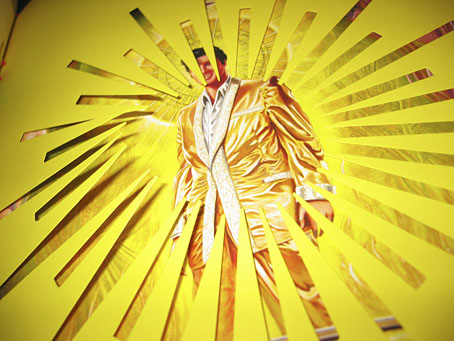
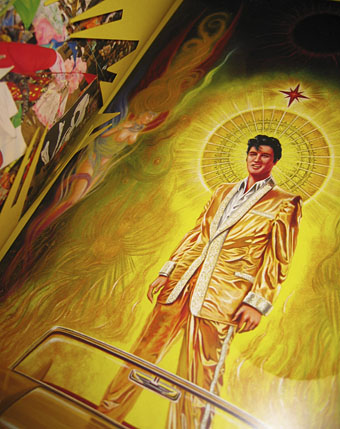
Catalogues for big art and design events often tend to the lavish and expensive but the Elsewhere book is the most lavish I’ve ever encountered. The production runs the gamut of the many expensive options which modern printing can provide: metallic inks, varnish effects, iridescent and translucent sheets, embossing, die-cutting, tipped-in inserts, and variable page sizes. The inflexible icing on the cake comes in the shape of a small square of polished marble glued to one of the pages. Excess aside, the print quality is excellent, and I’m very pleased with the way my Elvis painting appears.

sunking.jpg

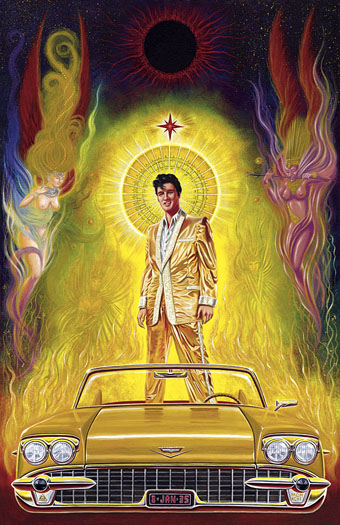
Sun King (1996).

Sun King was commissioned by Creation Books in 1996 as cover art for a Jeremy Reed novel which ended up being dropped by the company. The concept was the author’s, and while I’m pleased with the way it turned out I always felt it should have had more of a Gustave Moreau quality. This is the first time the picture been used anywhere although I did reuse the Elvis-in-a-Cadillac idea recently for one of the Alas Vegas Tarot cards.

heliotropic1.jpg

My painting is included in the Heliotropic section of the book which shows some of François Bernard’s inspirations. I’m pleased they placed one of the die-cut overlays before my piece. The photos below show some of the pages from the other sections which concern the inspirations of Elizabeth Leriche—her section includes the chunk of marble—and Vincent Grégoire whose section features futurism, space scenes, metallic effects, and Daft Punk.

heliotropic2.jpg

heliotropic3.jpg

Continue reading “Heliotropic”

Songs for the Witch Woman

cameron1.jpg

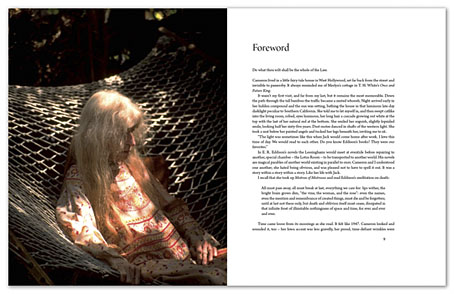
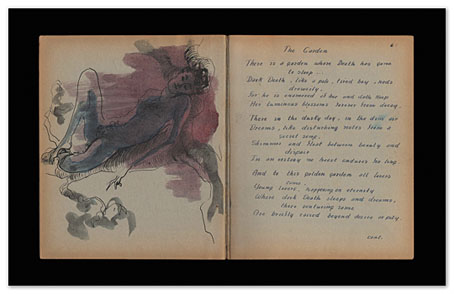
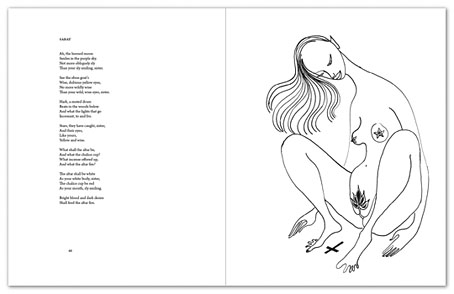
It wasn’t so very long ago that occult artist Marjorie Cameron (1922–1995) was visible only as a silent and enigmatic presence in films by Kenneth Anger and Curtis Harrington. Previous posts here have catalogued the resurrection of interest in her life and work which now includes a book of poems by husband Jack Parsons, embellished by Cameron’s drawings and paintings. This is another quality production from Fulgur Esoterica who provided me with these page layouts. Details of the book follow. See this page at Fulgur for a few more pieces of artwork.

cameron2.jpg

Songs for the Witch Woman
A Romantic Tragedy filled with Magic

‘He’ll be back some time. Laughing at you’

Fulgur Esoterica has announced today the publication of a collection of poems by rocket scientist Jack Parsons’ illustrated by his wife and magical partner Marjorie Cameron. The drawings and poetry have been gathered by Cameron after her husband’s death and are here published together for the first time. The book is the first publication to mark 100 years from Parsons’s birth (1914).

Jack Parsons was not only the most influential Californian magician of his day but was also at the heart of the US rocketry programme as one of the founder of the Jet Propulsion Laboratory before his untimely death at the early age of 37. He died in an explosion which was probably an accident but which has also been seen by some as either a result of his ‘Babalon Working’ or, by some occultists, as a direct result of tampering with dark forces.

Parsons’s wife Cameron continued to illustrate the poems he wrote for her years after his death. Cameron was an artist and actress who after Parsons’ death moved on to become one of most sought after faces in counter cultural Hollywood circles having appeared in Kenneth Anger’s Inauguration of the Pleasure Dome (1954) and Curtis Harrington’s Wormwood Star as herself and having figured on the cover of Wallace Berman’s first issue for Semina (1955).

The collaboration presented here creates a unique insight into an intense and unique romantic tragedy. As stated by Parsons’s official biographer and contributor to Songs for the Witch Woman George Pendle, “A collection of uneasy love poems, the language and meter of Songs for the Witch Woman owe a considerable debt to the Romantic poets. Keats’ “Lamia”, Byron’s Browning’s “Childe Roland to the Dark Tower Came”, Tennyson’s “Idylls of the King” are all referred to. […] But nothing is quite what it seems”. He further states that “many of the poems speak of entrapments and reversals, of women tricking or teasing men into their web to be devoured or eaten. And although a rich, pungent sensuousness overlays the poems, with datura and jasmine filling the lines with a somnolent musk, neurosis and fever, worry and sickness, never seem far away. In many ways the poems seem to act as a sort of testing ground for the emotions stirred up by the often masochistic relationship with the fiercely independent Cameron.”

The volume is complemented by critical essays and by a diary entry from Cameron’s magical diary. Some say this text constitutes the summoning of a magical entity while others looked at it as an invocation to her lost lover.

Price: Hardback £40.  Deluxe £140. Dimensions and info: large format (305mm x 240mm). 176 pages. Premium Italian Paper.
cameron3.jpg

Marjorie Cameron was born in Belle Plaine, Iowa in 1922. The fiery and uncompromising character for which she would later be known manifested from an early age. School friends and teachers alike saw her as a peculiar child who by nature looked at the world from a different angle. After the outbreak of the Second World War Cameron enrolled in the Navy and after a period of training became the cartographer for the Joints Chiefs of Staff. Discharged from the military in 1945, she joined her family in Pasadena where less than a year later she met the man who would change her life.

Cameron was twenty-four when she met Jack Parsons, a young and charismatic rocket scientist at the peak of his public career, associate founder of the Jet Propulsion Laboratory and acting master of the  ‘Agape Lodge of the Ordo Templis Orientis’. For the following seven years Cameron and Parsons worked together in magick, love and art giving birth to one of the most legendary magico-artistic partnerships of the century. Firmly believing that Cameron’s appearance in his life was the result of an intense series of magical workings carried out in the weeks preceding the encounter, Parsons famously wrote to Aleister Crowley ‘I have found my Elemental’. Be it as it may, in the first years of their relationship Cameron was not only unaware of such goings-on but also uninterested in Jack’s spiritual path, preferring art and love over the practice of magic.

But as time went by Parsons assumed another function in Cameron’s life as he quickly became her magical mentor. He renamed her Candida, recommended books, prescribed rituals and meditative practices to deal with her depressions. When Jack Parsons died in an explosion at the age of thirty-seven, Cameron was left alone, wondering whether she was human or elemental.

A very dramatic period follows for Cameron. For a time she withdraws into the desert, where she attempts to connect with the spirit of her lost lover through a series of magical workings. A few years later she comes back to Los Angeles, where in 1954 she appeared in Kenneth Anger’s landmark film Inauguration of the Pleasure Dome. She also met the director Curtis Harrington, for whom she appeared as herself in the short film Wormwood Star. In 1955 she was featured on the cover of the first issue of Wallace Berman’s artistic and literary journal Semina, so marking her firm arrival in the Hollywood artistic counter-culture.

Cameron spent the last decades of her life in West Hollywood, painting, writing and mastering the art of Thai Chi. She died of cancer in 1995 at the age of 73.
cameron4.jpg

cameron5.jpg

Previously on { feuilleton }
More Cameron
Inauguration of the Pleasure Dome: The Eldorado Edition
The Wormwood Star
Street Fair, 1959
House of Harrington
Curtis Harrington, 1926–2007
The art of Cameron, 1922–1995