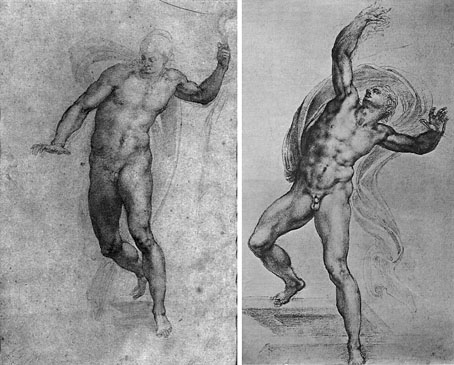
Two Studies for the Risen Christ by Michelangelo (both 1533).
Following the predictable outrage over Cosimo Cavallaro’s My Sweet Lord, aka the Chocolate Jesus, it’s worth remembering that the depiction of Jesus sans clothing is nothing new. Aside from all the paintings of Jesus as a naked infant, a quick search turns up these two examples by Michelangelo. The drawing on the right is owned by the Head of the Church of England (ie: Queen Elizabeth II) who—so far as we know—seems to have no trouble contemplating a naked Christ. Puritan factions among Christians baulk at nudity of any sort but it was Catholics who seemed to voice the strongest objection to Cavallaro’s work despite Pope John Paul II writing in Love and Responsibility in 1981:
“Nakedness itself is not immodest… Immodesty is present only when nakedness plays a negative role with regard to the value of the person, when its aim is to arouse concupiscence, as a result of which the person is put in the position of an object for enjoyment.”
The early Christian church seemed to have a different attitude to nude depictions, many scenes of Jesus’s baptism show a naked Christ. Censorship came in later, as with the painting over of Michelangelo’s Last Judgement in the Sistine Chapel and the painting of leaves over Masaccio’s Expulsion from the Garden of Eden.
The fig leaves were added three centuries after the original fresco was painted, probably at the request of Cosimo III de’ Medici in the late 17th century, who saw nudity as disgusting. During restoration in the 1980s the fig leaves were removed along with centuries of grime to restore the fresco to its original condition.
Michelangelo’s work was assaulted again during this period when an unlikely bronze wrap was attached to his statue of Christ in the church of Santa Maria sopra Minerva in Rome.
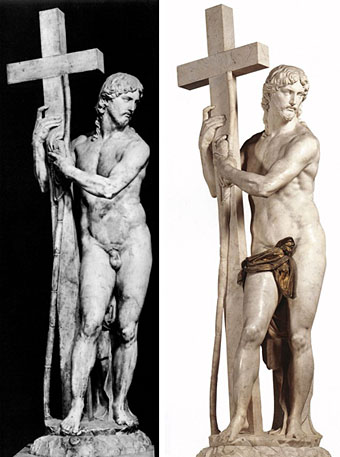
Christ Carrying the Cross by Michelangelo (1521).
These censorious attitudes are a world away from TV presenter and art critic Sister Wendy Beckett (a Carmelite nun, no less) enthusing in Sister Wendy’s Odyssey about the “wonderfully fluffy” pubic hair in Stanley Spencer’s Self Portrait with Patricia Preece (1937). Not all Christians find nudity a problem but then people who regularly complain about art rarely look at it or even seem to like it. As George Santayana famously said, “Those who cannot remember the past are condemned to repeat it.”
Previously on { feuilleton }
• Giant Skeleton and the Chocolate Jesus
• The Poet and the Pope
• Angels 1: The Angel of History and sensual metaphysics
• Gay for God
• Michelangelo revisited