The teamLab experience

teamlab01.jpg

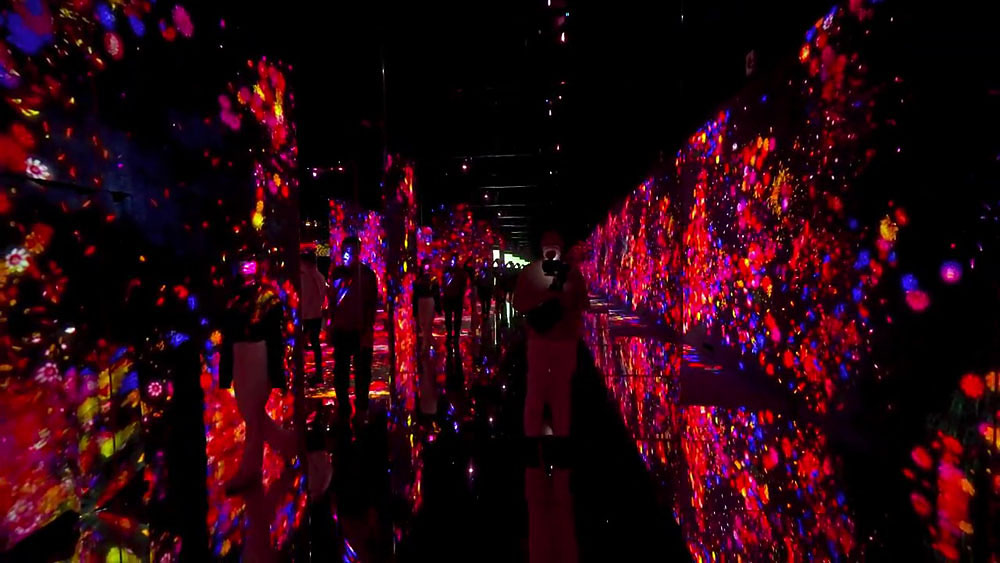
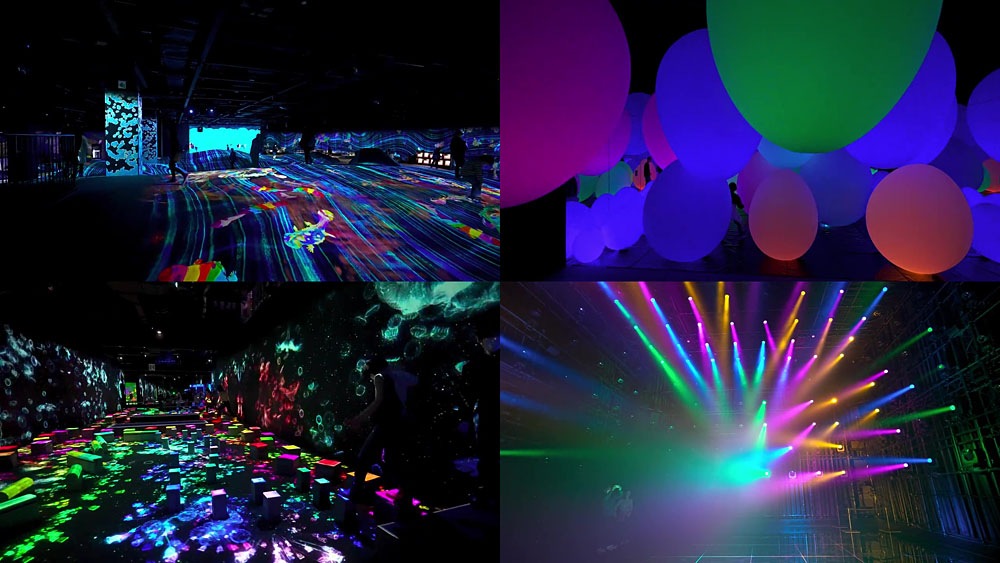
One of the surprise pleasures of browsing Rambalac’s YouTube channel was finding two visits to his local teamLab exhibitions. teamLab is a Japan-based arts collective who use digital technology to create immersive artworks using light and sound. Rambalac’s main excursion takes you to teamLab Borderless in Odaiba, Tokyo*, a building-sized collection of the group’s past creations situated in interconnected rooms on two floors. As with other Rambalac videos, what you have here is one man wandering around the place with a camera, which in this case gives us the opportunity to see Borderless from a visitor’s point of view. teamLab also has its own YouTube channel but most of the videos there are promotional pieces, usually a few minutes in length and heavily-edited. Rambalac seldom edits his videos which generally run for an hour at a time.

teamlab02.jpg

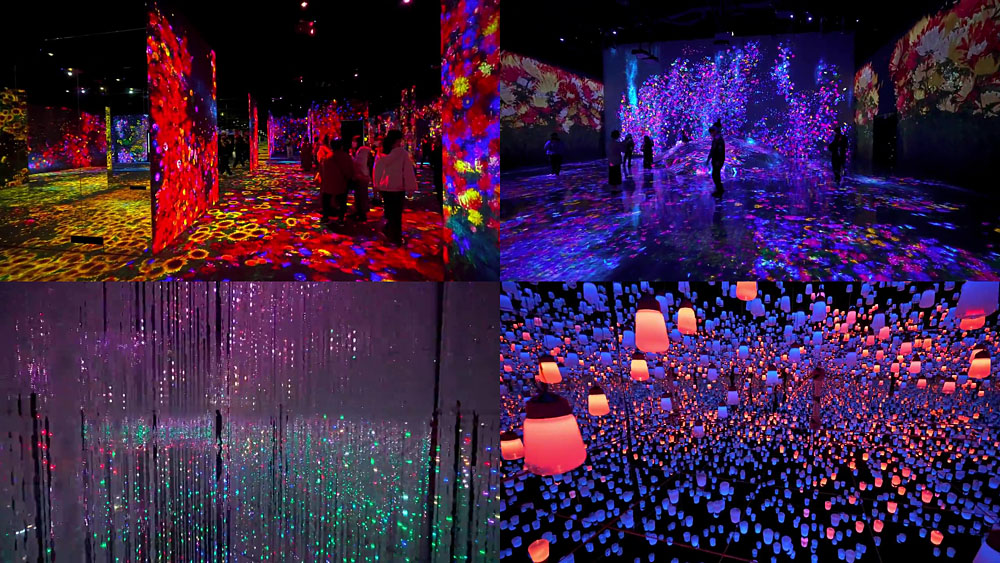
The Borderless exhibits variously resemble nightclub interiors, Yayoi Kusama installations, theme-park attractions and psychedelic lightshows, with some of the larger, projection-filled areas giving the impression of walking around inside the DMT trip from Enter the Void. Kusama’s infinite mirror reflections are obvious precursors, especially in The Infinite Crystal Universe, a room containing a mass of illuminated cables running from mirrored floor to mirrored ceiling. The main difference, of course, is that Kusama’s installations are as static as most contemporary art, whereas teamLab’s creations are continually in flux. Some of the change relies on viewer participation; there are touch-sensitive surfaces and phone apps that allow visitors to adjust the parameters of specific works. It’s not all child-friendly psychedelia, at least at the conceptual level. The titles of some of the creations remind me of the portentous declarations favoured by Keiji Haino for his doom-laden recordings: Life is Flickering Light Floating in the Dark; Continuous Life and Death at the Now of Eternity; Massless Suns and Dark Spheres; Matter is Void

teamlab03.jpg

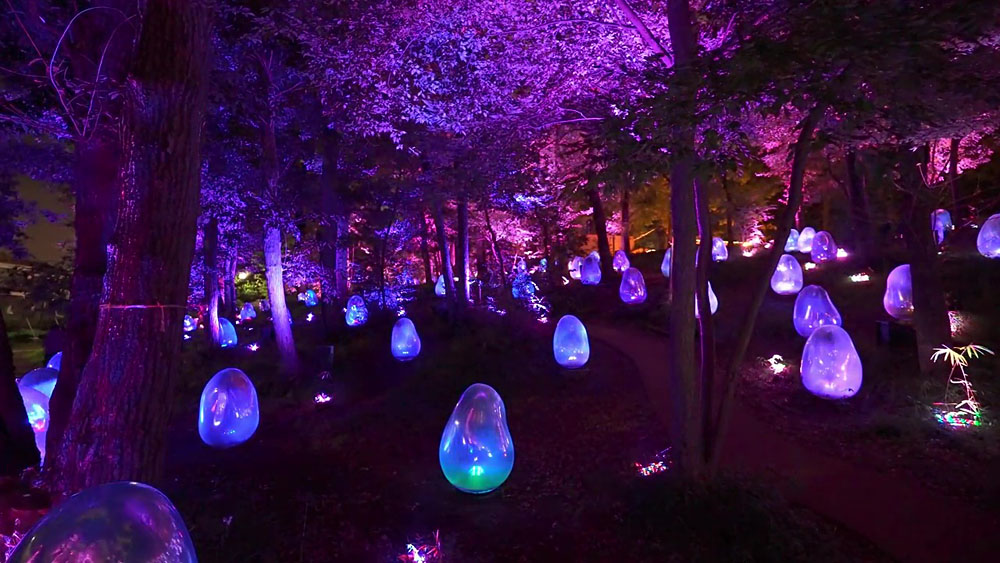
I find all of this fascinating and exciting, it’s just a shame that you have to travel halfway around the world to see the things in person. teamLab does exhibit in other countries but to date most of their external work has been close to Japan. Some of the musical accompaniment at Borderless is overly dramatic for my tastes, like extracts from an anime soundtrack, but elsewhere the exhibits have their own brand of generative ambient music which in this context is genuinely ambient, not the diluted techno that we’ve been burdened with since the early 1990s. A good example of this is can be found in the other Rambalac video which visits Resonating Life in the Acorn Forest, an exhibit in a wooded park at Higashi-Tokorozawa.

teamlab04.jpg

In this installation the trees are lit with coloured lights controlled by the illuminated polythene blobs sitting beneath them. The blobs emit electronic chimes when touched; each chime affects the nearest blobs which in turn change the colours of the lights. An additional bonus in Rambalac’s video is the nocturnal chirping of cicadas. teamLab are big on rippling fluctuation, it’s a quality found in many of their other exhibits. The ripples have become physical in more recent exhibits which require visitors to get their feet wet. I’ve no idea how Living Crystallized Light has been created but whatever the technology behind it the end result is quite incredible.

I’m predisposed to enjoy this kind of thing when I’ve always liked art that involves coloured light and mirrors—I’ve a lot of time for the creations of James Turrell and Olafur Eliasson—but I’ve been wondering for a while now when we’d start to see the emergence of art that feels like it belongs in this century instead of yet more expensive (and inert) novelties sitting in blank-walled galleries. teamLab aren’t the only people using technology in this way, there’s an increasing overlap between art and sound among electronic musicians like Robert Henke and Ryoji Ikeda, while Brian Eno has been evolving his own abstract sound-and-light environments for many years. More like this, please.


* Borderless in Odaiba permanently closed in August but teamLab will be opening a similar venue in Toyko next year.

Previously on { feuilleton }
Light Leaks
Eno’s Luminous Opera House panorama
Infinite reflections
Yayoi Kusama
Maximum Silence by Giancarlo Neri

Weekend links 643

wittdorf.jpg

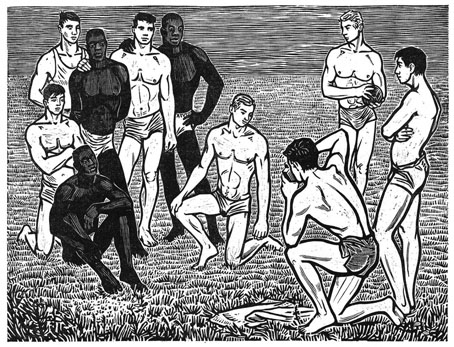
Freundschaftsfoto (1964) by Jürgen Wittdorf.

• “It’s truly astonishing how Laswell collided with vastly divergent musicians and genres while somehow still representing complementary musical spheres.” Yes, indeed. Mixes of the week: Bill Laswell Research Institute: Vol I & II, two 90-minute collections at Aquarium Drunkard dedicated to the career of the indefatigable musician/producer/catalyst.

• “These pieces are created using custom developed software and laser specialised machines resulting in highly detailed laser cut works on layered paper with some works comprising over a thousand individual parts.” Works in paper at Studio Ibbini.

• “The visual history of polyhedra is littered with false starts, poignant failures, and allegories unable to convey the weight of their subject matter.” Noam Andrews explores the history of rendering polyhedral objects in art.

• “When it came to homosexuality, the east was as bourgeois as the west.” Homoerotic art from the communist era by Jürgen Wittdorf (1932–2018) receives a reappraisal.

• More MR James: All of James’ ghost stories in a single volume at Standard Ebooks, the home of free, high-quality, public-domain texts.

• More mixes: A mix for The Wire by NikNak, and XLR8R Podcast 769 by The Sun Ra Arkestra.

• At Spoon & Tamago: Tracing the history of railways in Japan through art.

• At Dennis Cooper’s: Marie Menken Day.

Angeline Morrison‘s favourite albums.

Ghost Train (1961) by Virgil Holmes | Ghost Train (1961) by Electro-Tones | Ghost Train (1962) by The Partners

Weekend links 631

desgoffe.jpg

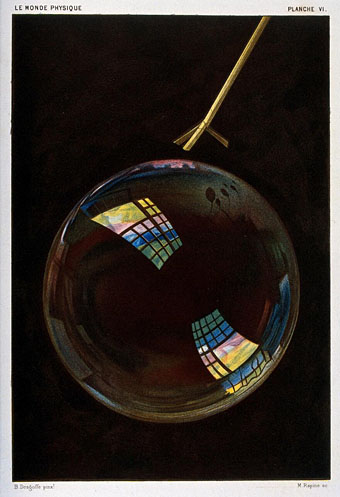
Soap Bubble (1882) by Alexandre-Blaise Desgoffe. Via.

• “…there is not now, has never been, and will never be a single Platonic form of the paragraph to which all others must conform.” Richard Hughes Gibson on the history of the paragraph.

• At Spoon & Tamago: imaginary covers by international illustrators for The Tokyoiter, a New Yorker-style magazine about the Japanese capital.

• New music: tick tick tick by Stephen Mallinder, and A Vibrant Touch by Aleksandra Slyz.

The Kat had a cult following among the modernists. For Joyce, Fitzgerald, Stein, and Picasso, all of whose work fed on playful energies similar to those unleashed in the strip, he had a double appeal, in being commercially nonviable and carrying the reek of authenticity in seeming to belong to mass culture. By the thirties, strips like Blondie were appearing daily in roughly a thousand newspapers; Krazy appeared in only thirty-five. The Kat was one of those niche-but-not-really phenomena, a darling of critics and artists alike, even after it stopped appearing in newspapers.

Amber Medland on George Herriman, EE Cummings and Krazy Kat

35mm.online: Polish feature films, documentaries and animations, all free to view.

• At Dennis Cooper’s: Spotlight on…Georges Bataille Erotism: Death and Sensuality.

• Inside the Espai Corberó, the home/gallery of the late Xavier Corberó.

Strange Attractor Journal Five.

• RIP Claes Oldenburg.

Krazy Kat (1928) by Frankie Trumbauer & His Orchestra | Krazy Kat (1949) by Artie Shaw | Krazy Kat (1975) by Teddy Lasry

Weekend links 626

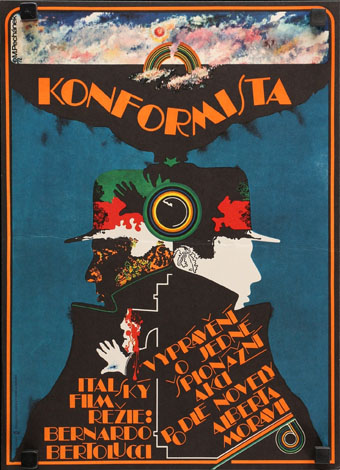
conformist.jpg

Czech poster for Bernardo Bertolucci’s The Conformist. Art and design by Miroslav Pechánek, 1972.

• “Acknowledgements are not part of the novel; in fact, they break the spell the author has spent 200 or more pages weaving. We should take a book on its merits, knowing as little about the author as possible. As one reader put it to me, ‘the end of a book is time for thinking about the book, not for an acceptance speech’.” John Self on dedications and acknowledgements.

• Mixes of the week: a Power Ambient mix by A Strangely Isolated Place, and a mix for The Wire by Nexcyia.

• At Spoon & Tamago: 3D-scanned stones create vessel for human-made interventions.

Weeks turned into months. Slowly it dawned on me that I was performing the role of Boswell for a man who might be: a) a put-on maestro or arcane troll; b) a fiction writer slash performance artist; or c) a lunatic. But by his own admission King had tagged me with a familiar spirit. Whether or not he was telling the truth was irrelevant at this point. I could feel something squatting on my soul. I needed to see what it was.

Kent Russell on looking for demons in a disenchanted world

• A trailer for Mad God, Phil Tippett’s 30-years-in-the-making animated feature.

• New music: Vesta by Azu Tiwaline, and Right, Right, Right by Nils Frahm.

• At Dennis Cooper’s: Max Hattler Day.

• “Marcel Duchamp was not a thief.”

• RIP Jean-Louis Trintignant.

Demons Of Rage (1972) by Nik Raicevic | Shall Come Forth The Demons (1991?) by Yuri Morozov | Angels Of Darkness, Demons Of Light (2011) by Earth

Men and Wild Horses: Théodore Géricault

gericault1.jpg

Yes, I’ve been watching a lot of films about art recently, and here’s another one. Artists and Models was the series title for three 80-minute drama-documentaries broadcast by the BBC in 1986: The Passing Show, Slaves of Fashion, and Men and Wild Horses. The writer and director of all three productions was Leslie Megahey, a name I always looked out for in TV listings throughout the 1980s, and still do in the case of films such as these. I watched the series at the time, and taped the episode about Géricault but the tape went astray many years ago so it’s great to find again.

gericault2.jpg

Art, especially painting, was a recurrent theme in Megahey’s work going back to the 1960s. In his later films he combined this interest with careful period recreations, the most celebrated example of which is his superb supernatural drama, Schalcken the Painter, an adaptation of the Sheridan Le Fanu ghost story. Artists and Models favours art history over drama, being an examination of the connected careers of three French painters of the late-18th and early-19th centuries: Jacques-Louis David, the Neoclassicist who was probably the only artist in history to sign the execution warrants of his own king and queen; Jean-Auguste Ingres, the Academician and painter of sensual nudes; and Théodore Géricault, the gloomiest of all the French Romantic artists. Being partial to the Romantics, especially the gloomy ones, I was always going to be more interested in the Géricault film. But all three films are worth seeing, each depicting an aspect of French art during a time of great historical upheaval: state propaganda (David), meticulous portraiture (Ingres), and tormented realism (Géricault).

gericault5.jpg

The Raft of the Medusa (1819). All photo reproductions of this painting are compromised by the bitumen that Géricault painted into the shadows, a substance that degrades badly over time.

Men and Wild Horses uses the researches of Géricault’s first biographer, Charles Clément, to investigate the life of an artist whose bouts of depression and early death cut short a career that promised much but delivered less than the artist hoped. Clément, portrayed by Alan Dobie, informs us that Géricault only exhibited three paintings in the Paris Salon, none of which sold while the artist was alive. The largest of the three, The Raft of the Medusa, is recognised now as one of the great paintings of its age, but the Paris art world didn’t think so at the time. The story of the shipwreck survivors, and Géricault’s obsession with depicting their plight, forms the centrepiece of Megahey’s film which avoids too much awkward historical recreation. Géricault himself is only present via Clément’s account of his life, the memories of the artist’s friends, and the voiceover by Martin Jarvis which provides detail that the biographer was unable to find. The camerman for all three films in this series was Megahey’s regular collaborator, John Hooper, a real artist himself in his manipulation of light and shade. Men and Wild Horses is filled with many beautiful chiaroscuro compositions, so it’s a shame that the copy at YouTube isn’t better quality. The same account also has a copy of the Ingres film, Slaves of Fashion, while the David film, The Passing Show, may be seen here.

gericault3.jpg

One of the “interviewees” in the film is Antoine Étex, the creator of Géricault’s monument in Père Lachaise cemetery. I took a few photos of this when I was there in 2006; it’s easier to stumble across than some of the other famous tombs, and includes among its details bronze reliefs of Géricault’s three major paintings. British readers will know that “gee-gee” is a colloquial term for a horse so there’s some wry amusement for les rosbifs in the sight of the letters surrounding the monument of a horse-obsessed painter. Despite snapping a close-up of the bronze Raft of the Medusa I was more interested in chasing Symbolist paintings in the Musée d’Orsay and the Gustave Moreau Museum so I didn’t go to look at the original in the Louvre. Maybe next time.

gericault4.jpg

Previously on { feuilleton }
The Complete Citizen Kane
Schalcken the Painter revisited
Leslie Megahey’s Bluebeard