Art on film: Providence

providence01.jpg

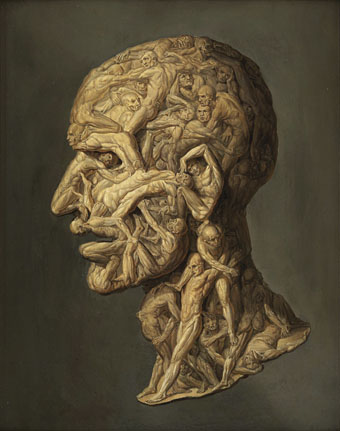
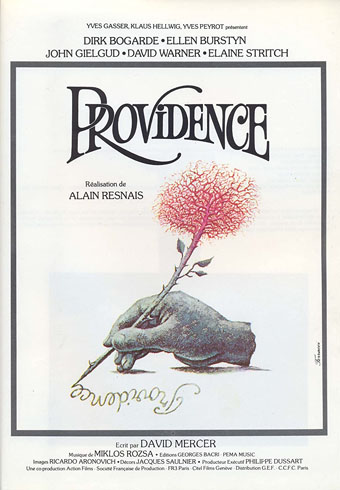
Art by René Ferracci.

Continuing an occasional series about artworks in feature films. Most people know HR Giger’s work via his production designs for the Alien films; a much smaller number of people also know about his designs for Jodorowsky’s unmade film of Dune, but hardly anyone knows that his art first appeared in a major film two years before Alien was released. This isn’t too surprising when the film in question, Providence, directed by Alain Resnais, has been increasingly difficult to see since 1977; the film isn’t mentioned in any of Giger’s books either, a curious omission for an artist who spent his career logging every public appearance of his work.

Providence began life as a collaboration between Resnais and British playwright David Mercer, with the resulting script leading to a Swiss/French co-production that was filmed in English. The film has an exceptional cast—Dirk Bogarde, Ellen Burstyn, John Gielgud, Elaine Stritch, David Warner—marvellous photography by Ricardo Aronovitch, and a sumptuous score by Miklós Rózsa. If you’re the kind of person who regards awards as designators of quality then it’s worth noting that Providence won 7 Cesar Awards in 1978, including the one for best picture. Yet despite all this, and despite being regularly described as a peak of its director’s career there’s only been a single DVD release which is now deleted. I’d been intending to write about the film for some time but first I had to acquire a decent copy to watch again; this wasn’t an easy task but I managed to “source” a version that was better than the VHS tape I used to own.
providence13.jpg

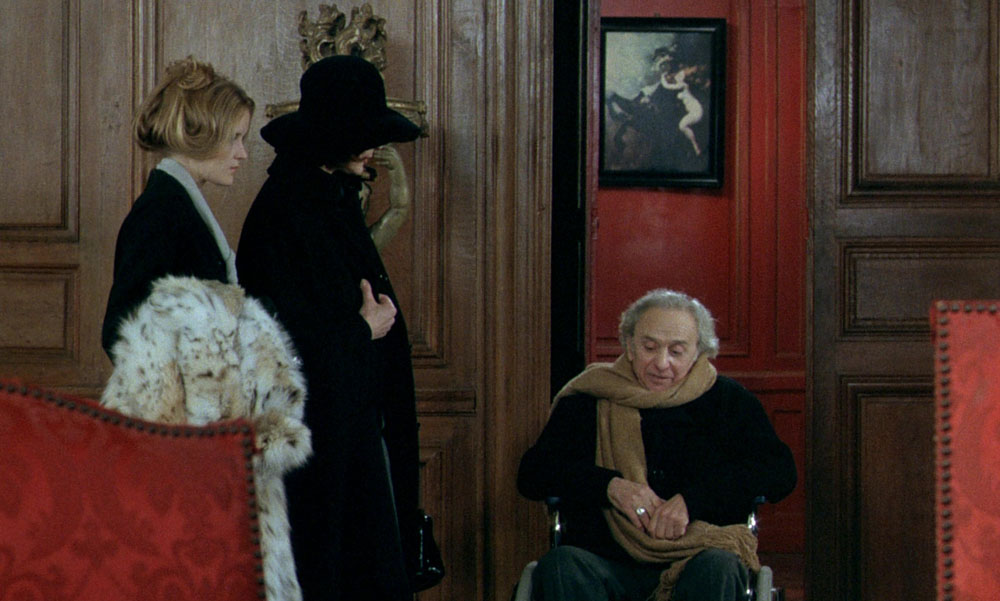
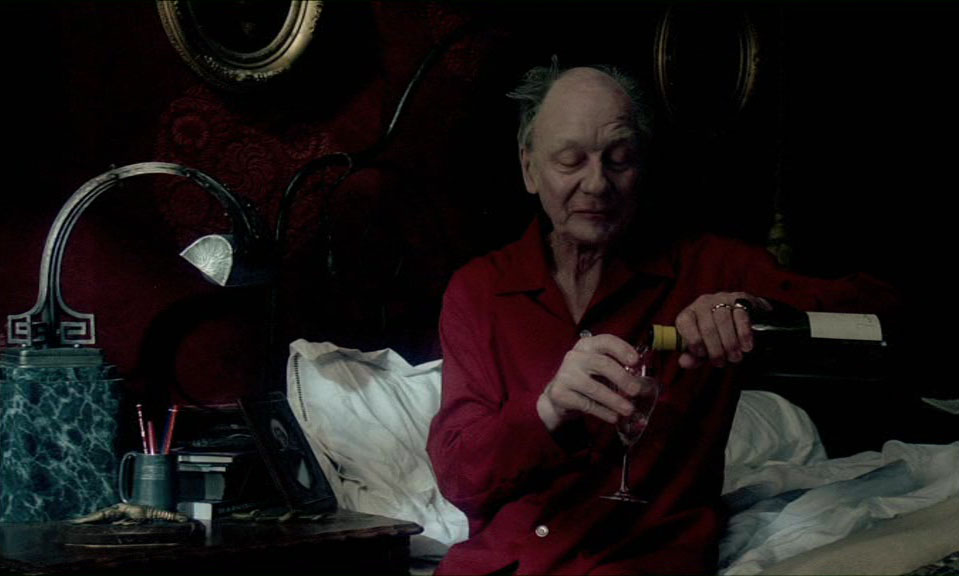
For most of its running time Providence is a film about artistic invention, more specifically about the process of writing. Clive Langham (John Gielgud) is an ailing author spending a sleepless night alone in his huge house, “Providence”, wracked by unspecified bowel problems, painful memories and fears of impending death. To distract himself from his troubles he drinks large quantities of wine while mentally sketching a scenario for a novel in which the people closest to him are the main characters. In this story-within-the-story Langham’s son, Claude (Dirk Bogarde), is a priggish barrister whose primary conflicts are with his absent father, his bored wife, Sonia (Ellen Burstyn), and a listless stranger, Kevin (David Warner), who Sonia has befriended and seems attracted to even though Kevin won’t reciprocate. While Claude cajoles and insults the pair he also conducts an affair of his own with Helen (Elaine Stritch), an older woman who resembles his dead mother. The scenario is elevated from being another mundane saga about middle-class infidelities by its persistently dream-like setting, and by the interventions and confusions of its cantankerous author. If you only know John Gielgud from his later cameos playing upper-class gentlemen then he’s a revelation here, boozing and cursing like the proprietor of Black Books. Between spasms of illness and self-pity Langham shuffles his playthings around like chess pieces, revising scenes while trying to keep minor characters from interfering; “Providence” isn’t only the house where Langham lives but also the watchful eye of its God-like author. Meanwhile, his characters bicker and chastise each other, paying little attention to the disturbing events taking place in the streets outside: terrorist bombings, outbreaks of lycanthropy, and elderly citizens being rounded up for extermination.
Continue reading “Art on film: Providence”

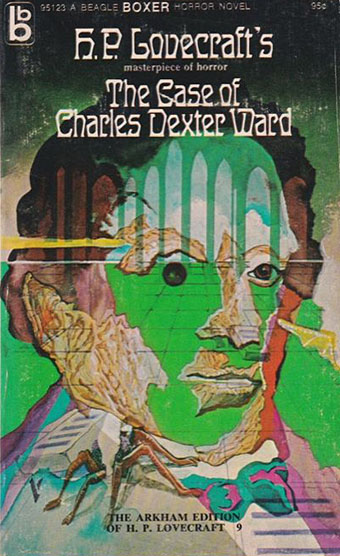
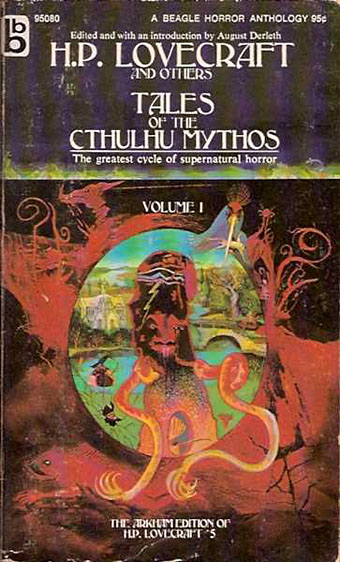
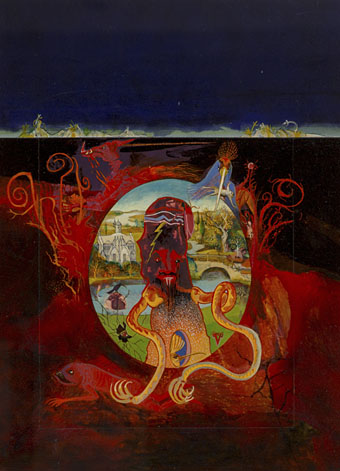
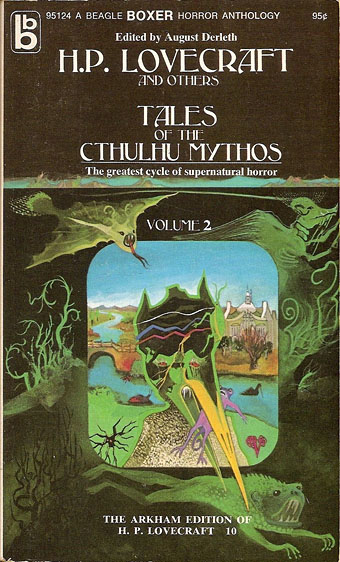
Victor Valla book covers

valla01.jpg

Lancer Books, 1971.

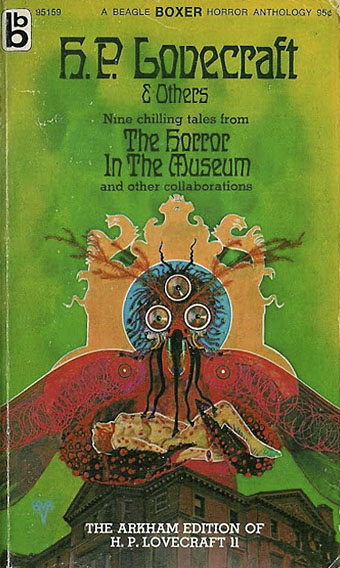
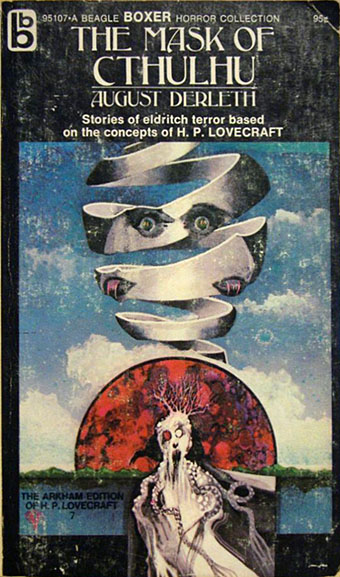
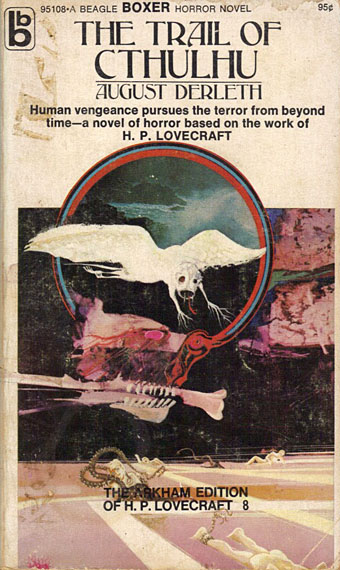
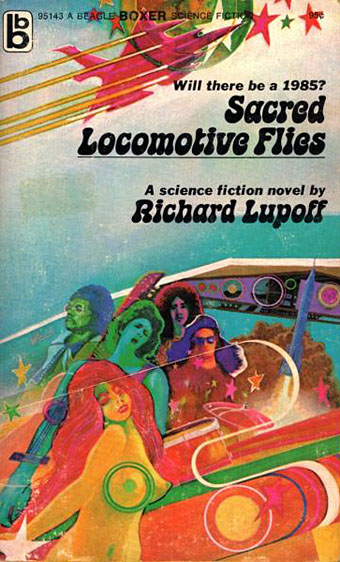
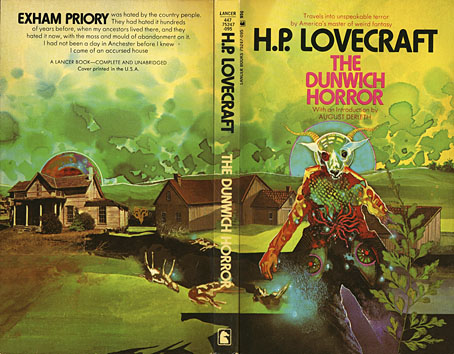
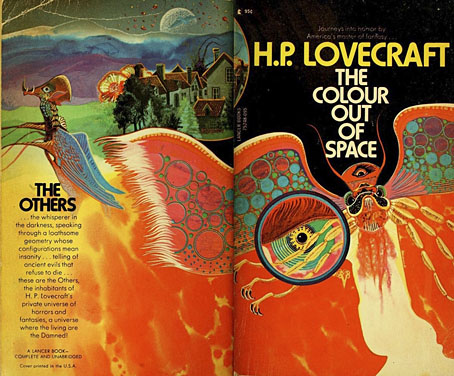
Victor Valla’s cover for The Dunwich Horror has appeared here before, and his cover for The Colour Out of Space is very familiar, but I hadn’t gone looking for anything else of his until this week. There isn’t much to be found on genre titles, just the rest of these covers plus a handful of undistinguished paintings for Gothic dramas and Dracula novels. His Lovecraft and Derleth covers are the kind of thing I always like to see more of, however, being less illustrations of story details than renderings of the feelings the story generates when you read it. This is especially the case with The Colour Out of Space, a story that suggests far more than it shows, and whose central motif—a colour alien to the Earth—is impossible to depict at all. In the 1970s it was easier to get away with this on paperback covers; Lovecraft was still a niche author and there wasn’t the legacy of imagery there is today. Incidentally, the Richard Lupoff book below isn’t as anomalous as it may seem if you know that Lupoff later wrote a novel, Lovecraft’s Book, with HPL as one of the main characters.

valla02.jpg

Lancer Books, 1971.

valla10.jpg

Beagle Books, 1971.

valla05.jpg

Beagle Books, 1971.

valla03.jpg

valla06.jpg

Beagle Books, 1971.

valla07.jpg

Beagle Books, 1971.

valla04.jpg

Beagle Books, 1971.

valla08.jpg

Beagle Books, 1971.

valla09.jpg

Beagle Books, 1971.

Elsewhere on { feuilleton }
The book covers archive
The illustrators archive
The Lovecraft archive

Weekend links 622

balbi.jpg

Testa Anatomica (1854) by Filippo Balbi.

The New School of the Anthropocene is “…an experiment. But it is also an act of repair. In partnership with October Gallery in London, we seek to reinstate the intellectual adventure and creative risk that formerly characterised arts education before the university system capitulated to market principles and managerial bureaucracy… (more)”

• “Every once in a while, you come across old music that generates a shock of new excitement.” Geeta Dayal on Oksana Linde whose electronic compositions are being released in a retrospective collection next month.

• More Walerian Borowczyk: Anatomy of the Devil, a collection of Borowczyk’s short stories, newly translated into English by Michael Levy, and with a cover design by the Quay Brothers.

• Washing machines, garden snails, and plastic surgery: A stroll through the Matmos catalogue. Related: “Why scientists are turning molecules into music.”

• Coming soon from Strange Attractor: Boogie Down Predictions, Hip Hop, Time and Afrofuturism, edited by Roy Christopher.

• At Spoon & Tamago: Exploring Japan’s historical landmarks and shrines in the middle of streets.

• New music: Adrian Sherwood Presents: Dub No Frontiers, music by female dub artists.

Winners of the 2022 Milky Way Photographer of the Year.

• A Vision In Many Voices: The art of Leo and Diane Dillon.

Molecular Delusion (1971) by Ramases | DNA Music (Molecular Meditation) (1985) by Riley McLaughlin | Pop Molecule (Molecular Pop 1) (2008) by Stereolab

Art on film: The Beast

beast1.jpg

The Beast: Lisbeth Hummel, Elisabeth Kaza and Marcel Dalio.

In which Polish director Walerian Borowczyk places a little-known Symbolist painting in the background of The Beast, his strange sex film (or should that be strange-sex film?) from 1975. I’ve spent the past week or so working my way through Arrow’s box of Borowczyk films, of which The Beast is the last in the collection. It’s also the one film by the director that many people may be aware of even if they’ve never seen it, thanks to a historical reverie in which an 18th-century woman has a very graphic sexual encounter with the beast of the title, a bear-like creature with a fully-functioning phallus. This episode is framed by a somewhat farcical modern-day story set in a French chateau, with the bestiality flashback being the culmination of a parade of sexual antics that include equally graphic scenes of horse-breeding, female masturbation, and thwarted attempts by the daughter of the house to have sex with one of the servants.

frenzy.jpg

Frenzy aka Frenzy of Exultations (1893).

And this is the painting that Borowczyk shows. I said that it’s little-known but it happens to be the most visible of all the paintings by Polish artist Władysław Podkowiński (1866–1895), with a popularity in Poland that extends to reproduction on postcards and jigsaw puzzles. (That huge area of shadow must cause puzzle-solvers some headaches.) I only recognised the picture because Michael Gibson includes it in his wide-ranging study of Symbolist art, although he doesn’t have much to say about it apart from its having caused a minor scandal when it was first exhibited. This isn’t too surprising; prior to the 20th century there were few Western artworks that were so overt in their depiction of erotic delirium without tipping into outright pornography. Given this you’d expect Borowczyk to make more of the reference but he keeps the picture in the background, a reward for the small percentage of the audience who can identify the thing at a distance.

Frenzy is dramatically different to Podkowiński’s other paintings, most of which are Impressionist studies, and is further distinguished by having been attacked by its creator when the artist slashed the canvas with a knife while it was still being exhibited. Paintings and sculptures have been subject to attacks by members of the public for many years but this is the first I’ve heard of an artist attacking their own work while it was on display. The scandalous history suits the film as much as the salacious subject matter; The Beast was almost subject to an obscenity prosecution when an uncensored print was shown in London in the 1970s. For a long time it was one of those troublesome features that you’d be more likely to read about than to see.

Continue reading “Art on film: The Beast”

Hidden Hands: A Different History of Modernism

hh1.jpg

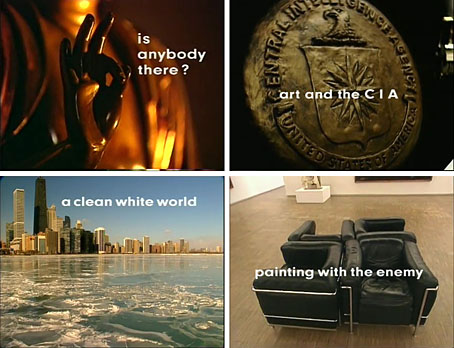
I thought I’d finished with the arts documentaries until I remembered this four-part series from 1995. Hidden Hands was based on researches by Frances Stonor Saunders who also co-produced. As the subtitle suggests, the programmes examined aspects of Modernist art and architecture that weren’t exactly unknown but were often downplayed (sometimes deliberately ignored) by the art establishment. The episodes were as follows:

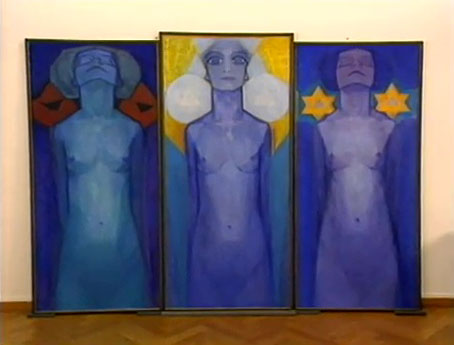
1: Is Anybody There? The occult roots of abstract painting, especially the influence of Theosophy on Vasily Kandinsky and Piet Mondrian. Kazimir Malevich and František Kupka are also mentioned at the beginning of the programme but we don’t hear anything more about them.

2: Art and the CIA. A history of the Congress for Cultural Freedom, a CIA front for channelling money to avant-garde exhibitions and literary magazines during the Cold War.

3: A Clean White World. Modernist architecture as a reaction to, and proposed solution for, the squalor of 19th-century city life. Also the similarity between the impulses that drove the Modernist architectural ideal, and the later health and purity obsessions of European fascist states.

4: Painting with the Enemy. The inadvertent way in which the animus towards “degenerate art” shared by the Nazis and the Vichy regime in occupied France helped sustain Modernism during the war years.

hh2.jpg

This is a very good series on the whole, informative and with a roster of authoritative interviewees. The narration overstates the contrarian angle in places but that’s television for you. Much of the history under investigation wasn’t necessarily hidden, more sidestepped by general discussions of 20th-century art. Even so, fifteen years earlier in the architecture episode of The Shock of the New, Robert Hughes covered similar territory and with similar criticisms, following the development of what would become known as the International Style while noting Mussolini’s adoption of a Modernist idiom for the architecture of Fascist Italy.

Elsewhere, when Hughes reviewed a major Kandinsky retrospective he paid sufficient attention to Kandinsky’s Theosophical beliefs; this was in 1982 for TIME magazine, not exactly an obscure publication. Theosophy’s ectoplasmic tentacles are all over the art of the late 19th century so you’d expect some crossover into the art of the new century, as there was in the careers of the artists themselves. (Matisse was a pupil of Gustave Moreau, for example, an inconvenient detail that often irritated critics.) Given the amount of artists swayed by Madame Blavatsky’s writings, a more interesting argument might have been to propose Theosophy as the prime cause of early abstraction rather than another inconvenient factor in its development. Hilma af Klint’s pioneering abstract paintings were as much products of her Theosophical studies as were those of Kandinsky but in the 1990s nobody was paying her very much attention.

hh3.jpg

Mondrian’s mysticism: Evolution (1910–1911).

As for the CIA, the agency’s clandestine cultural adventures were exposed by a leak in the late 1960s—Stephen Spender famously resigned in shame from his editorship of Encounter magazine—so this could almost be classed as old news. What you wouldn’t have had in the past, however, is the agents involved in the scheme openly discussing their activities.

Continue reading “Hidden Hands: A Different History of Modernism”