The art of Yves Doaré

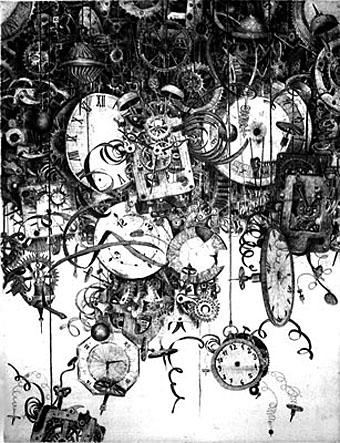
doare1.jpg

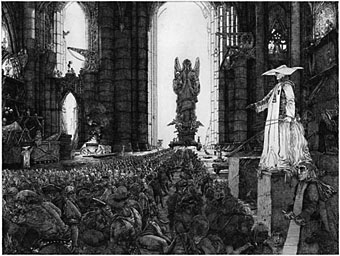
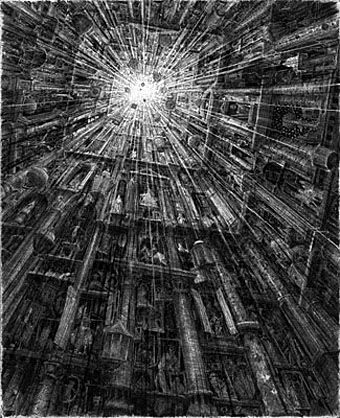
Ange (1981).

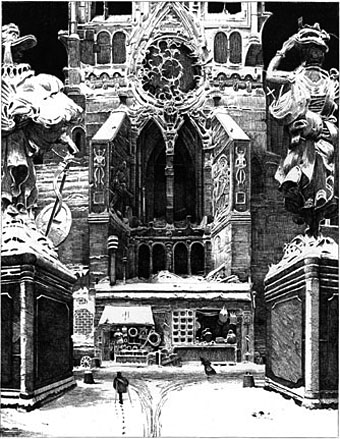
doare2.jpg

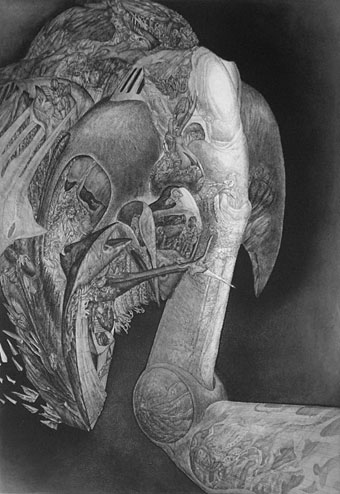
Le réservoir (1979).

Yves Doaré is well known for his paintings and drawings but better known for his haunting etchings, drypoints and wood engravings. Doaré began exhibiting his art in France in 1966 and since that time his art has been the subject of one man exhibitions at the Gallery Sumers, New York (1975), the Gallery Michele Broutta, Paris (1982), the House of Culture, Orleans (1985), the Gallery Dom Quichotte, Rome (1987), Workshop of Arts, Douarnenez (1993) and the Museum of Contemporary Art, Chamalieres, Belgium (1994). His art is now included in such public collections as the Museum of Annecy, the Museum of Morlaix, the Museum of Fine Arts, San Francisco, and the National Library of Paris.

Many of Doaré’s original etchings and engravings explore the theme he has termed, “a kind of geological memory.” Using as his starting point the actual etching plate or engraving block, Doaré explores the surface’s capacity to reveal its own forms and figures. Much like a sculptor, Doaré thus orchestrates the emergence of the random forms which the surface suggests.

More pictures at the Fitch-Febvrel Gallery, Galleria del Leone and the artist’s own site.

Update: more reproductions at Velly.org.

Elsewhere on { feuilleton }
• The etching and engraving archive

Metropolis posters

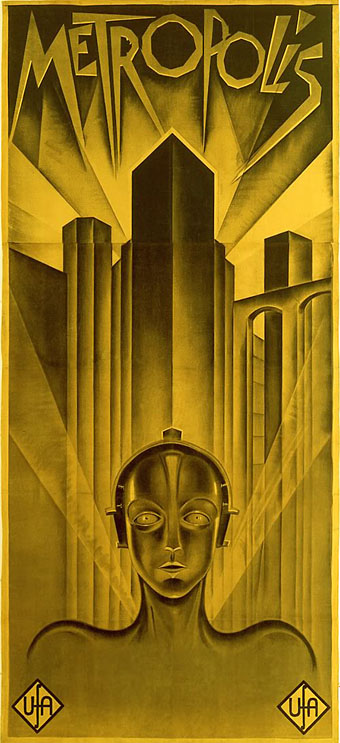
Fritz Lang’s masterpiece via some of its posters, all from 1927.
This site is a great source of information about the film.

metropolis01.jpg

Designer: Heinz Schulz-Neudamm.
As of 2005, the world’s most expensive film poster, selling for $690,000.

Continue reading “Metropolis posters”

The art of Philippe Mohlitz

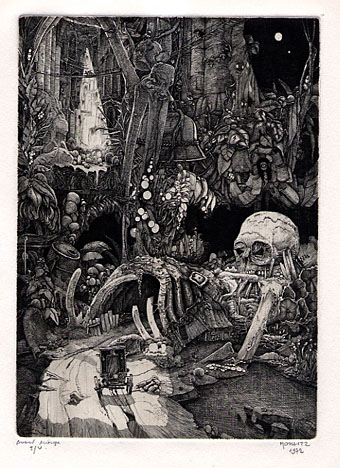
mohlitz3.jpg

Planche où je me suis perdu (1972).

mohlitz1.jpg

31 Decembre (1982).

mohlitz2.jpg

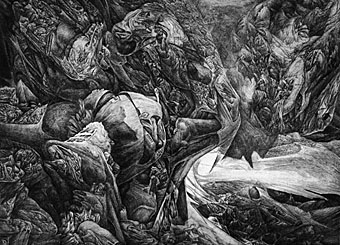
Batir (1989).

Recipient of the Grand Prix L.G. Baudry 2000, Philippe Mohlitz is well known to printmakers and collectors for having spectacularly rescued the art of copper engraving from a long period of increasingly stiff and stylized treatment. A true virtuoso of the burin (engraving tool), Mohlitz has restored a freedom of line to the medium not seen for centuries. In his best work he achieves a flow of light, particularly difficult to render in engraving, reminiscent of Dürer’s “St. Jerome in his Study”. The artist’s imagination, moreover, is equal to his technique, with fantastic visions which fascinate in both composition and detail.

Frustratingly small reproductions of what appear to be very detailed engravings here and here. Slightly larger images gathered here.

Update: another gallery of pictures at Velly.org.

Elsewhere on { feuilleton }
• The etching and engraving archive
Surrealist women

Was the Surrealist movement the first art grouping to give female creators more of an equivalent status to their male counterparts? The recent posting about Leonora Carrington had me considering this question again (yes, this is what taxes my brain while it’s awake). The answer isn’t so easy to find since women artists had been emerging gradually since the late 19th century, from Berthe Morisot onwards. Women certainly played a greater role in the development of Surrealism than they were allowed to do in earlier art movements, and their work is continually featured in histories of the period. The men were still accorded all the glory, of course, and many of the women were only given an opportunity by virtue of being wives or lovers of the male artists, but they still managed to map out their own imaginative territory. The following are some of the more notable examples.

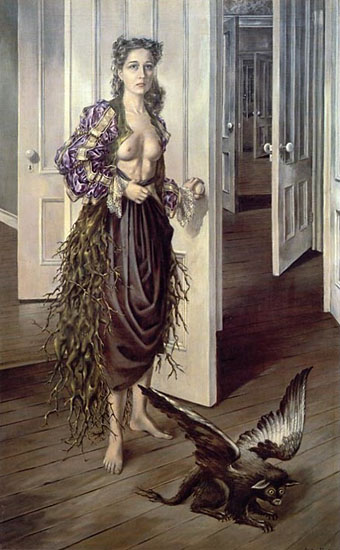
tanning.jpg

Birthday by Dorothea Tanning (b.1910).
My personal favourite, a very accomplished painter who married Max Ernst.

Continue reading “Surrealist women”