 So, another week, another gay sex scandal in America… Schadenfreude levels are going through the roof with all this happening days before a critical midterm election. Latest culprit is Pastor Ted Haggard, president of the 30-million-member National Association of Evangelicals who yesterday was denying that he paid for sex with a male escort and bought drugs (yet he still resigned; er, okay…) but now seems to be fessing up, perhaps prompted by incriminating voicemails being passed to the press.
Pastor Ted claims to have the ear of the White House and has been very vocal in the past about the iniquities of gay sex. Here’s a random sample from the NAE website:
May 17, 2004
A Special Message From Pastor Ted Haggard, President
Today, homosexual couples are marrying in the Commonwealth of Massachusetts. The crisis concerning marriage is now a real and present danger to our society. Join with the National Association of Evangelicals for an important 90-minute Church Communication Network (CCN) broadcast this Sunday evening, May 23rd, 6:00-7:30 PM Mountain Daylight Time. Hear some of the nation’s leading experts on the crisis of homosexual marriage and its detrimental impact on America’s families — Dr. James Dobson, Chuck Colson, Bishop Wellington Boone and Tony Perkins — as they inform, educate, and call the Church to action.
Business-as-usual, in the world of the god-botherers, and there’s more of the same drivel here. But Pastor Ted has gone beyond mere preaching in the past, as this eye-popping Harper’s article reveals:
Pastor Ted soon began upsetting the devil’s plans. He staked out gay bars, inviting men to come to his church; his whole congregation pitched itself into invisible battles with demonic forces, sometimes in front of public buildings.
Seems like the sinful gay men may have done some inviting of their own. Then there’s this:
He called the evil forces that dominated Colorado Springs—and every other metropolitan area in the country—”Control.”
Sometimes, he says, Control would call him late on Saturday night, threatening to kill him. “Any more impertinence out of you, Ted Haggard,” he claims Control once told him, “and there will be unrelenting pandemonium in this city.”
This may be coincidence, but any reader of William Burroughs’ work will tell you that Burroughs patented the term “Control” as a name for abstract forces (human or otherwise) attempting to dominate the world. Burroughs’ work, of course, contains a lot of gay sex, often used as a means of combating that same Control.
The Harper’s article has a great description of Haggard’s World Prayer Center:
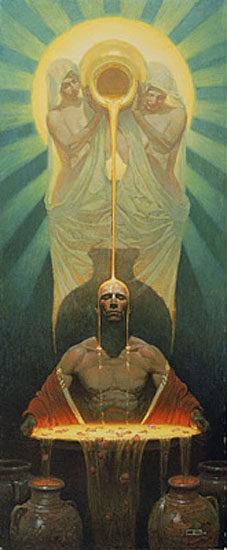
The angel’s pedestal stands at the center of a great, eight-pointed compass laid out in muted red, white, and blue-black stone. Each point directs the eye to a contemporary painting, most depicting gorgeous, muscular men—one is a blacksmith, another is bound, fetish-style, in chains—in various states of undress. My favorite is The Vessel, by Thomas Blackshear (above), a major figure in the evangelical-art world. Here in the World Prayer Center is a print of The Vessel, a tall, vertical panel of two nude, ample-breasted, white female angels team-pouring an urn of honey onto the shaved head of a naked, olive-skinned man below. The honey drips down over his slab-like pecs and his six-pack abs into the eponymous vessel, which he holds in front of his crotch. But the vessel can’t handle that much honey, so the sweetness oozes over the edges and spills down yet another level, presumably onto our heads, drenching us in golden, godly love. Part of what makes Blackshear’s work so compelling is precisely its unabashed eroticism; it aims to turn you on, and then to turn that passion toward Jesus.
In fairness to the artist, I think that’s supposed to be annointing oil they’re pouring. Blackshear’s paintings are certainly preferable to the dreadful figurines on his site, the kind of things that give kitsch a bad name. His eroticism is of the unspecified variety that one sees in Frank Frazetta’s work and which was also present in the fascist sculptures that Arno Breker produced for the Nazis. Breker was gay but Hitler managed to overlook that inconvenience, just as the evangelicals probably overlook the ambiguous qualities in Blackshear’s paintings. As Kenneth Clark says in The Nude: A Study in Ideal Form, all nude art is erotic. Or maybe that’s just “Control” speaking through us lousy perverts?
To return to Pastor Ted, I’m curious now to see how the “gay is a lifestyle choice” contingent deal with this one. The wingnuts who deny a biological component to gay attraction are going to have to accept that their noble leader willingly entered into a sinful relationship rather than being driven there by even the slightest genetic impulse. In Colorado at the moment it seems that Control has the upper hand.
Update: latest news is that Pastor Ted bought crystal meth (an addictive compound very popular among gay men when used during sex) out of curiosity. More than once. At $100 a shot. That’s an expensive curiosity habit you have there, Ted. Oh and the escort gave him a massage but they didn’t have sex, no sir. The current Congressman for Colorado is the egregious Marilyn Musgrave, a woman who recently made Rolling Stone‘s list of “10 Worst Congressmen“, and “an evangelical Christian who married her Bible-camp sweetheart”. Marilyn is down on the gay in a big way:
Once in Congress, Musgrave introduced a constitutional amendment to outlaw gay marriage — which she calls “the most important issue that we face today” — nearly a year before a Massachusetts court approved civil unions. “She doesn’t like the idea of one gay person,” says Rep. Barney Frank of Massachusetts. “So obviously the idea of two of us hanging out makes her very unhappy.” For her opposition to gay marriage — as well as her push to legalize concealed weapons — Musgrave received an endorsement from the KKK in May.
I wonder what she has to say about Pastor Ted’s curiosities?
And there’s more from the party of gay hate, with the news that the Republican National Committee has accepted donations from the president of a gay porn distribution company, Marina Pacific Distributors. I think this is what’s called sending a confusing message to the voters. Coming next (as it were), President Bush is caught being fellated by a chimpanzee in the Oval Office. Maybe.
Previously on { feuilleton }
• The election Google Bomb
• Why doesn’t America believe in evolution?