The Art of Deception

myatt.jpg

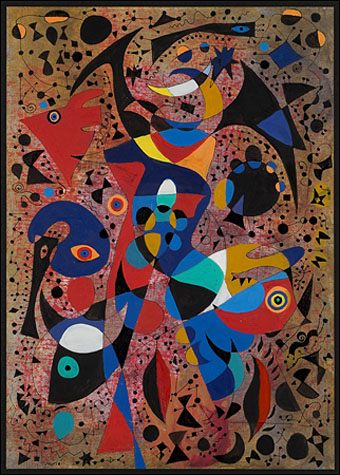
Harlequin Disturbs Sleeping Fish by John Myatt
in the style of Joan Miró (no date).

Fakes and Forgeries: The Art of Deception is an exhibition at the Bruce Museum, Connecticut, running from May 12th–September 9th 2007.

For its major spring/summer exhibition, the Bruce Museum explores a subject that is exceptionally topical in today’s art world. Fakes and Forgeries: The Art of Deception presents 60 examples of Western paintings, works on paper, sculpture and decorative arts that have been recognized as imposters, including examples of the rarest and most famous deceptive works.

Fakes and Forgeries: The Art of Deception reveals the strategies and techniques of the world’s most successful forgers and exposes the extraordinary lengths to which they went to produce authentic-looking artworks. It also addresses techniques used to expose these deceptions, including X-ray fluorescence, pigment analysis, spectrography, dendrochronology, and carbon dating.

The exhibition presents Western painting and sculpture that has been faked from all periods of art, starting with fakes from antiquity and moving chronologically through the Middle Ages, Renaissance and Baroque eras, exposing forgeries ranging from medieval sculpture and quattrocento gold backs to the rare art of Vermeer.
meergeren.jpg

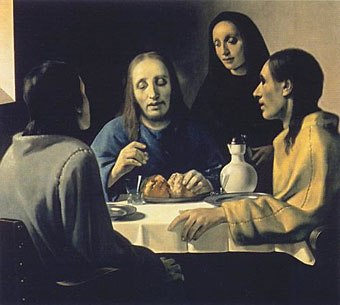
Christ and His Disciples at Emmaus by Han van Meegeren
in the style of Jan Vermeer (1937).

What exactly is a fake or a forgery? Perhaps the biggest problem in this field is the complexity of determining what constitutes an authentic work versus a vast array of faked, forged, copied, attributed, misattributed and replicated work. A fake is a work that replicates an existing work of art; it may be a deliberate deception or simply not the real thing. A forgery is a work that mimics the style of an artist or replicates his signature in a deliberate attempt to deceive.

Paintings in this exhibition that have fake signatures include forgeries of Edouard Manet, Juan Gris, and Giorgio de Chiricio; the etching Le Bain purportedly by Picasso also bears a forged signature. One of the show’s highlights is Han van Meegeren’s legendary forgery, Christ and His Disciples at Emmaus, in the style of Johannes Vermeer, which is arguably the most famous forgery in the world.

Bruce Museum
One Museum Drive
Greenwich
CT 06830
USA

The art of Lucio Bubacco

bubacco1.jpg

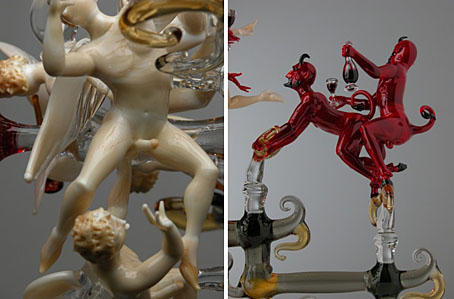
Devils and Angels.

There’s been plenty of speculation over the past twenty-four hours concerning the nature of the post-mortem torments that might await Jerry Falwell now that his soul has departed its corpulent container. Various suggestions I’ve seen run the gamut from the fanciful—being buggered for eternity by purple Teletubbies—to the semi-serious—finding himself in the Third Circle of Dante’s Inferno along with the rest of the gluttons who, so Dante tells us, lie in continual hail and rain whilst eating their own excrement. For a man who spent most of his life talking shit, the latter would seem to be a fitting end.

bubacco2.jpg

Devils and Angels (details).

Which disrespectful preamble brings us to another Italian, Lucio Bubacco, and his glass artworks. Bubacco is a Venetian and Venice has long been a centre of excellence in glass-blowing and sculpture. Yet Bubacco excels even by the standards of his birthplace, and his work is a deal more witty, imaginative and finely-crafted than the dull porn glassworks Jeff Koons had produced (by Italians also) for his Made in Heaven series in 1991. Of the work on Bubacco’s site my favourites are those in the “Transgressive” section which includes the marvellous Devils and Angels tableaux shown above, where a complement of masculine angels and demons are arranged about the central pillar in a Kama Sutra of celestial copulation. Not all his work is this outrageous, some is merely sweetly subversive like The Kiss showing an amorous encounter between a satyr and a naked man. That’s still enough to upset Falwell’s Puritan pod people but then they’re beyond our salvation, aren’t they?

Official site | Lucio Bubacco on MySpace

Elsewhere on { feuilleton }
The gay artists archive

Previously on { feuilleton }
The art of ejaculation
Czanara’s Hermaphrodite Angel
Angels 4: Fallen angels
Angels 1: The Angel of History and sensual metaphysics
The glass menagerie

Congratulations are in order…

invitation.jpg

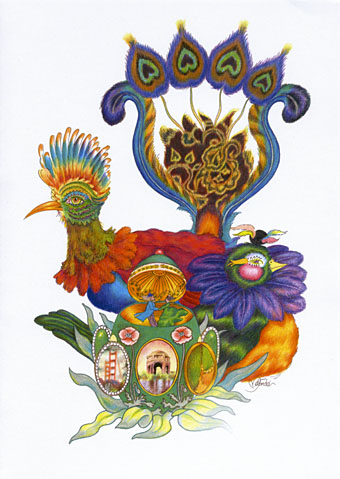
…for Miss Melinda Gebbie and Mr Alan Moore on the day of their wedding. I can’t make it to Northampton today but here’s the delightful invitation that Melinda created which features a Fabergé egg adorned with views of San Francisco and the happy couple dancing inside. I hope the weather’s good for them.

Update: Neil Gaiman posted photos.

Previously on { feuilleton }
Alan Moore in Arthur magazine

The art of Patten Wilson, 1868–1928

wilson3.jpg

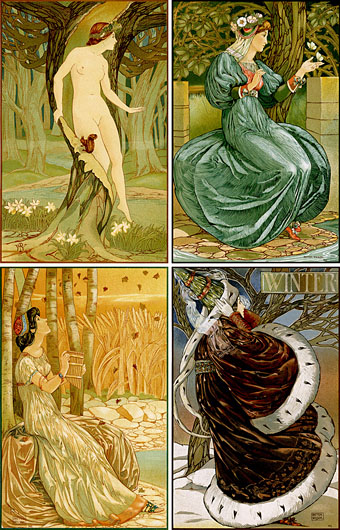
The Four Seasons (1897).

Typically gorgeous work from the unjustly neglected Victorian illustrator. There’s more scans of the Coleridge illustrations (shown below) at Dr Chris Mullen’s excellent Visual Telling of Stories site.

Continue reading “The art of Patten Wilson, 1868–1928”