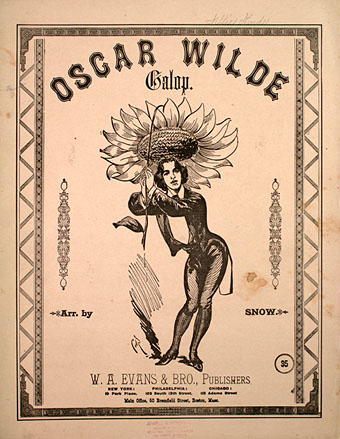
When Oscar Wilde arrived in America to begin his lecture tour in 1882 the excursion provoked considerable comment on both sides of the Atlantic. Wilde was there in his capacity as an ambassador for Aestheticism, a position which had already made him a figure of fun in the pages of Punch magazine while the Aesthetes generally and Wilde in particular had been caricatured the year before by Gilbert & Sullivan in their opera, Patience. The Oscar Wilde Galop was one of a number of topical dance pieces which capitalised on Wilde’s arrival in America, the full score of which can be seen in the Levy Sheet Music Collection at Johns Hopkins University. No one seems to give the name of the composer of these works for some reason, but this piece and others like it can be found on a CD, To Oscar: A Collection of Aesthetic Melodies.
I suspect Oscar would have been flattered by his portrayal on the sheet music, it’s milder than the Punch cartoons and gives him a wasp waist he never possessed even in his youth. Wilde enjoyed his lecture tour, and was always happy to be the centre of attention, of course, but America (and others) paid the price for the ribbing later on, as in this exchange from The Picture of Dorian Gray:
“I am told, on excellent authority, that her father keeps an American dry-goods store,” said Sir Thomas Burdon, looking supercilious.
“My uncle has already suggested pork-packing Sir Thomas.”
“Dry-goods! What are American dry-goods?” asked the duchess, raising her large hands in wonder and accentuating the verb.
“American novels,” answered Lord Henry, helping himself to some quail.
The duchess looked puzzled.
“Don’t mind him, my dear,” whispered Lady Agatha. “He never means anything that he says.”
“When America was discovered,” said the Radical member—and he began to give some wearisome facts. Like all people who try to exhaust a subject, he exhausted his listeners. The duchess sighed and exercised her privilege of interruption. “I wish to goodness it never had been discovered at all!” she exclaimed. “Really, our girls have no chance nowadays. It is most unfair.”
“Perhaps, after all, America never has been discovered,” said Mr. Erskine; “I myself would say that it had merely been detected.”
“Oh! but I have seen specimens of the inhabitants,” answered the duchess vaguely. “I must confess that most of them are extremely pretty. And they dress well, too. They get all their dresses in Paris. I wish I could afford to do the same.”
“They say that when good Americans die they go to Paris,” chuckled Sir Thomas, who had a large wardrobe of Humour’s cast-off clothes.
“Really! And where do bad Americans go to when they die?” inquired the duchess.
“They go to America,” murmured Lord Henry.
Elsewhere on { feuilleton }
• The Oscar Wilde archive