Max Klinger’s New Salomé

klinger.jpg

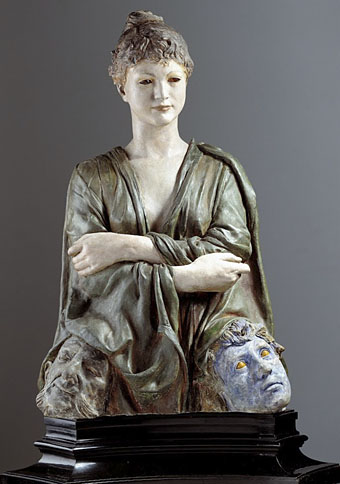
The New Salomé (1887–1888) by Max Klinger.

The German Symbolist Max Klinger (1857–1920) is celebrated today for the etchings which comprise his Ein Handschuh (A Glove) series, ten prints that in their curious details and dream-like quality prefigure Surrealism and Giorgio de Chirico’s “metaphysical” paintings. During his life Klinger was highly regarded for his sculpture as well as his etchings: his Beethoven was a centrepiece of the Secession building in Vienna in 1902. His New Salomé is one of the handful of Klinger works at the Google Art Project where I still feel we ought to be able to view sculpture in the round. I’ve seen many photos of this piece before but hadn’t realised until now that the eyes were…what? Rubies? Amber? Whatever they are, their fiery cast ensures that his imperious female sits unequivocally with the Evil Women that proliferated in the late 19th century.
pla.jpg

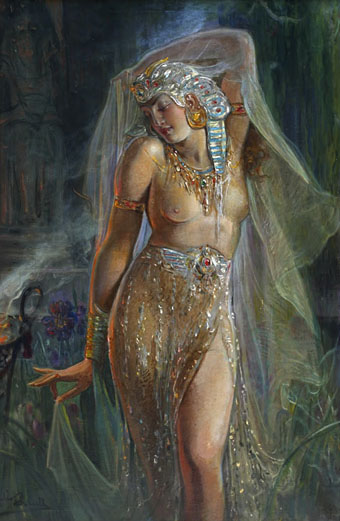
Salomé (c.1910) by Julio Borrell Pla.

Klinger’s sculpture may have been fashionably misogynist but it was at least a serious piece of art. Twenty years later the Salomé theme had devolved to little more than titillating exotica, as with this vaporous painting by Julio Borrell Pla which I hadn’t come across before. The last gasp of this exhausted trend is William Dieterle’s 1953 film in which Rita Hayworth plays Herod’s daughter as all titillation and little else.

Elsewhere on { feuilleton }
The Salomé archive

The art of Juan de Valdés Leal, 1622–1690

leal1.jpg

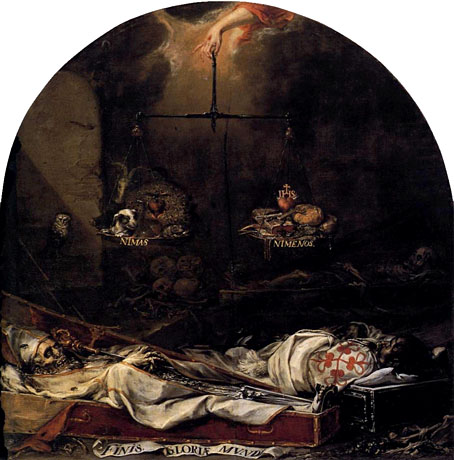
In ictu oculi (1672).

Having castigated Somerset Maugham yesterday for a novel that even he professed to dislike, thanks can be offered for the passage in The Magician which draws attention to a painter I hadn’t come across before. With a scythe-wielding skeleton snuffing a candle flame, and a bishop rotting in his casket, these are a very Spanish take on the vanitas genre. Some of the subsequent works of Salvador Dalí and Luis Buñuel are less surprising when you see art that’s this grotesque.

leal2.jpg

Finis gloria mundi (1672).

Previously on { feuilleton }
Alfred Rethel’s Totentanz
The art of Jacopo Ligozzi, 1547–1627
Massachusetts memento mori
Skull cameras
Walmor Corrêa’s Memento Mori
The skull beneath the skin
Vanitas paintings
Very Hungry God
History of the skull as symbol

Weekend links 109

magritte.jpg

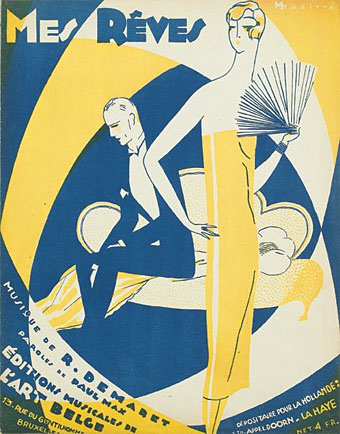
Dreams before Surrealism: a sheet music cover from 1926 by René Magritte.

• The week in music: Listen to compositions by Annea Lockwood. | At the Free Music Archive: Uncomfortable Music, a tribute to David Lynch’s Eraserhead (and, it should be said, to Alan Splet’s unique soundtrack). | Alan Licht plays a track from Trout Mask Replica then loops some Donna Summer and improvises guitar noise over it. | Music Experiments with Terror: The Spooky Isles presents Joseph Stannard‘s list of recent eldritch sounds from British musicians.

Great art, or, let’s just say, more modestly, original art is never created in the safe middle ground, but always at the edge. Originality is dangerous. It challenges, questions, overturns assumptions, unsettles moral codes, disrespects sacred cows or other such entities. It can be shocking, or ugly, or, to use the catch-all term so beloved of the tabloid press, controversial. And if we believe in liberty, if we want the air we breathe to remain plentiful and breathable, this is the art whose right to exist we must not only defend, but celebrate. Art is not entertainment. At its very best, it’s a revolution.

Salman Rushdie on the censorship of art

• All Diamond, No Rough” says the School Library Journal about the first volume of The Graphic Canon. Volume two should be out in August.

Scientific American asks: Do Psychedelics Expand the Mind by Reducing Brain Activity?

• From 2010: A Dandy in Aspic – A letter from Derek Marlowe.

Tom Phillips and A Humument: how a novel became an oracle.

Timeline Maps at the David Rumsey Map Collection.

• Happy 50th birthday, A Clockwork Orange.

Jim Dandy (1956) by LaVern Baker | Larks’ Tongues in Aspic, part one (1972) by King Crimson, live on Beat Club.

Against Nature in New York

huysmans.jpg

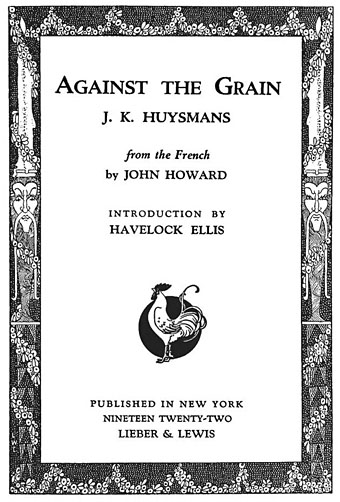
I’ve always preferred Against Nature as an English translation of Huysmans’ À rebours, it’s a snappier and more provocative title than Against the Grain which these days might be taken as a prescription for a paleo diet.

À rebours this month is also the title of an art exhibition opening Venus Over Manhattan, a new exhibition space in New York City created by art collector and writer Adam Lindemann:

À rebours at Venus over Manhattan explores the notion of “against the grain” through a selection of more than 50 works including African fetishes. The artists represented range from Odilon Redon – the favorite of the book’s protagonist – to Henri Fuseli, Gustave Moreau, Felicien Rops, Franz von Stuck, Lucas Samaras, William Copley, Jeff Koons, Glenn Brown, Salvador Dalí, Walter Dahn, David Hammons and Bernard Buffet, as well as Jeni Spota, Andra Ursuta and Gavin Kenyon.

A document detailing the exhibits may be downloaded in pdf form here. Few of the works have any direct connection with Huysmans’ novel but there are some book covers there I hadn’t seen before. The exhibition runs to 30th June, 2012. (Thanks to @supervert for the tip.)

Looking around for some more Huysmans-related imagery turned up the uncredited title page above (the entire book is here), and the following quote from Theophile Gautier which Havelock Ellis uses in his introduction. Gautier was discussing Baudelaire but, as Ellis says, it’s an excellent statement of the principles of Decadence as an artistic concept:

The poet of the Fleurs du Mal loved what is improperly called the style of decadence, and which is nothing else but art arrived at that point of extreme maturity yielded by the slanting suns of aged civilisations: an ingenious complicated style, full of shades and of research, constantly pushing back the boundaries of speech, borrowing from all the technical vocabularies, taking colour from all palettes and notes from all keyboards, struggling to render what is most inexpressible in thought, what is vague and most elusive in the outlines of form, listening to translate the subtle confidence of neurosis, the dying confessions of passion grown depraved, and the strange hallucinations of the obsession which is turning to madness. The style of decadence is the ultimate utterance of the Word, summoned to final expression and driven to its last hiding-place. One may recall in this connection the language of the later Roman Empire, already marbled with the greenness of decomposition, and, so to speak, gamy, and the complicated refinements of the Byzantine School, the last forms of Greek art falling into deliquescence. Such indeed is the necessary and inevitable idiom of peoples and civilisations in which factitious life has replaced natural life, and developed unknown wants in men. It is, besides, no easy thing, this style disdained of pedants, for it expresses new ideas in new forms, and in words which have not yet been heard. Unlike the classic style it admits shadow… One may well imagine that the fourteen hundred words of the Racinian vocabulary scarcely suffice the author who undertakes the laborious task of rendering ideas and things in their infinite complexity and multiple coloration.

Previously on { feuilleton }
À Rebours illustrated
Arthur Zaidenberg’s À Rebours

Weekend links 108

newyorker.jpg

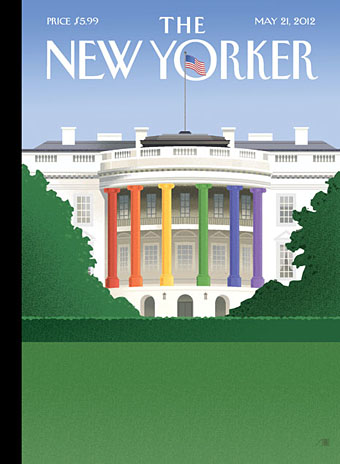
Bob Staake’s cover illustration acknowledges President Obama’s statement last week in favour of gay marriages.

• Related to the above: Gay rights in the US, state by state, an infographic and a useful riposte to people like Orson Scott Card (yes, him again) who claim that gay Americans are equal in everything but the right to marry. On the same theme, “Now Obama’s come out on same-sex marriage, maybe so will I,” says Edmund White (yes, him again), and Eric Berkowitz, author of Sex & Punishment: 4,000 Years of Judging Desire, who writes that “In the period up to roughly the thirteenth century, male bonding ceremonies were performed in churches all over the Mediterranean.”

• The fifth edition of A Humument by Tom Phillips will be published soon by Thames & Hudson. The Tom Phillips website has just been relaunched in a form which now incorporates the notes I made in December about Phillips’ album cover designs.

• The Greenfriars are encouraging people to follow their example and get involved with their local communities (the habits are optional). Kudos for the choice of a Dürer knot.

The action centres on the arrival of a man who may or may not be a prophet, or the devil, or just a violent con-man, in a rotting, rain-drenched Hungarian hamlet. This is the “estate”, apparently some sort of failed collective, where all hope has been lost and all the buildings are falling down. It is inhabited by a cast of semi-crazed inadequates: desperate peasants cack-handedly trying to rip each other off while ogling each other’s wives; a “perpetually drunk” doctor obsessively watching his neighbours; young women trying to sell themselves in a ruined mill; a disabled girl ineptly attempting to kill her cat.

Sátántango by László Krasznahorkai is published in a new translation by George Szirtes

• The Quietus interviewed Kevin Shields following the long-awaited reissue of the My Bloody Valentine catalogue.

• The first volume of Russ Kick’s Graphic Canon (to which I’m a contributor) has been sighted in the wild.

Rise of the Living Type: Stylised 17th century floriated letterforms & grotesque mask sprinkles.

Ed Jansen’s Camera Obscura III, a tour of museums, galleries and venues, 2009–2011.

• io9 reports on the new translation of Roadside Picnic by Arkady & Boris Strugatsky.

Shanghai Expression: Graphic Design in China in the 1920s and 30s.

Liberty Realm, a monograph of drawings by Catharyne Ward.

• 100 mins of Adrian Sherwood‘s best dub productions.

Strange Flowers checked into the Chelsea Hotel.

Chelsea Girls (1967) by Nico | Chelsea Morning (1968) by Fairport Convention | Chelsea Hotel #2, Rufus Wainwright sings Leonard Cohen.