Weekend links 127

whirlpool.jpg

M15, The Whirlpool Galaxy photographed by Martin Pugh. The overall and deep space winner of Astronomy Photographer of the Year, 2012.

The Final Academy, the series of William Burroughs-themed events that took place in London and Manchester in 1982, will be celebrated at the Horse Hospital, London, on 27th October. Academy 23, a publication edited by Matthew Levi Stevens, will include my report on the Manchester Haçienda performances.

• “Architects are the last people who should shape our cities,” says the thrillingly pugnacious Jonathan Meades in a piece from his new writing collection Museums Without Walls. Andy Beckett reviews the book here.

• Ex-Minimal Compact singer/bassist Malka Spigel talks about her new album, Every Day Is Like The First Day, which can be streamed in full here.

What’s new about the current acknowledgments page is that it’s unsolicited—it appears like an online pop-up ad, benefiting no one but the author and his comrades. This is surely why these afterwords are often so garrulously narcissistic and strewn with clichés. The most radical experimentalist adheres to the most mindless acknowledgments-page formula; the most stinging social critic suddenly becomes Sally Field winning an Oscar.

Sam Sacks at the New Yorker on the blight of novelists’ acknowledgments pages. DG Myers at Commentary Magazine piles on.

• Another streaming album: Composed by Jherek Bischoff. Try Insomnia, Death & The Sea featuring Dawn McCarthy.

• Film of Lindsay Kemp being interviewed in 1977 about his production of Salomé.

Electronic Performers (2004): a video by Machine Molle for the song by Air.
djuna.jpg

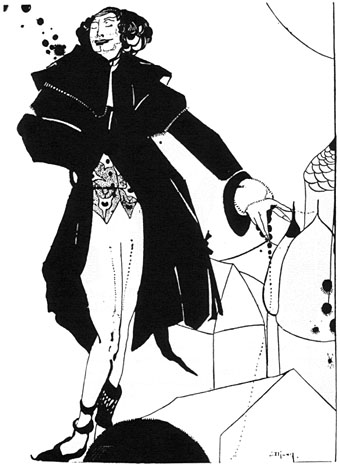
One of a series of Beardsley-like drawings by Djuna Barnes posted at Strange Flowers. The resurgent Ms. Barnes is mentioned three times in this Terry Castle review of All We Know: Three Lives by Lisa Cohen.

Fictitious Dishes, meals from novels photographed by Dinah Fried.

• Life, the Dinosaurs & Everything: Cosmicomics by Italo Calvino.

The Baby Died: Morbid Curiosities found in Old Newspapers.

• Portishead’s Adrian Utley gives a tour of his synth collection.

• Minimal Compact: Babylonian Tower (1982) | Not Knowing (1984) | When I Go (1985) | Nil Nil (1987).
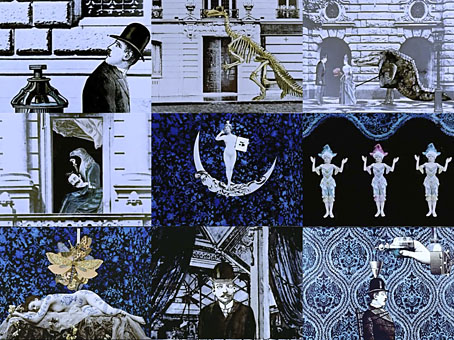

Labirynt by Jan Lenica

labirynt1.jpg

Labirynt.

One of the links at the weekend was to this post about the favourite Polish posters of the Brothers Quay, a piece which included an example by designer and illustrator Jan Lenica (1928–2001). Lenica, like the Quays, was also a filmmaker who started out by producing short animations, Labirynt (1963) being one of these works. I’d not come across this before but now that I’ve watched it I’d be very surprised if Terry Gilliam hadn’t seen it at some point in the 1960s, the animation of collaged illustrations and hand-tinted photographs from 19th-century sources is precisely the kind of thing that Gilliam was doing a few years later. So is the generally Surrealist atmosphere with a bowler-hatted protagonist being menaced in the street by a host of hybrid creatures, encountering the women one sees in old erotic postcards, being seized by a giant hand, and so on.

labirynt2.jpg

Many Eastern European animations from the Cold War period involve a degree of political allegory, and Labirynt is no exception. One of the menacing figures is a mechanical gentleman who captures Bowler Hat Man and subjects him to a series of forced operations, eventually building a cage inside the captive’s head. Given this, and some opening shots which show Bowler Hat flying over the city using self-powered wings, it’s not stretching a point to see this 13-minute film as Brazil in miniature. Watch it for yourself here.

Previously on { feuilleton }
Brothers Quay scarcities
Gilliam’s shaver and Bovril by electrocution
Short films by Walerian Borowczyk
The Brothers Quay on DVD

Beardsley and His Work

beardsley1.jpg

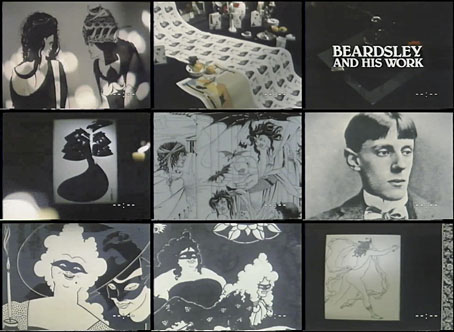
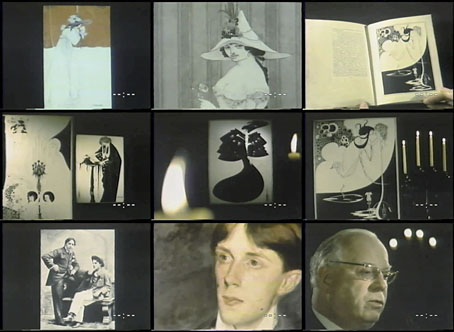
Back in 2008 I wrote at some length about Aubrey, an excellent BBC TV dramatisation of the last years of Aubrey Beardsley’s life written by John Selwyn Gilbert, and screened once in 1982. Mr Gilbert himself added a comment to that post in which he mentioned that he’d written and directed a documentary which was screened in tandem with the play, Beardsley and His Work. I have the documentary on tape but it’s a copy of a copy and is also missing ten minutes or so of its opening so it’s good to find that the entire thing is now on YouTube. (Thanks to Dominique for drawing my attention to this.)

Beardsley and His Work is essential viewing for Beardsleyphiles since it’s the only place you’ll see Beardsley scholar Brian Reade—author of the huge monograph, Beardsley (1967)—and Brigid Brophy—author of two excellent studies, Black and White (1968) and Beardsley and His World (1976)—talking at length about the artist. In addition there’s another artist, Ralph Steadman, examining some of Beardsley’s original artwork and discussing the techniques of ink drawing. The fifty-minute film is divided into four chunks, unfortunately, but is otherwise complete:

Part one | part two | part three | part four

beardsley2.jpg

Elsewhere on { feuilleton }
The Aubrey Beardsley archive

Weekend links 126

dogo.jpg

Mala Reputación (1991) by Dogo Y Los Mercenarios. Cover art by Nazario Luque.

Artist Nazario Luque was Spain’s first gay comic artist who’s also known for the drawing which appeared (without permission) on the sleeve of Lou Reed Live – Take No Prisoners in 1978. On his website Nazario says he’s been described as “Exhibicionista, solidario, provocador, agitador moral, rompedor, arriesgado, polifacético, transgresor, canalla, pintiparado, morigerado o simplemente superviviente…” Via Música, maestros, a two-part post (second part is here) about album cover art by comic artists.

The BBC Radiophonic Workshop Returns. And quite conveniently, Ubuweb posts some original Radiophonic creations by electronic music genius Delia Derbyshire. Ms Derbyshire is profiled along with her other pioneering colleagues in an hour-long TV documentary, Alchemists of Sound.

• Tor.com celebrates the fiction of Shirley Jackson. Too Much Horror Fiction has a substantial collection of Shirley Jackson book covers.

Phantasmagorical and all but plotless, Nightwood flings itself madly upon the night, upon Wood, and upon the reader. Its sentences pomp along like palanquins and writhe like crucifixions. They puke, they sing. Their deliriums are frighteningly controlled. […] TS Eliot loved Nightwood so much that he shepherded its publication and wrote the introduction to the first edition. Dylan Thomas complimented it with his left hand by calling it “one of the three great prose books ever written by a woman” and with his right hand by stealing from it. […] Nightwood’s Dr. Matthew-Mighty-grain-of-salt-Dante O’Connor, florid monologist and transvestite, seems to have been a model (along with Captain Ahab) for Judge Holden in Blood Meridian. The difference is that Cormac McCarthy’s Judge is essentially Satan, whereas O’Connor is essentially Christ; they’re only just on opposite sides of the border of madness.

Austin Allen on The Life and Death of Djuna Barnes, Gonzo “Greta Garbo of American Letters”. There’s a lot more Djuna Barnes at Strange Flowers.

• Out at the end of the month, Extreme Metaphors, interviews with JG Ballard, 1967–2008, edited by Simon Sellars & Dan O’Hara.

• The favourite Polish posters of the Brothers Quay. Over at Cardboard Cutout Sundown there are more Quay book covers.

The Mancorialist: people on the streets of Manchester are given the Sartorialist treatment.

The Liverpool International Festival Of Psychedelia takes place on 29th September.

The Caves of Nottingham are explored in a detailed post at BLDGBLOG.

• In Remembrance: Bill Brent, Groundbreaking Queer Sex Publisher.

Confessions of a Bookplate Junkie

The Uranus Music Prize 2012

Fuck Yeah René Lalique

Dr Who: original theme (1963) by Ron Grainer with Delia Derbyshire | Falling (1964) by Delia Derbyshire | The Delian Mode (1968) by Delia Derbyshire | Blue Veils And Golden Sands (1968) by Delia Derbyshire.

Books of blood

kushner1.jpg

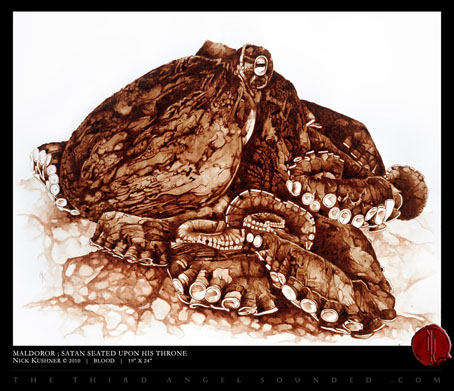
Artist Nick Kushner writes to alert me that his 2010 painting Maldoror: Satan Seated Upon His Throne has been used on the cover of a recent Russian edition of Lautréamont’s novel. Kushner uses his own blood to create his paintings, and the cover below has been created using the same material. Maldoror himself would no doubt demand that proper homage be paid by binding the volume in human skin. That’s something publisher Provocateurs’ Club can maybe try for the special edition.

kushner2.jpg

This news has reminded me that I had a mail last month from another American artist, Robert Sherer, concerning a book collection of his own blood paintings. Sherer also uses the blood of friends both HIV-negative and HIV-positive. Blood Works: The Sanguineous Art of Robert Sherer is published by Kennesaw State University Press.

Previously on { feuilleton }
Magritte’s Maldoror
Frans De Geetere’s illustrated Maldoror
The art of Robert Sherer
Maldoror illustrated