Shapeshifters

arvin.jpg

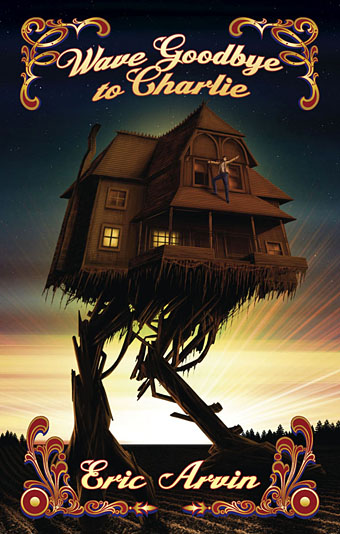
Time for another work update. These are three covers for fantasy novels from LGB imprints due for release in the next week or so. The brief for Eric Arvin’s cover was walking house plus some kind of fairground (or carnival) decoration. I found a nice trove of fairground art at Sheffield University but the picture was working so well I didn’t want to clutter it with extraneous detail. Wave Goodbye to Charlie is published by Wilde City Press.

hale1.jpg

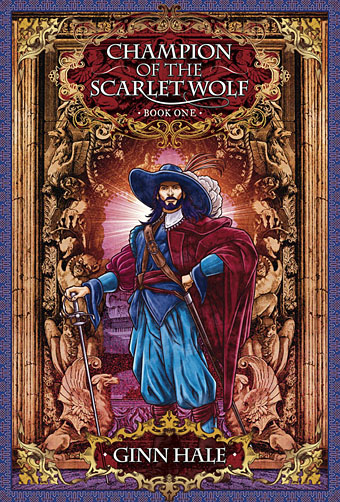
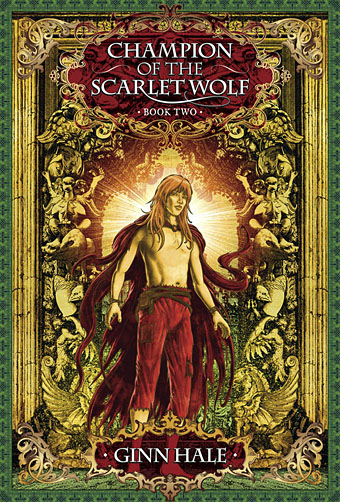
And speaking of extraneous detail… Ginn Hale’s books continue a series featuring swashbuckling, shapeshifting characters, witches and the like. (There’s also a witch in Eric Arvin’s novel but she drives a Buick.) I spent a great deal of time collaging bits of gargoyles and statuary from A. Raguenet’s six-volume Materials and Documents of Architecture and Sculpture (1915) into two elaborate arch designs…then covered them over. This is a bad habit but at least everything ended up in the finished artwork. My other bad habit is spending ages creating something only to place it into the composition and find it doesn’t work at all… Ginn Hale’s novels are published by Blind Eye Books.

hale2.jpg

Weekend links 227

grim.jpg

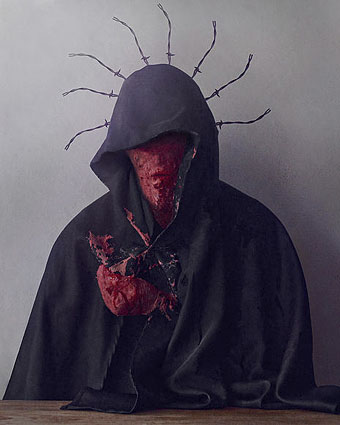
A Follower by Jason Grim.

Haunted Futures, a multi-genre anthology from Ghostwoods Books, will feature stories by Warren Ellis, John Reppion, Liesel Schwarz, Chuck Wendig, Richard Kadrey, Stephen Blackmoore and others. It will also feature some of my illustrations but only if this this Kickstarter fund is successful.

• “…at issue here is restriction versus potential: protect a specific set of choices versus open the field to the exploration of everything.” Sam Potts offers a refutation of Robert Bringhurst’s design textbook The Elements of Typographic Style.

• “I discovered that if one looks a little closer at this beautiful world, there are always red ants underneath.” Morgan Meis quoting David Lynch in a review of David Lynch: The Unified Field, a new exhibition of Lynch’s paintings.

But among these novels only Moravagine, first discovered for English-speaking readers by Henry Miller and a direct ancestor of Céline’s Voyage au bout de la nuit, has survived as an underground classic. A monstrous admixture of Lautréamont’s Maldoror, Feuillade’s Fantômas, Nietzsche’s Superman, Jack the Ripper and (according to the Cendrars scholar Jay Bochner) the deranged Jung and Freud disciple Otto Gross, Moravagine remains Cendrars’s most nihilistic and darkly comic other.

Richard Sieburth on Blaise Cendrars and his “Dada update of Dostoevsky”, coincidentally the subject of a post here earlier in the week.

• “…the duchess became enthralled with the idea of creating a garden of plants that could kill instead of heal.” Natasha Geiling on Jane Percy’s Poison Garden.

• Mix of the week: Kosmik Elektronik [part 3] by The Kosmische Club. More Kosmische musik: Agitation Free on French television in 1973.

• At Dangerous Minds: Secret Weapons (1972), 22 minutes of made-for-TV dystopian science fiction directed by David Cronenberg.

Project Praeterlimina, “a journal of daemonology, magic, and the human condition”.

The NOS Project: download Shed’s score for Murnau’s Nosferatu.

• At Lambda Literary: Toy, a poem by Evan J. Peterson.

Drew Daniel doesn’t want to play the listicle game.

Surrealism and Magic

Stuff in old books

Haunted Island (1973) by Agitation Free | Haunted Heights (1977) by Peter Baumann | Haunted Dancehall (1994) by The Sabres of Paradise

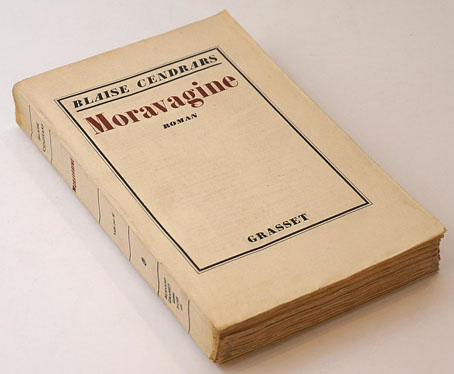
Moravagine book covers

moravagine01.jpg

First publication, Grasset, 1926.

I should have liked to open all cages, all zoos, all prisons, all lunatic asylums, see the great wild ones liberated and study the development of an unheard-of kind of human life…

Recent reading was Moravagine (1926) by Blaise Cendrars, a novel that resists easy summary. It’s a Modernist work to some extent although the prose (a good translation from the French by Alan Brown) is never unorthodox in style; it’s also scabrous, amoral, misogynist and deeply misanthropic. The narrative is a picaresque affair narrated by a young doctor who frees the mysterious Moravagine from an asylum where he’s been imprisoned for many years. “Moravagine” is an adopted name whose origin and meaning is never addressed, although a French reader would find a rather unavoidable pun on “death by vagina”. Moravagine himself is an otherwise unnamed member of the Hungarian royal family, a dwarfish intellectual psychopath with a bad leg who goes on the run with the doctor, first to pre-revolutionary Russia, then to the United States and South America.

Reviewers have compared the book to Beckett, Céline and Burroughs although it’s much lighter reading than the first two, and the prose is more coherent than Burroughs in cut-up mode. Since we’ve been hearing a lot about the First World War this year it’s tempting to read the book as a kind of Dadaist reaction to Cendrars’ own experiences in the war, even though the entirety of the conflict is dispensed with in two pages. Cendrars appears as a character in the later chapters; he lost an arm in the war so he has his narrator lose a leg while Moravagine loses his reason altogether. At the end of the book he’s found imprisoned in another asylum where he believes he’s an inhabitant of the planet Mars, and where he spends his last months writing a huge, apocalyptic account of how the world will be in the year 2013.

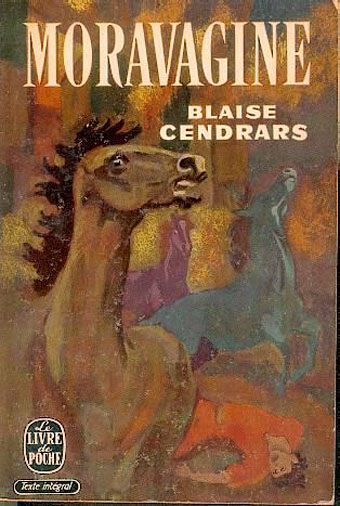
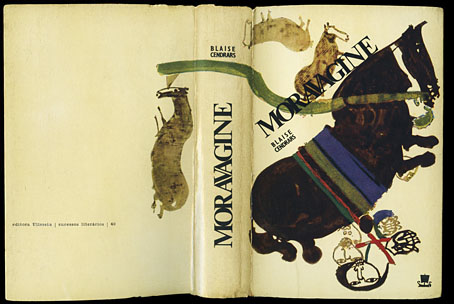
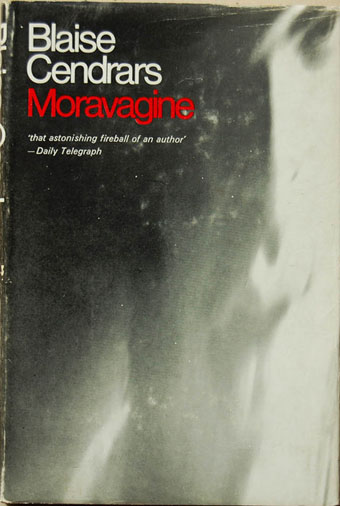
All this, of course, presents a challenge for a cover designer. I have two Penguin editions, both with very different covers, neither of them unsuitable. Curiosity impelled me to see how the book has been treated since 1926. There aren’t many editions but their difference shows the difficulty of trying to encapsulate the contents of this strange novel in a graphic form. The selection here has avoided text-only treatments in favours of those using some form of illustration.
moravagine05.jpg

Le Livre de Poche, 1957.

In an early chapter Moravagine describes fleeing the imperial household by strapping himself to a horse. Without knowing this narrative detail the painting here seems bizarrely arbitrary.
moravagine02.jpg

Editora Ulisseia, Portugal, 1966.

The horses again, with Moravagine strapped underneath one of them. I’d guess the illustrators of these two books didn’t read very far.
moravagine03.jpg

First UK edition, Peter Owen, 1968.

Peter Owen commissioned the first English translation which is still in use today.

Continue reading “Moravagine book covers”

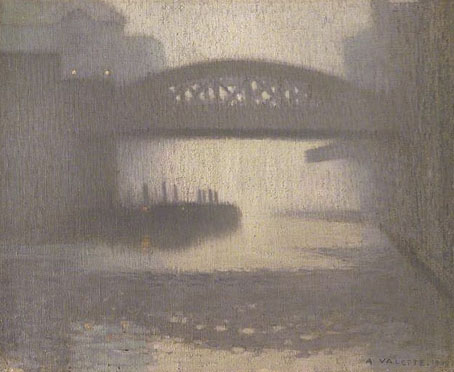
Valette’s steam and smoke

valette1.jpg

Windsor Bridge on the Irwell (1909).

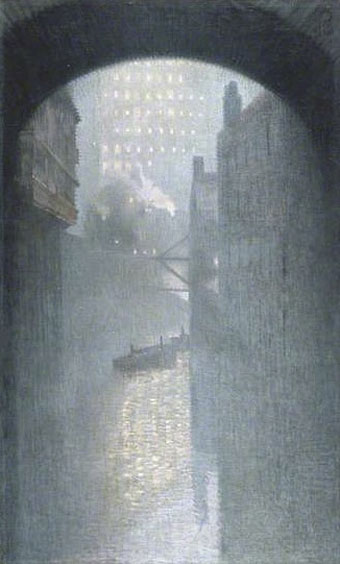
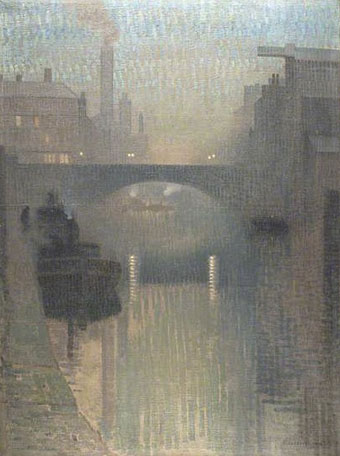
Adolphe Valette (1876–1942) was a contemporary of Lionel Walden, and where Walden was an American who spent some time painting views of Cardiff, Valette moved to Manchester in 1905 where he painted a series of celebrated views of the city. If it’s a commonplace that foreign eyes often see what locals ignore, this has certainly been the case in Manchester. Friedrich Engels catalogued the lethal living and working conditions of the city’s labourers in The Condition of the Working Class in England in 1845, and it took Valette to find a subject for his art in the city’s smogs and polluted atmospheres at a time when many British artists were still painting scenes from Tennyson or the tales of King Arthur.

valette2.jpg

India House, Manchester (1912).

Valette’s Manchester paintings now reside in the Manchester Art Gallery whose curators have always made much of his being “the Manchester Impressionist”. The term isn’t unjustified even though Impressionism was long gone by the time he began these paintings; there is something Monet-like to a few of them. The gallery contains a large amount of fairly typical Victorian art, including a couple of well-known Pre-Raphaelite pieces, so Valette’s work has always stood apart not only for its urban theme but for its looser technique. My favourite is the view of India House from the banks of the River Medlock. Many of the bridges and buildings in these paintings can be seen today, albeit cleaned and (in the case of India House) gentrified. Valette captures the final years of unrestrained industrial pollution when the air in Manchester, London and other cities was often as bad as it is in some parts of China today.

valette3.jpg

Bailey Bridge, Manchester (1912).

Continue reading “Valette’s steam and smoke”

Steam and smoke

walden1.jpg

Cardiff Docks (1894) by Lionel Walden.

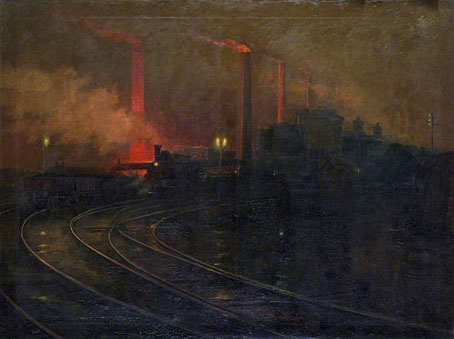
There’s a tendency to consider the art of the 19th century as being preoccupied with the rural, the mystical and the historic: all true in the case of the Pre-Raphaelites. But the effects of the Industrial Revolution attracted enough artists to create a sub-genre of painting that takes the miasmas of factories and the hellish glow of furnaces as its subject; Philip de Loutherbourg’s Coalbrookdale by Night (1801) is one of the more well-known examples, not least for being a painting that shows the future emerging from a rural landscape in a truly infernal manner.

Lionel Walden (1861–1933) was an American artist who was in Wales long enough to paint several scenes of the Cardiff docks and the steelworks. I’d not seen this gorgeously atmospheric painting of the docks before but it captures the light and the ambience of a British autumn/winter with the same fidelity as John Atkinson Grimshaw, an artist who made chilly mornings and smoky twilights his speciality. Walden’s other paintings are a lot lighter, with more traditional views of docks, boats and fishermen. (Via Beautiful Century.)

walden2.jpg

The Steelworks, Cardiff at Night (1893–97) by Lionel Walden.

Previously on { feuilleton }
How It Works
The art of John Atkinson Grimshaw, 1836–1893