Weekend links 244

scarpulla.jpg

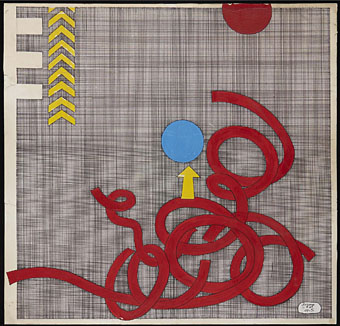
MMOB :: Far West (2013) by Alison Scarpulla.

• “…although same-sex love is as old as love itself, the public discourse around it, and the political movement to win rights for it, arose in Germany in the late nineteenth and early twentieth centuries. This message may surprise those who believe that gay identity came of age in London and New York, sometime between the Oscar Wilde trials and the Stonewall riots.” Alex Ross reviewing Robert Beachy’s Gay Berlin: Birthplace of a Modern Identity. Beachy talks about his book here.

• “I was in a room with tube synthesizers, where you had to tune them up to play them. It was unbelievable.” John Carpenter talking to Joseph Stannard about composing with electronics. Carpenter’s album of new music, Lost Themes, may be previewed here.

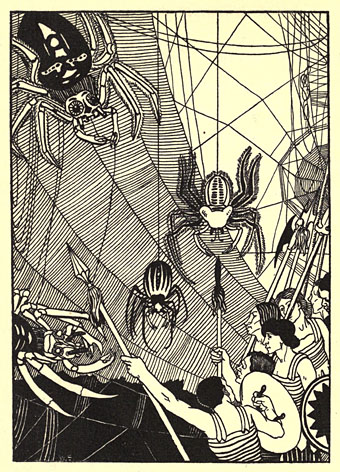
• From 2010: John Ridpath on Mervyn Peake’s illustrations for Lewis Carroll’s Alice Through the Looking Glass and Alice in Wonderland. Related: “The most twisted version of Alice in Wonderland you’ll ever see.”

I was brought up in a world where art was something owned and insured—usually inherited: but seldom if ever made by anyone one I knew.

I had an early inkling that there was fun to be had over the hill, like the feeling when faced with a sunset that someone’s throwing a mega awesome party just beyond the nearest cloud, and I set off to join the caravan. Let’s just say I was in search of company, headed towards the glow, and I found it.

Tilda Swinton‘s speech at the Rothko Chapel

• “Her art often touches on alchemy and magic; and in her memoir of insanity she writes of misreading an Imperial Chemicals sign as ‘chemistry and alchemy’.” Charlotte Higgins on Leonora Carrington.

Shadows Over Main Street, an anthology of small-town Lovecraftian terror, is out this week from Hazardous Press. 20 stories and poems plus interior illustrations including a contribution of my own.

• “With Fantastic Planet, I felt torn about using it, because it’s…the title of an animated film.” Guitarist Sarah Lipstate, aka Noveller, talks to Ned Raggett about her new album.

Jim Jupp of Belbury Poly and the Ghost Box record label answers 15 questions.

• A DeLorean driving through a Tron cityscape: Retrowave by Florian Renner.

• Powell & Pressburger’s Tales of Hoffmann (1951) has been restored.

Music from Forbidden Planet (1956) by Louis & Bebe Barron | The Four Horsemen (1972) by Aphrodite’s Child | Assault on Precinct 13 (Main Theme) (1976) by John Carpenter

January

january2.jpg

January, Where Daffodils Lie Sleeping (no date) by Samuel John Lamorna Birch.

One day left to post some more January paintings. These are mostly British scenes, and the snowier ones give a good sense of how it’s been here for the past few days.

january8.jpg

Morning in January (no date) by Gerald Gardiner.

january6.jpg

January (1960) by Denis Booth.

Continue reading “January”

Alphonse Mucha record covers

mucha01.jpg

Henryk Wieniawski / Alexander Glazunov: Violin Concerto No. 2 In D Minor / Violin Concerto In A Minor (1965); Ida Haendel, Prague Symphony Orchestra, Václav Smetácek. Artwork: Morning Star (1902).

Continuing an occasional series about artists or designers whose work has been used on record sleeves. Note that this is a selection of works by Alphonse Mucha only. Pastiches of the Mucha style are plentiful, and some—like Barney Bubbles’ cover for Space Ritual by Hawkwind—are very familiar, but I’ll leave it to someone else to go looking for those.

mucha04.jpg

Gypsy (1970) by Gypsy. Artwork: La Plume: Zodiac (1896).

mucha02.jpg

Dvorák: Slavonic Dances (1993); Czech Philharmonic Orchestra, Václav Talich.

Mucha is one of the most celebrated of all Czech artists so it’s no surprise his work appears on releases from Czech label Supraphon. This is one of a series of orchestral recordings that use a Mucha postage stamp for the cover art.

Continue reading “Alphonse Mucha record covers”

Wildeana 14

bench.jpg

BookBench by Trevor Skempton.

Continuing an occasional series. Recent (and not-so-recent) Wildean links.

• The BookBench above is one of several pieces of street furniture placed around London last autumn all of which were based on literary works past and present. Trevor Skempton’s design for Oscar Wilde was based on The Importance of Being Earnest which wouldn’t have been my choice (Dorian Gray, please). See the rest of the designs here.

• “Rare Play About Oscar Wilde Will Return to NYC“: John Gay’s solo play Diversions & Delights will get its first professional New York staging since Vincent Price performed it on Broadway in 1978.

Chapter Three, “Strike a Pose,” concerns Wilde’s visit to the New York studio of the celebrated portrait photographer Napoleon Sarony, where he posed for twenty-seven portraits. The now-familiar images from this session would be used not only for publicity, but also on trade cards advertising “products ranging from cigars to kitchen stoves.” An image of Wilde even wound up promoting “Mme Marie Fontaine’s Bosom Beautifier for Beautifying & Enlarging The Bust.’”

Jennie Rathbun reviews Wilde in America: Oscar Wilde and the Invention of Modern Celebrity by David M. Friedman

• “Letters unravel mystery of the death of Oscar Wilde’s wife: Grandson of Irish dramatist has unearthed medical evidence in private family letters which points to likely cause of death”.

fontaine.jpg

Mme Marie Fontaine’s Bosom Beautifier for Beautifying & Enlarging The Bust. Trade card, 1882.

Books from Oscar Wilde’s library discovered in the National Library of the Netherlands.

Wilde-inspired: a list of recommended film viewing.

Elsewhere on { feuilleton }
The Oscar Wilde archive

Weekend links 243

burgoyne.jpg

Genesia (2011) by Bette Burgoyne.

• “…so I started buying these old gay porn novels, just for the covers and kept on collecting them.” Maitland McDonagh on the underexamined world of gay pulp. McDonagh’s 120 Days Books is reprinting some of these scarce titles. More gay erotica: Plans are afoot to republish Des Grieux, the rare prequel to Teleny or The Reverse of the Medal (1893), a novel often attributed (without much evidence) to Oscar Wilde.

Merricat is the name under which the Turrell Brothers, John & Tom, produce their atmospheric “nacht music”. Albums with titles such as Oneiros, Widdershins and Zerkalo give an idea of the spheres of interest. They also make short films, clips from which may be seen here.

• “Fascists don’t like satire. They don’t like it at all. And they especially don’t enjoy visual satire. Because of its unique power to communicate.” Ralph Steadman talking to Robert Chalmers about recent events.

There is an unexamined commonplace now floating around the social media, which has it that satire derogates its proper function when it stops targeting the powerful, and targets the relatively powerless instead. Theodor Adorno has also been cited here and there with his remarks on satire in the Minima Moralia of 1951, but few have noticed that the account he offers there stands in direct contradiction to the current received wisdom. For Adorno, satire is in its essence wistful and traditionalist. It looks back to something that has been lost, and dismisses the straight-facedness of everyone who attempts, against all evidence, to maintain the illusion that there is anything respect-worthy about the present state of things. It targets not just elected officials, but the yokels who elected them; not just the honcho who runs the saloon, but the sucker who hands over his last possessions at the poker table. There is a need for this: the yokels and the suckers need it most of all. There is redemption in it, and I confess to harboring whatever amount of traditionalism it takes to appreciate this redemptive quality.

Paris, 2015: a lengthy meditation by Justin EH Smith on the responses of left and right to the Charlie Hebdo killings

• “When the surface of the world is so overloaded with competing narratives…there is an understandable impulse to go underground.” Iain Sinclair on the excavation of London.

• More German music: Sinai Desert (1981) and Kailash, Pilgerfahrt Zum Thron Der Götter (no date), two films with music by Popol Vuh.

Kim Fowley: Sins & Secrets of the Silver Sixties. UglyThings Magazine makes available its definitive Fowley interview from 2001.

• More electronica and mix of the week: the FACT guide to the Yellow Magic Orchestra and associates.

• Vegetable-snake Undersea Beings: Allen Ginsberg writes to the Paris Review about LSD in 1966.

• The Edge Question for 2015: What do you think about machines that think?

Life of Cats: Selections from the Hiraki Ukiyo-e Collection.

Lake Baikal frozen over

Serial Killer Barbie

NGC 891 (1974) by Edgar Froese | Overture (1974) by Tangerine Dream | PA 701 (1976) by Edgar Froese