René Bull’s Salomé

bull.jpg

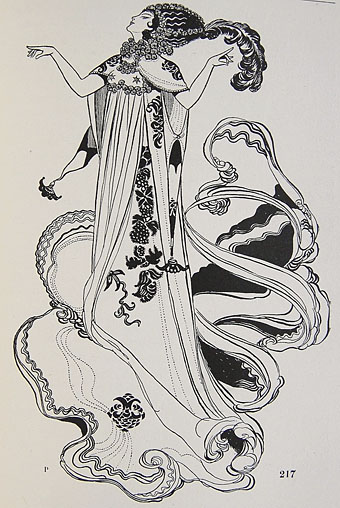
An illustration by René Bull (1872–1942) from The Russian Ballet (1913) by AE Johnson. Bull seems to be primarily known as one of the many illustrators of that Golden Age staple, The Arabian Nights, although his interpretation is a little too comical for my taste. You can judge for yourself here.

Other Salomés turning up recently include a George Barbier picture in this BibliOdyssey post, Salomé, la Gran Diva at Bajo el Signo de Libra, and the Guardian’s review of David McVicar’s Pasolini-esque opera production.

Elsewhere on { feuilleton }
The illustrators archive
The Salomé archive

Dodgem Logic #4

dodgem1.jpg

The magazine isn’t out for another couple of weeks but my cover art has been posted to various websites so I can finally show this here. Alan Moore was in touch at the beginning of February asking for a wraparound cover design, the only brief being that he liked my Alice in Wonderland calendar and asked for something equally florid or—for want of a better term—psychedelic. Alan’s magazine owes something to the underground mags of the 1960s and a common feature of those, especially Oz magazine, was a degree of provocation in the choice of cover art. A picture of two boys kissing is nothing more than a show of affection yet to many people the sight still inspires enormous outrage. This was demonstrated a week or so after I’d finished the cover when the Washington Post was deluged by angry letters and emails after they showed a photo of two newly-weds outside the Washington DC Superior Court. People used to have a similar reaction to the sight of a black man kissing a white woman; the only way attitudes change is when something becomes so commonplace it’s no longer worthy of note.

dodgem2.jpg

Aside from the politics, this was also an excuse to run riot with more Art Nouveau motifs, especially peacocks and butterflies. The butterfly-winged boys are a nod to the paintings of Yannis Tsarouchis, and this in turn gave me an excuse to borrow from another magazine cover, Frank X Leyendecker’s 1922 painting of The Flapper for Life. Frank X was the brother of the more renowned illustrator JC Leyendecker. Joseph C was known to have been discreetly homosexual; so too was brother Frank according to this article in which case his butterfly woman has an additional resonance.

dodgem3.jpg

Having written a lengthy polemic about Roger Dean’s work in January I had the idea of doing the magazine title in his lettering style. I spent the best part of two days working on these as I wanted the result to be as accurate as possible. All the gold parts of the cover shown here are gradients but I made a slightly different version for print which will render those areas in gold ink. I’m looking forward to seeing this printed.

Previously on { feuilleton }
Roger Dean: artist and designer
The art of Yannis Tsarouchis, 1910–1989
Dodgem Logic
Psychedelic Wonderland: the 2010 calendar
Butterfly women

Alexandre de Riquer book covers

riquer.jpg

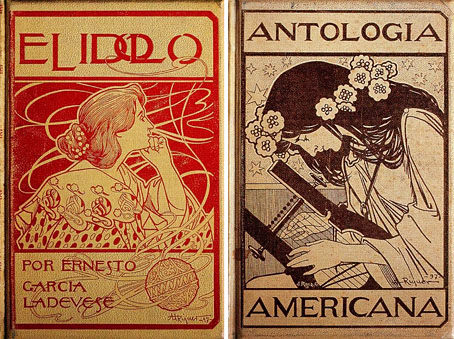
A pair of cover designs by the very prolific Alexandre de Riquer (1856–1920), an illustrator and designer who might be described as the Catalan equivalent of Alphonse Mucha. It’s often the case with the artists of this period that you find one or two examples of their work in books but see little else. Riquer has better representation on the web than most. These are from a post at Bajo el Signo de Libra which features other cover designs while this site has many pages devoted to the artist’s paintings, bookplates, poster designs, decorative work and even his books of poetry.

Elsewhere on { feuilleton }
The book covers archive

Odes and Sonnets by Clark Ashton Smith

cas.jpg

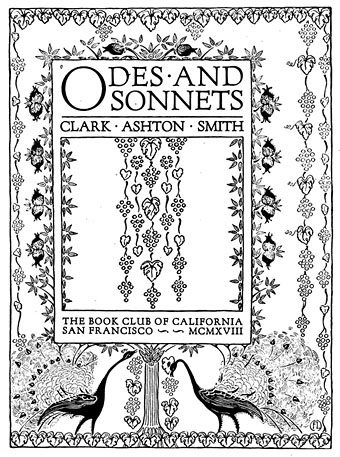
Clark Ashton Smith’s weird fiction is reprinted more often and more widely than his poetry so it’s convenient for those curious about his verse that the Internet Archive has two volumes of early work. Odes and Sonnets is from 1918 and features embellishments by illustrator Florence Lundborg whose grape-devouring peacocks nod towards the fin de siècle spirit Smith was trying to capture in his poems. The Star-Treader, and Other Poems is Smith’s first book from 1912, published when he was just 19, and is heavily indebted to the Decadents. That Decadent influence carried over into the stories he wrote for Weird Tales and augments their unique flavour and over-heated atmosphere, an atmosphere which raised his work above the often mediocre level of his contemporaries. On page 58 of The Star-Treader can be found The Eldritch Dark, the poem from which the leading Smith website takes its name.

Previously on { feuilleton }
Clark Ashton Smith book covers

Weekend links 16

clockwork.jpg

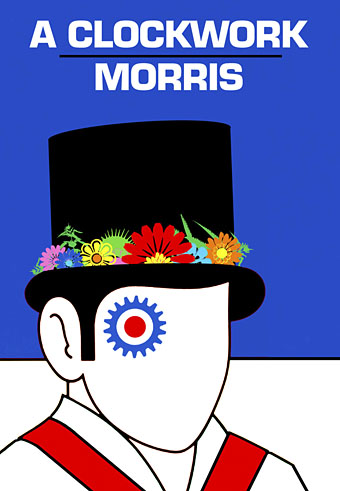
Sumer Is Icumen In but you wouldn’t have known it today, it being cold and wet, O my brothers. The picture above is the work of David Owen whose Ink Corporation does a splendid job of updating the iconography of the folk music world. Via Electric Eden.

• Biting the hand that feeds: designer Jonathan Barnbrook’s contribution to the Biennale of Sydney takes a dig at the whole enterprise. The art market is impervious to criticism (or shame) but the gesture is an amusing one.

Emanuel Schongut’s book covers of the 1960s and 1970s on the artist’s own Flickr pages. Via A Journey Round My Skull.

• Owen Freeman on illustrating William Burroughs. Related: Reality Studio interviews Victor Bockris.

• RIP Jack Birkett, Derek Jarman’s Caliban and the Pope in Caravaggio. And RIP Dennis Hopper, actor, director and photographer.
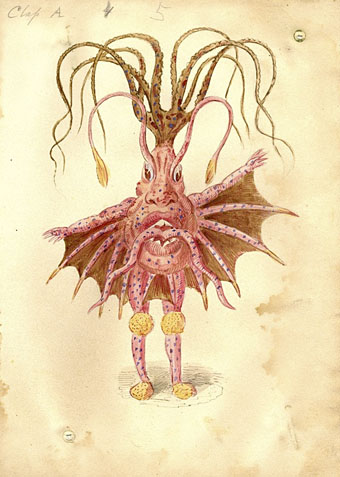
seanettle.jpg

“Sea Nettle” (1873), a costume design by the Mistick Krewe of Comus. From this BibliOdyssey posting of New Orleans Mardi Gras designs.

• Chris Summerfield’s surfer boys at Lulu.

• Homotography also has a Tumblr page.

The Ghost Box Study Series Singles.

• More 3D projection on buildings.

John Foxx interviewed at FACT.

Song of the week: Ineffect (1989) by Material.