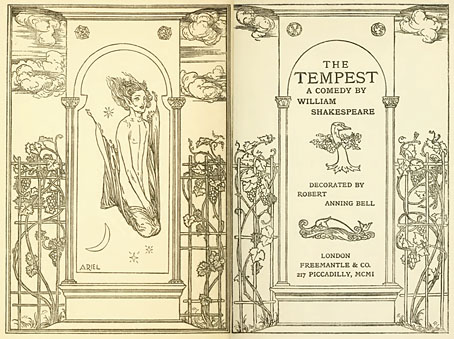
Robert Anning Bell’s Tempest

bell1.jpg

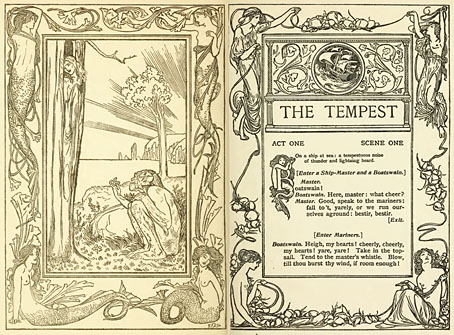
British artist and designer Robert Anning Bell (1863–1933) illustrates Shakespeare in this 1901 edition at the Internet Archive and the work seemed to give him an excuse to embellish many of the pages with writhing mer-folk. His adaptation isn’t as striking as William Heath Robinson’s Midsummer Night’s Dream from 1914 but then few books are. In style Bell is closer to his contemporary Charles Ricketts with very open line work and no heavy black areas. Ricketts produced his own version of Ariel’s Song to Ferdinand for The Magazine of Art in 1895 but doesn’t seem to have illustrated much more of The Tempest as far as I’m aware, although his Vale Press did issue an edition of Shakespeare’s complete works. It hadn’t occurred to me before how few illustrated editions there are of The Tempest; this seems surprising given the fantastic nature of the story. It might be that illustrated plays have never sold so well despite there having been a number of illustrated Midsummer Night’s Dreams. I’d love to have seen Harry Clarke tackling Ariel and Caliban.
bell2.jpg

bell4.jpg

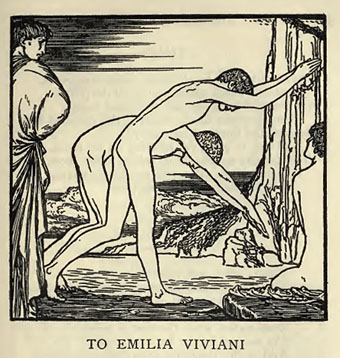
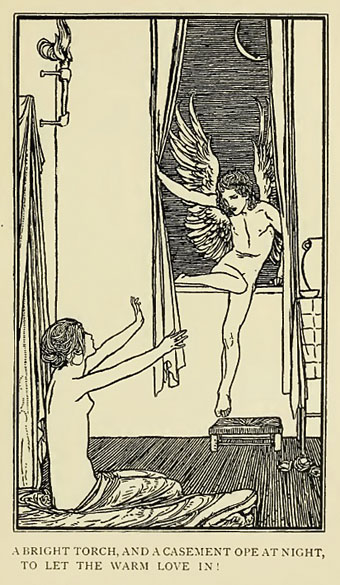
Also at the Internet Archive is a 1902 edition of Shelley’s poems illustrated by Bell (above) and an 1897 edition of Keats in the same series (below). Great poetry doesn’t necessarily lend itself to illustration so it’s no surprise that these books are less interesting than the Shakespeare.
bell3.jpg

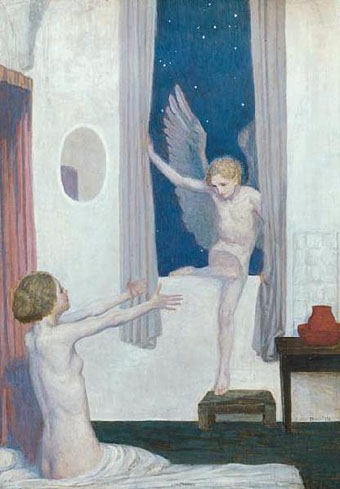
Bell later reworked his illustration for Keats’s Ode to Psyche as a painting which he called Cupid’s Visit. I much prefer the drawing to the painting.
bell5.jpg

Cupid’s Visit (1912).

Elsewhere on { feuilleton }
The illustrators archive

Previously on { feuilleton }
Charles Ricketts’ Hero and Leander
Another Midsummer Night
Arthur Rackham’s Midsummer Night’s Dream
The art of Charles Robinson, 1870–1937
William Heath Robinson’s Midsummer Night’s Dream
Jugend, 1898

jugend-98-01.jpg

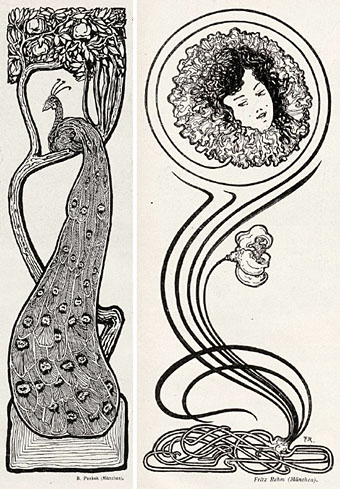
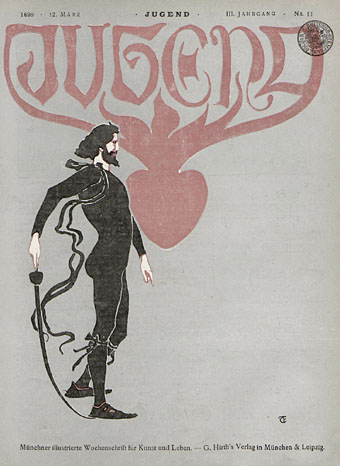
Continuing the delve into back issues of Jugend magazine, the German fin de siècle periodical of “art and life”, this post covers the year 1898. As before, Jugend was so copiously illustrated that the selection here can only scratch the surface. Anyone wanting to see more of these graphics is advised to explore the bound volumes at the Heidelberg University archive. The two books for 1898 can be found here and here.

jugend-98-02.jpg

Continue reading “Jugend, 1898”

Albrecht Dürer’s Triumphal Arch

durer.jpg

Albrecht Dürer’s Triumphal Arch (1515), a wall-sized print produced by 192 separate print blocks. I had a good look at this the last time I was the British Museum. The Museum’s site has some sample details of the work but the size of them isn’t so good, unfortunately. This is one of those pictures you either have to see in situ or find a huge digital copy to scrutinise in order to fully appreciate its incredible detail.

The Triumphal Arch is one of the largest prints ever produced. It was commissioned by the Holy Roman Emperor Maximilian I (1459-1519). The programme was devised by the court historian and mathematician, Johann Stabius, who explains underneath that it was constructed after the model of ‘the ancient triumphal arches of the Roman Emperors’. (More.)

The Triumphal Arch at The American Institute for Conservation | An overview of the prints and some good views of the full scale of the work.
The Triumphal Arch at Backtoclassics.com | A large view and some details.

Elsewhere on { feuilleton }
The etching and engraving archive

Dugald Stewart Walker revisited

dsw5.jpg

The Golden Porch (1925).

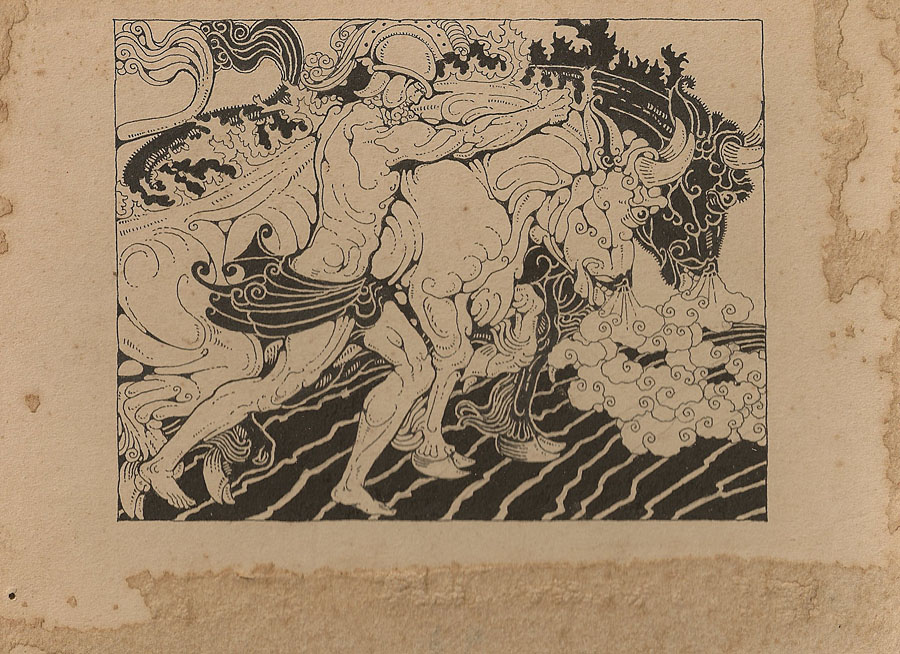
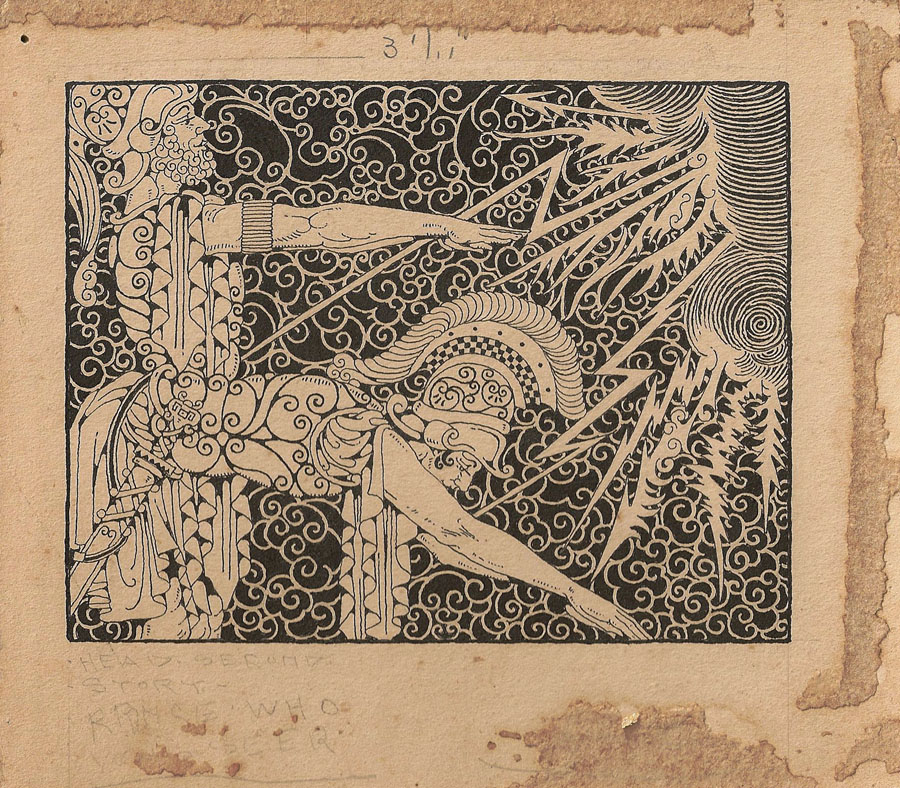
A post prompted by an email from Deborah Hirsch who wrote to tell me about some original works she’d found by American illustrator Dugald Stewart Walker (1883–1937), scans of which are shown here with her permission. This has made me take another look at Walker’s drawings, many of which I’d overlooked during earlier searches. His body of work runs from the usual fairy-tale illustration to some very fine renderings of tales from Ancient Greece. He was also an excellent peacock illustrator although you’ll have to look elsewhere for those; Golden Age Comic Book Stories has made several postings of his book plates. The drawings shown here are from Snythergen (1923) by Hal Garrott, The Golden Porch (1925) and Orpheus with His Lute (1926), both by WML Hutchinson.

dsw6.jpg

The Golden Porch (1925).

Every so often an artist’s work sets me wondering about their sexuality, a consideration which agitates some, especially surviving relatives, who find such speculation to be unwarranted or vulgar. The matter is relevant for two reasons: firstly, if an artist turns out to be gay or bisexual (as was the case with Hannes Bok) then certain details in their work become informed by that knowledge. Secondly, there’s still a lot more work to be done in retrieving from history the lives of gay people who have added to our culture in some way. Illustrators receive little attention in this area since illustration has always been the poor cousin to gallery art. I try to be wary of projecting my own concerns onto an artist for whom such attention may be unwarranted, and I’m not saying one can read anything substantial into Walker’s life simply by looking at his pictures. I do, however, have a mental checklist for any gay vs. straight appraisal which includes among its subjects common themes such as Greek myths (especially those concerning Orpheus and Narcissus), a recurrence of nude males, excessively florid décor, etc. Let’s just say that certain aspects of Walker’s work are (as Sherlock Holmes would say) “suggestive”, and the ex libris plate at the end of this post is notable for illustrating Keats’ famous quote about truth and beauty with a peacock and a (nude?) boy. If anyone has any relevant details about Dugald Stewart Walker’s life, as always they’re encouraged to leave a comment.

A Dugald Stewart Walker set at Flickr
Dream Boats and Other Stories (1920) at the Internet Archive

Continue reading “Dugald Stewart Walker revisited”

Cabala, Speculum Artis Et Naturae In Alchymia

speculum.jpg

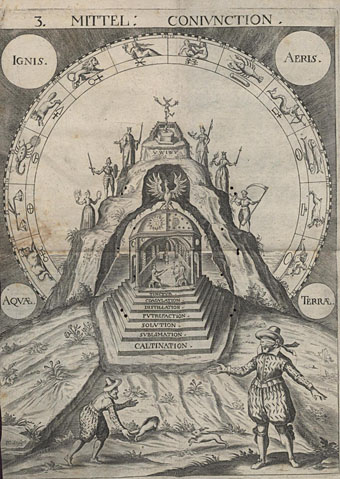
The plates from Stephan Michelspacher’s Cabala, Speculum Artis Et Naturae In Alchymia (1654) are familiar from histories of alchemy but SLUB Dresden has high-resolution scans of the entire book. Also there is Wenzel Jamnitzer’s astonishing Perspectiva Corporum Regularium (1568), a volume covered in detail at BibliOdyssey last year.

Elsewhere on { feuilleton }
The etching and engraving archive

Previously on { feuilleton }
Digital alchemy