Babel details

babel01.jpg

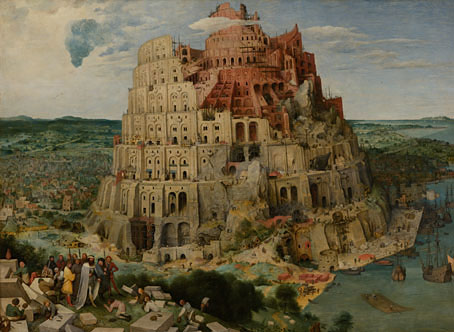
The Tower of Babel (c. 1563) by Pieter Bruegel the Elder. Kunsthistorisches Museum, Vienna.

Seeing as how I have a fetish for Towers of Babel I ought to have examined this one sooner, the copy at the Google Art Project being one which allows you to explore the surface of the picture in greater detail than the artist himself would have seen unless he was using a magnifying glass. I still find the Art Project interface awkward so the grabs here were taken from a massive jpeg at Wikipedia: 30,000 pixels across, or 243 MB, scaling up to around 1.84 GB in Photoshop which means it’ll make older machines grind in complaint.

babel02.jpg

The detail is astonishing even by Bruegel’s standards. I’d never realised before how much care is given to the individual actions of every single worker on the tower, however small. Bruegel’s close observation of the working habits of the people around him is here reflected in the myriad figures, all of whom are doing something purposeful. At this resolution you’re able to see that the workers have taken their wives and children up the tower with them—there’s the familiar line of washing hung out to dry—while various beasts of burden haul building materials up the spiral roadway. You could spend a long time exploring the details of the tower before even looking at the background where tiny boats are sailing the sea and the rivers, and more fortunate animals have been left to graze in fields.

Wikipedia has several more of these enormous images. It’s a shame there aren’t many more of Bruegel’s works available at this size, his other crowded paintings deserve equal scrutiny.

babel03.jpg

One of the builders on his lunch break.

babel04.jpg

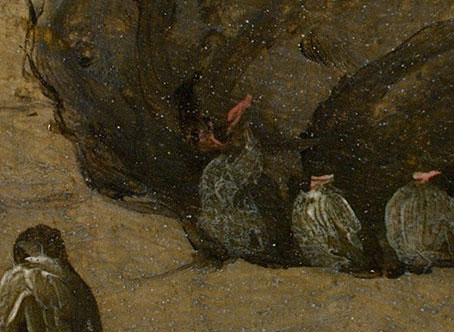
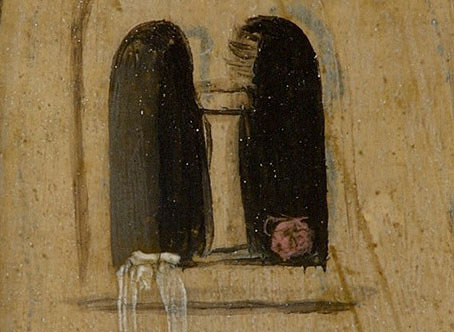
A jug on a window sill.

Continue reading “Babel details”

Out of season

fisher1.jpg

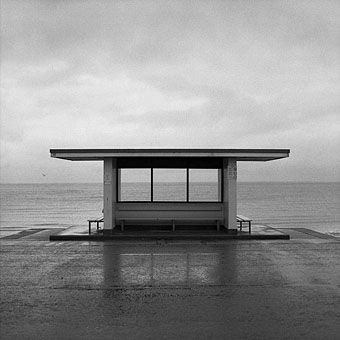
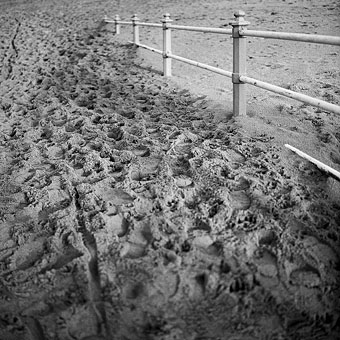
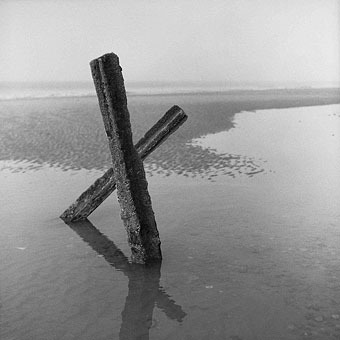
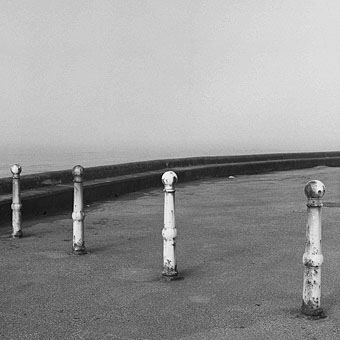
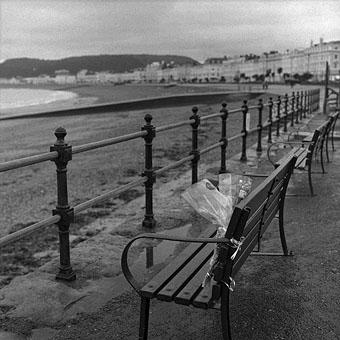
Photographer Andrew G Fisher sent a link to his web galleries recently, among which there’s a great series of shots from various seaside towns. If I respond to these more than the others it’s because I grew up by the sea. Views like this are an indelible feature of my childhood memories, they often recur in dreams. The peculiar melancholy of an out-of-season holiday resort isn’t exactly an unknown quantity, but if you’ve grown up in one of these places it becomes an ingrained feature of your life. Resort towns have no industry other than catering to holidaymakers; for half the year they lie fallow and appear semi-deserted when their population has been so drastically reduced. Add to this the disparity between the sunny days for which all the facilities cater, and the winter when many of those facilities have been closed down and the weather brings gales howling off the sea, and you have a curious parallel existence which the inhabitants of other towns and cities never experience.

Andrew Fisher’s photographs capture some of this parallel life: the abandoned shelter under a grey sky, empty promenades with iron bollards corroded by the salt air, a line of unused seats made even more cheerless by the presence of a floral tribute. That last shot fixes the nature of the seaside resort as an absolute boundary; the built environment can extend no further than this. Yes, I miss the sea.

fisher2.jpg

fisher3.jpg

fisher4.jpg

fisher5.jpg

Previously on { feuilleton }
Old lighthouses

Le Panorama Exposition Universelle

exposition01.jpg

One day I really will have exhausted this subject but for the moment here’s another look at the Paris Exposition Universelle of 1900. I’d downloaded this photo album months ago from the excellent resources at the University of Heidelberg then promptly forgot all about it. The book is of interest for the variety of views it gives of the exposition; despite this being a world event that attracted a host of photographers and even (as we’ve seen) early filmmakers, the views you see are often the same remote shots of the major buildings.

Ludovic Baschet’s book compensates for this with photos by the Neurdein brothers, Étienne and Antonin (assisted by Maurice Baschet) which show many close views of the pavilions, including a couple I hadn’t seen before in any detail. The oddest thing about these views is that many seem to be composites, with figures from other shots dropped into the scenes; this may be more obvious to eyes schooled in the disparities of Photoshop. Baschet’s book also has the best views I’ve seen of the Swiss exhibit, a miniature village built in the 7th arrondissement complete with livestock, authentic milkmaids and a fake mountain. And is that a joke at Britain’s expense in the view of Edwin Lutyens’ surprisingly dull British pavilion? Philippe Jullian tells us that Paris endured a heatwave in the summer of 1900—there are many parasols in evidence—yet the British pavilion is shown with a rain-soaked pavement, and set against a mass of impending storm clouds.

exposition02.jpg

exposition03.jpg

Continue reading “Le Panorama Exposition Universelle”

London zoom

london01.jpg

I’m generally indifferent to panoramic views of cities, especially London where the sprawl lacks the distinct contours of Manhattan or the Napoléonic severity of Hausmann’s Paris. This view is different, however, being a 320 gigapixel panorama of the capital seen from the top of the BT Tower. This view is currently the world’s largest panoramic photo, and while the wide view is of the usual grey cloudscape and undifferentiated vista of 19th-century roofs and 20th-century ducting, the ability to zoom down into the streets (and, in some cases, into windows) is unprecedented at this resolution.

london02.jpg

These screengrabs show a zoom towards the river from the widest angle down to the painted sign of the Duke of York pub on the corner of Rathbone Street and Charlotte Place in Fitzrovia. At the end of the zoom there’s a reverse view from Google Maps showing the pub itself, and the tower, the one landmark you won’t otherwise see. MetaFilter’s members have bookmarked various points of interest. I’m surprised there are so many roof gardens in this area of London although I think Paris still has the edge in that department.

london03.jpg

london04.jpg

Continue reading “London zoom”

Weekend links 148

lanna.jpg

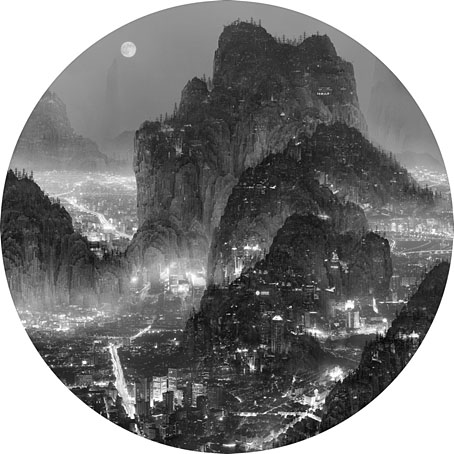
Quantum Entanglement by Duda Lanna.

An hour-long electronica mix (with the Düül rocking out at the end) by Chris Carter for Ninja Tune’s Solid Steel Radio Show.

• “…a clothes-optional Rosicrucian jamboree.”: Strange Flowers on the paintings of Elisàr von Kupffer.

• A Paste review of volume 2 of The Graphic Canon has some favourable words for my contribution.

It is an entertaining thought to remember that Orlando, all sex-change, cross-dressing and transgressive desire, appeared in the same year as Radclyffe Hall’s sapphic romance The Well of Loneliness. The two novels are different solar systems. The Well is gloomy, beaten, defensive, where women who love women have only suffering and misunderstanding in their lonely lives. The theme is as depressing as the writing, which is terrible. Orlando is a joyful and passionate declaration of love as life, regardless of gender. The Well was banned and declared obscene. Orlando became a bestseller.

Jeanette Winterson on Virginia Woolf’s androgynous fantasia.

Jim Jupp discovers the mystical novels of Charles Williams.

Michael Andre-Driussi on The Politics of Roadside Picnic.

Les Softs Machines: 25 August 1968, Ce Soir On Danse.

• At 50 Watts: Illustrations and comics by Pierre Ferrero.

Soviet posters: 1469 examples at Flickr.

Oliver Sacks on drugs (again).

• At Pinterest: Altered States.

• Farewell, Kevin Ayers.

Darkest London

Why Are We Sleeping? (1969) by The Soft Machine | Lady Rachel (1969) by Kevin Ayers | Decadence (1973) by Kevin Ayers