Les Murailles de Samaris by Schuiten & Peeters

map.jpg

The Obscure World.

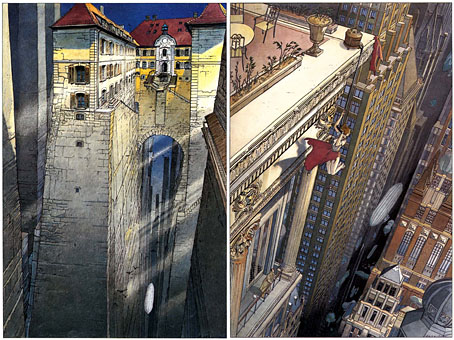
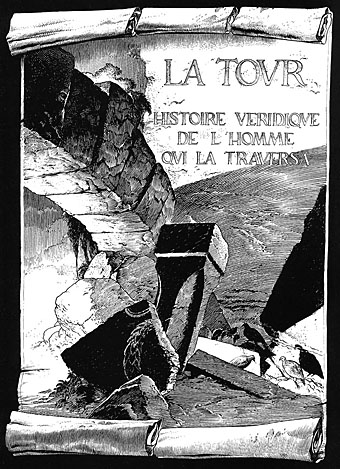
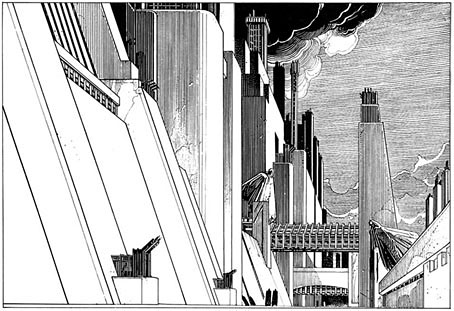
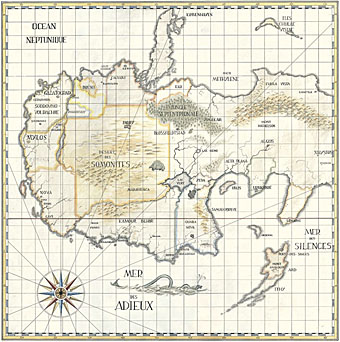
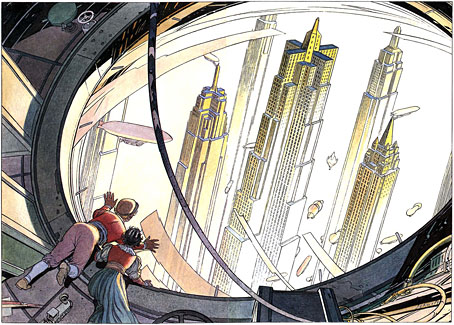
Les Murailles de Samaris (1983) by François Schuiten and Benoît Peeters is the first of the stories which explores the world of Les Cités Obscures, a “counter-Earth” on the opposite side of our Sun with a continent of separate city-states, each with their own distinct architectural style. Having discovered these stories first in their French editions it wasn’t immediately apparent how much the Obscure World was supposed to be connected to our own; a number of the books contain references to people or places in our world, while the city of Brüsel, subject of the book of that name, is a kind of parallel Brussels. The counter-Earth explanation isn’t given in the early books but seems to have evolved later, as does Schuiten and Peeters’ introduction of portals between the worlds which imply a two-way leakage of influence. Writer and artist encourage readers of the series to suggest or “discover” new portals to the Obscure World.

samaris1.jpg

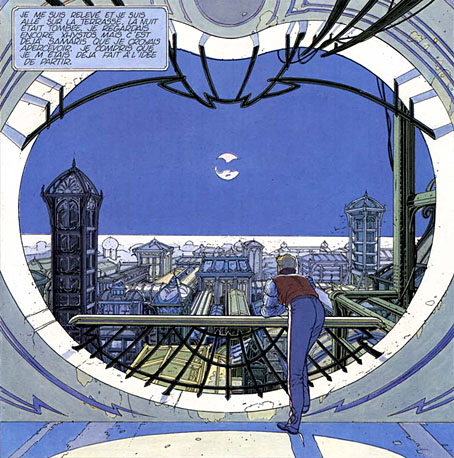
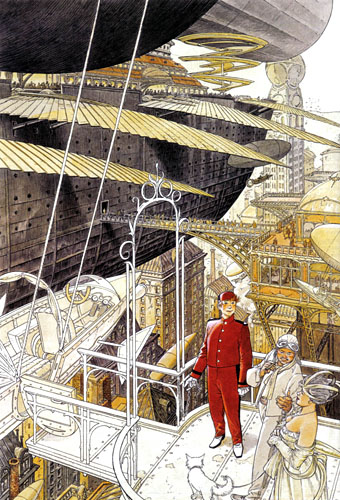
A view over Xhystos.

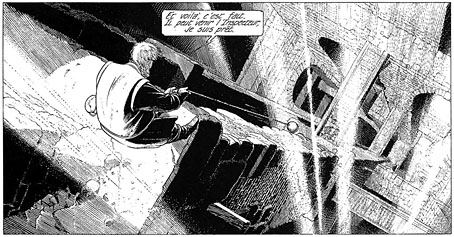
The distant city of Samaris is the mysterious destination of Les Murailles de Samaris (The Walls of Samaris). The story begins in the city of Xhystos whose style is fully Art Nouveau in a manner reminiscent of the celebrated Belgian architect Victor Horta, if Horta had been allowed to design a city where every building is decorated with wrought-iron curves and glass-canopied roofs, and where trams go by on elevated roads several storeys high. The narrator, Franz, is informed by the city authorities that he’s been chosen to go on a perilous mission to discover whether rumours about the nature of Samaris are true or not. Previous explorers have failed to return so Franz’s friends and girlfriend regard his acceptance of the mission as suicidal. What follows is a journey by steam train out of the city into a surrounding zone of lawless ruins, then a journey by “altiplane” and “aerophele”, the latter being a kind of multi-winged sand yacht.

Continue reading “Les Murailles de Samaris by Schuiten & Peeters”

The art of François Schuiten

schuiten1.jpg

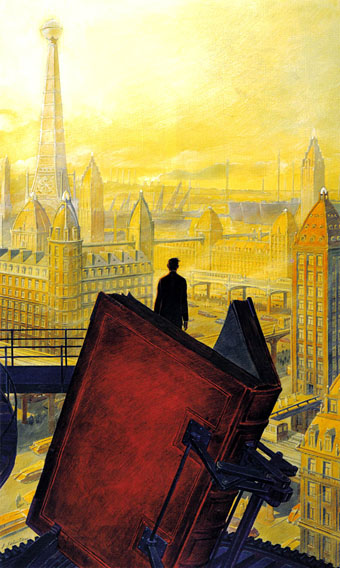
Paris au XXieme Siecle by Jules Verne (1994).

Following a comment I made last week in the post about the Temples of Future Religions by François Garas I’ve decided it’s time to give some proper attention to one of my favourite comic artists, François Schuiten, a Belgian whose obsession with imaginary architecture resembles the earlier endeavours of Garas and others. Schuiten’s parents were both architects which perhaps explains his predilection. In addition to a large body of comics work, he’s produced designs for film—notably Taxandria by Raoul Servais—Belgian stamps, and a steampunk makeover for the Arts et Métiers station of the Paris Métro. In 1994 he created cover designs and a series of illustrations for the publication of Jules Verne’s rediscovered manuscript, Paris au XXieme Siecle.

schuiten2.jpg

Cover for Spirou (2000).

I first encountered Schuiten’s work in a 1980 issue of Heavy Metal magazine which was reprinting translated stories from the French Métal Hurlant along with original work. Schuiten’s story, The Cutter of the Fog, was an erotic and futuristic tale of a small community and the obsession of the local “fog-cutter”. François’s brother Luc wrote the piece and it bears some similarity with JG Ballard’s Vermilion Sands story, The Cloud Sculptors of Coral D. Unusually for Schuiten, the architecture was downplayed in this one although the small homes with their geodesic roofs are like extrapolations of architectural plans from one of the Whole Earth Catalogues.

The next time I saw his work was several years later when artist Bryan Talbot showed me some of the comic albums he’d brought back from a European convention. Among these there were several of the Cités Obscures books that Schuiten had been creating during the Eighties and Nineties with writer Benoît Peeters. These knocked me out with their apparently effortless creation of an imaginary world comprised of several city states, each with their own unique architectural style, and a wealth of retro-future technology, from dirigibles of all shapes and sizes to ornithopters and huge motorised unicycles. One of the many things I liked about European comic artists, and something which made me favour their work over their American counterparts, was the creation of richly detailed imaginary universes with inhabitants one could expect to meet in our world, not facile superheroes or vigilantes. Schuiten went further than his contemporaries by making the architecture meticulously believable and foregrounding its design to an extent that in some of the Cités Obscures stories architecture itself is the subject.

Continue reading “The art of François Schuiten”

Villa d’Este

deste1.jpg

Detail of the Water Organ (1902).

Samples from a set of pictures at LUNA Commons of the wonderful water gardens at the Villa d’Este, Tivoli, Italy. Among the 164 items in the collection are plans, engravings, and photographs old and new. I’m partial to the older photos, most of which seem to be photogravure reproductions whose temporal distance and technical shortcomings only add to the mystique of the place.

deste2.jpg

Alley of the hundred fountains (1997).

Previously on { feuilleton }
Gertrude Käsebier’s crystal gazer
The Door in the Wall
Paris II: The River Fountain

Temples for Future Religions by François Garas

garas1.jpg

Temple à la Pensée, dédié à Beethoven, vue en cours de construction (1897).

Another artist discovered whilst searching for something quite unrelated. The Musée d’Orsay are custodians of this drawing by François Garas (1866–1925), and they also have the most substantial appraisal of his career.

François Garas remains a mysterious architect, whose artistic pantheon included Baudelaire and Edgar Allan Poe, as well as John Ruskin, Richard Wagner, Jean Carriès and Edouard Manet. He obtained his diploma in 1894, and until 1914 regularly exhibited utopian architectural projects at the Salon de la Société Nationale des Beaux Arts. His career started with the exhibition Architects’ Impressions in 1896 at the Le Barc de Bouteville gallery, alongside his fellow architects Henri Sauvage, Henry Provensal and Gabriel Guillemonat. This exhibition, accompanied by a rebellious booklet by the architect Frantz Jourdain, wanted to get rid of “the mental slavery produced by the exclusive study of Greek and Roman architecture, and by a knowledge of nothing but the Italian Renaissance”. This drawing featured in the exhibition; then it was seen again, the same year, in an exhibition by the Société Nationale des Beaux Arts, as part of a collection entitled Artists’ Interiors.

From 1897, Garas exhibited increasingly oneiric projects at the Salon – “temples for future religions”, dedicated to Beethoven, Wagner, Life, Death and Thought. While his companions from the early days were designing social housing, Garas continued along the same fanciful path, then disappeared from the architectural scene without any of his projects ever having been built.

garas3.jpg

Temple à la Pensée, dédié à Beethoven, vue perspective depuis l’arrière du temple (1897).

garas4.jpg

Temple à la Pensée, dédié à Beethoven, visions du temple, clair de lune (1900).

The museum has several pages of various plans and sketches for these Temples for Future Religions, and also some quasi-Gothic designs for “Artist’s interiors” which would benefit from being seen at a larger size. Among his other works are a series of very diffuse pastel studies which look more like Claude Monet drawing the ruins of Angkor than architectural designs.

garas2.jpg

Un temple pour les religions futures (1901).

Previously on { feuilleton }
Exposition Universelle publications
Exposition cornucopia
Return to the Exposition Universelle
The Palais Lumineux
Louis Bonnier’s exposition dreams
Exposition Universelle, 1900
The Palais du Trocadéro
The Evanescent City

Battersea Power Station

battersea.jpg

A photograph of the control room of Battersea Power Station, London, by Michael Collins, one of a series which will shortly be on display at the Royal Institute of British Architects.

The images show Battersea Power Station as what Collins describes as a “twentieth century ruined castle” – a building that was built to last, with a high quality structure and interior, including Art Deco walls and ceilings.

Giles Gilbert Scott’s enormous temple of heavy industry continues to sit decaying on the banks of the Thames while property developers come and go. The latest of these, Real Estate Opportunities, has fallen into debt which means proposals to develop the site are once again on hold. A part of me likes the idea of the building sitting there unused and purposeless year after year, like some vast Steampunk Stonehenge; Giles Gilbert Scott’s other Thames-side power station, Bankside, was successfully transformed as Tate Modern, but we know from various proposals that the fate of Battersea, whether as theme park or shopping centre, is likely to be a lot less edifying.

quark1.jpg

It took redevelopment to transform Bankside from temple of industry to temple of culture but Battersea’s unmistakable presence has a powerful cultural history of its own. Everyone knows the Hipgnosis sleeve design for Pink Floyd’s Animals (1977); less familiar is the photos of the control room which Hipgnosis used for Hawkwind’s Quark, Strangeness and Charm the same year. I tend to prefer the back cover of this sleeve to the front; that octagonal readout device is more interesting than the rather unconvincing sparks and exchanges of energy. And speaking of energy, my former employers are still active, unlike the rancorous Floyd.

quark2.jpg

There’s a page here listing other uses of the power station, including its many film appearances which date back to the 1930s. That list mentions the control room’s use as a background for the “Find the Fish” sequence in Monty Python’s The Meaning of Life (1983) but they omit an earlier Monty Python appearance when you briefly see the building in operation during And Now for Something Completely Different (1971). It was closed down a few years later. So here it is, then, belching fumes over west London on a profoundly gloomy winter afternoon.

battersea2.jpg

Elsewhere on { feuilleton }
The album covers archive

Previously on { feuilleton }
The Sonic Assassins
The Bradbury Building: Looking Backward from the Future