Hope Sandoval – she went away but now she’s back | Free track available from her forthcoming album.
Author: John
The art of Pamela Colman Smith, 1878–1951
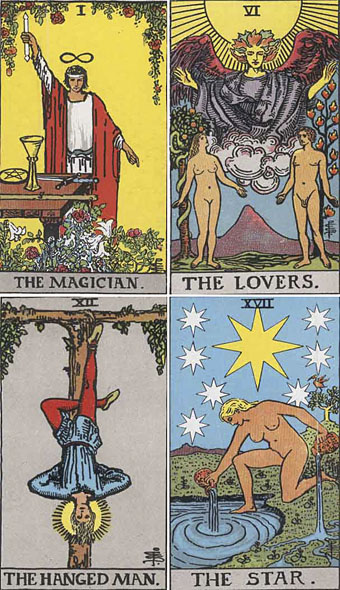
Following yesterday’s post about Frieda Harris’s Tarot designs, it only seems right to acknowledge the other major Tarot artist of the 20th century. Pamela Colman Smith has been overshadowed by her male mentor, Golden Dawn scholar AE Waite, even more than Frieda Harris whose name at least gets mentioned as much as Crowley’s in discussion of her paintings. US Games lists Smith and Waite’s so-called Rider-Waite Tarot of 1909 as “the world’s most popular tarot deck” and uses a silhouette of Smith’s design for The Fool as the company logo, yet it was years before I saw a credit for Smith as artist of this deck, her personal presence being reduced to a tiny monogram in the corner of each picture.
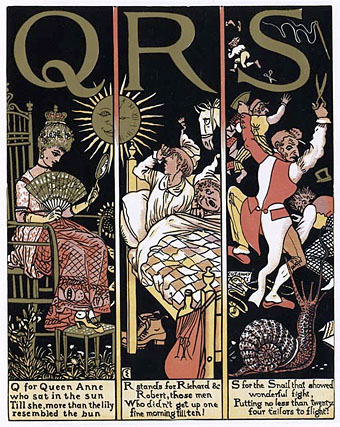
The Absurd ABC by Walter Crane (1874).
I’ve often thought of Smith’s deck as “the Art Nouveau Tarot” which it isn’t really—it’s more late Victorian in style, if anything—but it was created when Art Nouveau was at its height and has some of the character of the poster art of the period. Smith’s designs are incredibly striking in places, with the clarity of drawn archetypes, and her style possibly owes something to the books Walter Crane created for children in the 1870s and 1880s; the clean lines and bright colouring are very similar. In that respect, Smith’s deck might be more fittingly labelled “the Arts and Crafts Tarot.”
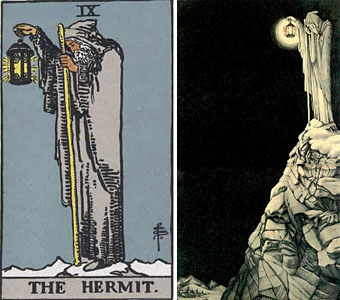
left: Pamela Colman Smith’s Hermit; right: Barrington Colby’s inner sleeve for Led Zeppelin IV.
Pamela Colman Smith also worked as a book illustrator but her other work is overshadowed completely by the popularity of the Rider-Waite cards. Her design for The Hermit was famously borrowed by Crowley obsessive Jimmy Page in 1971 for a gatefold illustration, View in Half or Varying Light by Barrington Colby, on Led Zeppelin IV. This use alone makes it possibly the most famous Tarot card in history (there was even a statue made of it for the now defunct Hard Rock Park Led Zeppelin roller coaster) but I doubt many people familiar with the image could name the original artist.
Happily, Ms Smith’s obscurity is gradually diminishing. US Games recently produced the Pamela Colman Smith Commemorative set for the 100th anniversary of the Rider-Waite deck, a package featuring a book of her artwork (including non-Tarot drawings), prints, postcards and a reprinted set of cards. A long overdue reappraisal but, as is always the case, it’s better late than never.
Mary K Greer’s Tarot blog has some excellent postings devoted to Pamela Colman Smith including this page which gathers links to sites containing further information about the artist’s life and work.
Elsewhere on { feuilleton }
• The illustrators archive
Previously on { feuilleton }
• Layered Orders: Crowley’s Thoth Deck and the Tarot
• William Rimmer’s Evening Swan Song
• The art of Cameron, 1922–1995
Layered Orders: Crowley’s Thoth Deck and the Tarot
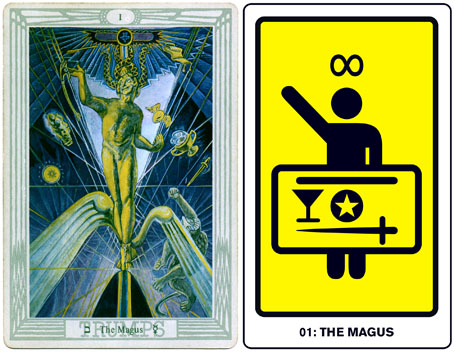
left: The Magus from the Thoth Tarot by Frieda Harris and Aleister Crowley (1938–1940?); right: The Magus from The Major Arcana by John Coulthart (2006).
Phantasmaphile presents another magickal art event in NYC next week. Layered Orders: Crowley’s Thoth Deck and the Tarot is described as “a personal narrative by Jesse Bransford”, an artist with a very distinctive approach to traditional occult symbolism. Bransford’s talk will focus on the peerless Thoth Tarot deck which Frieda Harris painted over several years under the careful direction of Aleister Crowley. The Thoth deck for me is still the ultimate Tarot deck. Crowley and Harris sought to create a Tarot for the 20th century, throwing out much of its tired and degraded iconography. This they replaced with dramatic interpretations which brought new layers of symbolism to the cards—including references to contemporary science—and also acknowledged the developments of Cubism and Futurism in the visual sphere. Tarot decks have proliferated since the 1960s but the Thoth deck has few (if any) rivals. I made use of Crowley’s controversial reordering and renaming of the cards in 2006 when I produced my set of Major Arcana designs based on international symbol signs.
The Tarot in general and Aleister Crowley’s Thoth Tarot in particular represent a miasmic confluence of image and thought into a single structure that is both liberating and overwhelming in its scope. In creating the deck, Crowley (in collaboration with painter Lady Frieda Harris) sought to integrate the mythological structures of the major mystical systems of both Western and Eastern occult traditions and to bring them into line with contemporary scientific thinking. The symbolism of the cards blends Kabbalah, Alchemy, Astrology, Egyptian mythology, quantum physics and even the I-Ching in ways that are at the same time clear and utterly confounding.
In an image-soaked personal narration Bransford, whose research-based artwork has delved into many of the territories Crowley sought to unify, will discuss some of the basic concepts of Tarot symbolism, returning to Crowley’s deck as among the most total example of the cards’ syncretism and as the most controversial.
Layered Orders: Crowley’s Thoth Deck and the Tarot takes place at Observatory, 543 Union Street, Brooklyn, NYC on Friday, July 17 at 7:30pm. Admission is free and there are further details at the Observatory website and Phantasmaphile.
Previously on { feuilleton }
• Fata Morgana: The New Female Fantasists
• Aleister Crowley on vinyl
• The Man We Want to Hang by Kenneth Anger
• The art of Cameron, 1922–1995
The art of Robert R Bliss, 1925–1981
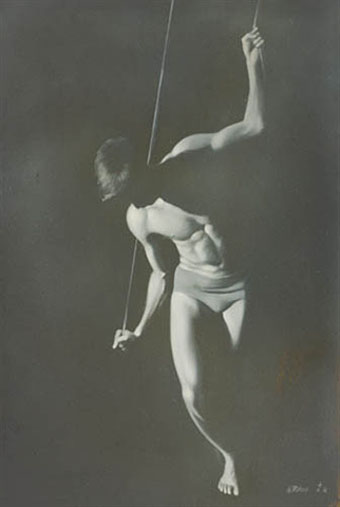
Standing boy pulling ropes (1962).
The chiaroscuro above looks like a photo print but is actually a painting. I’ve seen Bliss’s name mentioned a few times before but he remains rather difficult to track down online, most of the visible works being on auction sites. What there is consists mostly of young men in swim suits, to a degree which seems like an idée fixe given the lack of nudes or variation in the poses.
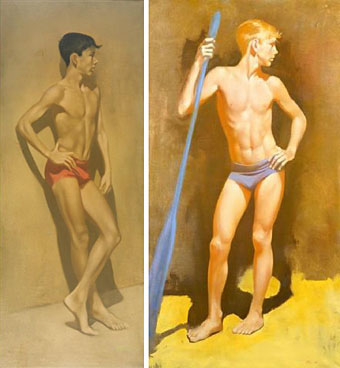
left: Standing boy with red trunks (1961); right: Boy with oar (no date).
In a career outline on the Leslie-Lohman site there’s this curious paragraph:
Bliss…after 20 years of alcoholism, discovered LSD. After that he completely stopped drinking. His work then completely shifted to colorful landscapes as well as psychedelic visionary paintings.
I’ve not been able to find any of this psychedelic work at all. If anyone knows of any, please leave a comment.
Update: Added a few more examples of his male studies.
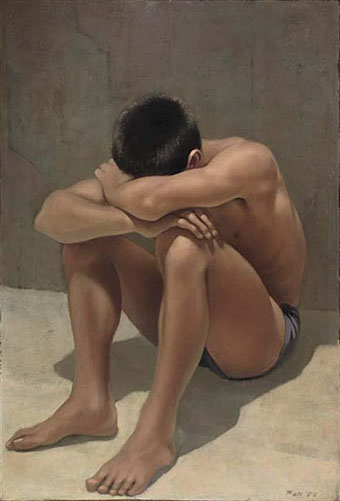
Seated Boy (1950).
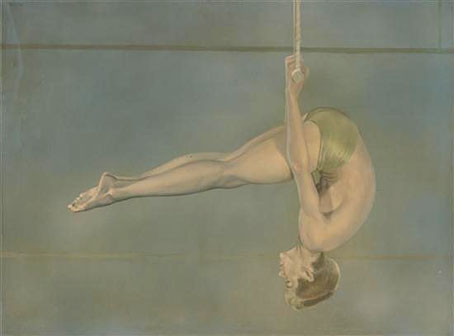
Swinging Boy (1959).
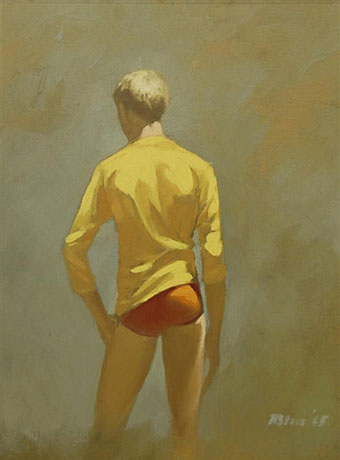
Yellow Shirt (1963).
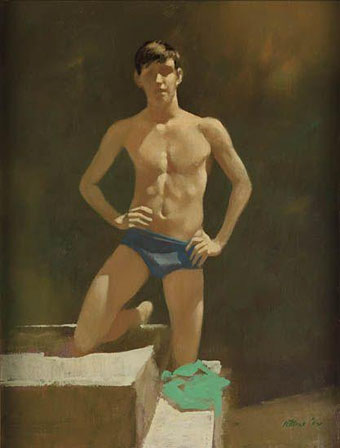
Kneeling Male Athlete (1964).
Elsewhere on { feuilleton }
• The gay artists archive
Der Orchideengarten
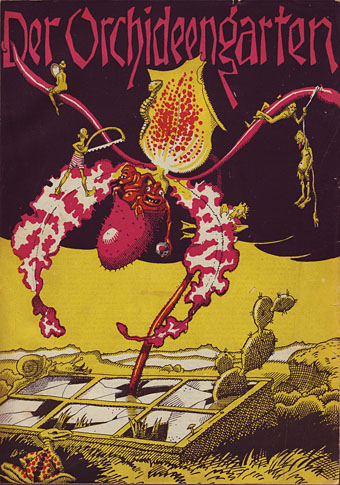
Will at A Journey Round My Skull turned up some gold this week in the form of several covers from a German periodical, Der Orchideengarten, which ran for 51 issues from 1919 to 1921. This is generally credited as being the world’s first fantasy magazine which makes its unaccountable obscurity all the more surprising. Both Will and I first encountered the magazine in Franz Rottensteiner’s essential history of fantasy, The Fantasy Book, published by Thames & Hudson in 1978, with a US edition produced by Collier Books. As well as being a wide-ranging history, Rottensteiner’s book is profusely illustrated throughout and includes two tantalising and distinctly weird covers from Der Orchideengarten, a magazine which Rottensteiner describes as “one of the most beautiful fantasy magazines ever published.” Over the years I’ve found myself becoming thoroughly acquainted with most of the book’s contents as authors were discovered and various gaps filled. One of the few points of obscurity left was that column which describes Der Orchideengarten and those two covers. So you can perhaps appreciate the excitement at seeing more of these rare specimens brought to light.
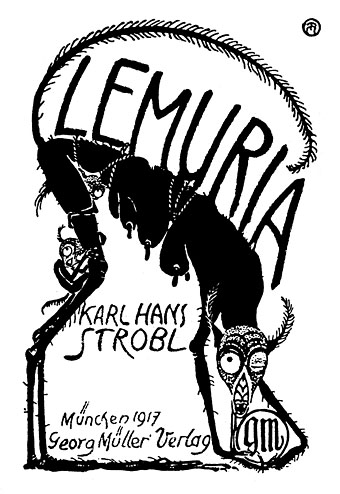
There’s no need to repeat the history when you can read it for yourself on Will’s page and see the covers. One of the magazine editors was author Karl Hans Strobl whose collection of weird tales, Lemuria, had been published two years earlier. This monochrome copy of the cover design is by Richard Teschner, taken from one of my Art Nouveau design books where it stands out like a rather grotesque sore thumb. I don’t know if Teschner was a contributor to Der Orchideengarten but on the strength of this he should have been.
Update: Will posts some interior illustrations.
Elsewhere on { feuilleton }
• The illustrators archive
Previously on { feuilleton }
• The Great God Pan
• Jugend Magazine
• Meggendorfer’s Blatter
• Simplicissimus