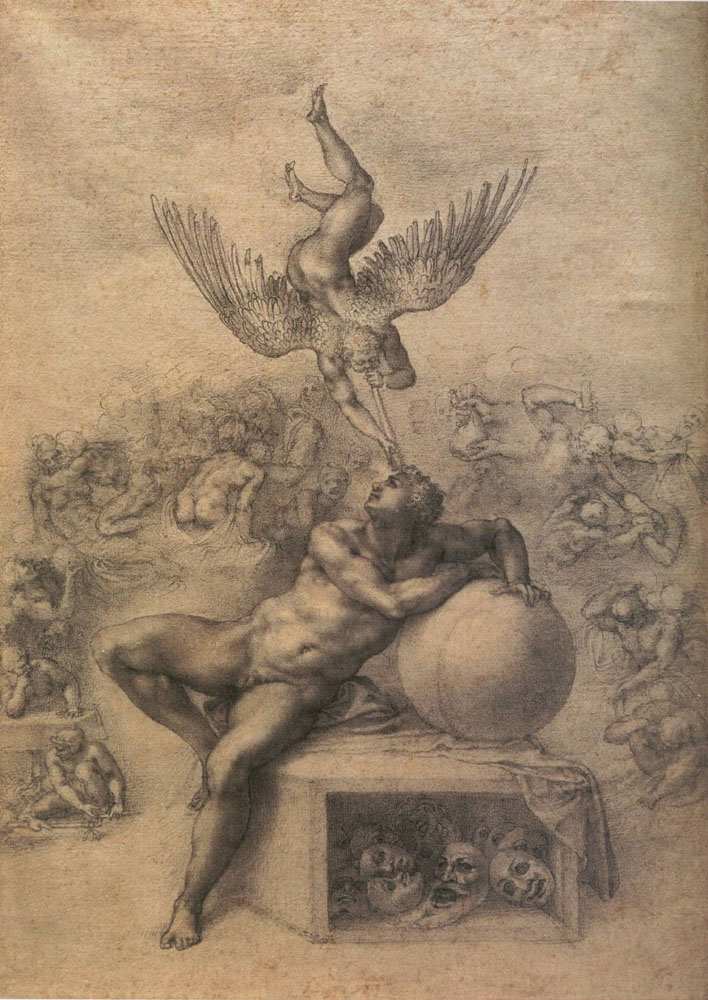
Michelangelo’s Dream

michelangelo.jpg

The Dream of Human Life by Michelangelo (1533).

Michelangelo was of course homosexual. That obvious fact still needs restating, simply because generations of art historians have been embarrassed by it. Attempts to deal with the subject have a certain comic interest. E. H. Ramsden, who translated Michelangelo’s letters, refutes the slur of homosexuality with a resounding old-fashioned “Tush!” Anthony Burgess gives an equally Victorian shudder over the David, “so epicene that it invokes unpleasing visions of Michelangelo slavering over male beauty.” Many nineteenth century critics denied him any sexuality at all, apparently preferring a eunuch to a deviant; and even today, it is a common ploy to argue that his genius inhabits some transcendently bisexual—and therefore nonsexual—realm. The evidence for his homosexual loves is too strong to be denied, particularly in the letters to and about one of his models Febo di Poggio, and those about the fifteen-year-old Cecchino de’ Bracci. And it is immediately obvious in his art.

So writes Margaret Walters in The Nude Male: A New Perspective (1978). Appraisals of the great artist’s sexuality have thrown off the prudery in the past thirty years, and a new exhibition at the Courtauld Gallery, London, looks directly at Michelangelo’s attraction to young men. The central work is The Dream of Human Life (or The Dream), one of a number of drawings Michelangelo presented to Tommaso de’ Cavalieri, a Roman nobleman and (we’re told) very handsome youth he met in 1532. No pictures of Cavalieri exist, unfortunately, so we have to take his good looks on trust but it’s unlikely that a 57-year-old artist would have plied a boy with beautiful drawings and hundreds of love poems without good reason. Guardian critic Jonathan Jones has a book about Michelangelo published soon and he writes enthusiastically about the exhibition:

The Courtauld Gallery, that sombre, academic institution, dares to go where Irving Stone never went in his bestselling novel about Michelangelo, The Agony and the Ecstasy. It refutes, with all the authority at its command, centuries of bowdlerisation that have left the nude saints in Michelangelo’s painting The Last Judgment still – in 2010 – emasculated by prudish drapes. It gives us the unmade movie Michelangelo in Love, pouring out his soul in art and verse to a handsome youth whose beauty crystallised all the longings inherent in Michelangelo’s art ever since he carved his teenage masterpiece The Battle of the Centaurs, with its vision of life as a tumult of wrestling male bodies. (More.)

Also on display are previously unexhibited handwritten poems. The Courtauld site has more details about Michelangelo’s Dream which runs from February 18 to May 16, 2010.

Elsewhere on { feuilleton }
The gay artists archive

Previously on { feuilleton }
The fascinating phallus
Behold the (naked) man
Michelangelo revisited

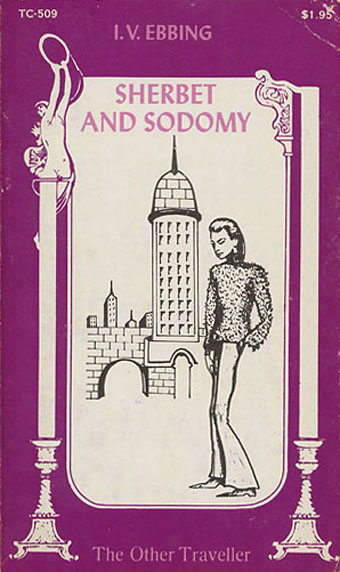
Sherbet and Sodomy

ebbing.jpg

Cover art by Coker.

We had Shock Headed Peters walking through Sodom yesterday so this novel from 1971 seems like a fitting follow-up. The eye-catching title is no doubt an allusion to Byron’s description of Turkish baths as “marble palaces of sherbet and sodomy”, an epithet which one imagines sent generations of sweet-toothed Uranians trekking to Constantinople throughout the 19th century. I’d seen the cover of this book before on sites which collect the gay fiction of the late Sixties and early Seventies—that doubly-phallic tower makes a good match for the cover of Bugger Boy—but I don’t recall reading a description of the contents before. Homobilia has an extract from the opening page:

My name is Jud. I am eighteen and a half. I was born from the felicitous conjunction of an anthropologist and an ethnologist under the sign of Capricorn. I have been called cute, handsome, pretty, and good-looking; actually, I am beautiful… my nose is classically English, along the line of Reynolds, maybe with a little Caravaggio thrown in around the nostrils. My athletic adolescence on the swimming team at Sterling High has given me a slender muscular body… my eyes are South Pacific blue. I have read Hesiod. I masturbate regularly. I have no concept of money or its value. I try to keep my farts silent. I have juvenile down on my ass. I have read the minor Elizabethan poets and I have looked at my anal sphincter in the mirror. Until last week I considered myself heterosexual…

Four art and literatures references in a single paragraph…yes, I’m intrigued. The book is out of print, unfortunately, but searching at Abebooks reveals copies for sale and an additional description:

How does a handsome young cat, newly out and grooving on the gay scene of Greenwich village, suddenly find himself in the silken clutches of El-Dahabi, an Arab sect which celebrates the attainment of perfect love through pain and submission?

So now the Byron reference makes sense. Many of these gay paperbacks were written under nommes de plume and IV Ebbing may well be another of these, there’s certainly no other reference to he (or, indeed, she…) on the web aside from this title. There’s a notable dearth of information about the fiction which emerged in a flood after the first flush of liberation in the late Sixties, when numerous titles for lesbians and gay men were published as cheap paperbacks. Strange Sisters and Gay on the Range document the cover art but I’d like to see a site which told us more about the writers and, where possible, the books themselves. The history of all kinds of pulp fiction has been extensively chronicled; isn’t it time that someone did the same for gay erotica?

Elsewhere on { feuilleton }
The book covers archive

Previously on { feuilleton }
Bugger Boy
Gay book covers

Weekend links 2

heart.jpg

A picture for embittered lovers.

Among other things this week I’ve been working on the design for another CD featuring photos by Liz Eve, a photographer whose pictures are always a pleasure to use. (Our earlier encounters can be seen here, here and here.) The latest set have this anti-Valentine for an eye-popping cover image. I’ll be posting the finished layouts once everything is approved by the label.

Crash: JG Ballard’s artistic legacy. Iain Sinclair on Ballard and a new art exhibition inspired by the author’s fiction.

• More art: Clive Hicks-Jenkins’ Artlog is essential reading. Lots of insights into his beautiful work.

Raw Power by Iggy and the Stooges will be released in an expanded edition on April 27th with outtakes, documentary, book and other extras.

• Sonic Youth dude and fellow Arthurian Thurston Moore has a blog.

• “That’s all it comes down to in the end, though, isn’t it? Put it in and jiggle it about a bit.” Alan Bennett & John Fortune discuss sex. A hoot.

• “I wanna walk through Sodom with a boy on my arm / Who’s so damn pretty I don’t know where I am…” A song from 1984 for Valentine’s Day: I, Bloodbrother Be (£4,000 Love Letter) by Shock Headed Peters.