Nirvana and The Conquerors

nirvana.jpg

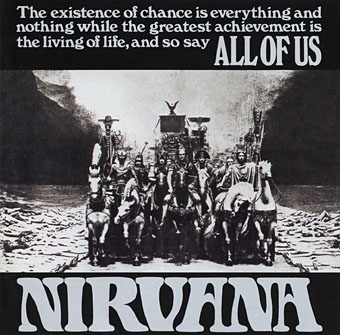
All Of Us by Nirvana (1968).

Every now and then the web’s great proliferation of images serves a useful purpose by solving some minor artistic conundrum. All Of Us is the second album by UK psychedelic band Nirvana (no relation to Kurt and co.) and the striking cover painting—a long line of emperors and warriors from different ages parading down an avenue of corpses—is annoyingly uncredited. The notes for the 2003 CD reissue inform us that “Patrick had found, in an exhibition of Nazi art (in Bremen, Germany), a still shot from a propaganda film directed by Adolf Hitler’s favourite film-maker, Leni Riefenstahl.” Setting aside the bizarre use of such a picture by one of London’s more effete psychedelic groups, I wasn’t convinced that this was a Nazi-era painting. The style is more like a piece of Neoclassical academic art from the late 19th century, and that’s what it turns out to be.
fritel1.jpg

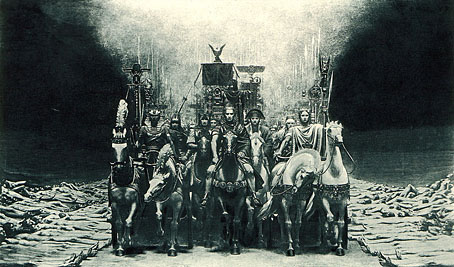
Les Conquérants (1892) by Pierre Fritel. From this Flickr page.

It was a search for works by French academician George Antoine Rochegrosse that turned up a copy of the painting in Google Images. “Aha, it’s Rochegrosse, then!” thought I, only it wasn’t. The picture is entitled Les Conquérants and the artist responsible is one Pierre Fritel (1853–1942) about whom there’s very little information on the web. There is, however, a discussion here which details the painting’s symbolism:

Through the Valley of the Shadow of Death, whose limits are obscured in darkness, advance, hollow-eyed and remorseful, the conquerors of all ages, marching in close ranks between a double row of corpses, stripped and rigid, lying packed close together with their feet toward the procession. In the center of the van rides Julius Caesar, whom Shakespeare has pronounced “the foremost man of all this world.” On his right are the Egyptian called by the Greeks Sesostris, now known to be Rameses II., Attila, “the Scourge of God,” Hannibal the Carthaginian, and Tamerlane the Tartar. On his left march Napoleon, the last world-conqueror, Alexander of Macedon, Nebuchadnezzar of Babylon, that “head of gold” in the great image seen in his vision as interpreted by the prophet Daniel, and Charlemagne, who restored the fallen Roman Empire.

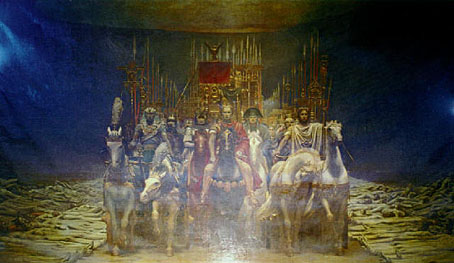
There’s a follow-up discussion on MetaFilter where a commenter makes the Nirvana connection, and the Internet Archive even has the catalogue for the Salon of 1892 which lists the painting’s first public appearance. See a larger monochrome version here. The only mystery now is the whereabouts of the painting itself. Artnet tells us it was sold in 1988, and they have a poor quality colour photo of the picture (below) which looks a lot less dramatic than the moody monochrome reproductions. If anyone knows the current location of Fritel’s canvas, please leave a comment.
fritel2.jpg

Elsewhere on { feuilleton }
The album covers archive

Previously on { feuilleton }
The art of Vasili Vereshchagin, 1842–1904

Danseur Noble

kozik2.jpg

The Adam Kozik Studio was in touch earlier this week with news of Danseur Noble, a photo-series of male dancers posed indoors and out. See the rest of the series here.

kozik.jpg

Previously on { feuilleton }
The tights have it
Torero
Eonism and Eonnagata
Tiger Lily
Chris Nash
Peter Reed and Salomé After Dark
Felix D’Eon
Dancers by John Andresen
Youssef Nabil
Images of Nijinsky

Weekend links 12

archigram.jpg

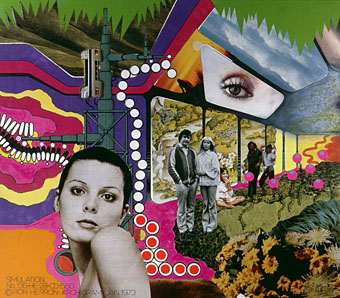
Simulation No. 136 (1973); From the Archigram Revival Project.

Scientific American looks at DMT: “the only psychedelic known to occur naturally in the human body”. Related: Hofmann’s Elixir: LSD and the New Eleusis, a book from the Beckley Foundation Press.

• “People weren’t quite sure what this guy was doing.” Colin Marshall talks to Eno biographer David Sheppard.

• LA FAN presents its debut group show, Eve in the Garden of Lost Angels, curated by Milla Zeltzer, at Optical Allusion Gallery, downtown Los Angeles, from May 15 to June 12, 2010.

Masturbation: literature’s last taboo. The words “last” and “taboo” should never be used together; taboos don’t vanish, they migrate.

Announcing the Text: Development of the Title Page, 1470–1900.

The Anachronism is an award-wining Steampunk short about two children who discover the wreck of a giant squid submarine on a beach near their home.

Out There is a brand new, bi-annual, international magazine for gay men and their friends.

The Big Picture looks at the eruption of Eyjafjallajokull.

Expo 2010 opens in Shanghai on May 1st.

• (Walter) Benjamin in Extremis.

Nathalie returns to Bomarzo.

• Acronymic songs of the week: Lucy In The Sky With Diamonds (1967) by The Beatles; The Stars That Play With Laughing Sam’s Dice (1967) by The Jimi Hendrix Experience; London Social Degree (1968) by Billy Nicholls; Love’s Secret Domain (1991) by Coil.

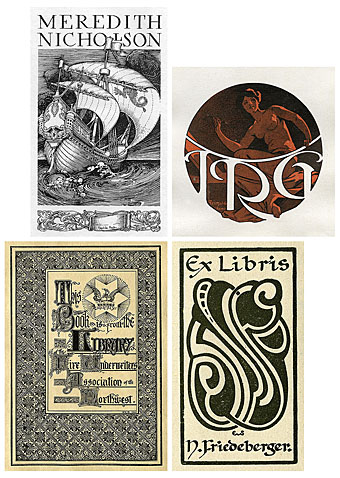
Pratt Libraries Ex Libris Collection

pratt.jpg

It wouldn’t surprise me if the web’s image-hoarders have already found Pratt Libraries’ huge collection of ex libris plates at Flickr but I hadn’t seen these before. A great variety of different designs from artists known and unknown. The one at the top left is by American illustrator Franklin Booth.

Elsewhere on { feuilleton }
The illustrators archive

Previously on { feuilleton }
The Evil Orchid Bookplate Contest
David Becket’s bookplates
Franklin Booth’s Flying Islands

Engelbrecht lives to fight another day

engelbrecht1.jpg

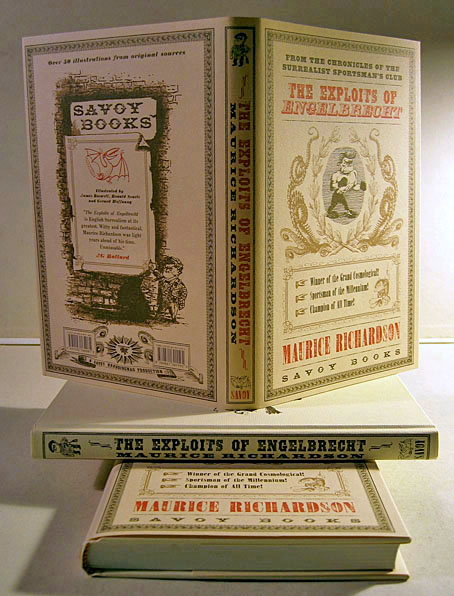
The beat Engelbrecht had drawn for the early morning rise was a stretch of jet black water between the Jubilee Gasometer and the Municipal Slaughter House. A dank mist lay over the canal. The vampire bats were out in swarms. The bot-fly waltzed in virid clouds. You could hardly have had a better surrealist fishing day.

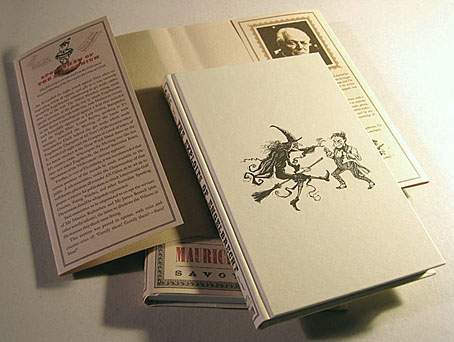
Thus Maurice Richardson in The Exploits of Engelbrecht, newly-printed copies of which I picked up this week from the Savoy Books’ office. This is the reprint of the Savoy edition which was published in 2000 and would have been out two years ago had various problems not intervened. As a result it’s inadvertently become an anniversary edition which is fitting since Engelbrecht was the first title in the line of books from Savoy’s publishing relaunch ten years ago. I’ve mentioned before that I was dissatisfied with my original design so it was a pleasure being able to rework the book slightly in a manner which better suits Richardson’s marvellous stories. The main change is a completely re-designed dust jacket done in three colours printed on textured paper; this has made the book a nice thing to handle as well as look at. A few new illustrations were added courtesy of Savoy artist Kris Guido. Kris is a far better cartoonist than I and his drawing of Engelbrecht facing one of his broomstick-riding foes adorns the front board.

engelbrecht2.jpg

Another cartoonist, Martin Rowson (currently at the Guardian), reviewed the earlier edition for The Independent on Sunday:

Far more obscure, but for my money the best book of the year, is The Exploits of Engelbrecht by Maurice Richardson. Richardson, who died in 1978, was one of the old school of hacks; he later became a stalwart infester of the Colony Rooms and the sordid pubs round Soho that teemed with pissed-up talent in the 1940s and 1950s. The Exploits of Engelbrecht, the dwarf surrealist boxer, and his adventures shooting witches, boxing grandfather clocks, playing football on Mars and games of surrealist golf which last for infinity, originally appeared in Lilliput when it was at its post-war zenith. The stories were illustrated by, among others, Searle and Hoffnung. Ah, God, those were the days.

This edition is lavishly illustrated and comes with endorsements from artist James Cawthorn (who provided some illustrations and an introduction), Michael Moorcock (who provided the afterword), and JG Ballard (who provided a blurb). Since its original publication in 1950 Engelbrecht had been one of Ballard’s favourite books; I wish he could have lived long enough to see this latest edition.

Engelbrecht isn’t on sale yet as I don’t think a price has been decided on but since this is a limited run it’ll be around £25 + p&p. Any queries should be directed to Savoy Books who have a PDF of the first chapter (plus illustrations) available to read. Next up is the enormous Moorcock tome; more about that soon.

Previously on { feuilleton }
Ronald Searle book covers
Engelbrecht again
Mervyn Peake in Lilliput