The Choise of Valentines, Or the Merie Ballad of Nash His Dildo

nash.jpg

My little dilldo shall suply their kinde:
A knaue, that moues as light as leaues by winde;
That bendeth not, nor fouldeth anie deale,
But stands as stiff as he were made of steele;

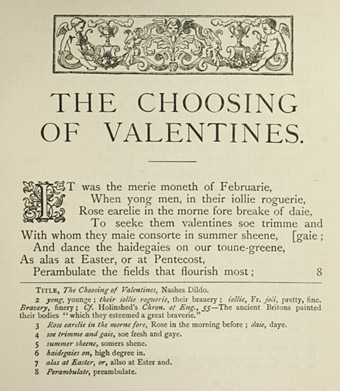
A salacious post for chocolate-and-roses day. There’s a degree of confusion around this work and its author, an Elizabethan poet, playwright and pamphleteer. The poem, which was distributed privately, dates from around 1593 and has a variety of titles, while its author is variously credited as Thomas Nashe or Thomas Nash. Despite the bawdy reputation of the Elizabethan era Nash’s contemporaries were sufficiently scandalised by the poem for it to remain unpublished, with the result that it survives imperfectly in a few handwritten copies. It’s a lengthy piece so let’s go to Wikipedia for a précis:

It describes the visit of a young man named “Tomalin” to the brothel where his girlfriend Frances (“Frankie”) is employed. Having paid ten gold pieces for her favours, Tomalin is embarrassed to find that merely lifting her skirts makes him lose his erection. She perseveres in arousing him however and they make love, but to her disappointment he has an orgasm before her. Frankie then decides to take matters into her own hands: hence the informal title by which the poem was known, Nashe’s Dildo.

The Oxford English Dictionary credits Nash with the first appearance in English of the word “dildo”, a term “of obscure origin” we’re told, whose usage here predates John Florio’s Worlde of Wordes (1598), Ben Jonson’s The Alchemist (1610), and Shakespeare’s A Winter’s Tale (1611). Nash’s achievement is something of a cheat since his poem wasn’t actually published until 1899, and then in a private edition. As usual the Internet Archive has the book in question, and it’s their version which follows, albeit without the copious footnotes.

The Renaissance English Literature site has more about Thomas Nash (or Nashe), his life and his work.

Continue reading “The Choise of Valentines, Or the Merie Ballad of Nash His Dildo”
Weekend links: fifth anniversary edition

demuth.jpg

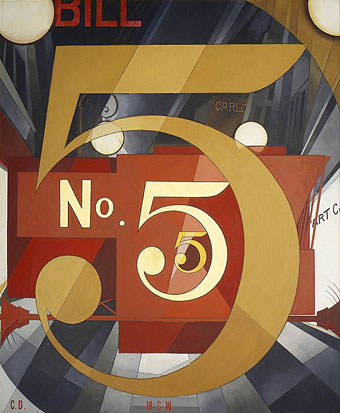
The Figure 5 in Gold (1928) by Charles Demuth.

It’s a little surprising to find I’ve been doing this for five whole years yet here we are. Having seen a number of blogs call it quits at the five-year point I should note that I don’t feel quite that exhausted although maintaining a discipline of daily posting can be a chore at times, especially when you’re pressured by work. On the whole the advantages continue to outweigh the disadvantages. Some of the discoveries here have fed back into things I’ve been working on or opened avenues for future exploration. Researching something for an audience (however slight that audience or the resulting post) encourages you to look more deeply into a given subject; sometimes you learn more as a result and occasionally make surprising discoveries. Obsessions are teased out which might otherwise have lain dormant. Yes, it’s an extra bout of work but I’ve spent much of my life saying to people “if you like that, you may like this”, and that’s all many of these posts are doing.

This year promises to be an interesting one so watch this space. And, as always, thanks for reading!

John x

On to the links…

Cathedral Scan translates the architectural plans of Gothic cathedrals into open-ended musical scores via custom software. There’s more at Blake Carrington‘s website.

Forty-three William Burroughs recordings (tape experiments and readings) at the Ubuweb archives.

• The opening scene of Deadlock (1970), an obscure German film with a theme by the mighty Can.

Strange Lands: A Field-Guide to the Celtic Otherworld, a new book by Andrew L Paciorek.

• The enduring nature of Frankenstein, currently on stage at the National Theatre, London.

shimojo.jpg

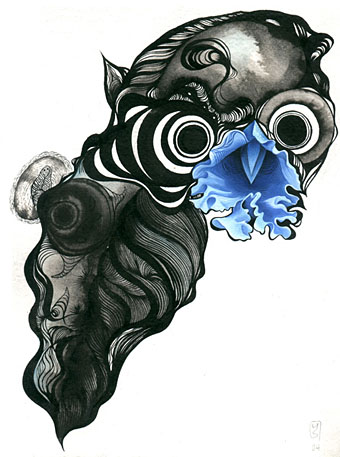
Owl One (2004) by Yuri Shimojo.

¡Activista! by Sonny Smith: Drag Queens, Borders, Rivers, Death and Transformation.

• Estonian sculptor Mati Karmin makes furniture out of Russian anti-submarine mines.

Alan Moore’s contribution to the Save Our Libraries campaign.

• Innsmouth Free Press is raising funds for their running costs.

A history of queer street art (Facebook link, unfortunately).

Illuminated book design for Heston’s Fantastical Feasts.

Physica Sacra, an engraving set at Flickr.

Egypt (1985) by Tuxedomoon | Egyptian Basses (1998) by Coil | Soleil D’Egypte (2001) by Natacha Atlas.

The specimen jars of Frederik Ruysch

ruischii1.jpg

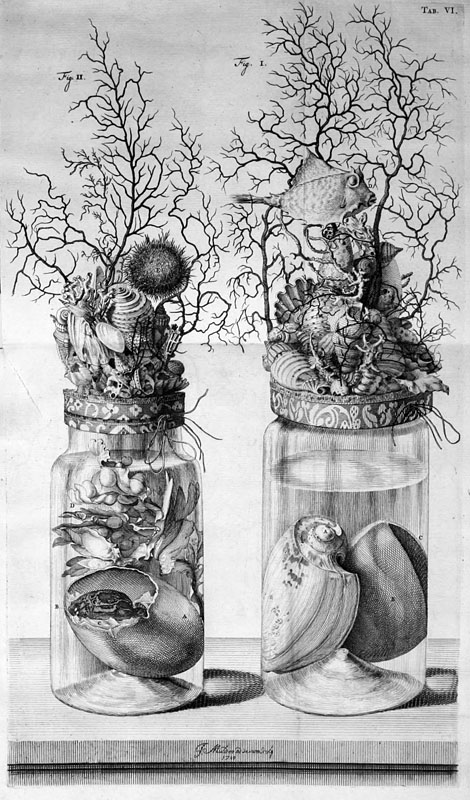
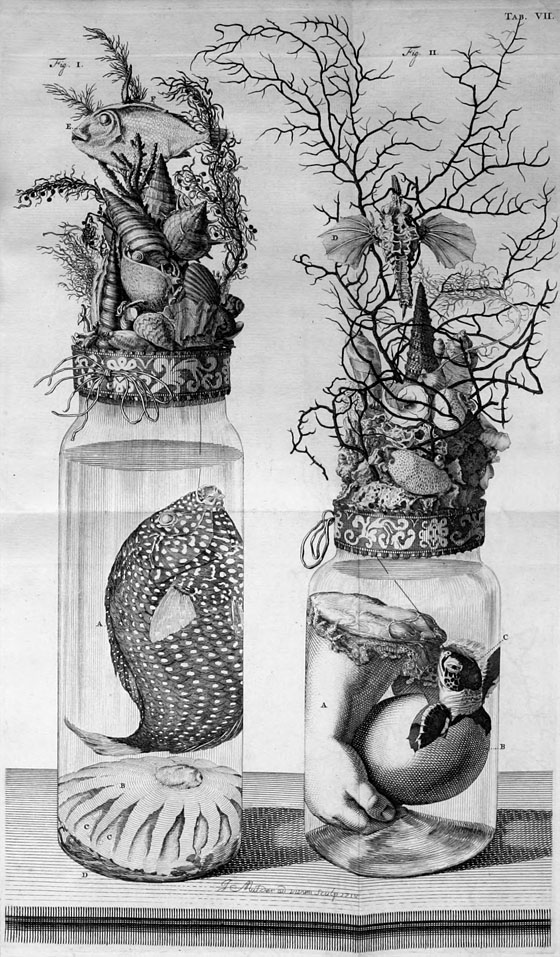
Some plates for Darwin Day from Thesaurus Animalium Primus (1710) by Dutch botanist and anatomist Frederik Ruysch. As is evident from these examples, Ruysch wasn’t above some frivolous indulgence when it came to illustrating his scientific texts, and he often gathered specimens into little tableaux which verge on the bizarre, such as the conjunction below of a child’s arm and a hatching turtle. Gone are the days when a renowned man of science might be depicted plucking at the entrails of a dead baby. This site has more about Ruysch’s specimens while BibliOdyssey posted some examples of Ruysch’s anatomical tableaux (with baby skeletons this time) and links to the books which contain them.

ruischii2.jpg

Previously on { feuilleton }
Darwin at 200

Deutsche Kunst und Dekoration #7

dkd07-01.jpg

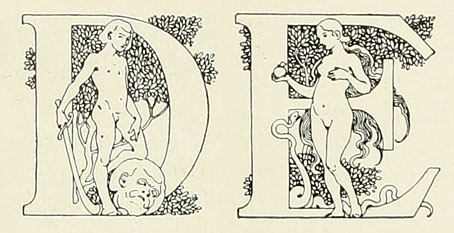
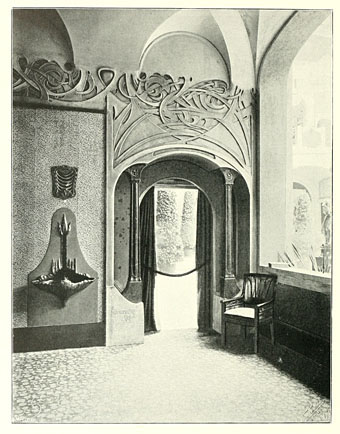
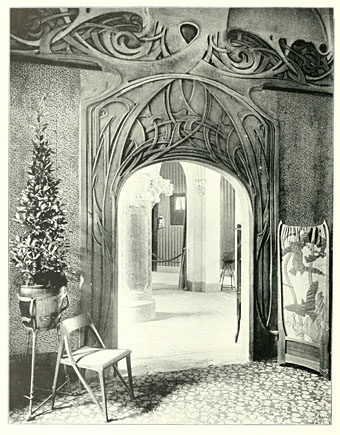
Continuing the delve into back numbers of Deutsche Kunst und Dekoration, the German periodical of art and decoration. Volume 7 covers the period from October 1900 to March 1901 and features a set of ornamental capitals throughout this edition designed by Karl Lürtzing, part of a presentation of typefaces in the Art Nouveau style. The figures in Lürtzing’s alphabet all seem to be Biblical or mythological (as with David and Eve above) although some are easier to decipher than others. Volume 6 paid a visit to the Exposition Universelle in Paris and there’s a few more examples from that event here, along with further examinations of the best in German art and design. As usual, anyone wishing to see these samples in greater detail is advised to download the entire volume (which comprises over 300 pages) at the Internet Archive. There’ll be more DK&D next week.

dkd07-02.jpg

Remarkable interiors by Richard Riemerschmid.

dkd07-03.jpg

Continue reading “Deutsche Kunst und Dekoration #7”

More Queer Noise

smiths.jpg

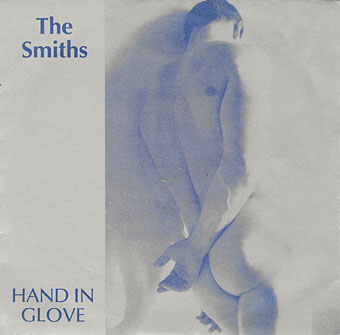
Hand In Glove (1973) by The Smiths, 7″ single.

This celebrated pair of buttocks turned up in the inbox this week, courtesy of a news mail from the Manchester District Music Archive announcing their Queer Noise website, an online exhibition exploring LGBT music and club culture in Greater Manchester. It was just over a year ago that I designed a poster for the Queer Noise music event which preceded the online collection; writer and journalist Jon Savage was the host that evening and he’s provided an intro for the site. And speaking of queer noises, I’ve been told recently that John Gill’s 1995 book of that name, Queer Noises: Male and Female Homosexuality in Twentieth-Century Music is shortly to be republished in an updated edition. No further details as yet.

french.jpg

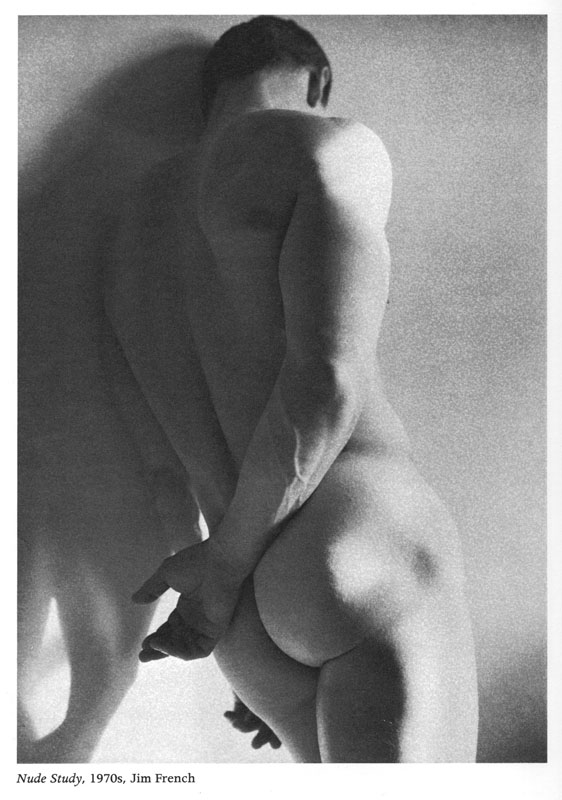
Meanwhile, back at the buttocks, it seems that Morrissey swiped his cover photo for the first Smiths single from The Nude Male (1978) by Margaret Walters. I have that very book so here is that very photo, an impressive study by beefcake photographer Jim French.

Previously on { feuilleton }
Queer Noise in Manchester
Queer Noise and the Wolf Girl
The fascinating phallus
Queer Noises