Tentacles #2: The Lost Continent

lost4.jpg

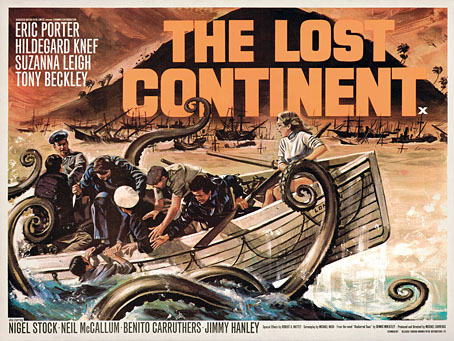
If William Hope Hodgson’s The Boats of the ‘Glen Carrig’ represents the Sublime of tentacular sea fiction then The Lost Continent, a 1968 Hammer film based on Dennis Wheatley’s 1938 novel Uncharted Seas, is the correspondingly Ridiculous end of the subgenre. The Lost Continent is an irritating film for Hodgson enthusiasts since it’s still the most Hodgsonian film out there, at least where the Sargasso side of things is concerned.
uncharted1.jpg

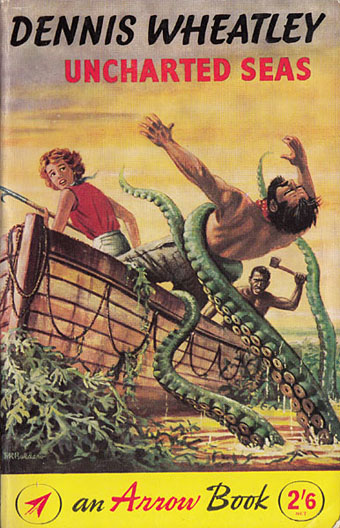
Illustration by SR Boldero (1960).

Despite its Wheatley origins the similarities to Hodgson’s sea stories are no coincidence: Wheatley chose two Hodgson titles—Carnacki, the Ghost-Finder and The Ghost Pirates—for the Dennis Wheatley Library of the Occult series that Sphere Books published in the 1970s. In the introductions Wheatley notes that Hodgson was a favourite writer whose work he discovered in the 1920s; he also mentions having collected a set of Hodgson first editions. Wheatley could have justifiably claimed that the “Weed-World” as a location wasn’t unique to Hodgson but Uncharted Seas also features the giant crabs, marauding octopuses and besieged castaways familiar from The Boats of the ‘Glen Carrig’ and the short stories.
Continue reading “Tentacles #2: The Lost Continent”

Tentacles #1: The Boats of the ‘Glen Carrig’

boats-1945.jpg

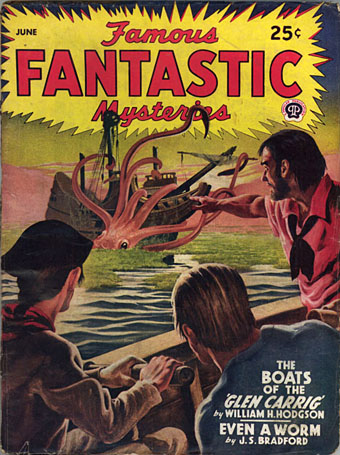
Famous Fantastic Mysteries, June 1945. Illustration by Lawrence (Sterne Stevens).

Following last week’s revelation of Lovecraftian horror, I thought it might be worth demonstrating just how much the tentacle-menacing-a-ship scenario is owned by William Hope Hodgson. The Boats of the ‘Glen Carrig’ (1907) is one of Hodgson’s lesser novels, overshadowed by the cosmic horrors of The House on the Borderland and The Night Land, but it’s a memorable work all the same. The narrative fits into his cycle of Sargasso Sea stories: a small band of 18th-century sailors, survivors of the wreck of the ‘Glen Carrig’, drift across the Atlantic into the weed-strewn “cemetery of the oceans” where they have to fight off giant octopuses and the predations of “weed men”, humanoid creatures with tentacular hands. As will be seen below, it’s the attack on a wrecked ship trapped in the weed that many of the illustrators have chosen to focus on.

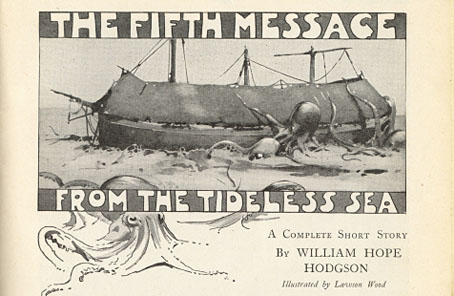
tideless-1911.jpg

Illustration by Lawson Wood (1911).

This was something I hadn’t seen before: an illustration for a story with a scenario very similar to ‘Glen Carrig’ where the sailors journey under canvas in their lifeboats. Another tale of the sinister Sargasso:

This is the fifth message that I have sent abroad over the loathsome surface of this vast Weed-World, praying that it may come to the open sea ere the lifting power of my fire-balloon be gone, and yet, if it come there, how shall I be the better for it? Yet write I must, or go mad, and so I choose to write, though feeling as I write that no living creature, save it be some giant octopus that lives in the weed about me, will ever see the thing I write. (more)

boats-1971-1.jpg

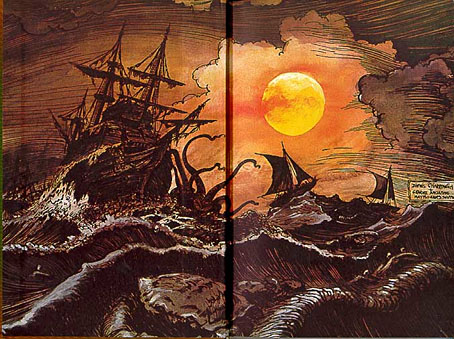
Les Canots du “Glen Carrig” / La Maison au bord du monde / Les pirates fantômes (1971). Illustration by Philippe Druillet.

A French Hodgson collection, the octopoid cover of which can be seen here. These were the endpapers; the rest of Druillet’s illustrations can be seen here.

Continue reading “Tentacles #1: The Boats of the ‘Glen Carrig’”

Cthulhu Calendar

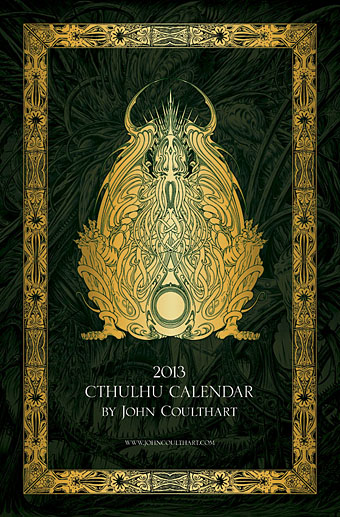
calendar00.jpg

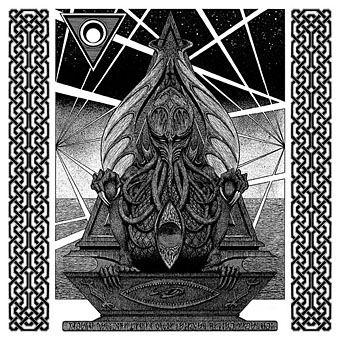
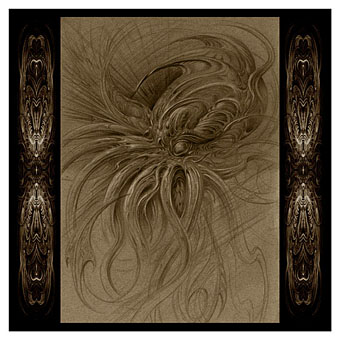
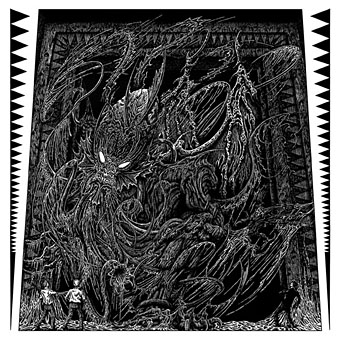
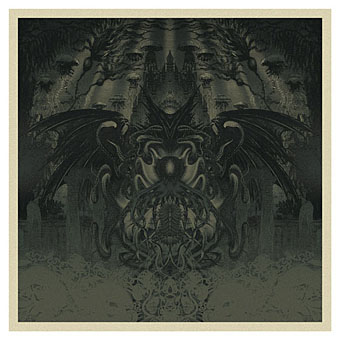
So here it is at last, the stars are right, etc. I had the idea for a Cthulhu calendar after I finished the Cthulhoid piece in January and realised I had about eight or more different representations of everyone’s favourite dreaming alien monstrosity. In gathering them together I’ve alternated between old and new works to avoid the front of the run being all black-and-white drawings. I could have coloured the black-and-white pieces, of course, but since they were never intended to be seen that way I prefer to leave them alone. The main alteration has been the adding of side panels or borders in order to help rectangular artwork fill out a square space. As usual this calendar is available through CafePress, priced at $19.99 / £15.00 / €18.50.

Before making a purchase please note: CafePress recently added a completely unnecessary feature to their calendars whereby purchasers can choose to have the pages start in late 2012 instead of January 2013. They don’t give me any way to disable this option, hence the warning. If you want a calendar beginning in January 2013 you have to select that option yourself.

Examples of the pages follow. See the artwork at a larger size here.

calendar01.jpg

JANUARY: Title page from The Call of Cthulhu (1987).

The opening page from my comic strip adaptation of the story.

calendar02.jpg

FEBRUARY: Resurgam (2012).

calendar03.jpg

MARCH: Cthulhu Arisen from The Call of Cthulhu (1988).

Cthulhu’s appearance from the comic strip adaptation.

calendar04.jpg

APRIL: De Profundis (2012).

Continue reading “Cthulhu Calendar”

Weekend links 127

whirlpool.jpg

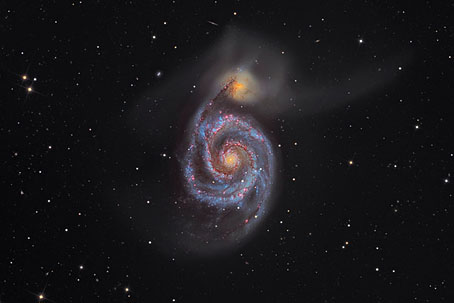
M15, The Whirlpool Galaxy photographed by Martin Pugh. The overall and deep space winner of Astronomy Photographer of the Year, 2012.

The Final Academy, the series of William Burroughs-themed events that took place in London and Manchester in 1982, will be celebrated at the Horse Hospital, London, on 27th October. Academy 23, a publication edited by Matthew Levi Stevens, will include my report on the Manchester Haçienda performances.

• “Architects are the last people who should shape our cities,” says the thrillingly pugnacious Jonathan Meades in a piece from his new writing collection Museums Without Walls. Andy Beckett reviews the book here.

• Ex-Minimal Compact singer/bassist Malka Spigel talks about her new album, Every Day Is Like The First Day, which can be streamed in full here.

What’s new about the current acknowledgments page is that it’s unsolicited—it appears like an online pop-up ad, benefiting no one but the author and his comrades. This is surely why these afterwords are often so garrulously narcissistic and strewn with clichés. The most radical experimentalist adheres to the most mindless acknowledgments-page formula; the most stinging social critic suddenly becomes Sally Field winning an Oscar.

Sam Sacks at the New Yorker on the blight of novelists’ acknowledgments pages. DG Myers at Commentary Magazine piles on.

• Another streaming album: Composed by Jherek Bischoff. Try Insomnia, Death & The Sea featuring Dawn McCarthy.

• Film of Lindsay Kemp being interviewed in 1977 about his production of Salomé.

Electronic Performers (2004): a video by Machine Molle for the song by Air.

djuna.jpg

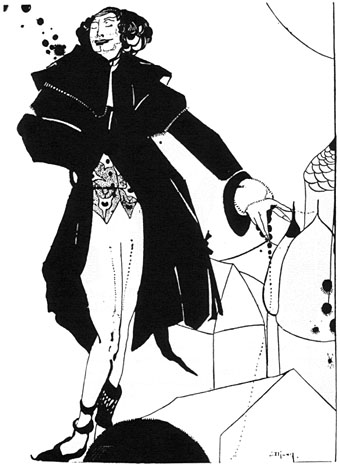
One of a series of Beardsley-like drawings by Djuna Barnes posted at Strange Flowers. The resurgent Ms. Barnes is mentioned three times in this Terry Castle review of All We Know: Three Lives by Lisa Cohen.

Fictitious Dishes, meals from novels photographed by Dinah Fried.

• Life, the Dinosaurs & Everything: Cosmicomics by Italo Calvino.

The Baby Died: Morbid Curiosities found in Old Newspapers.

• Portishead’s Adrian Utley gives a tour of his synth collection.

• Minimal Compact: Babylonian Tower (1982) | Not Knowing (1984) | When I Go (1985) | Nil Nil (1987).

Dom by Walerian Borowczyk and Jan Lenica

dom.jpg

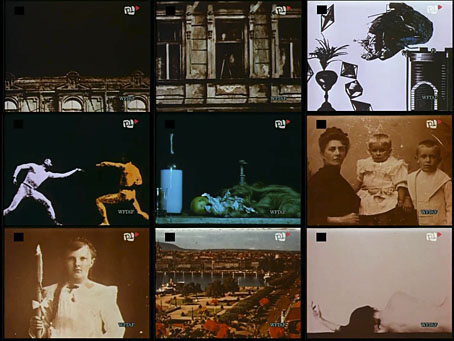
Dom.

Having referred this week to individual animated films by Borowczyk and Lenica here’s their ten-minute collaboration from 1959. “Dom” means “house”, with the house in question providing a vague framing device for otherwise disconnected episodes, some of which repeat themselves. It’s more of a curio than anything, most interesting (again) for the moments that would be better explored by future directors. In addition to further collage animation there’s a short sequence which gives octopoid life to a human wig that’s very reminiscent of Jan Švankmajer. Watch the whole thing here.

Previously on { feuilleton }
Les Jeux des Anges by Walerian Borowczyk
Labirynt by Jan Lenica
Short films by Walerian Borowczyk