The art of Benvenuto Disertori (1887–1969)

disertori15.jpg

L’arco di Tito (1918).

Benvenuto Disertori was an Italian artist with a parallel career as a musicologist. I forget how his prints came to my attention but they’re just the kind of thing I like to see: meticulous monochrome views with an emphasis on architecture and eroded mineral surfaces. Some printmakers tend to concentrate on a single medium—wood engraving, for example—but Disertori embraced a wide range of etching and engraving techniques. Once again, the influence of Piranesi is discernible in some of these views (another point in their favour), especially those that depict Roman ruins or older Italian buildings like the medieval towers in San Gimignano.

disertori08.jpg

Il Pensatore (1909).

disertori01.jpg

L’edera (1911–13).

disertori12.jpg

Gubbio. La Campanella di S. Giovanni Battista (1912-13).

disertori09.jpg

La Nicchia (1913).

Continue reading “The art of Benvenuto Disertori (1887–1969)”

Weekend links 810

luminet.jpg

Image of a Spherical Black Hole with Thin Accretion Disk (1979) by Jean-Pierre Luminet. Via.

• “I would be willing to bet that every student of fantastic fiction has at some point in his or her career read a book with the name EF Bleiler printed on its cover.” Brian J. Showers of Swan River Press talked to EF Bleiler in 2005.

• “James Webb Space Telescope confirms 1st ‘runaway’ supermassive black hole rocketing through ‘Cosmic Owl’ galaxies at 2.2 million mph.”

• “You have to be ready to see it”: Abel Ferrara and Catherine Breillat on why Pasolini’s Salò is a gift that keeps giving.

• At Dennis Cooper’s: Kosten Koper presents…Bill Nelson: Acquitted By Mirrors (1982–1987).

• At Skurrilsteer: Ongoing research into the life, work and legacy of Edward James.

• At The Daily Heller: All that jazzy record cover design.

Cygnus X-1 (1977) by Rush | Blackhole Dropout (1979) by Tod Dockstader | The Competition Of Supermassive Black Holes And Galactic Spheroids In The Destruction of Globular Clusters (1999) by Jah Wobble

Harry Clarke’s Elixirs of Life

jamesonad.jpg

A magazine ad.

Of all the books illustrated by Harry Clarke the most scarce are a pair of slim volumes published 100 years ago by the Jameson distillery to promote their brand of Irish whiskey. The books were never widely distributed, being given away to distillery visitors. Copies of the illustrations were still hard to find in 2011 when I wrote a brief post about them. Collections of Clarke’s work seldom pay the books much attention beyond reproducing one or two drawings but by trawling the auction houses it’s now possible to accumulate most of the illustrations. With the ongoing interest in Clarke’s work I keep expecting Jameson to publish facsimile reprints but so far this doesn’t seem to have happened. The information below is taken from Harry Clarke: His Graphic Art (1983) by Nicola Gordon Bowe. A couple more illustrations from The History of a Great House may be found in Hiroshi Unno’s exceptional study, Harry Clarke – An Imaginative Genius in Illustrations and Stained-glass Arts.


The History of a Great House — Origin of John Jameson Whiskey, containing some Interesting Observations thereon together with the Causes of Its Present Scarcity. Printed by Maunsel and Roberts Ltd, Dublin 1924 for the distillers; 24 pp, 8 x 4.75 inches, 21 black line drawings blocked in with viridian, one repeated as an endpiece, custard paper cover (8 x 5 inches), printed with additional black and viridian drawing.

jameson-history01.jpg

jameson-history02.jpg

jameson-history03.jpg

jameson-history04.jpg

Continue reading “Harry Clarke’s Elixirs of Life”

Weekend links 809

hubacher.jpg

Atlantis by Sarah Hubacher.

• Regular readers will know Leigh Wright from his Wyrd Daze creations which I’ve linked here many times in the past. (The same goes for his frequent Mixcloud compilations.) Leigh’s wife died recently which means he now has to return to the UK from Canada where he doesn’t have permanent resident status. His request for help is here.

Melinda Gebbie’s Greatest Fits: “Ranging from painting, illustration, Comix, portraiture, eroticism and so much more, this fully illustrated and beautifully presented book is a glimpse into the unique mind of a woman forged in the fire of counterculture.”

• At The Daily Heller: Adrian Wilson’s collection of elaborate vintage fabric stamps is explored in a two-part feature here and here.

• Mixes of the week: DreamScenes – December 2025 at Ambientblog, and ASIP – Reflection on 2025 at A Strangely Isolated Place.

Dennis Cooper’s favourite fiction, poetry, non-fiction, film, art, and internet of 2025. Thanks again for the link here!

• At Colossal: “Field Kallop meditates on universal patterns through bold chromatic compositions.”

• “Scientists discover massive underwater ruins that may be a lost city of legend.”

• New music: The King In Yellow by Blarke Bayer.

• RIP Rob Reiner.

Atlantis (1955) by Les Baxter | The Atlantis Healing Harp (1982) by Upper Astral | A Man For Atlantis (2000) by Broadcast

Fire in the Blood: Harry Clarke

clarke1.jpg

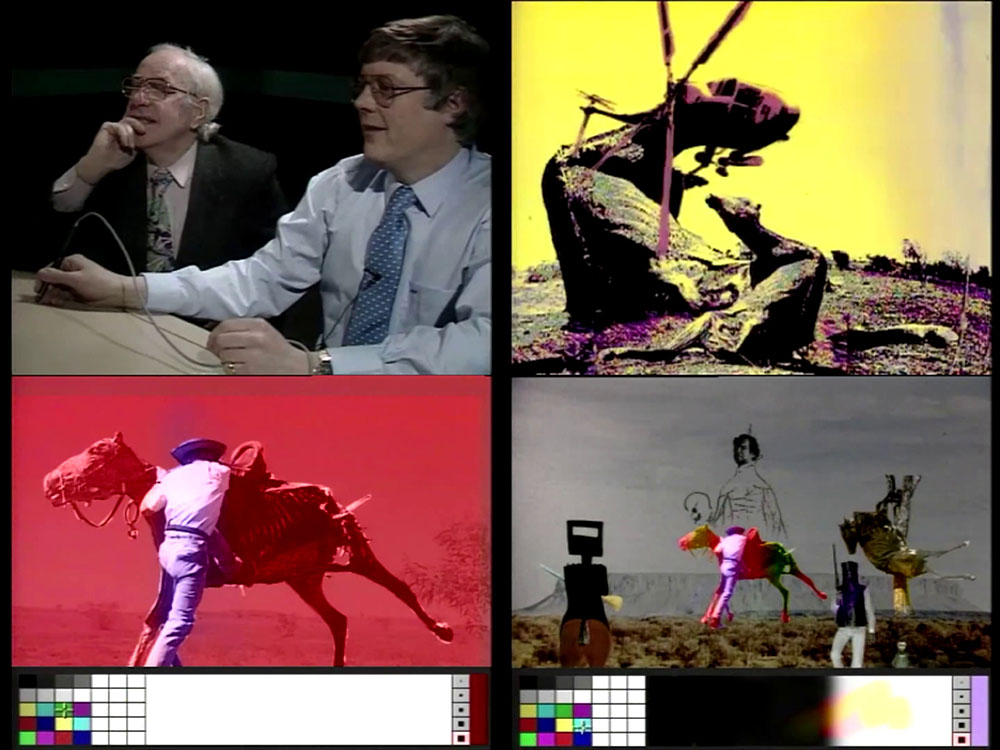
An all-too-short run through the biography of Harry Clarke, Fire in the Blood was made by Irish TV channel RTE in 2016 as part of a series devoted to the Celtic Revival. Camille O’Sullivan is the guide to Clarke’s life and work in a film which includes some commentary from Clarke expert Nicola Gordon Bowe, among others. 24 minutes isn’t enough time to cover the full range of the artist’s work but any Clarke documentary is better than none, and this one has a number of points in its favour. Clarke’s stained-glass windows are given a prominent place in the discussion, a reminder that stained-glass production was Clarke’s primary business even while his success as an illustrator increased. The stained-glass medium is an especially attractive one for a TV documentary—the colours of the windows glow on the screen in a manner they can never do on a page—and you could easily fill an hour with a discussion of Clarke’s remarkable glasswork alone. The end of the film includes some discussion about the scandal of Clarke’s last major work in the medium, the so-called Geneva Window, commissioned by the Irish government as a gift for the League of Nations then disowned when Clarke’s choice of subject (and the manner of its depiction) was deemed unsuitable. As with earlier objections to the work of Aubrey Beardsley, the complaints seem scarcely credible today but the window ended up being sold to an American collector.

clarke2.jpg

On the illustration side we get to see pages from a little-known work of Clarke’s, the frame designs for the pages in Ireland’s Memorial Records, a multi-volume record of the names of Irish soldiers who died in the First World War. Nicola Gordon Bowe’s Clarke studies show the title page but seeing all the frames in print wasn’t possible until the publication of Harry Clarke’s War by Marguerite Helmers. The silhouettes of the soldiers embedded in each frame form a sequential narrative describing the progress of the war amid knotted borders that hark back to the page designs of the Book of Kells.

Elsewhere on { feuilleton }
The illustrators archive

Previously on { feuilleton }
Harry Clarke’s illustrated Swinburne
More Harry Clarke online
Harry Clarke online
Harry Clarke record covers
Thomas Bodkin on Harry Clarke
Harry Clarke: His Graphic Art
Harry Clarke and others in The Studio
Harry Clarke’s Fairy Tales of Charles Perrault
Harry Clarke in colour
The Tinderbox
Harry Clarke and the Elixir of Life
Cardwell Higgins versus Harry Clarke
Modern book illustrators, 1914
Illustrating Poe #3: Harry Clarke
Strangest Genius: The Stained Glass of Harry Clarke
Harry Clarke’s stained glass
Harry Clarke’s The Year’s at the Spring
The art of Harry Clarke, 1889–1931