Weekend links 280

crisafi.jpg

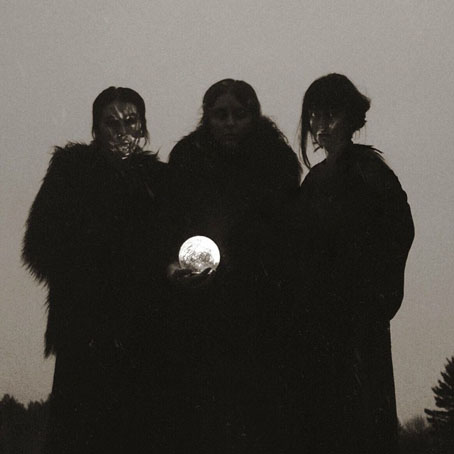
Keepers of the Moon by Bill Crisafi.

• More Thomas Ligotti for obvious reasons: Weird Fiction Review now has two Ligotti interviews, one from 2011, and a new one prompted by the Penguin edition of his stories. Also at Weird Fiction Review, two Ligotti narratives: The Night School, and The Red Tower. The latter demonstrates how weird fiction can dispense with character and story and still have a powerful effect.

• Related to the above: Terrors supernatural and psychological: Laird Barron on Ray Russell’s The Case Against Satan; Russell’s novel is also being reprinted by Penguin this month. And at Dangerous Minds: a collection of vintage dolls and ventriloquist dummies.

• “Time and again his books—even as they tell of remote planets and their inhabitants—foresee something perplexingly close to our present-day society, from visionary constructions to machines of destruction.” Strange Flowers on Paul Scheerbart.

Coil’s out-of-print discography gets a career-spanning reissue through Threshold Archives. Related: Russell Cuzner interviews Thighpaulsandra.

• Mixes of the week: The Ivy-Strangled Path Vol. XI by David Colohan, and Sounds From Beyond (October 2015) by Glossop Record Club.

Bill Crisafi: Artist, Dreamer, Feral Mystic. An interview with the artist by S. Elizabeth for Dirge magazine.

• Also being given the revenant treatment, out-of-print short stories by Aleister Crowley.

Alex Mar on the powerful appeal of modern witchcraft—even for a skeptic.

A Rest Before The Walk is a new album by Keith Seatman.

The Wounded Kings set out their stall at Bandcamp.

The Witch Queen Of New Orleans (1971) by Redbone | Witch (1977) by Goblin | Ditch Witch (2009) by Pink Mountain
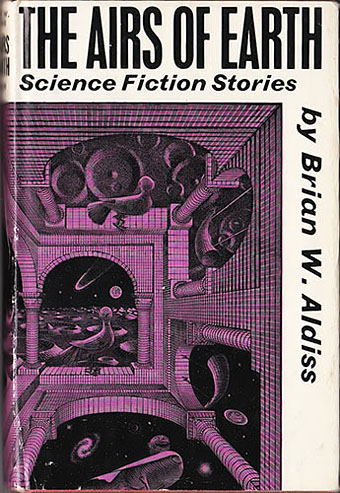
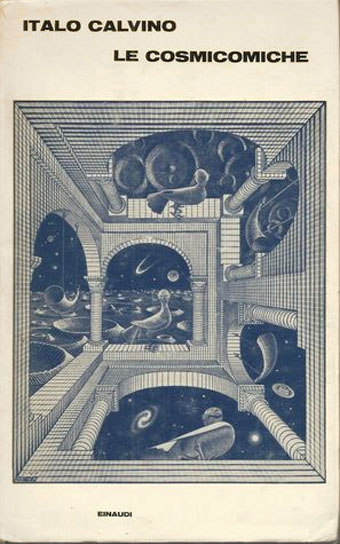
MC Escher book covers

escher08.jpg

1963. Art: Other World (1947).

MC Escher’s prints have been touring the UK this year: a few months ago they were in Scotland, this month they can be seen at the Dulwich Picture Gallery in London. The renewed attention prompted the BBC to produce a documentary, The Art of the Impossible: MC Escher and Me, in collaboration with Professor Roger Penrose. One of the programme researchers saw my earlier post about the use of Escher’s work on album covers, and asked if I wanted to appear on camera talking about this, something I politely refused to do. I’m happy to hold forth from a keyboard, however, so here’s a post about some of the books that have used Esher’s work to decorate their covers. Most of these are fiction but there must be many more non-fiction titles—especially in the fields of science and mathematics—that borrow Escher’s prints.

escher09.jpg

The first edition of Calvino’s comic stories from 1965.

escher10.jpg

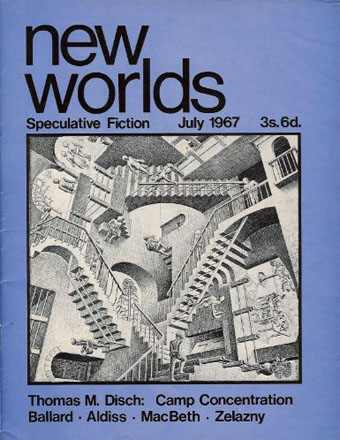
Art: Relativity (1953).

Not a book but editor Michael Moorcock has claimed that this was the first UK magazine to print any of Escher’s work.

Continue reading “MC Escher book covers”

George Barbier’s Le Bonheur du Jour

barbier11.jpg

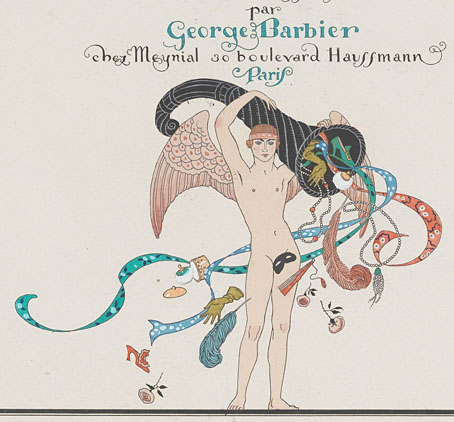
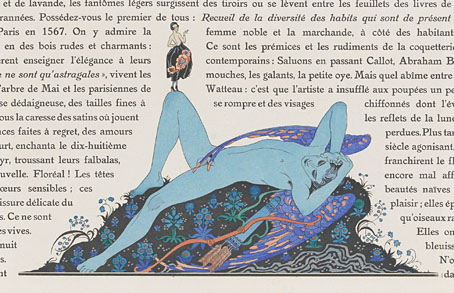
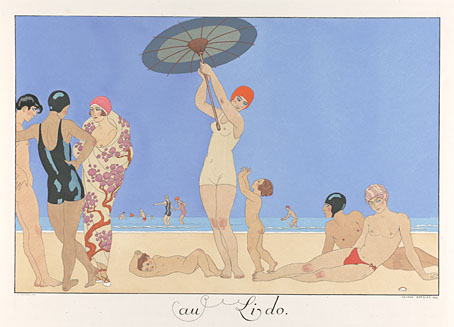
French artist and designer George Barbier was born on 16th October, 1882, so here’s a post for his birthday. Barbier’s work has appeared here in the past but there’s still more to be seen, especially his book illustrations. Le Bonheur du Jour; ou, Les Graces a la Mode is a series of prints from 1924, some of which turn up in collections of Art Deco graphics. Those tend to be the society scenes but I’m always more interested in Barbier’s decorative or decadent work examples of which are also represented here. Of note is a Sapphic scene in an opium den (a common theme in the 1920s), a great deal of Chinoiserie, and more of a homoerotic flavour than usual: the languid blue Cupid is like a male equivalent of Saga in Saga de Xam, while the scene au lido features a surprisingly naked man on the left who may be eyeing the bare breast of one of the women nearby but could also be capturing the gaze of the swimmer in the black cap on the right. More of these prints may be seen at the Metropolitan Museum of Art.

barbier12.jpg

barbier02.jpg

Continue reading “George Barbier’s Le Bonheur du Jour”

Hyakumonogatari Kaidankai

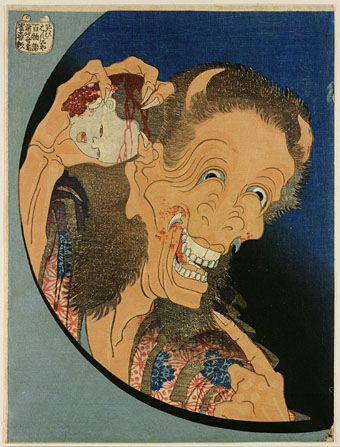
hokusai1.jpg

Laughing Demoness (Warai Hannya).

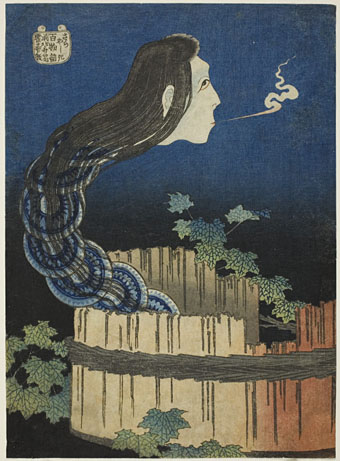
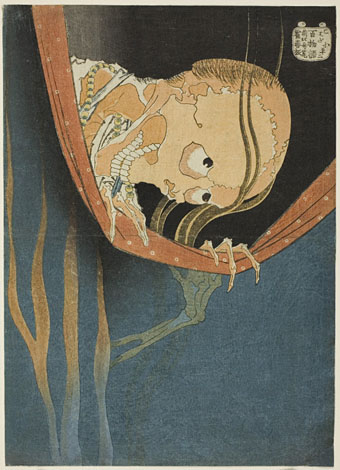
Halloween approaches. Hyakumonogatari Kaidankai (more popularly known as Hyaku Monogatari) translates as A Gathering of One Hundred Supernatural Tales, or simply One Hundred Ghost Stories. This is a Japanese parlour game some of whose traditional stories were illustrated in a series of five prints by the great Katsushika Hokusai (1760–1849). For anyone wishing to play the game later this month, Wikipedia has a description:

The game was played as night fell upon the region using three separate rooms. In preparation, participants would light one hundred andon (lamps) in the third room and position a single mirror on the surface of a small table. When the sky was at its darkest, guests gathered in the first of the three rooms, taking turns orating tales of ghoulish encounters and reciting folkloric tales passed on by villagers who claimed to have experienced supernatural encounters. These tales soon became known as kaidan. Upon the end of each kaidan, the story-teller would enter the third room and extinguished one andon, look in the mirror and make their way back to the first room. With each passing tale, the room slowly grew darker and darker as the participants reached the one hundredth tale, creating a safe haven for the evocation of spirits.

hokusai3.jpg

The Mansion of the Plates (Sara yashiki).

hokusai4.jpg

Kohada Koheiji.

Continue reading “Hyakumonogatari Kaidankai”

John Batten’s Indian Fairy Tales

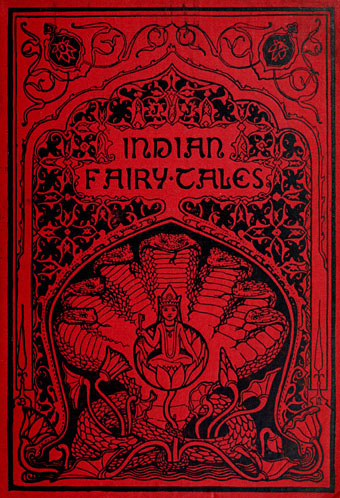
batten01.jpg

I keep intending to write some longer pieces, including a review of Aleksei German’s unforgettable Hard To Be A God, but the workload has been heavy again so here’s another illustrated book.

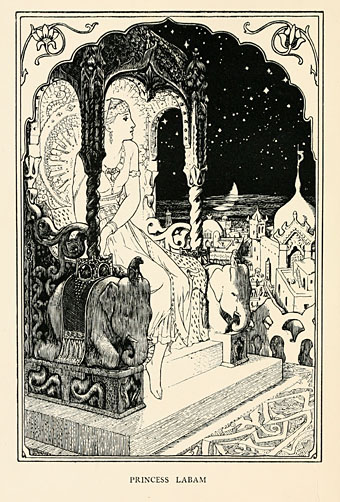
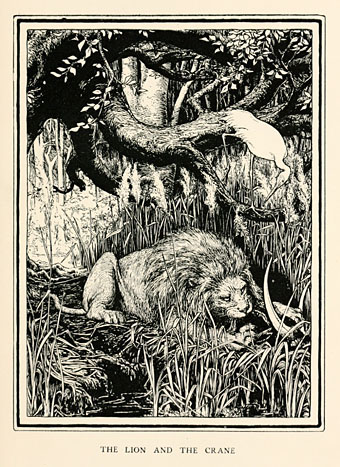
Illustrations by John Dickson Batten (1860–1932) have appeared here before, all of them for collections of fairy tales compiled and adapted by Joseph Jacobs. Indian Fairy Tales (1892) is another Batten/Jacobs collaboration, and is as fine as their other books, with Batten enclosing many of his full-page drawings in elaborate frames. Most of the figures look nothing like Indian people but that’s standard for books of this period. The Internet Archive has several copies of this title, including a limited, numbered copy with hand-coloured illustrations. I prefer the illustrations in black-and-white, however, so that’s what you see here.

batten02.jpg

batten03.jpg

Continue reading “John Batten’s Indian Fairy Tales”