Weekend links 812

satantango.jpg

• RIP Béla Tarr. I came late to Tarr’s films, he’d retired from directing by the time I worked my way through most of his oeuvre in 2019. As I’m always saying: better late than never. What I never expected from reading reviews was the irreducible strangeness at the heart of the later films, as well as their meticulous construction. With regard to the latter, mention should be made of the director’s regular collaborators: Ágnes Hranitzky (wife, editor and co-director), László Krasznahorkai (writer), and Mihály Víg (composer).

More Tarr: “The whole fucking storytelling thing is everywhere the same. That’s why I decided I have to do my movies.” Tarr talking to R. Emmet Sweeney in 2012; and at Criterion, Béla Tarr: Lamentation and Laughter by David Hudson.

• “When [Fela Kuti] first saw Lemi Ghariokwu’s work, he said, ‘Wow!’ Then he plied him with marijuana and asked him to design his album sleeves. The artist recalls their extraordinary partnership – and the day Kuti’s Lagos HQ burned.”

• At Smithsonan Mag: “Hundreds of mysterious Victorian-era shoes are washing up on a beach in Wales. Nobody knows where they came from.”

• At Ultrawolvesunderthefullmoon: The collage art of Wilfried Sätty.

• At the BFI: Leigh Singer selects 10 great Lynchian films.

• At Unquiet Things: The vast luminous art of Andy Kehoe.

• At Dennis Cooper’s it’s another Jan Švankmajer Day.

• New music: Light Self All Others by Tarotplane.

• At I Love Typography: Heart-shaped books.

• At Colossal: Luftwerk.

• Sailin’ Shoes (1972) by Van Dyke Parks | Dead Man’s Shoes (1985) by Cabaret Voltaire | New Shoes (2007) by Angelo Badalamenti.

Wilfried Sätty and the Cosmic Bicycle

satty1.jpg

Listen, Sleep, Dream (1967), a poster by Wilfried Sätty.

Continuing the San Francisco theme, twenty years ago today I was visiting the city myself. Jay Babcock, Richard Pleuger and I had driven up there from Los Angeles to research some of the history of Wilfried Sätty (1939–1982), master collagist, psychedelic poster artist, record cover designer and book illustrator. We spent 24 hours driving around the Bay area: up to Petaluma, where we met Sätty’s friend and artistic collaborator, David Singer, a fine collage artist in his own right; then to Berkeley to talk to Walter Medeiros, custodian of the Sätty estate and one of the leading scholars of the psychedelic poster scene; finally to North Beach, where we found the house in Powell Street where Sätty was living and working in the 1960s and 70s.

satty2.jpg

Sätty and an unknown woman in the artist’s basement pad/studio at Powell Street, a place he referred to as “the North Beach U-boat”. This was from a magazine feature that I photographed at David Singer’s house. I forget the source, it may have been from a 1972 TIME article about San Francisco artists.

The trip was a dizzying experience, but fascinating for what it revealed about Sätty and his work. From David Singer we learned, among other things, that the name “Sätty” had been chosen as a pseudonym by the former Wilfried Podriech for its echo of Ancient Egypt; the pronunciation, when you pay attention to the umlaut, conjures the word “Seti”. Walter Medeiros showed us stacks of original Sätty artwork, including all the collages intended for the artist’s final book, Visions of Frisco, a visionary history of the city which was published in 2007. Medeiros later emailed me a few additional notes which I have filed somewhere, correcting my guesswork in the piece I’d written about Sätty for Strange Attractor Journal earlier in 2005. At the time the only information I had to hand was the scant biographical information in Sätty’s books, the interview that he gave to Man, Myth and Magic in 1970, and a few web pages devoted to the artist which someone had put together in the late 1990s then never updated.

satty3.jpg

The house at 2143 Powell Street as it was in 2005. Those trees have grown considerably in the past 20 years.

All of which had me looking last week to see whether Sätty had a more substantial web presence today. Happily, he does, with this dedicated site maintained by Ryan Medeiros, Walter’s son. I’m saddened to read that Walter Medeiros is no longer with us but it’s gratifying to discover his family continuing his efforts to preserve Sätty’s legacy. Sätty is often reduced to a minor figure in the history of San Francisco poster art but he was more than this: a book creator as well as an illustrator, and a collage artist who extended Max Ernst’s engraving collage into new dimensions, using printing presses to multiply and overprint his assemblages.

satty4.jpg

Sätty’s first book, The Cosmic Bicycle, was published in 1971 by Straight Arrow Books, the publishing imprint of Rolling Stone magazine. This is a collection of collages, a few of them in colour, in which the compositions have a distinctly Surrealist quality. Sätty’s subsequent work downplayed the wild juxtapositions in favour of greater compositional control. His subsequent collection, Time Zone (1973), is a wordless “novel” in the manner of Max Ernst’s collage books.

satty5.jpg

The Cosmic Bicycle is also the title of a 4-minute animated film which brings to life some of Sätty’s pictures from the book. I linked to a copy of this years ago but that link is now defunct so here it is again, an odd little film which runs the artwork through a solarisation process then moves pieces of them around to the accompaniment of an electronic score. (As usual with Vimeo today, you have to log in to see it.) The film was directed by Les Goldman, an animation producer who was mentioned here recently in relation to The Hangman (1964), a short film he made with Paul Julian. Goldman’s own film seems almost amateurish in comparison but the music is by Moog pioneers Paul Beaver and Bernie Krause, credited here as Parasound Inc. Beaver and Krause’s Gandharva album features one of Sätty’s finest cover designs, with title lettering by David Singer. The film score isn’t the duo’s finest by any means—I’d even describe it as rather annoying—but it’s good to see their Sätty connection reinforced.

Previously on { feuilleton }
The original Gandharva
The Occult Explosion
Wilfried Sätty album covers
Nature Boy: Jesper Ryom and Wilfried Sätty
Wilfried Sätty: Artist of the occult
Illustrating Poe #4: Wilfried Sätty

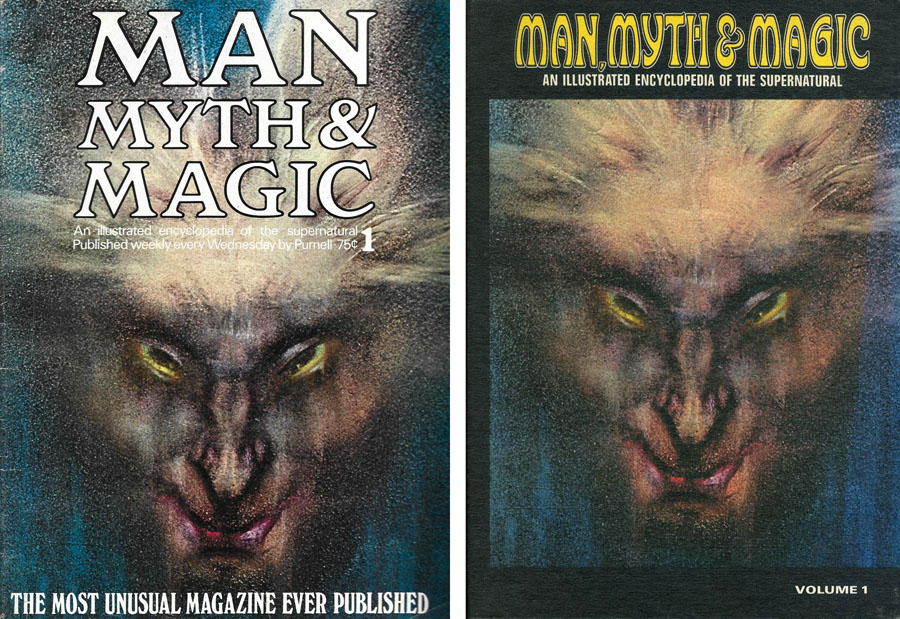
The most unusual magazine ever published: Man, Myth and Magic

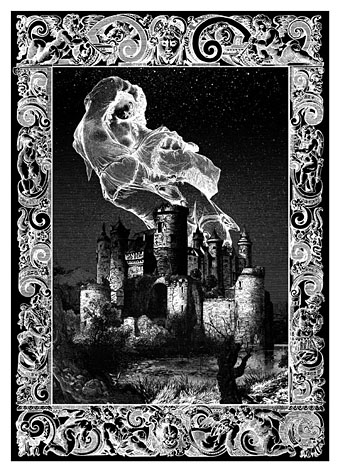
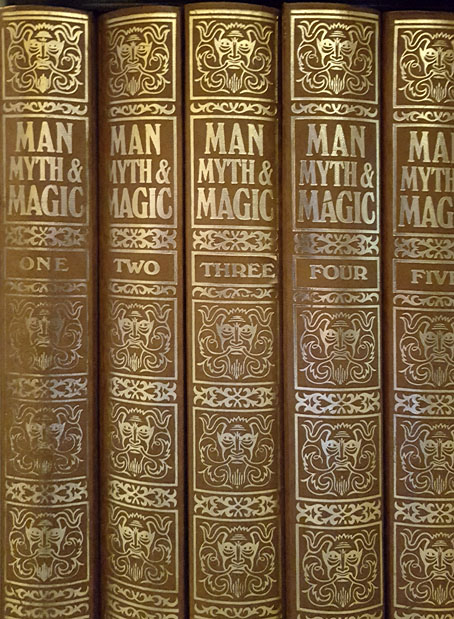
mmm1.jpg

Collect the set!

I don’t really need a digital copy of Man, Myth and Magic—I’ve been the fortunate owner for many years of the bound set of original magazines you see above—but I imagine a few readers of this post will welcome a download of all 3144 pages of the 1995 edition. For the impatient I’ll put the link up front: go thou here.
mmm2.jpg

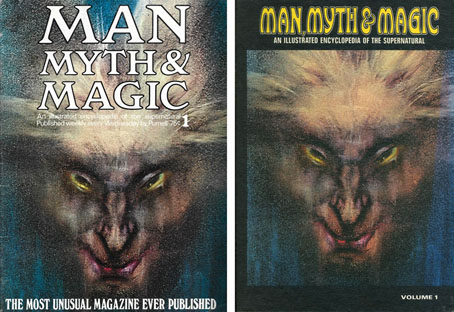
The world goes Spare: A US copy of issue no. 1 and the first volume of the 24-volume set. Austin Spare’s cover art is known either as The Elemental or The Vampires are Coming.

Man, Myth and Magic exists in several different versions along with a number of spin-off books which mined its texts for information and reused its picture archive. The first edition was the “Illustrated Encyclopedia of the Supernatural” which appeared in the UK each week from 1970 to 1971 as 112 magazine-sized issues, a series that built eventually into a collection of seven volumes. The first issue famously used a detail of a picture by Austin Osman Spare on its cover, giving Spare and his art a prominence unlike anything he received during his lifetime. The same part-work was published a couple of years later in the USA with an accompanying TV ad. Magic and the supernatural was the selling point but the encyclopedia was as much about religion and general anthropology as the occult, with the editorial stance being unsensational, factual and neutral. The seven-volume set was later republished in book form as 24 hardcover volumes, then revised in 1995 as a new set of 21 volumes with a different subtitle, “The Illustrated Encyclopedia of Mythology, Religion and the Unknown”. In the early 1970s you could also find a hardback collection of the first six issues bearing the subtitle “The most unusual book ever published”, a rather unrealistic claim. My mother bought one of these, giving me my first encounter with the encyclopedia itself and many other things besides, not least the Austin Spare drawings in Kenneth Grant’s piece of borderline cosmic horror about Spare and “resurgent atavisms”.

mmm3.jpg

Richard Cavendish was Editor-in-Chief of all the editions of Man, Myth and Magic, with Brian Innes acting as picture editor and subsequently co-editor for the 1995 edition. Cavendish had been the author of The Black Arts in 1967, a book which I still rate as one of the best general introductions to Western occultism. The Black Arts may have a title designed to grab the attention of Dennis Wheatley readers but it was a serious study that set the tone for the encyclopedia. The editorial board of Man, Myth and Magic was composed of heavyweight academics, together with John Symonds (Aleister Crowley’s literary executor and biographer), while the group of special consultants included Katharine Briggs (folklore), William Gaunt (art) and Francis Huxley (anthropology). Symonds brought Kenneth Grant on board. Grant at this time was the official head of Crowley’s Ordo Templi Orientis, and his presence gave the editorial team access to his large collection of Austin Spare artwork.
mmm4.jpg

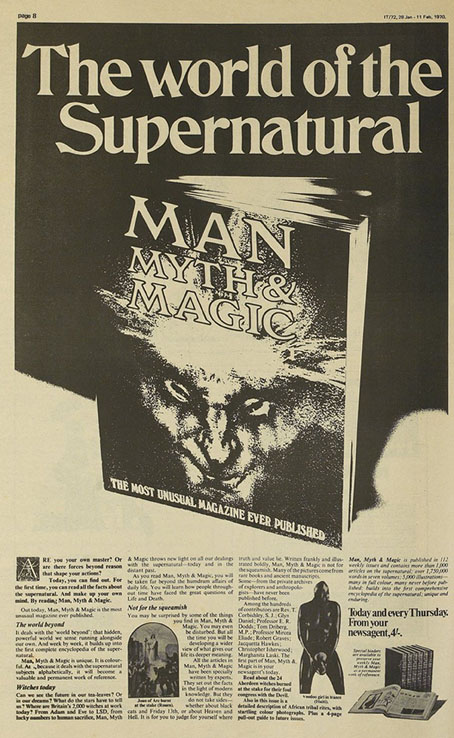
“From Adam and Eve to LSD, from lucky numbers to human sacrifice…” International Times, Jan 28, 1970.

Among the never-to-be-repeated list of contributors were Geoffrey Ashe, Robert Baldick, Robert Graves, Celia Green, Douglas Hill, Christina Hole, Christopher Isherwood, Patrick Moore, Kathleen Raine and JB Rhine. Kenneth Grant and John Symonds weren’t the only contributors who’d known Aleister Crowley, there was also Tom Driberg MP, a man whose promiscuous homosexuality and alleged treachery made him one of the more notorious members of Parliament. The other British politician among the contributors was the comparatively prosaic John Selwyn Gummer, a future government minister and current member of the House of Lords. (I wish I could tell you which article was Gummer’s but he’s listed in the contributor section without a credit. I’d have to hunt through the volumes to find out.) Elsewhere you’ll find entries by both Francis Kings—confusingly listed without their identifying initials—in what may be the only time the pair appeared together in the same publication. Francis H. King, writing here about Japan, was a well-regarded author whose novels included a number of gay romances; Francis X. King was an occultist and author of non-fiction books whose research was packaged under lurid titles such as Sexuality, Magic and Perversion, and Satan and Swastika. The contents of Man, Myth and Magic have long been rendered superfluous by the internet but the contributor list gives the encyclopedia a curiosity value if nothing else. All of the entries are unique pieces of writing which are unavailable outside these pages.

I confess that I hadn’t known that Man, Myth and Magic had been revised and reprinted until I discovered this scanned edition, I’d always thought the encyclopedia was too much of its time to be republished. Richard Cavendish in the editorial preface for the 1995 edition says that some of the articles were amended or expanded to take account of new researches and developments. So they have been, although at first glance the page layout looks very much as it did in the original printing. Closer examination reveals that some of the more dated pictures have been replaced, like the photo of a typical hippy girl in the entry about bells. Dated pictures aside, what you see here is still 95% the original “illustrated encyclopedia of the supernatural”.

mmm5.jpg

Frontiers of Belief.

The most substantial change in the later reprintings was the absence of the “Frontiers of Belief” section, a series of mostly topical essays which ran each week across the inside back cover and the back of the magazine. Collectors of the volume binders could also purchase an additional binder to store the issue covers and the FoB supplements. Whoever compiled my own volumes failed to do this, but I did once own a partial set of the magazine as separate issues, and still have the FoB articles from those issues. Two of these pieces—a profile of artist Wilfried Sätty and Kenneth Grant on HP Lovecraft—have appeared here in the past. As far as I know none of the FoB pieces have ever been officially reprinted. The very last piece was “Occultism—The Future”, in which a number of writers were asked for their prognostications. The ubiquitous Dennis Wheatley—who, for once, didn’t contribute to the previous pages— delivered a typically ominous warning against involvement in the Black Arts. A more sober final word was provided by Colin Wilson:

In science a new cycle has begun, a revolt against the old rigid reductionism, a recognition that ‘materialism’ leaves half the universe unexplained. Biologists, psychologists, even physicists, are cautiously trying to feel their way into new worlds. They are acknowledging at last that they are dealing with a living universe, a universe full of strange forces. The magic of the past was an intuitive attempt to understand and control these forces: the science of the future will be a fully conscious attempt. Magic will be the science of the future, or should we say that science will be the magic of the future?

Previously on { feuilleton }
Jan Parker’s witches
Typefaces of the occult revival
Dreaming Out of Space: Kenneth Grant on HP Lovecraft
MMM in IT
The Occult Explosion
Wilfried Sätty: Artist of the occult
Owen Wood’s Zodiac

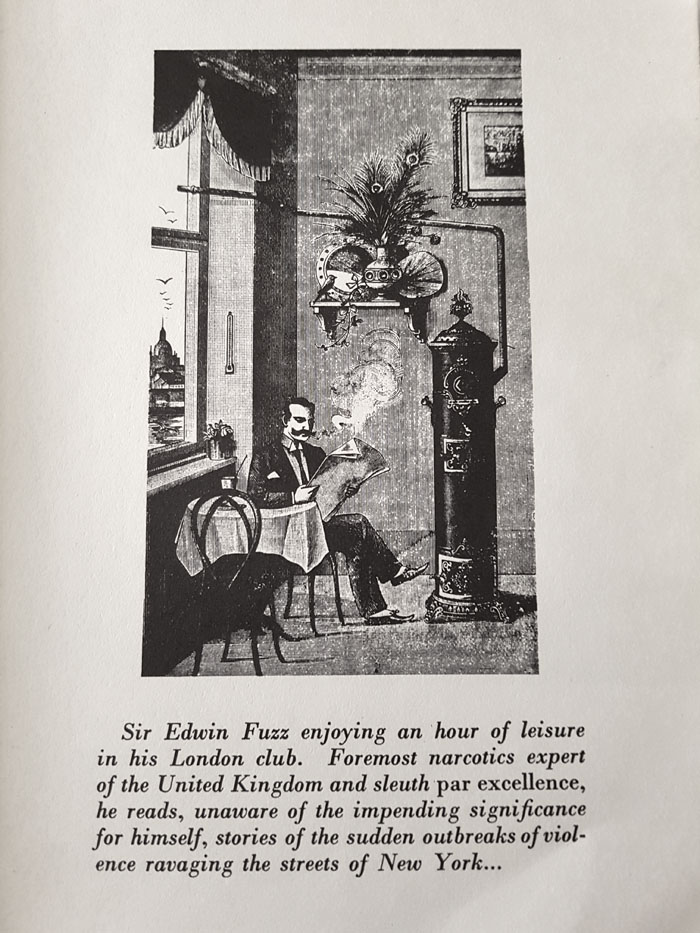
Fuzz Against Junk & The Hero Maker

rubington1.jpg

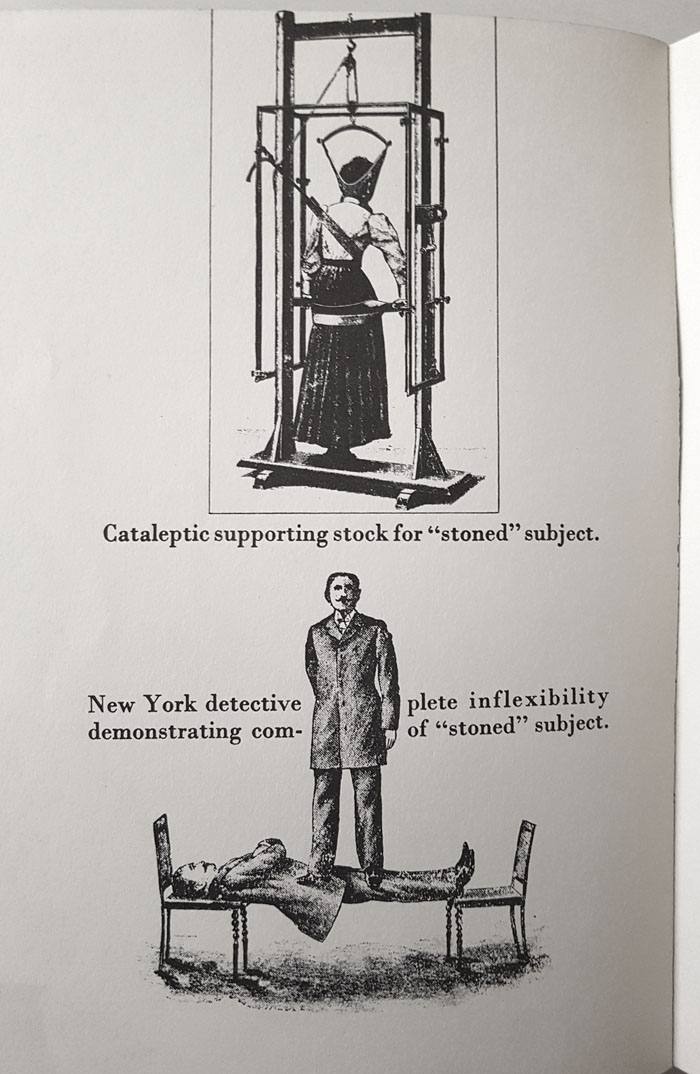
This is another of those posts in which I brag about finding an old book in a charity shop for a lot less than you’d have to pay for it online. But it does give me the opportunity to say something about American writer/artist Norman Rubington and his alter ego Akbar Del Piombo, something I was sure I’d done already. One of the weekend posts linked to an article about Rubington’s work but my discussion of his collages is in the essay I wrote about Wilfried Sätty for the Strange Attractor Journal, a piece which isn’t available here.

rubington8.jpg

The engraving collages of Norman Rubington (1921–1991) were probably the first to use the form developed by Max Ernst for explicitly humorous purposes. They’re certainly among the earliest to take the lead from Ernst while aiming themselves at an audience outside the art world. There is humour in some of Ernst’s collages, of course, but it tends to be the black variety favoured by the Surrealists (and actually defined by them; André Breton’s 1940 Anthology of Black Humour was a pioneering study). Rubington’s small books exploit the comic potential of antique illustrations by repurposing them as the primary content in a series of absurd narratives; these aren’t “graphic novels”, they’re more like heavily-illustrated comedy routines. There were four books in the original series—Fuzz Against Junk (1959), The Hero Maker (1959), Is That You Simon? (1961) and The Boiler Maker (1961)—with a fifth title, Moonglow, appearing in 1969. Olympia Press published the books in France, with US editions appearing around the same time under the Far-Out imprint used by Citadel Press. My charity purchase is the 1966 New English Library reprint of an Olympia Press collection of the first two volumes. The olive-green Olympia covers always provoke a Pavlovian grab response when I see one on a shelf although I’ve yet to find a copy that wasn’t an NEL reprint.

rubington2.jpg

rubington3.jpg

rubington4.jpg

Continue reading “Fuzz Against Junk & The Hero Maker”

Narraciones extraordinarias by Edgar Allan Poe

poe01.jpg

Berenice.

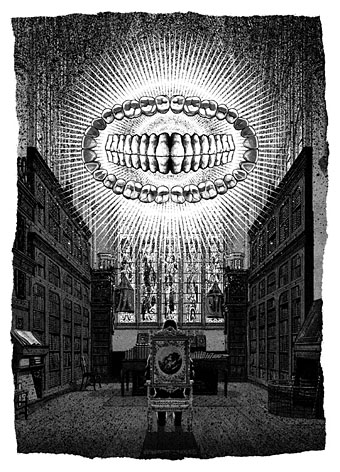
Narraciones extraordinarias was the first commission that arrived from Spanish publisher Editorial Alma earlier this year but it’s the second one to be revealed here. (Copies of the pictures at a larger size may be seen on the main website.) I confess I was rather dismayed when the request came through for this. I was pleased to have the opportunity to illustrate so many stories but Edgar Allan Poe is a tough brief when Harry Clarke has already created the definitive set of illustrations. The challenge, then, became one of trying to successfully illustrate the stories without repeating anything by Clarke or the many other illustrators who’ve tackled Poe, not least my favourite collagist, Wilfried Sätty.

poe02.jpg

Morella.

One advantage of the collection was the inclusion of several pieces that you seldom find in the common English reprints of Poe, stories such as A Tale of the Ragged Mountains. The style is Sätty-esque, of course, although less surreal in approach thanks to the flexibility of digital tools. I’ve been developing this engraving collage style over the past year or so to create a hybrid that blends drawn and collaged material into a seamless whole. When this works, as with The Man in the Crowd (below), you shouldn’t be able to easily tell which elements are drawn and which collaged. (And more importantly, it shouldn’t really matter.) This technique has been developed further in the most recent work I’ve done for Editorial Alma but you’ll have to wait a while to see the results.

poe03.jpg

Ligeia.

Despite my initial misgivings, this job worked out better than I expected, not least because the deadline was so tight. Several of these pictures were created in a day, a work-rate common to many comic artists but not one that I’m used to (or happy with) at all. I’m still unhappy with MS. Found in a Bottle which lazily swiped a chunk of a Gustave Doré illustration; if I’d had the time I would have changed it, and if this series of pictures is ever reprinted that’s one I’ll be reworking.

As before, this is a Spanish-language hardback, and the only purchase link I have is an Amazon one. My next contribution to this series should be out early next year.

poe04.jpg

The Fall of the House of Usher.

Continue reading “Narraciones extraordinarias by Edgar Allan Poe”