Weekend links 187

delia.jpg

Delia Derbyshire (2007) by Iker Spozio.

Whatever you think of Doctor Who, Delia Derbyshire’s recording of Ron Grainer’s theme tune is a landmark piece of electronic music. Those glassy electronic tones still sound unique today, not least for their having been created using rudimentary oscillators and much laborious tape editing. In Radiophonic Workshop: the shadowy pioneers of electronic sound, Joe Muggs looks at the history of the BBC’s electronic composers. If you’re a Radiophonic-head then the Alchemists of Sound TV documentary from 2003 is essential viewing.

There’s more (there’s always more): Delia Derbyshire – Sculptress of Sound: part one of a seven-part radio documentary about the great electronic music composer, and Blue Veils and Golden Sands, Martyn Wade’s radio play about Delia. Related: Delia-Derbyshire.org, Delia Derbyshire: An audiological chronology and A History of the Doctor Who theme. And don’t miss: Silence Is Requested In The Ultimate Abyss (1969) by Welfare State and White Noise, an incredible slice of electro-psychedelia from the John Peel Presents Top Gear album.

• “Why don’t books for grown-ups have illustrations any more?” asks Christopher Howse. Some of them do, this past week I’ve been finishing a new series of illustrations for a story anthology.

• From 2006: Ian Penman on cigarettes, espionage, and the masterful (and superior) television adaptation of Tinker, Tailor, Soldier, Spy.

It was Malcolm [McLaren] who suggested that the main characters be a boy who looks like a girl who looks like a boy and vice versa. What was strange was that, actually, in 1985 this was nobody’s vision of the fashion industry. Since then, fashion and fascism have crept closer: you’ve got John Galliano doing his promotional bits for the Third Reich, you’ve got Alexander McQueen killing himself, you’ve got Versace and that horrible, violent stalker coming for him. Since it was written, almost all of it has come true apart from the nuclear winter, but I think we’re working on that. The actual society that the story happens in is much more like the society we have now than culture was in 1985.

Alan Moore on Fashion Beast, Situationism, and why he hates superheroes.

• KW Jeter talks about his latest novel, Fiendish Schemes, and the “cultural juggernaut” that is steampunk.

• Grit and Social Dynamics in Smoke Ghost: Elwin Cotman on the weird fiction of Fritz Leiber.

The Secret Lives of the Vatican’s Gay Cardinals, Monks, and Other Clergy Members.

Don Cherry & Organic Music Theatre, live in the RAI TV studios, 1976.

• Otherworldly Art and Photography: Mlle Ghoul finds the best things.

• From 1998: Rahma Khazam on composer Bernard Parmegiani.

• Mix of the week: Marshland: The Mix by Hackneymarshman.

• “Let’s colonize the clouds of Venus,” says Ian Steadman.

J. Hoberman on David Cronenberg’s Visual Shock.

The Delian Mode (1968) by Delia Derbyshire | Tom Baker (1981) by The Human League | Doctor Who? (1984) by Doctor Pablo & The Dub Syndicate

Tonto’s expanding frog men

tonto.jpg

I wasn’t going to write about album cover art three times in a row but things keep catching my attention this week. Anyone interested in the history of electronic music knows the name Tonto’s Expanding Head Band, the duo formed by Malcolm Cecil and Robert Margouleff to create music with Cecil’s huge, custom-built TONTO (The Original New Timbral Orchestra) synthesizer. Cecil and Margouleff recorded two albums together: Zero Time (1971) and It’s About Time (1974), the latter credited to Tonto only. Zero Time was incredibly advanced for 1971, not classical adaptations like those being produced by Wendy Carlos and her many imitators, but all-original pieces created polyphonically, a feat that only the TONTO synth could easily achieve.

Given how successful the album is musically I’ve always thought it a shame that the sleeve art, inside and out, was the kind of amateurish “psychedelic” doodling that you find on many albums of this period. The design above was for a 1975 reissue, something I’d not seen before. The artist was illustrator Jeffrey Schrier who has a small, and no doubt incomplete, listing at Discogs with nothing similar to this in evidence. At a guess I’d say the evolving frog men are derived from the lyrics of Riversong, a meandering piece with singing processed via early vocoder-style technology, something that Wendy Carlos was also experimenting with. It’s not all hippy ambience: Jetsex sounds like an outtake from Kraftwerk’s Autobahn (albeit three years early) while Timewhys wouldn’t have been out-of-place on The Human League’s Travelogue album almost a decade later. Easy to see why Stevie Wonder and others were eager to work with Malcolm Cecil throughout the 1970s.

Elsewhere on { feuilleton }
The album covers archive

Previously on { feuilleton }
A Clockwork Orange: The Complete Original Score

Martin Rushent, 1948–2011

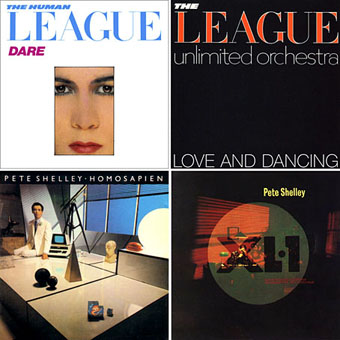
rushent.jpg

Pop music is one of the best forms of time travel when it summons a memory that returns you to a specific time and place. All I need to revisit the summers of 1981/82/83 is a blast from one of these albums, each a Martin Rushent production that benefited from his expertise with synth and drum-machine programming. Much as I enjoyed Dare, I tended to play Love and Dancing a lot more, a follow-up to the League’s finest album that was dismissed at the time as a quick cash-in but which was a perfect dub of the album proper, pieced together from extended mixes on the 12″ singles. Rushent was an early master of the extended mix, a side of his production skills I’ve not seen mentioned in the obituaries circulating this week. Reggae artists had been doing this for years but Rushent was ahead of the game in turning successful pop songs inside out, extending tracks without taxing the patience of the listener.

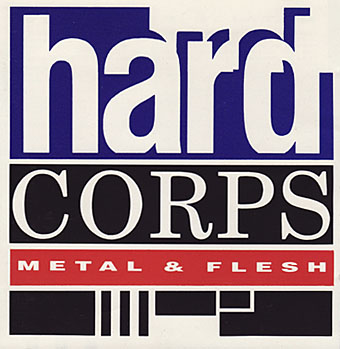
hardcorps.jpg

One of Rushent’s pet projects in the mid-1980s has also fallen by the wayside in the career retrospectives. Hard Corps were an outfit comprising three British guys and one French woman, Regine Fetet, who presented themselves as a kind of UK answer to Computer World-era Kraftwerk, albeit with more eros than Kraftwerk generally manage. Their sound was a combination of hard electronics and pop tunes which I found irresistible but the rest of the world stubbornly resisted, being too hard for the pop crowd and too poppy for the second generation Industrial crowd. (Propaganda were doing something similar during this period, and also managing to alienate too many people to be anything more than a cult success.) Martin Rushent produced two of Hard Core’s singles including the closest they got to a hit, Je Suis Passée (1985). There’s a site devoted to the group here.

Telegraph obit by Paul Gorman

• Altered Images: I Could Be Happy (extended mix) (1981)
• Pete Shelley: Homosapien (elongated mix) (1981)
• Pete Shelley: Witness The Change (dub mix) (1981)
• The Human League: Don’t You Want Me? (1981)
• The League Unlimited Orchestra: Hard Times (1982)
• Pete Shelley: What Was Heaven? (1983)

Previously on { feuilleton }
A Secret Wish by Propaganda
A Clockwork Orange: The Complete Original Score

Old music and old technology

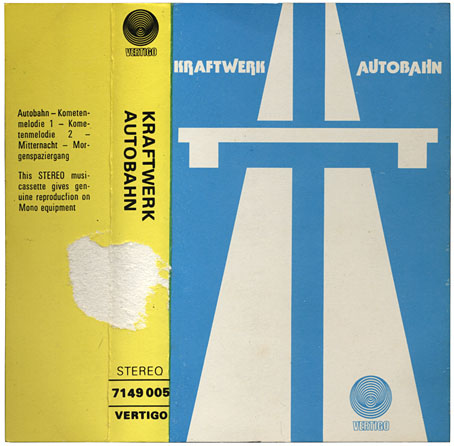
autobahn1.jpg

Clearing junk today turned up some obsolete artefacts one of which (the Kraftwerk) has been kept for purely sentimental reasons. It’s been amusing the past few years watching the vinyl disc refuse to crawl onto the scrapheap of history despite its death having been announced many times over by journalists who should know better. Several of the CD releases I’ve designed recently have also been brought out in vinyl editions. Meanwhile the audio cassette really is on the way out: “Sales of music cassettes in the U.S. dropped from 442 million in 1990 to about 700,000 in 2006” says Wikipedia. I certainly won’t mourn its passing; portability aside, I always hated these things. Music sounded shitty unless the tape was chrome or some other high-quality format, and whatever the quality they were all subject to mangling by cheap cassette players.

Continue reading “Old music and old technology”