Kosmische vampires

vampira4.jpg

Here at last is something I’ve been waiting many years to see. Vampira is a strange German TV film which shouldn’t be confused with the horror comedy from 1974 that shares its name. Descriptions of the German Vampira make it sound like a drama-documentary but it’s really a kind of illustrated lecture with vampires as the predominant theme. George Moorse directed for the WDR TV channel which broadcast the film in 1971. Vampira is almost solely of interest today for the soundtrack by Tangerine Dream, a unique collection of short pieces totalling around 34 minutes which have never been officially released. The music offers the same spectral timbres that you hear on the group’s early kosmische albums—Alpha Centauri (1971), Zeit (1972) and Atem (1973)—and is close enough to the atmospherics of Zeit to sound like rehearsals for their droning meisterwerk.

vampira1.jpg

The existence of the music always raised the question of what Vampira might actually look like, especially when the musicians sound as though they’re playing more for themselves than accompanying anything on a screen. Moorse’s film is stranger than the low-budget horror I was expecting. The first thing we see is Manfred Jester, a bespectacled man surrounded by old books, who proceeds to describe (in unsubtitled German) the history of vampires. After a minute of two of this there’s a cut to the first interlude which illustrates the preceding sequence—or so I’m guessing since I had to rely on my rudimentary schoolboy German to understand what Herr Jester was talking about. The rest of the film follows this format: a minute or two of Jester’s lecturing (with references to the Tarot, Montague Summers, Baudelaire and so on) separated by dramatised interludes, all of which are scored by Tangerine Dream. The dramatisations are the oddest part of the whole enterprise. Aside from the music these sequences are almost completely silent (with one brief exception), and acted in a manner which is more symbolic than conventionally dramatic, giving the appearance in places of Kenneth Anger directing one of Jean Rollin’s vampire films. Moorse’s visuals are quite striking in places; if you clipped out all the Jester sequences you’d have 34 minutes of languid Gothic weirdness with a kosmische soundtrack.

vampira2.jpg

The remaining mystery is why the film and its music have been buried for so long, especially when the Tangerine Dream estate has been releasing old recordings for the past few years. I’d guess that the tapes have been lost, but then the same might once have been said about the 1974 Oedipus Tyrannus score until the whole thing was released for the first time six years ago. Vampira was so scarce that I thought it too might have been lost for good, or destroyed like many of the BBC productions from the early 1970s. The music was at least available in unofficial form in the Tangerine Tree bootleg set, a fan-made series which still circulates today if you know where to look. Many of the Tangerine Tree concerts have since been officially reissued, as have other soundtrack recordings the group made for German television. More recently, the Vampira score turned up on another bootleg, a vinyl release limited to 38 copies. All the isolated cues don’t provide a great deal of music for a standalone album but any future release which added the short Oszillator Planet Concert (which also dates from 1971) would push things to a more substantial 42 minutes. It’s likely that the Vampira music was originally a single improvised piece that was then edited to match the film; the pieces certainly blend very easily if you mix their beginnings and ends together.

vampira3.jpg

George Moorse followed Vampira with many more TV films including HP Lovecraft: Schatten aus der Zeit (1975), an adaptation of The Shadow Out of Time starring Anton Diffring. Now that I’ve finally seen the vampire film I’m a little more inclined to see how Moorse treats Lovecraft.

Previously on { feuilleton }
Cosmic music and cosmic horror
Tangerine Dream in concert
Drone month
Pilots Of Purple Twilight
A mix for Halloween: Analogue Spectres
Edgar Froese, 1944–2015
Tangerine Dream in Poland

Weekend links 790

firebird.jpg

Set design by Vladimir Pleshakov for the Ballets Russes’ The Firebird (1923).

• The latest book from Swan River Press is A Mystery of Remnant and Other Absences, a collection of fictions by the late B. Catling. Copies include postcards with accompanying texts by Alan Moore and Catling’s friend and regular collaborator, Iain Sinclair.

• New music: The Loneliness Of The Hollow Earth Explorer Vol. 1 by Arrowounds; The Eraserhead: Music Inspired By The Film Of David Lynch by Various Artists.

• Among the new titles at Standard Ebooks, the home of free, high-quality, public-domain texts: The Purple Cloud by MP Shiel.

• A catalogue of lots at another After Dark: Gay Art and Culture online auction. Homoerotic art, photos, historic porn. etc.

• At Colossal: Laser-cut steel forms radiate ornate patterns in Anila Quayyum Agha’s immersive installations.

• Photographs by Man Ray and Max Dupain showing at the Heide Museum of Modern Art, Melbourne.

• Mix of the week: Isolatedmix 134 by Artefakt.

• At Dennis Cooper’s it’s Anna Karina’s Day.

Three Imposters

Purple Haze (1967) by The Jimi Hendrix Experience | Pilots Of Purple Twilight (1981) by Tangerine Dream | Purple Rain (live, 1985) by Prince & The Revolution

Weekend links 770

finlay.jpg

Abstraction #51 (1965) by Virgil Finlay.

• “I think the world venerates him as this deeply religious composer who tackles eternal themes in his music, but I think it’s also good to remember that he also has a playful experimental side.” Maria Juur discussing Estonian composer Arvo Pärt in a review by Geeta Dayal of a new recording of four Pärt compositions.

• “Rubycon feels like an epic soundtrack to a great lost film…” Jeremy Allen on the 50th anniversary of a Tangerine Dream album that’s always been a favourite of mine.

• At the Internet Archive: Browse the catalogue for a forthcoming auction of rare books and artworks from The Library of Barry Humphries.

• At Public Domain Review: Through a Glass Lushly: Michalina Janoszanka’s reverse paintings (ca. 1920s).

• At Colossal: “Vintage postcard paintings by David Opdyke demonstrate an ecological future in peril“.

• At the BFI: Michael Brooke offers suggestions for ten great Slovak New Wave films.

• DJ Food unearthed four sheets of Dave Roe wrapping paper from 1968.

• New music: Doppelgänger by Ian Boddy & Harald Grosskopf.

Ten minutes of Sun Ra and the Arkestra on French TV in 1969.

Depictions of Atlantis in retro science fiction art.

• Old music: Flora (1987) by Hiroshi Yoshimura has been reissued.

Atlantis (1961) by The Blue Bells | Atlantis (1969) by Donovan | Atlantis (1971) by Deuter

Weekend links 767

east-totem-west.jpg

East Totem West head shop poster, from DJ Food‘s latest delve into the psychedelic poster auctions.

• The week in science-fiction illustration: Joachim Boaz on Rodger B. MacGowan’s “approachable New Wave art”; and Andrew Liptak talks to Adam Rowe about Rowe’s Worlds Beyond Time: Sci-Fi Art of the 1970s.

• At The Wire: Philip Brophy sets out his intentions for the return of his long running column on film music.

• At Public Domain Review: Gustatory Wisdom: Bruegel the Elder’s Twelve Proverbs (1558).

Though the project’s genesis predated Roeg’s involvement, Cammell said that his codirector “needled” him: “He provoked me, made me focus more and more clearly on what I was trying to say.” It was Roeg’s visual sensibility, Cammell graciously admitted, that “mobilized” and “improved” his own concepts. It’s appropriate that the movie concerns two men who become fully realized only in meeting and merging with each other. Turner, said Cammell, “believes himself to be at the end of his creative life. He’s a man in despair. And then destiny brings him his mirror image, Chas, the man in whom he sees what he was and what he could be again.”

Roeg and Cammell were hardly in despair in 1968; both were novices in the foothills of their own artistry. It is not fanciful, though, to see in their collaboration something like the same lightning connection that forms between Turner and Chas. Cammell said that he set out “to make a transcendental movie.” In achieving that goal, he stretched and challenged not just himself but cinema too. Even as Performance closed the lid definitively on the sixties, it opened the door to a radical new way of making films.

Ryan Gilbey on Donald Cammell and Nicolas Roeg’s Performance

• At A Year In The Country: Broadcast and Pathways Through Otherworldly Villages.

• “Pilot is an elegant and expressive display serif,” says Kim Tidwell.

Winners of the 2025 World Nature Photography Awards.

• New music: Forgotten Worlds by Rodrigo Passannanti.

• Janus Rose presents her Digital Packrat Manifesto.

• RIP Jamie Muir and Gene Hackman.

Pilots Of Purple Twilight (1981) by Tangerine Dream | Pilots (2000) by Goldfrapp | I’m With The Pilots (2001) by Ladytron

Music beyond time: Jenzeits

jenzeits00.jpg

Where Monday’s post was about the cosmic music of the 1970s, this one concerns something in the same zone that’s more contemporary. Chad Davis is an American musician who likes to compartmentalise his activities as separate projects with different names. Jenzeits is Davis in kosmische mode, drawing heavily on the Berlin School of electronica and similar music of the 1970s, with a name that collides Jenseits, a title from Join Inn, the fourth album by Ash Ra Tempel, with Zeit, the third album by Tangerine Dream. (“Jenseits” is the German word for beyond, while “zeit” means time, so “Jenzeits” might be taken as a pun meaning “beyond time”. German speakers, however, may see this less as a pun than simply poor use of their language.)

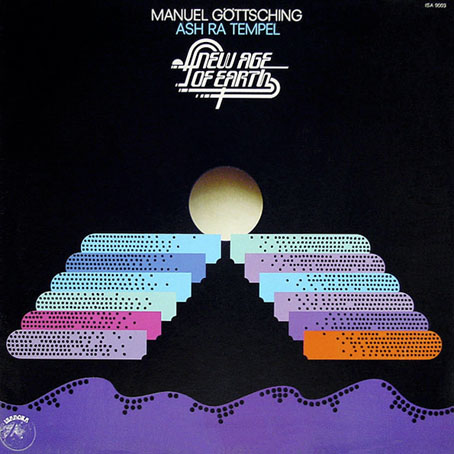
There’s been a lot of Berlin-School pastiching going on over the past few years, the mid-70s albums by Tangerine Dream and Klaus Schulze being very popular among the period imitators. I’m always referring to Redshift and Node as my favourite exponents in this idiom. Chad Davis is obviously inspired by the same albums but my attention was caught on a first hearing by his homages to the music that Manuel Göttsching was making under the Ash Ra Tempel/Ashra name during the same period, especially Le Berceau De Cristal, New Age Of Earth, and (to a lesser extent) Blackouts. Göttsching was always primarily a guitar player, but by the mid-70s he was combining his guitar work with sequencers and synthesizers to create instrumental electronic music with a different texture to his keyboard-based contemporaries. New Age Of Earth has a hippyish title that might be off-putting to curious listeners but it’s long been one of my favourite electronic albums, with a unique atmosphere that I wish Göttsching had pursued a little further. (The title in German on the back of the original French release is Neuzeit der Erde, literally “New Time of Earth”. Zeit again.) The album’s unique qualities are a product of its blend of processed guitar, keyboards and electronic rhythms, the latter being created by the EKO Computerhythm, an early programmable drum machine which could also be used to trigger other instruments to create sequencer patterns.

newage.jpg

New Age Of Earth (1976). Design by Peter Butschkow.

I can’t say for certain whether Davis had this music or instrumentation in mind when recording his third Jenzeits album, Jenzeits Cosmic Orbits, but the similarities were enough to make me want to hear more. One of the frustrations of electronic music historically has been the way the evolution of technology has dictated its form. Tangerine Dream’s music changed according to the instrumentation they had available at any given time; new equipment meant new sounds and musical possibilities very different to the ones the group had been exploring a couple of years before. This doesn’t happen to the same degree with other musicians, especially guitarists who are often happy to play the same battered instrument for years on end. For a listener, the technical evolution of electronic music has often left behind abandoned areas or unexplored avenues. In this respect, the music of Jenzeits is less a series of pastiches than an attempt to further some of these explorations.

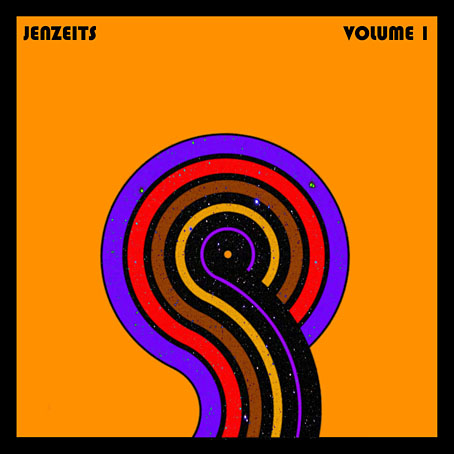
There are 12 Jenzeits releases to date, all of which are available on Bandcamp. Some of the earlier ones have also appeared on vinyl and cassette. If a CD box of the entire Jenzeits catalogue appeared I’d buy it in a second but I doubt this will happen any time soon. For the curious, Jenzeits Volume 1 is a good place to start. The last Jenzeits release was in 2020 which suggests we’ve seen the end of this particular project. For those who’d like more (and I still do), an earlier Chad Davis project, Romannis Mötte, ventured into similar territory.


jenzeits01.jpg

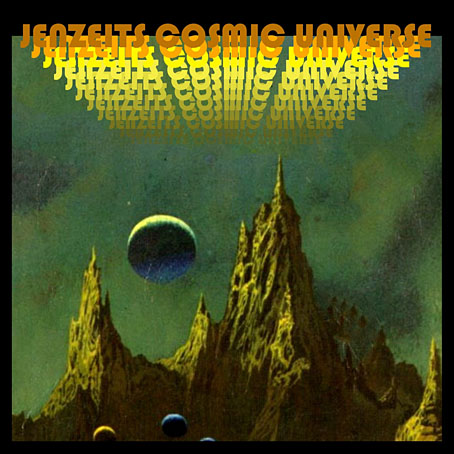
Jenzeits Cosmic Universe (2017).


jenzeits02.jpg

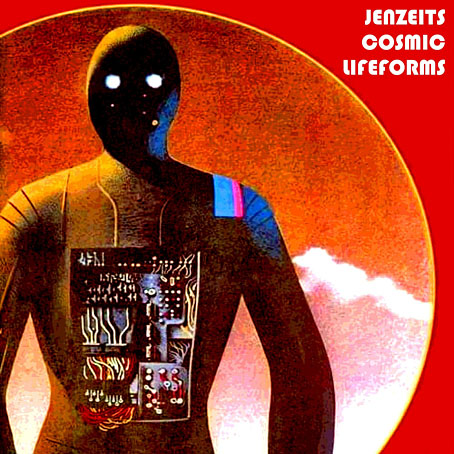
Jenzeits Cosmic Lifeforms (2017).


jenzeits03.jpg

Jenzeits Cosmic Orbits (2017).


jenzeits04.jpg

Jenzeits Volume 1 (2018).


Continue reading “Music beyond time: Jenzeits”