Weekend links 135

kuhlman.jpg

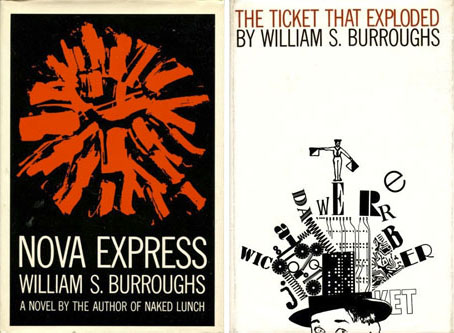
Two Grove Press covers by Roy Kuhlman. From Arden Kuhlman Riordan’s Pinterest page collecting her father’s cover designs.

• “When people asked me what boylesque was, I’d say I’m doing burlesque and I have a penis,” said Mr. Ferguson.

Sequence5: 42 tracks of new, atmospheric/ambient music. A free download in a variety of formats.

The trailer for Jimmy’s End, the forthcoming film by Alan Moore and Mitch Jenkins.

As a porn performer, I can say from experience and with confidence that I’ve never been objectified by other performers. Nor have I been objectified by viewers. At least not in a way that seemed to confuse them into thinking I was an object. What happens instead is that I shift in and out of object-hood. Athletes do this too—they engage with their bodies for a specific task. At the end of the game or the shoot, the context changes.

Conner Habib on The Virtues of Being an Object

Secret Weapons (1972), David Cronenberg’s lost TV movie resurfaces.

Joseph Burnett reviews Nude, the new album by The Irrepressibles.

Over a third of e-readers are used just once before being set aside.

The guarded, the cautious, the small-scale, the modest, the well-crafted—such books may be rewarded (in our own time, at the national level), but they are rarely preserved. They are not preserved because guardedness, caution, smallness, modesty, and craft can be replaced in any given generation. What is irreplaceable is excess: Of verbal kinesis, religious intensity, intellectual voracity.

Amit Majmudar on Entertainment and Excess: The Great Literary Audiences

Miniature Book Interviews with Louis Wain Bound by Hand.

A Tour Inside Salvador Dalí’s Labyrinthine Spanish Home.

• Horror fiction should be deep, not cheap, says Nina Allan.

• RIP Peter Kuhlmann aka Pete Namlook

More is More by Alex Trochut

The Useless Web

Lost In The Sea (1992) by Sequential (Pete Namlook & DJ Criss) | Angel Tech (1994) by Bill Laswell & Pete Namlook | Yenlik (Part II) (1996) by Burhan Öçal & Pete Namlook
Dalí in New York

dali.jpg

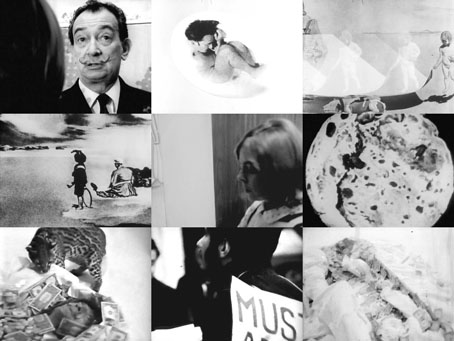
Another Dalínean gem surfaces at Ubuweb. Dalí in New York is a fascinating 50-minute account of the artist’s antics in New York City at the end of 1965. Unlike the reverential documentaries of the 1970s this film isn’t out to flatter its subject: scenes of the usual Dalí happenings are intercut with some combative verbal sparring from the equally remarkable Jane Arden who does her best to try and make sense of the painter’s pronouncements. The director was Arden’s collaborator, Jack Bond, most of whose work was for television although he’s also notable for having directed the Pet Shop Boys’ It Couldn’t Happen Here (1988), a film with some not entirely successful “surrealist” moments of its own.

Previously on { feuilleton }
The Secret Life of Edward James
René Magritte by David Wheatley
Soft Self-Portrait of Salvador Dalí
Mongolian impressions
Hello Dali!
Dirty Dalí
Impressions de la Haute Mongolie revisited

The art of Juan de Valdés Leal, 1622–1690

leal1.jpg

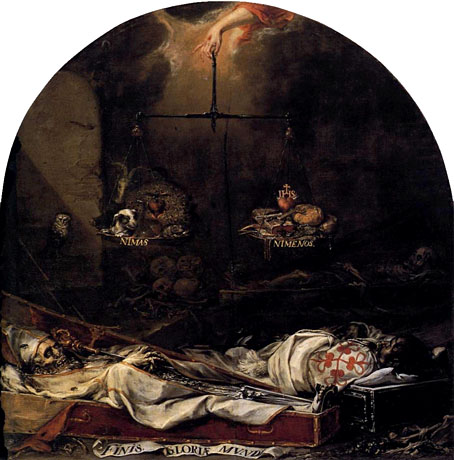
In ictu oculi (1672).

Having castigated Somerset Maugham yesterday for a novel that even he professed to dislike, thanks can be offered for the passage in The Magician which draws attention to a painter I hadn’t come across before. With a scythe-wielding skeleton snuffing a candle flame, and a bishop rotting in his casket, these are a very Spanish take on the vanitas genre. Some of the subsequent works of Salvador Dalí and Luis Buñuel are less surprising when you see art that’s this grotesque.

leal2.jpg

Finis gloria mundi (1672).

Previously on { feuilleton }
Alfred Rethel’s Totentanz
The art of Jacopo Ligozzi, 1547–1627
Massachusetts memento mori
Skull cameras
Walmor Corrêa’s Memento Mori
The skull beneath the skin
Vanitas paintings
Very Hungry God
History of the skull as symbol

Un Chien Andalou

andalou.jpg

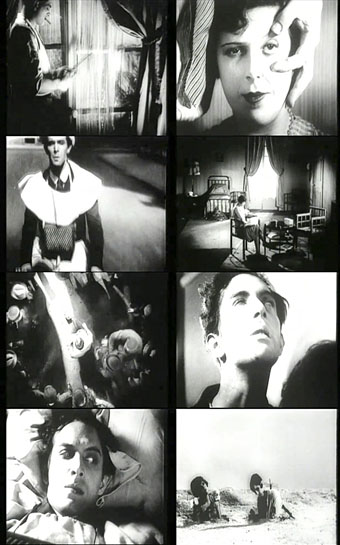
What is there to say about Buñuel and Dalí’s timeless film that hasn’t already been said? It’s one of the primary Surrealist documents and something that everyone should see at least once. Cyril Connolly attended the Paris premiere in 1929:

The picture was received with shouts and boos and when a pale young man tried to make a speech, hats and sticks were flung at the screen. In one corner a woman was chanting, “Salopes, salopes, salopes!” and soon the audience began to join in. With the impression of having witnessed some infinitely ancient horror, Saturn swallowing his sons, we made our way out into the cold of February, 1929, that unique and dazzling cold…

Why does this strong impression still persist? Because Un Chien Andalou brought out the grandeur of the conflict inherent in romantic love, the truth that the heart is made to be broken, and after it has mended, to be broken again. For romantic love, the supreme intoxication of which we are capable, is more than an intensifying of life; it is a defiance of it and belongs to those evasions of reality through excessive stimulus which Spinoza called “titivations.” By the law of diminishing returns our desperate century forfeits the chance of being happy and, because it finds happiness insipid, our world is regressing to chaos.

The film comes and goes on YouTube so serious viewers are directed to the BFI DVD/Blu-ray release which comes twinned with Buñuel’s L’Age D’Or.

Previously on { feuilleton }
Dreams That Money Can Buy
La femme 100 têtes by Eric Duvivier
Entr’acte by René Clair

The Secret Life of Edward James

james1.jpg

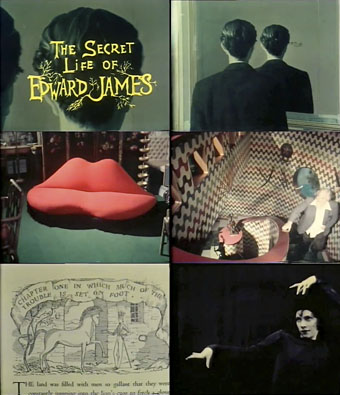
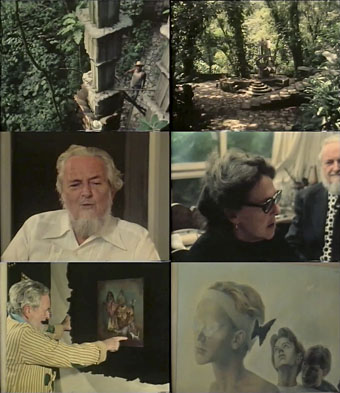
From the earliest days of YouTube there were two films about Surrealist art that I’d been hoping would one day be posted somewhere so I could watch them again. One was José Montes-Baquer’s collaboration with Salvador Dalí, Impressions de la Haute Mongolie – Hommage á Raymond Roussel (1976), which eventually turned up at Ubuweb; the other was Patrick Boyle’s The Secret Life of Edward James, a 50-minute documentary about the wealthy poet and Surrealist art patron that was screened once, and once only, on the UK’s ITV network in 1978. Boyle’s film, which was narrated by James’ friend and fellow Surrealism enthusiast, George Melly, was my first introduction to a fascinating figure who was one of the last—if not the last—of the many eccentric aristocrats that these islands have produced. I knew James’ name from Surrealist art books where the Edward James Foundation was credited as the owner of paintings by Magritte and Dalí, but had no idea that James was the model for three of Magritte’s paintings, including La reproduction interdite (1937); or that he’d abandoned his huge ancestral home to create a Surrealist house at nearby Monkton, and had also commenced the construction of a concrete fantasia, Las Pozas, in the heart of the Mexican jungle at Xilitla. Boyle’s film explores all of this in the calm and uncondescending manner that used to be a staple of UK TV documentaries. I’ve been telling people about this film for years, hoping that somebody might have taped it (unlikely in 1978) but no-one ever seemed to have seen it.

james2.jpg

In 1986, two years after James’ death, Monkton was up for sale so Central TV sent George Melly and director Patrick Boyle to revisit the place. Monkton, A Surrealist Dream, was the result, a 26-minute documentary which relied heavily on the earlier film to fill out the details of James’ life. The original resurfaced for me again, albeit briefly, in Brighton in 1998. A Surreal Life: Edward James (1907–1984) was an exhibition at the Brighton Museum & Art Gallery that featured many works from the James art collection, including major pieces by Leonora Carrington (who appears in Boyle’s film), Dalí, Leonor Fini, Magritte, Picasso, Dorothea Tanning, Pavel Tchelitchew and others. A tape of the 1978 documentary was showing on a TV in one part of the exhibition but the people I was with were reluctant to stand around for an hour so all I got to see was a minute or so of Edward in his jungle paradise. Happily we’re all now able to watch this gem of a film since it was uploaded to YouTube earlier this month (my thanks to James at Strange Flowers for finding it!).

james3.jpg

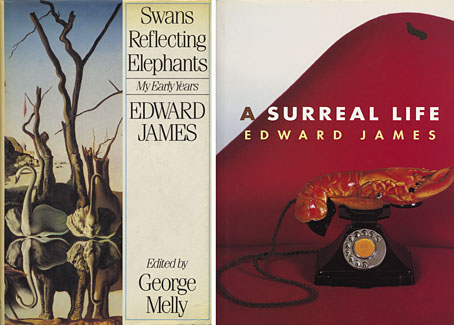
For anyone whose interest is piqued by all of this, two books are worth searching for: Swans Reflecting Elephants, My Early Years (1982) is an autobiography which George Melly compiled from conversations with its subject (and which apparently finished their friendship). James’ propensity for invention means it can’t always be trusted but then that’s the case with many memoirs. A Surreal Life: Edward James (1998) is the 160-page exhibition catalogue which explores James’ life and aesthetic obsessions in a series of copiously-illustrated essays. Both books can be found relatively cheaply via used book dealers.

Previously on { feuilleton }
Las Pozas panoramas
René Magritte by David Wheatley
Soft Self-Portrait of Salvador Dalí
Mongolian impressions
Hello Dali!
Return to Las Pozas
Dirty Dalí
Impressions de la Haute Mongolie revisited
Las Pozas and Edward James