Zones on wheels

zones.jpg

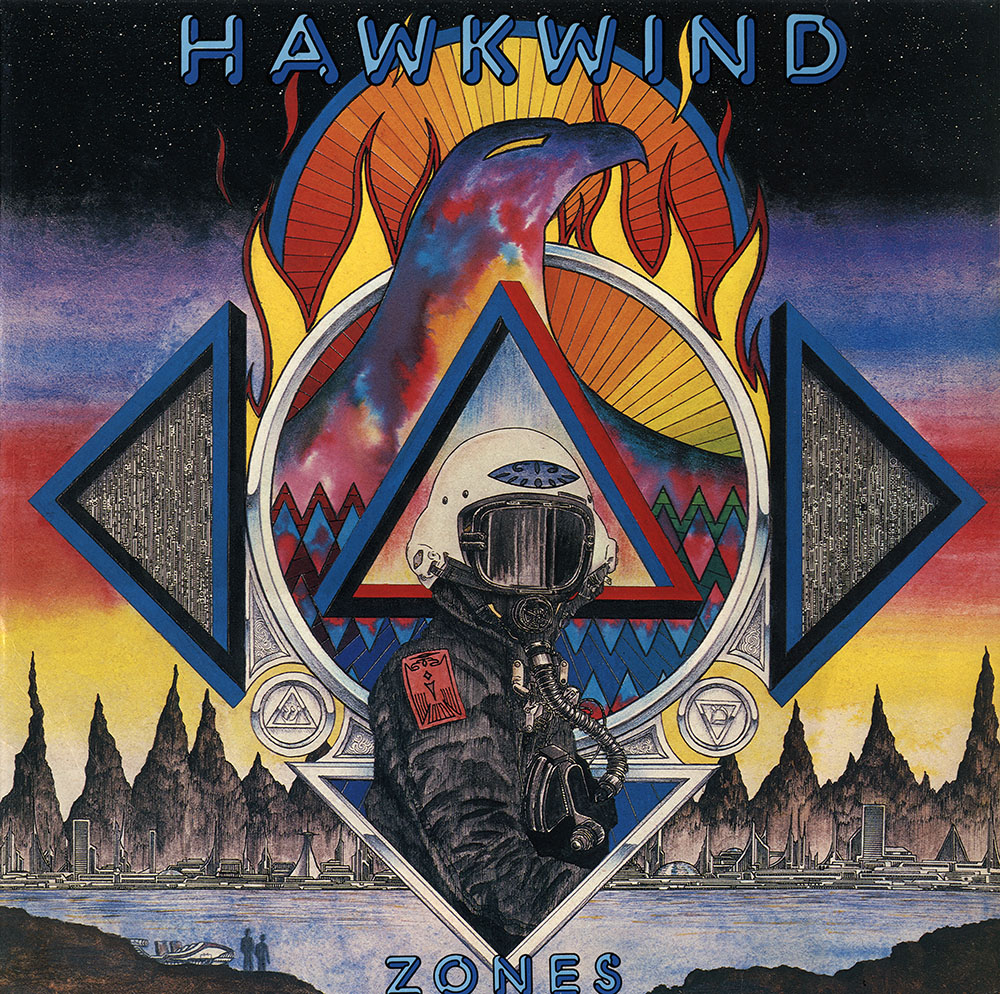
Zones (1983).

My thanks to Nigel Day for sending me the following photos of the rear end of a Lambretta scooter that he was recently asked to decorate with art based on my cover for Zones by Hawkwind. He’s done a marvellous job, and even improved a little on the colour gradations behind the hawk’s head which in my painting don’t evolve as smoothly as they should. Nigel trades under the name Harry’s Hotrod Shop; there’s a website here as well as pages under the same name at Facebook, Instagram and TikTok.
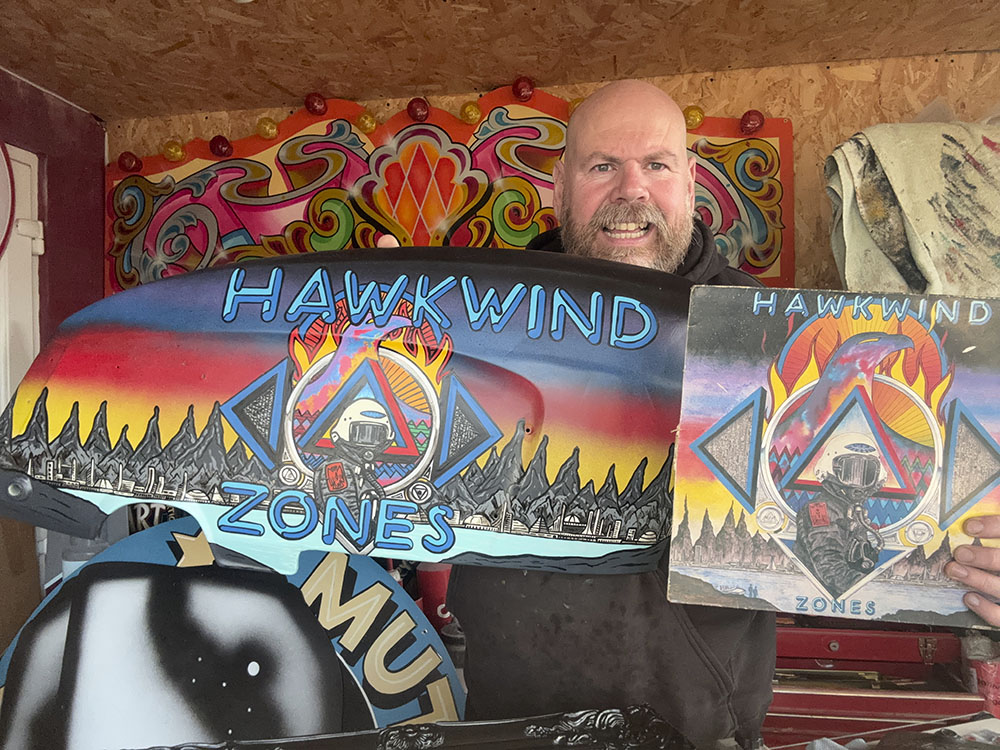

lambretta1.jpg

lambretta2.jpg

As I’ve no doubt said before, the Zones sleeve is one of the few Hawkwind covers I don’t feel abjectly embarrassed by. The album was released in October 1983, and was my second cover for Hawkwind, following an album released the month before whose terrible artwork was something I sent to Dave Brock that I never intended to have used anywhere. The Zones art was something I’d created on spec the year before, shortly after what would have been my cover for the Church Of Hawkwind album was forced onto the album’s lyric book by an art director at RCA who hated the material he’d been given to work with. This wasn’t the only unpleasant incident from the group’s short tenure at RCA. Zones was released on Flicknife Records, an independent label that proved to be a much better home for the band.
zones-japan.jpg

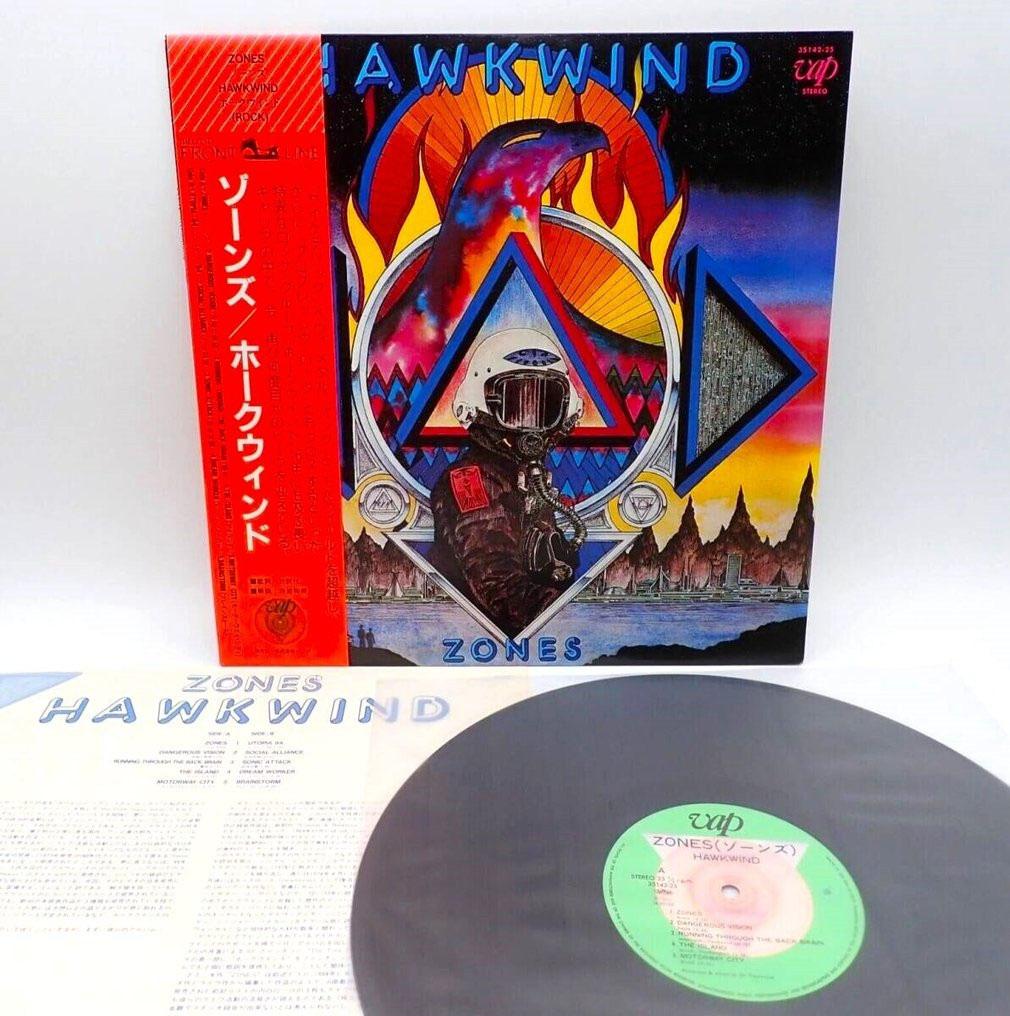
A rare Japanese vinyl release.

The album itself is a pretty good collection of live recordings from 1980 to 1982, with highlights that include a Michael Moorcock song, Running Through The Backbrain, with Moorcock himself on vocal. This was an exclusive piece until the entire concert (Lewisham, 1980) was released as part of the Levitation box set in 2009. Zones also contains several songs featuring Nik Turner, from the brief period when he returned to the group he’d been expelled from in 1976. And there’s also another live version of Motorway City, a song that first appeared on the Live Seventy Nine album. Having always liked Motorway City I was pleased when the Zones version was released as a single that used another spec piece of mine as the cover art (see this post).
zones-pic-disc.jpg

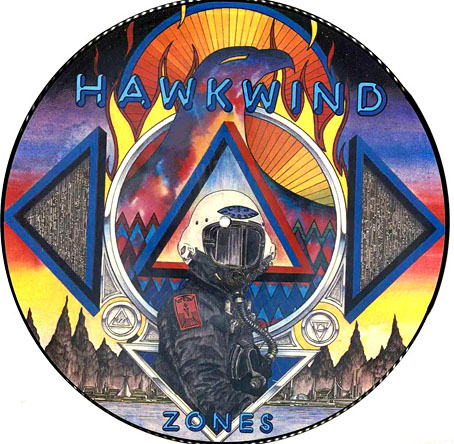
And a picture-disc.

As I said in the post about the single artwork, I was 18 when I did that drawing. I was only 20 when I painted the Zones cover. Imagine something you’d created when you were 20 years old continually turning up again decades later. It’s gratifying, of course, but it can also be disconcerting. People seem to like it anyway, which is more than can be said for some of my other album covers. The weather here is finally getting warmer; prepare for the summer with a Zones T-shirt!

Previously on { feuilleton }
Space is one trip: the Hawkwind takes off
New Wave Strangeness: Hawkwind’s Calvert years
Twinkle, twinkle little stars
Motorway cities
Reality you can rely on
Silver machines
Notes from the Underground
Hawkwind: Days of the Underground
The Chronicle of the Cursed Sleeve
Rock shirts
The Cosmic Grill
Void City
Hawk things
The Sonic Assassins
Barney Bubbles: artist and designer
Space is one trip: the Hawkwind takes off

isos1.jpg

1: The album
Back in the 1990s, when it became apparent that record companies were committed to never-ending CD reissues of their most popular albums, I suggested to a friend that this development would eventually give us releases of the unmixed recordings which the listener would then have to mix themselves: “Now you can be George Martin!” My suggestion wasn’t entirely serious, and there are many reasons why this will never happen, but the wholesale remixing of “classic” albums has been a trend now for ten years or more, and will no doubt continue. It’s easy to see endless reissues as a pernicious development—how many more copies of The Dark Side Of The Moon does the world need?—but I can think of one or two albums which would benefit from a reappraisal of their original mixes. The first two sides of Amon Düül II’s Dance Of The Lemmings, for example, have always sounded sonically inferior to the group’s other albums. The first side in particular is swamped by bass, and the drums, which are so prominent on the previous album, Yeti, are buried in the mix. Given the overtly psychedelic nature of the cover art I sometimes wonder whether anyone in the studio was drug-free during the recording.

Hawkwind shared a record label with Amon Düül II for their first six albums, and the groups are further connected by bass player Dave Anderson who played on Düül’s Yeti in 1970 and Hawkwind’s In Search Of Space in 1971. The latter has just been reissued by Cherry Red in a variety of formats which include the three-disc package (2 x CD and a blu-ray disc) that arrived here at the weekend. The set features two new mixes of the entire album (one of them being the de rigueur 5-channel surround mix), a couple of outtakes, both sides of the Silver Machine single, plus the promo film for the single. The set also contains a substantial booklet which incorporates a reprint of the 24-page logbook that came with early pressings of the album. More about that below.

isos2.jpg

Hawkwind didn’t arrive as fully-fledged cosmic voyagers on their self-titled debut in 1970, it’s here on their second album that the group myth takes flight, presenting the band as travellers through time and space, or “Sonic Assassins” as they were depicted shortly before the album’s release in Codename: “Hawkwind”, a two-page promotional comic strip created by Michael Moorcock and Jim Cawthorn. Many British bands were playing with space themes in 1971 but Hawkwind were the only group to adopt the trappings of science fiction as essential elements of their persona, elements that persisted from one album to the next. In Search Of Space is loosely spacey on the musical side—You Shouldn’t Do That is the earliest example of a future Hawkwind staple, the extended mantra-like groove over which synthesizers swoop and burble—but it’s the album package created by Barney Bubbles and (in the logbook) Robert Calvert that dispels the ambiguity of songs like Master Of The Universe and Adjust Me in a science-fiction scenario where the “space” referred to by the title is dimensional as well as cosmological, with the group’s flattened spacecraft embodied by the physical album. None of this is suggested by the music, you need to read the logbook as well, but the book and the die-cut record sleeve help to frame what would otherwise be a collection of disparate rock songs into a complex artistic statement.

When it comes to the remixing of albums I’ve been sceptical of the benefits of the trend. For the past few years Steven Wilson has been the prime remixer of music from the 1970s and 80s; among other things he remixed Hawkwind’s Warrior On The Edge Of Time and the albums on last year’s Days Of The Underground set, all of which are worth hearing. Less essential have been his new mixes for King Crimson and Tangerine Dream, the latter especially where there’s little discernible difference between the old and new versions. I think the main attraction for many listeners will be the 5-channel surround mixes, especially in the case of Tangerine Dream, but I don’t have a 5-channel sound system so can’t say how effective they are. The new In Search Of Space mixes are the work of another Steve, Stephen W. Tayler, whose reworking of the album has taken me by surprise, giving it a radically different sound rather than the discreet adjusting of levels and instrumentation that I was expecting. Dave Brock has said in interviews that he always dropped acid before making the final mix of the Hawkwind albums up to Warrior On The Edge Of Time, which may explain why In Search Of Space has always sounded rather thin and dry, while the album that followed it, Doremi Fasol Latido, is a bludgeon by comparison, with everything compressed into the wall of sound which Hawkwind had developed in their live performances. Tayler’s new mix of Master Of The Universe is revelatory, bolstering the bottom end and emphasising the inverted echoes on Nik Turner’s voice, while You Shouldn’t Do That explodes into jet-propelled life. Everything sounds more substantial, and possibly more cosmic; I’ve not done a side-by-side comparison yet but I think Tayler has given greater emphasis to the effects throughout the album, especially all the swooshing and burbling electronic instruments. If you’ve ever shared my scepticism about the remixing trend then Tayler’s work here should be considered an argument in its favour.

Continue reading “Space is one trip: the Hawkwind takes off”

Weekend links 647

oneill.jpg

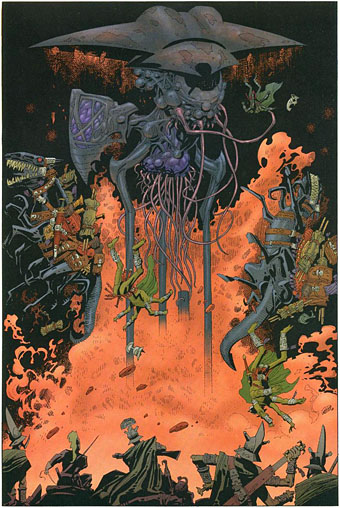
A local dispute on the planet Mars. Art by Kevin O’Neill from The League of Extraordinary Gentlemen.

• “…this image has puzzled enthusiasts of the scientific mystic’s works, both for its obscure provenance and cryptic symbolism. With its pastiche of Renaissance visual style and medieval caption — “A missionary of the Middle Ages tells that he had found the point where the sky and the Earth touch” — the illustration was once thought to have originated centuries before Flammarion published his text.” Hunter Dukes on the enduring mystery of the “Flammarion Engraving”.

• “For Spare, radio, and the waves that carried the music he loved to listen to, were more than just a metaphor for the spirit world. They were an active mode of conveyance for occult energies and vibrations – the swirling, ectoplasmic tendrils from which odd figures emerge in some of his most dense and haunting work.” Mark Pilkington explores Austin Osman Spare’s influence on the world of music.

• At Spine: Design studio Milk & Bone’s designer Alicia Raitt re-imagines all 14 of Kurt Vonnegut’s book covers to celebrate his 100th birthday.

• Farewell to Kevin O’Neill and Nik Turner, both of whom headed to the Western Lands this week.

Mean, moody and magnificent: film noir studio portraits – in pictures.

• Mix of the week: XLR8R Podcast 773 by Roméo Poirier.

• New music: Evergreen by Patrick Shiroishi.

Brainstorm (1972) by Hawkwind | Hurricane Fighter Plane (1985) by Inner City Unit | Brainstorm (1993) by Monster Magnet

Twinkle, twinkle little stars

turner1.jpg

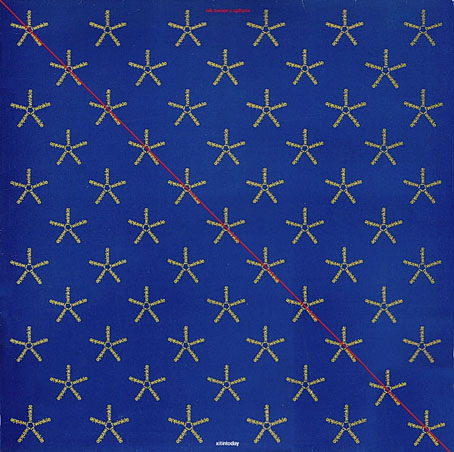
Xitintoday (1978) by Nik Turner’s Sphynx.

It’s been a long time since I’ve had a reason to write about Barney Bubbles but I’ve finally worked out why one of his more mysterious album covers looks the way it does.

When Nik Turner was unceremoniously kicked out of Hawkwind in 1976 he headed to Cairo to consider his next move. While there he recorded an hour or two of flute improvisations inside the sarcophagus in the King’s Chamber of the Great Pyramid of Cheops. The resulting tapes provided the basis for his first solo album, Xitintoday, which was released in 1978 on the Charisma label, and credited to Nik Turner’s Sphynx. Steve Hillage produced the album, helping to craft the meandering solos into a suite of songs based on passages from The Egyptian Book of the Dead. Xitintoday is one of the more unusual concept albums from a decade filled with such things. I’ve always liked it, in many ways it’s closer to Hillage’s oeuvre than Turner’s, as well as being very different to anything else in the Hawk-sphere.

turner2.jpg

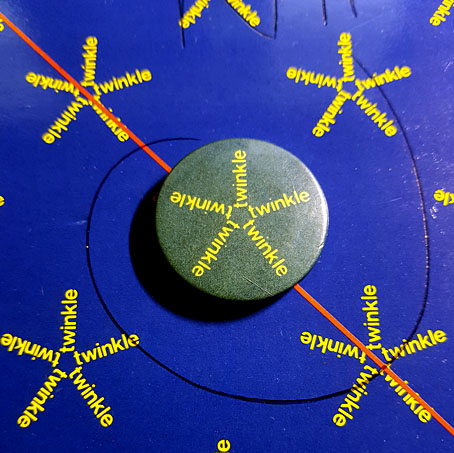
A faded promo badge. The ballpoint scrawl is Mr Turner’s autograph.

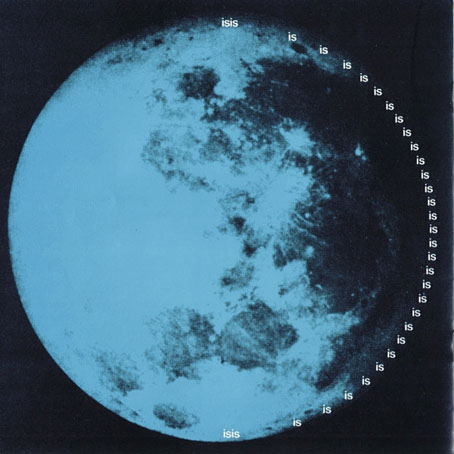
Barney Bubbles’ design for the album is also very different to anything else in the Hawk-sphere, an example of what might be called his High Modernist period, when the hippy motifs and decorative pastiches of his earlier work were replaced with bold, flat colours and playful graphic designs. Xitintoday was released with a square booklet containing lyrics, notes about the mythological theme, and a series of pictures which combine diagrams and Ancient Egyptian reliefs with calligram-like wordplay. The back cover of the album exemplifies the latter, with the word “Day” spelled out in much smaller words reading “Night”; inside the booklet there’s a page for Isis the Moon Goddess where the words “Isis is is is is…” form a curve around a photograph of the Moon. The cover design continues the cosmic theme with a field of star shapes in which each star is created by the word “Twinkle”. The star field makes sense in the context of the booklet but I’ve wondered for a long time why Barney Bubbles thought it was a suitable cover design rather than simply being another booklet page.

turner3.jpg

The solution arrived last week when work-related research had me looking through old design books for examples of Ancient Egyptian ornamentation. One of these, The Grammar of Ornament (1856) by Owen Jones, contains several pages of full-colour plates filled with Egyptian pattern samples.

egypt1.jpg

And on one of those pages there are these two squares which made me think immediately of the Xitintoday cover. This might seem tenuous when the cover design doesn’t feature any red dots but Barney Bubbles was an avid Egyptophile, avid enough to name his son after one of the Egyptian gods. A quick search revealed many more examples of this pattern which are closer matches for the cover design.

egypt2.jpg

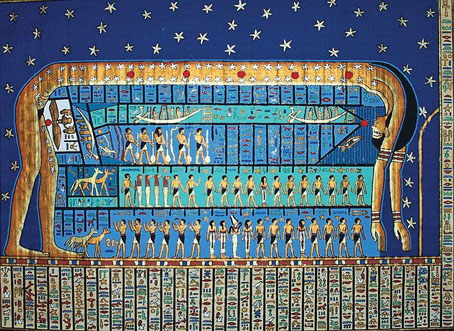
It turns out that the yellow star on a blue background was a common way of representing the night sky in Egyptian art, you’ll find the same stars in wall paintings and on the ceilings inside royal tombs.

egypt3.jpg

For years I’ve regarded the Xitintoday cover as being uncharacteristically random and abstract, surprisingly so when Bubbles designs from the same period are all so smart and well-considered. This discovery puts the Sphynx album in the same category, a design which avoids many more obvious solutions for a combination of the very old and the very new. Another feature of Barney Bubbles design is a kind of “Aha!” moment, when your appreciation of the design catches up with the thinking behind it. The appreciation this time has taken an outrageously long time to arrive but I’m pleased to have got there in the end.

Previously on { feuilleton }
Led Zeppelin IV: Jimmy Page versus Little Bo-Peep
The Grammar of Ornament revisited
On the pyramid

Weekend links 646

wallpaper.jpg

It’s that lethal book again. A sample of wallpaper impregnated with arsenic, one of many such pages in Shadows from the Walls of Death: Facts and Inferences Prefacing a Book of Specimens of Arsenical Wall Papers (1874) by RC Kedzie.

• “I like to spend time in the now because there I can create something new but in the past I cannot.” Damo Suzuki, former vocalist in Can, on creativity and his resilience in the face of long-term illness. Related: a trailer for Energy: A Documentary about Damo Suzuki.

• “I enjoy Carnival of Souls, but it is a dark form of enjoyment, with high stakes, because the enjoyment is predicated on me being able to shake myself free of the film after it is over, and that can be a struggle.” Colin Fleming on fear as entertainment.

• “Some people like fantasy epics or Regency romance or Sudoku or science-fiction world-building or the gentle challenge of cozy mysteries; I like the undead.” Sadie Stein on encounters with ghosts.

• “You’re now standing on the blocks of the Great Pyramid at Giza. For the first time ever you can explore the entire pyramid interior.” The Giza Project.

• “What do we think about when we watch films set in vanished decades that many of us experienced at first hand?” asks Anne Billson.

• At Bandcamp: Touch celebrates forty years of not being a record label.

• “Why scientists are sending radio signals to the Moon and Jupiter.”

• At DJ Food’s: Retinal Circus gig posters 1966–68.

• Steven Heller’s font of the month is Feneon.

The Pyramid Spell (1978) by Nik Turner | I Am Damo Suzuki (1985) by The Fall | Carnival Of Souls Goes To Rio (2001) by Pram