Kenneth Grant, 1924–2011

grant.jpg

Kenneth Grant by Austin Spare (c. 1951).

Kenneth Grant, writer and occultist, died last month but the event was only announced this week. He’ll be remembered for the nine fascinating occult treatises he wrote from 1972 to 2002, and for continuing the work of Aleister Crowley as head of the Ordo Templi Orientis, a position which became fraught in later years as various occult factions disputed his authority. Having collected occult books for much of the 1980s I find his name calls out from the shelves more than many other writers; as well as authoring his own works he edited all the major Crowley texts with Crowley’s executor John Symonds, presenting them in authoritative editions for a new readership.

Grant proved a very loyal champion of people he admired, significantly so in the case of Austin Osman Spare whose work he collected, exhibited and republished from the 1950s on. It was Grant’s position as one of the many advisors for Man, Myth & Magic in 1970 which resulted in the part-work encyclopedia using one of Spare’s stunning drawings as the cover picture for its first issue. That effort alone gave Spare an audience far beyond anything he received during his lifetime, and Grant ensured the magazine featured Spare’s work in subsequent issues. Grant’s occult works made liberal use of unique illustrations by his wife, Steffi Grant, Austin Spare and others. The books were singular enough even without their pages of curious artwork, a beguiling and sometimes incoherent blend of western occult tradition, tantric sex magick and hints of cosmic horror which were nevertheless always well-written, annotated and crammed with technical detail. Alan Moore in 2002 examined the experience of an immersion in Grant’s mythos with a wonderful review he called “Beyond our Ken“. He notes there the influence of HP Lovecraft, another of the visionary figures who Grant championed throughout his life.

between.jpg

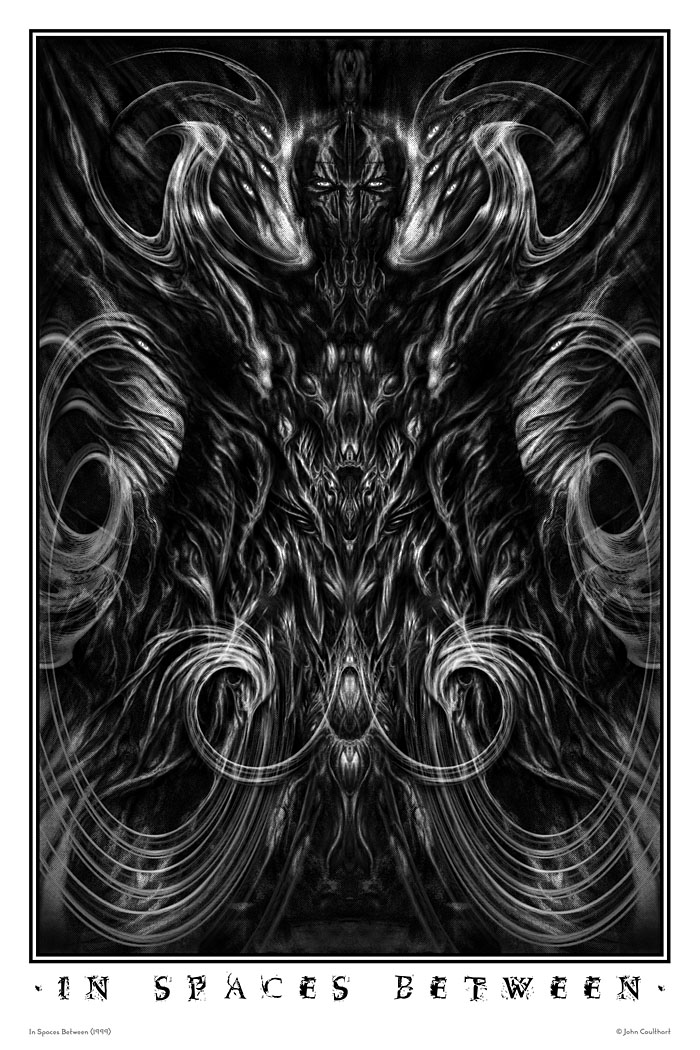
In Spaces Between from The Great Old Ones (1999).

And speaking of Lovecraft, I’ve often wondered whether Kenneth Grant ever saw a copy of my Haunter of the Dark collection. For the opening of the Great Old Ones Kabbalah sequence which Alan Moore and I created for the book I added an extra piece of art entitled In Spaces Between, a reference to Coil via an epigraph from Grant’s Outside the Circles of Time (1980) which I borrowed for the facing page:

For there are Thrones under ground
And the Monarchs upon them
Reign over Space and Beyond

Invoke Them in Darkness, Outside
The Circles of Time

In Silence, in Sleep, in Conjurations
Of Chaos, the Deep will respond…

Coil aficionados will recognise those words as the origin of some lines from Titan Arch (1991):

There are Thrones under ground
And Monarchs upon them
They walk serene
In spaces between

Grant followed his epigraph with another quote, from Lovecraft’s Necronomicon.

In addition to Alan Moore’s Grant review, Fulgur have a detailed Kenneth Grant bibliography on their pages. They were also the publishers in 1998 of Zos Speaks! Encounters with Austin Osman Spare by Kenneth and Steffi Grant, a memoir and celebration of Spare’s work which revealed this trio of remote astral voyagers to be human beings after all. The book is currently out of print but it’s essential for anyone interested in Austin Spare or, for that matter, Mr and Mrs Grant.

Previously on { feuilleton }
New Austin Spare grimoires
Austin Spare absinthe
Aleister Crowley on vinyl
Austin Spare’s Behind the Veil
Austin Osman Spare

Dan O’Bannon, 1946–2009

alien.jpg

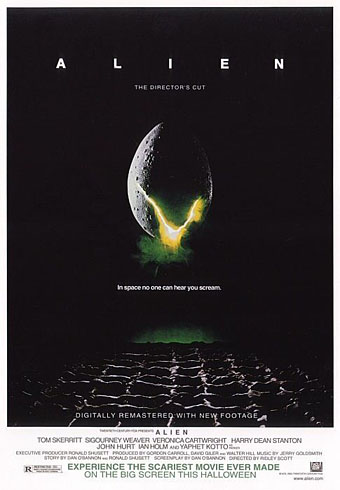
Re-release poster by Bemis Balkind.

Alien was a big deal for me when it appeared in late 1979, one of those films that seems to arrive at exactly the right moment. I’d just left school, I was eagerly reading reprints of French and Belgian comic strips in Heavy Metal magazine, and also paperback reprints of science fiction stories from New Worlds; I was listening to Hawkwind and becoming increasingly obsessed with HP Lovecraft. I was, in short, the target audience for a serious SF-themed horror film with contributions from major artists like HR Giger and Jean “Moebius” Giraud, and I went to see it three times in a row.

Watching Star Wars two years earlier (for which Dan O’Bannon created the computer displays), I’d enjoyed the special effects but been disappointed by its space-opera tone and dumb heroics. HR Giger’s large-format Necronomicon art book was published in the UK the same year and the sight of his work was a revelation for the way it pushed Dalí-esque Surrealism to a pitch of unprecedented mutation and malevolence. A year later his paintings were appearing in Omni magazine but it was Alien which exploded his popularity. Throughout 1979 you could hardly open a magazine or newspaper without finding a Giger interview or examples of his work. Alien benefited from the SF boom that Star Wars generated but Dan O’Bannon didn’t need George Lucas’s feeble mythology to point him towards science fiction, he’d already made one low-budget sf film, Dark Star, with John Carpenter, and was planning the effects for Jodorowsky’s ill-fated Dune project years before the world had heard of Luke Skywalker. Dune introduced him to Moebius, and the pair collaborated on an SF-noir strip, The Long Tomorrow, which was published in Heavy Metal in 1977. But it was Giger’s connection with the Dune project which proved crucial for Alien:

“(Dune) collapsed so badly,” O’Bannon says, “that I ended up in L.A. without any money, without an apartment, without a car, with half my belongings back in Paris and the other half in storage.”

He retreated to the sofa of a friend, screenwriter Ron Shusett, and didn’t leave it for a week. But depressed or not, O’Bannon knew he had to get back to work. He got his files and typewriter out of storage, and he and Shusett went to work on stacks and stacks of partially completed ideas.

“We pulled out one that I liked very much,” he says, “an old script called Memory that was half-finished and was basically what the first half of Alien is now. I told Ron I’d never been able to figure out the rest of the story. So he read it and said, ‘Well, you told me another idea you had once for a movie. It was the one where gremlins get onto a B-17 bomber during World War II and give the pilots a lot of trouble. So why don’t you make that the second half and put it on a spaceship?’

“That was a great idea, but then we had to figure out the monster. Well, I hadn’t been able to get Hans Rudi Giger off my mind since I left France. His paintings had a profound effect on me. I had never seen anything that was quite as horrible and at the same time as beautiful as his work. And so I ended up writing a script about a Giger monster.”

The working title was Star Beast. O’Bannon had a fortunate brainstorm late one night as he continued to write while Shusett slept. “I was writing dialogue and one of the characters said, ‘What are we going to do about the alien?’ The word came out of the page at me and I said, ‘Alien. It’s a noun and an adjective.’ So I went in the other room and shook Ron awake and told him and he said, ‘Yeah, OK,’ and went back to sleep. But I knew I had found a really hot title.”

The Book of Alien (1979) by Paul Scanlon and Michael Gross

Lest we forget, it was O’Bannon who insisted that Ridley Scott look at Giger’s work during the production of the film after artist Ron Cobb failed to produce a sufficiently nightmarish creature. O’Bannon’s script was mauled by Walter Hill who removed sub-plots, and further scenes were trimmed to speed the pace, but Alien‘s unique atmosphere remains as potent today as it was in 1979. It’s ironic that O’Bannon died in the week that James Cameron’s Avatar (which happens to star Sigourney Weaver) is released. To watch all four Alien films in sequence is to witness progressively diminishing returns, and it was Cameron’s sequel which set the pattern for the later films by dropping the adjective part of the O’Bannon’s title in favour of the noun. There had been plenty of movie monsters before but it was the inhuman quality which we label “alien” that O’Bannon and Giger brought to SF cinema. It’s a quality that few have been able to deliver since, not least in Avatar which (from what I’ve seen) looks less alien than something Frank R Paul might have painted in the 1930s. O’Bannon did a lot more after Alien, of course, but it’s his first big success which will always mean the most to me. I recommend Ridley Scott’s director’s cut from 2003 which restored scenes and shots removed from the original release.

Remembering the late, great Dan O’Bannon
The first action heroine: Ellen Ripley and Alien, 30 years on

Previously on { feuilleton }
Alejandro Jodorowsky’s Dune
The monstrous tome

A playlist for Halloween

rethel.jpg

Der Tod als Erwürger (1851) by Alfred Rethel.

It’s a fact (sad or otherwise) that a substantial percentage of my music collection would make good Halloween listening but in that percentage a number of works are prominent as spooky favourites. So here’s another list to add to those already clogging the world’s servers, in no particular order:

Theme from Halloween (1978) by John Carpenter & Alan Howarth.
What a surprise… All John Carpenter‘s early films have electronic scores and great themes, Halloween being the most memorable, and one that’s gradually infected the wider musical culture as various hip hop borrowings and Heat Miser by Massive Attack demonstrate.

Monster Mash (1962) by Bobby “Boris” Pickett.
The ultimate Halloween novelty record. A host of imitators followed the success of this single while poor Bobby struggled to be more than a one-hit wonder. It wasn’t to be, this was his finest hour. Available on These Ghoulish Things: Horror Hits for Halloween with some radio spots by Bobby and a selection of other horror-themed rock’n’roll songs.

The Divine Punishment (1986) & Saint of the Pit (1988) by Diamanda Galás.
Parts 1 & 2 of Galás’s Masque of the Red Death, a “plague mass” trilogy based on the AIDS epidemic. These remain my favourite records by Ms Galás; on the first she reads/sings passages from the Old Testament accompanied by sinister keyboards, making the Bible sound as steeped in evil and metaphysical dread as the Necronomicon. On Saint of the Pit she turns her attention to French poets of the 19th century (Baudelaire, Gérard de Nerval & Tristan Corbière) while unleashing the full power of her operatic vocalizations. Einstürzende Neubauten’s FM Einheit adds some thundering drums. “Correct playback possible at maximum volume only.” Amen to that.

The Visitation (1969) by White Noise.
An electronic collage piece about a ghostly lover returning to his grieving girlfriend. White Noise were David Vorhaus working alongside BBC Radiophonic Workshop pioneers Delia Derbyshire and Brian Hodgson to create an early work of British electronica and dark psychedelia. The Visitation makes full use of Derbyshire and Hodgson’s inventive tape effects and probably accounts for them being asked to score The Legend of Hell House a few years later. Immediately following this is the drums and screams piece, Electric Storm In Hell; play this loud and watch the blood drain from the faces of your Halloween guests.

Zeit (1972) by Tangerine Dream.
Subtitled “A largo in four movements”, Zeit is Tangerine Dream’s most subtle and restrained album, four long tracks of droning atmospherics.

The Masque of the Red Death (1997) read by Gabriel Byrne.
From Closed On Account Of Rabies, a Poe-themed anthology arranged by Hal Willner. The readings are of variable quality; Christopher Walken’s The Raven is effective (although I prefer Willem Defoe’s amended version on Lou Reed’s The Raven) while Dr John reads Berenice like one of Poe’s somnambulists. Gabriel Byrne shows how these things should be done.

De Natura Sonoris no. 2 (1971) by Krzysztof Penderecki.
More familiar to people as “music from The Shining“, this piece, along with much of the Polish composer‘s early work, really does sound like music in search of a horror film. His cheerily-titled Threnody For The Victims Of Hiroshima is one piece that won’t be used to sell cars any time soon. Kubrick also used Penderecki’s equally chilling The Dream of Jacob for The Shining score, together with pieces by Ligeti and Bartók.

Treetop Drive (1994) by Deathprod.
Helge Sten is a Norwegian electronic experimentalist whose solo work is released under the Deathprod name. “Electronic” these days often means using laptops and the latest keyboard and sampling equipment. Deathprod music is created on old equipment which renders its provenance opaque leaving the listener to concentrate on the sounds rather than be troubled by how they might have been created. The noises on the deceptively-titled Treetop Drive are a disturbing series of slow loops with squalling chords, anguished shrieks and some massive foghorn rumble that seems to emanate from the depths of Davy Jones’ Locker. Play it in the dark and feel the world ending.

Ouroborindra (2005) by Eric Zann.
Another collection of sinister electronica from the Ghost Box label (see this earlier post), referencing HP Lovecraft and Arthur Machen’s masterpiece, The White People. Spectral presences haunting the margins of the radio spectrum.

Theme from The Addams Family (1964) by Vic Mizzy.
Never the Munsters, always the Addams Family! If you don’t know the difference, you must be dead.

Happy Halloween!

Previously on { feuilleton }
The music of the Wicker Man