Gloves

klingerglove.jpg

A Glove: Anxieties (1881) by Max Klinger.

Although the Glove‘s scenario was given its due Germanic explication by contemporary critics, it defies rational analysis. The last picture, which was seen as a kind of happy ending to the glove’s peregrinations, is particularly ambiguous and leaves the whole meaning of the series in doubt. The story is a parable of loss based on a trivial lost article, like the lost keys in Bluebeard and in Alice, like Desdemona’s missing handkerchief, or like the philosopher’s spectacles in Klinger’s own Fantasy on Brahms, which have slid out of their proprietor’s reach just as he was nearing the summit of a kind of Matterhorn. There are overtones of erotic symbolism and fetishism in the glove and the phalloid monster who abducts it, heightened for a modern viewer by the Krafft-Ebing period costumes and décors (the engravings appeared in 1881, and the drawings were apparently finished in 1878).

John Ashbery describing Max Klinger’s extraordinary series of etchings A Glove (aka Paraphrase on the Finding of a Glove) which in their inexplicable narrative of fetishist obsession anticipate Surrealism. See the entire sequence here or here. For A Glove in print there’s The Graphic Works of Max Klinger from Dover Publications.
dechirico.jpg

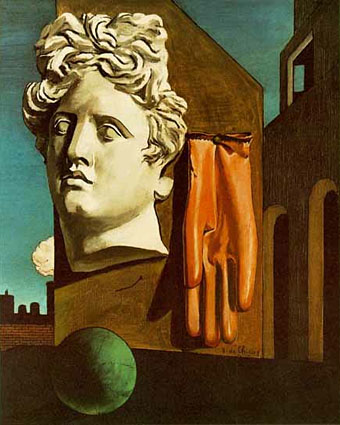
The Song of Love (1914) by Giorgio de Chirico.

Ashbery begins by discussing Giorgio de Chirico’s enthusiasm for Klinger’s work, a passion and influence that provides one of the many connections between the Symbolists and the Surrealists. This “metaphysical” painting looks back to Klinger and forward to Magritte.
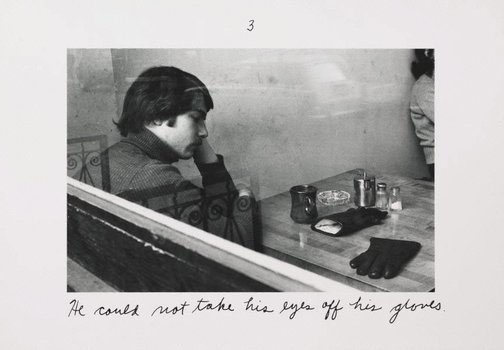
michalsglove.jpg

The Pleasures of the Glove, 3 (1974) by Duane Michals.

The enigmatic encounter of ‘The pleasures of the glove’ follows the lead character as he fantasises about a pair of gloves on the hands of a mannequin in a shopfront window. The perverse pleasure of desiring the gloves but not acquiring them leads him on a surreal adventure of first imagining his own glove as a queer furry tunnel that swallows his hand to the fantasy of stroking the naked body of a woman he sees on the bus with her own glove. (more)

A more contemporary take on the same idea, albeit without the intercession of a pterodactyl-like thief. If Klinger is pre-Surrealism then this is the post- version; Michals photographed René Magritte, and many of his other works run in a distinctly Surreal direction. (Thanks to Anne Billson for the tip!)
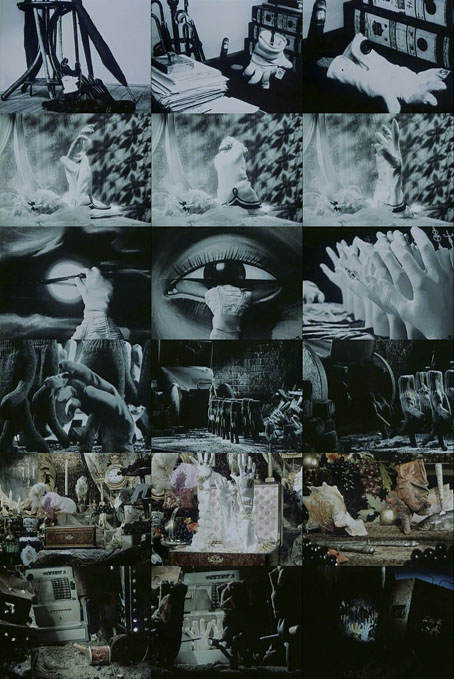
bartagloves.jpg

The Vanished World of Gloves (1982) by Czech animator Jiří Barta features sex, Surrealism and a lot more besides, all in the space of 16 minutes. A can of film is unearthed which contains a series of short episodes pastiching different cinematic styles: Chaplinesque slapstick, swashbuckling romance, Buñuel Surrealism, a war film, a Fellini orgy and a science fiction apocalypse. All the parts are played by gloves, of course, and if you didn’t see the credits you might take this at first for a Svankmajer short.

The Vanished World of Gloves: part one | part two

Update: I knew I’d forgotten something… Added de Chirico’s The Song of Love.

Previously on { feuilleton }
More Golems
Max Klinger’s New Salomé
Barta’s Golem

More Golems

barta.jpg

Golem by Jiri Barta.

There are always more golems. Among recent reading I’ve been catching up with the works of Michael Chabon, and have just finished The Amazing Adventures of Kavalier & Clay (2000), a novel concerned with several things that obsessed me when I was 13, namely Harry Houdini, conjuring tricks and the Empire State Building. Chabon even acknowledges JC Cannell’s The Secrets of Houdini, a book I re-read many times trying in vain to learn some of Houdini’s card tricks. What didn’t obsess me at that age happens to be the main subject of the novel: superhero comics. Chabon does a good job of communicating the enthusiasm that powered the early days of the American comics industry, however, and I can appreciate the enthusiasm that history generates for him even if I don’t quite share it. Lurking at the back of his story is the mute and symbolic figure of Rabbi Loew’s Golem of Prague, mention of which prompted me to see whether Czech animator Jiří Barta had managed to complete his film of the Golem story, a project which has been stalled since the 1990s. He hasn’t, unfortunately, but there is a trailer which I hadn’t seen before, a sight that makes the prospect even more tantalising. Someone give this man some money to finish his film.

emet.jpg

Emet (2009).

Elsewhere, there’s Emet by Bonsaininja Studio, Milan, a short steampunk take on the Golem creation story. Great use of CGI and digital animation but I’d still prefer to see Barta’s version. Meanwhile, the whole of Paul Wegener’s The Golem: How He Came into the World (1920) is now on YouTube. If you’ve never seen Wegener stomping around medieval Prague with his shopping basket then here’s your chance.

See also:
Golem: The Recipe For Life by Michael Chabon

Previously on { feuilleton }
Hodgson versus Houdini
Das Haus zur letzten Latern
Hugo Steiner-Prag’s Golem
Barta’s Golem

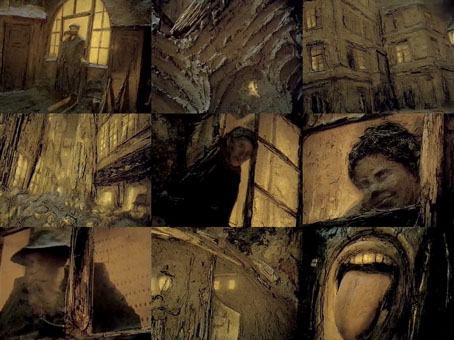
The Hourglass Sanatorium by Wojciech Has

hour-glass1.jpg

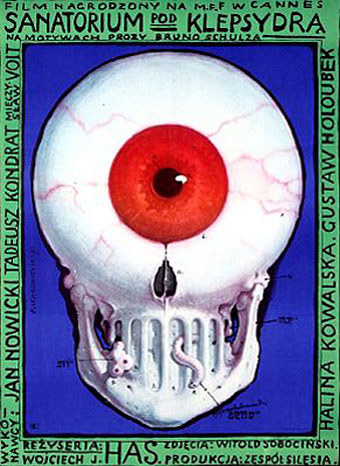
The original Polish poster by the incredible Franciszek Starowieyski.

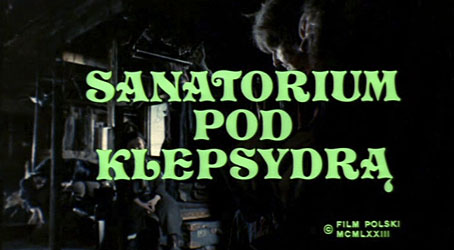
The shrinking pool of films still unavailable on DVD contracted by at least one title recently with the surprise appearance in the UK of The Hourglass Sanatorium (Sanatorium pod klepsydra; 1973) from the distinctively-named Mr Bongo Films. I’ve been waiting to see this for at least twenty years so being able to walk into Fopp and buy a copy for a mere £12 strikes me as one of those small but rarely acknowledged miracles of contemporary existence.

hour-glass2.jpg

Director Wojciech Has is  better known for his long and weird 1965 adaptation of the equally long and weird Saragossa Manuscript, a rambling semi-fantastical novel by Jan Potocki from around 1805. David Lynch described Saragossa as “Simultaneously horrific, erotic and funny…this is one mother of a film,” and the same description could be applied to The Hourglass Sanatorium, as far as I’m aware the only other excursion Has made into full-on strangeness. If anything, Sanatorium outdoes the earlier film on just about every level. Readers familiar with the writings of Bruno Schulz will already have recognised the title as being a truncated variant of Sanatorium Under the Sign of the Hourglass, the second and final collection of Schulz’s unique and very strange stories.

Continue reading “The Hourglass Sanatorium by Wojciech Has”