Firebirds

bilibin.jpg

Ivan Tsarevich Catching the Firebird’s Feather (1899) by Ivan Bilibin.

The firebirds are those that you find on the covers of recordings of Stravinsky’s Firebird ballet score, or on its popular distillation, The Firebird Suite. The latter has long been one of my favourite pieces of classical music, in fact it was one of the first I owned, via a cheap vinyl pairing with The Rite Of Spring that was mainly of interest for being conducted by Stravinsky himself. The cover photo showed a ballerina as the Firebird in a ballet performance, a common choice for the covers of Firebird recordings.

firebird-1955.jpg

No artist/designer credited, 1955.

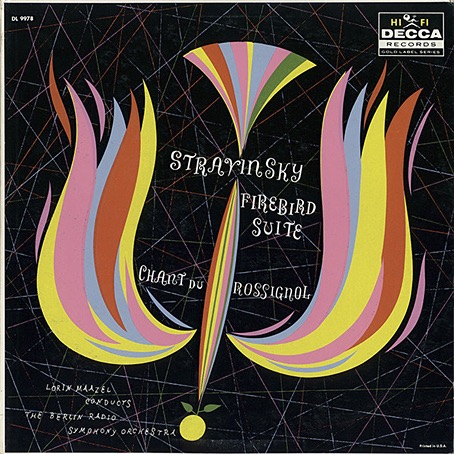
Much better was the cover of Tomita’s Firebird album (see below) which I bought around the same time, an uncredited tapestry design which is also a better album cover than the painting used on the earlier Japanese release. Depicting the Firebird itself is the other obvious choice when designing Stravinsky albums, and the dazzling, magical bird has helped this particular opus fare better in the world of classical album design than many other recordings.
firebird-1958.jpg

No artist/designer credited, 1958.

It’s easy to cast aspersions at the designers or art directors of classical records when you see an uninspired cover design, but the format presents a number of difficulties. There’s no such thing as a fixed design for a classical album because classical albums have no fixed form. With the exception of albums devoted to a single long composition most classical albums are compilations, pairing longer works with shorter ones, often by two or more composers. This confusion of identity creates problems for the designer, as does the huge quantity of classical releases. Then there’s the problems posed by the music itself which is so often abstract; you can’t “illustrate” The Goldberg Variations. The default choice is to use a painting or a drawing or a photograph of the composer as a cover image, or a photo of the conductor or performer. The easiest assigments, as these Firebird covers demonstrate, are albums based around a composition with a well-defined theme that can be depicted visually. Nobody has ever had a problem designing a cover for recordings of Debussy’s La Mer, for example, the only difficulty is deciding what picture of the sea you want to use.

firebird-1960-1.jpg

No artist/designer credited, 1960.

I’ve never had the impression that classical devotees care very much about these issues, it’s the music and the performance they’re interested in. Record labels (or their marketing departments) do seem to pay attention to visual matters now and then, and you’ll find occasional attempts to create a new line of themed covers. (The Orphic Egg series was one of the more bizarre examples from the 1970s.) Deutsche Grammophon have a history of decent cover design but even they resort to using photos of the artist or conductor far too often. I’ve never been asked to design a classical release, and I’m not sure I’d relish the task, but the problems raised by the form fascinate me. This is a subject I’ll no doubt keep returning to.

firebird-nd2.jpg

Irma Seidat, no date.

Continue reading “Firebirds”

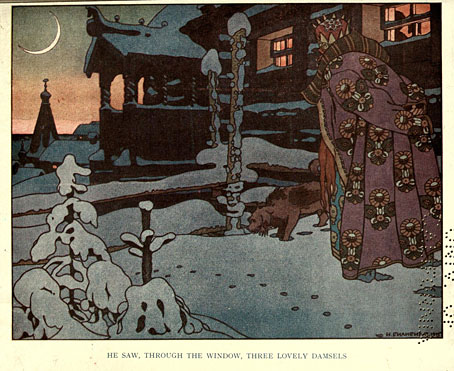
Ivan Bilibin’s Russian Wonder Tales

bilibin03.jpg

Halloween approaches so a picture of Wassilissa the Beautiful carrying a skull on a stick suits the season, as do the psilocybin-like mushrooms in the border. This edition of Russian Wonder Tales (1917) was a retelling of Russian folk tales by Post Wheeler for a British readership. Ivan Bilibin’s illustrations date from some twenty years earlier, however, and their colours are compromised by age and printing, but you at least get to see them with their stories in English. Among the pictures below there’s a nice portrait of the ever-bizarre Baba Yaga scooting through the forest.

bilibin01.jpg

bilibin02.jpg

Continue reading “Ivan Bilibin’s Russian Wonder Tales”

Diaghilev’s World of Art

miriskusstva1.jpg

Cover by Evgeny Lanceray for Prospectus of the Magazine, 1901.

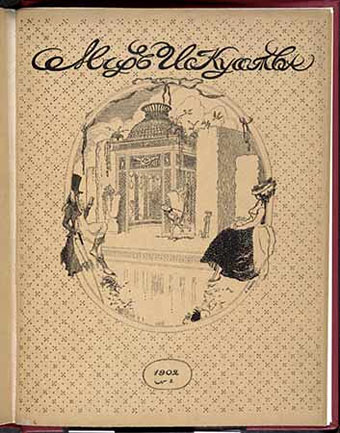
Previous posts here have concerned fin de siècle art magazines like The Savoy, Pan and Jugend; yesterday we had Sergei Diaghilev so it seems fitting to mention Diaghilev’s own magazine, Mir Iskusstva (World of Art), founded in 1899 with similar intentions to the European magazines which were highlighting developments in art beyond the academic sphere. Mir Iskusstva was also the name of the Russian art group who used the magazine as their forum, and a number of the artists involved in the movement, notably Léon Bakst, Ivan Bilibin and Nicholas Roerich, went on to work for Diaghilev at the Ballets Russes.

miriskusstva2.jpg

Cover by Léon Bakst for Mir iskusstva #8 (1902).

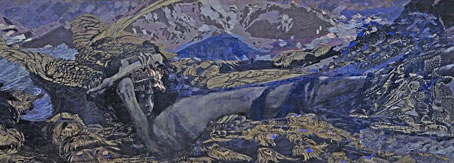
I find this later development especially fascinating since it positions the magazine as a precursor to the groundbreaking works which followed rather than being—as so many periodicals were and still are—a publication which had its moment of glory then faded from view. Of the works shown here, Vrubel’s Symbolist Demon, one of several painted by the artist, was featured in a 1903 edition of the magazine, whilst the Bakst painting, depicting the destruction of Atlantis, shows a Symbolist side to an artist who later became far better known for his Ballets Russes costume designs.

vrubel.jpg

Demon (1902) by Mikhail Vrubel.

Unlike the other magazines mentioned above, I’ve yet to come across a cache of whole editions of Mir Iskusstva (and I’m still waiting for Ver Sacrum to turn up somewhere). This page has an overview of the Russian art movement and its journal, while this page has a selection of works by the artists involved. For more of Vrubel’s work, Wikimedia Commons has the best collection of the artist’s paintings and sculpture.

bakst.jpg

Terror Antiquus (1908) by Léon Bakst.

Previously on { feuilleton }
Diaghilev and the Ballets Russes
Pamela Colman Smith’s Russian Ballet
The art of Ivan Bilibin, 1876–1942
Magic carpet ride
Le Sacre du Printemps
Images of Nijinsky

Diaghilev and the Ballets Russes

diaghilev1.jpg

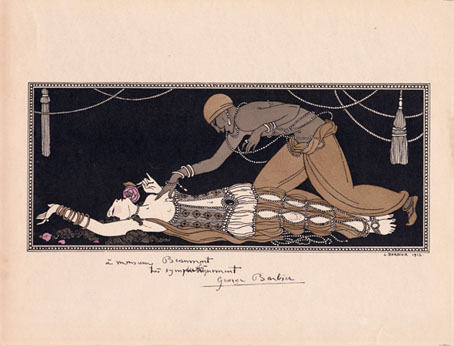
Ida Rubinstein as Zobeide and Vaslav Nijinsky as the Golden Slave in Schéhérazade (1913) by George Barbier.

Another great exhibition at the V&A, London, Diaghilev and the Ballets Russes gathers a wealth of costumes, stage designs, photographs and ephemera—including some of Stravinsky’s manuscripts—to present a history of the legendary ballet company and their visionary impresario. For those who can’t get to London the museum website shows some of the items which will be on display, and there’s also a blog about the installing of the exhibition. The enormous frontcloth from 1924 based on Picasso’s Two Women Running on the Beach received a flurry of attention in the press here but my own attention was caught by the picture of Natalia Goncharova‘s even more enormous backcloth for The Firebird. The exhibition runs to January 9, 2011.

diaghilev2.jpg

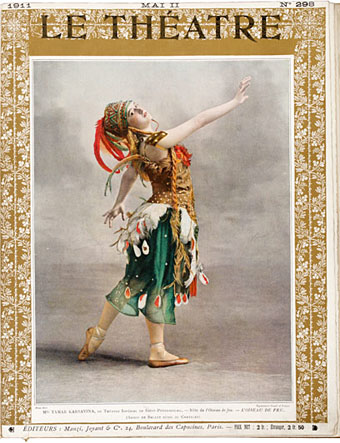
Cover of Le Théatre showing Tamara Karsavina in costume as the Firebird, May 1911.

While we’re on the subject, a new biography of the impresario, Diaghilev: A Life by Sjeng Scheijen, was reviewed last week in the New York Times:

Diaghilev loved beautiful young men, and at a time when the fashion in ballet was to exchange patronage for sex, his company provided a bounty. Scheijen dexterously plays his sources against one another to examine the erotic and professional dynamics between Diaghilev and his stars.

For a fictional (and necessarily heterosexual) account of those erotic and professional dynamics, I recommend Michael Powell & Emeric Pressburger’s The Red Shoes (1948) which not only has a central character based on Diaghilev but includes among the cast of real dancers Léonide Massine, dancer and principal choreographer of the Ballets Russes from 1915 to 1921.

See also:
Russian Ballet History | An archive and documentary site.

Previously on { feuilleton }
Pamela Colman Smith’s Russian Ballet
The art of Ivan Bilibin, 1876–1942
Jack Cardiff, 1914–2009
Magic carpet ride
Le Sacre du Printemps
Images of Nijinsky

Repin and Ljuba

repin.jpg

Sadko in the Underwater Kingdom (1876).

This painting by Russian artist Ilya Yefimovich Repin (1844–1930) is included in one of my Symbolist art books despite its pre-dating the Symbolist period and there being little else in the artist’s career which might suit the label. It’s a curious picture, however, illustrating a medieval folk tale and depicting the moment when the Sadko of the title is forced by the Sea Tsar to choose a wife from a line of aquatic maidens. It was art historian Philippe Jullian who had me returning to Repin, and the reminder gives me an excuse to post something by Serbian Surrealist Ljuba (aka Ljuba Popovic) whose colours, fauna and metamorphic female figures are a match for Repin’s sirens. Last time I looked for Ljuba pictures there were few available, a situation which has now been remedied by blogs such as this one.

ljuba.jpg

Lot and Lotus (1972).

Previously on { feuilleton }
The art of Ivan Bilibin, 1876–1942
Magic carpet ride
Short films by Walerian Borowczyk
The art of Ljuba Popovic