Hardy art

hardy1.jpg

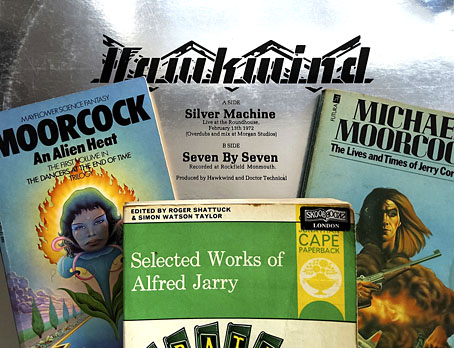
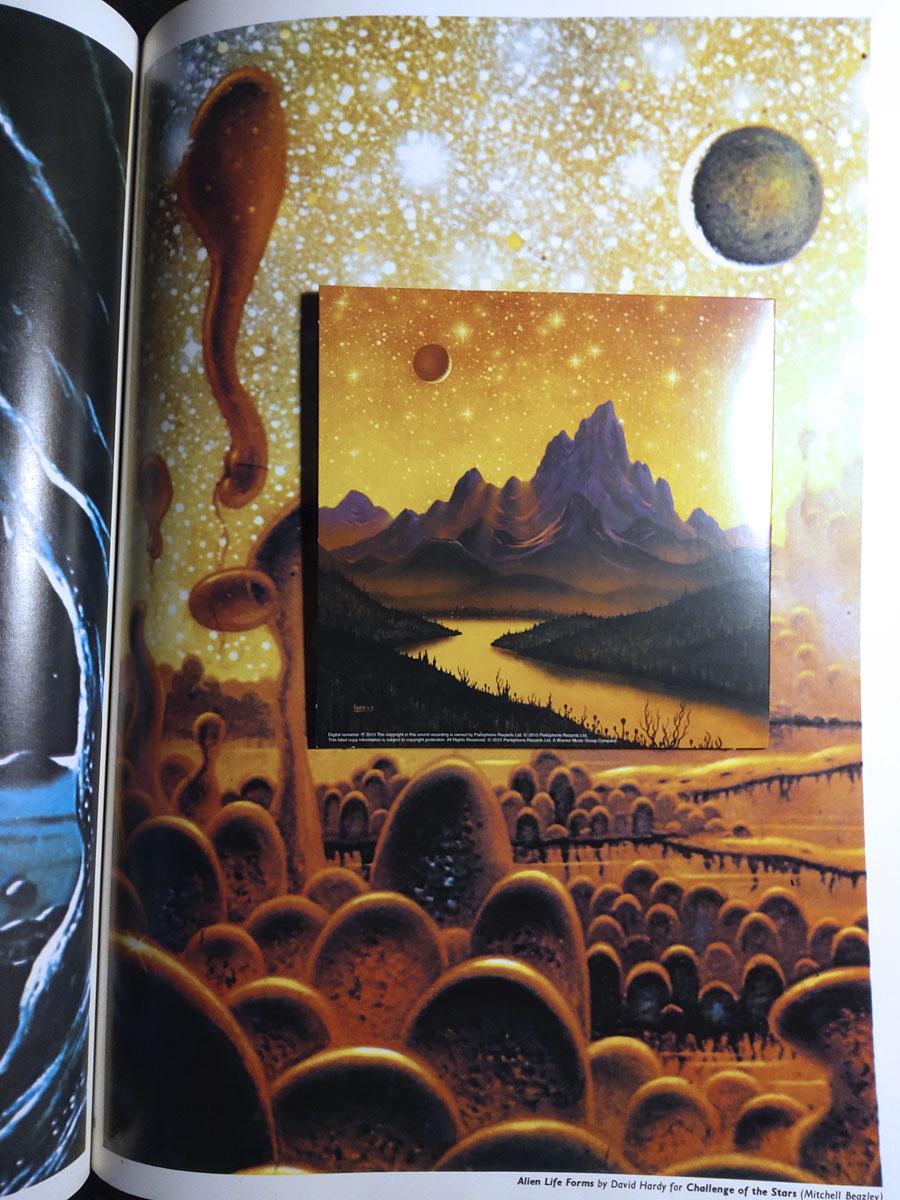
Hawkwind continue to be the overwhelming topic of the moment while I’m reading Joe Banks’ marvellously detailed account of the group’s first decade. One of the many attractions of Hawkwind for this listener was their intersection with other areas of interest: Moorcock and New Worlds, obviously (two of Robert Calvert’s poems appeared in New Worlds Quarterly), but also SF and fantasy in general. The alien planet on the back cover of the Hall of the Mountain Grill album was immediately recognisable as the work of British space artist David A. Hardy thanks to a feature in Visions of the Future (1976) a collection of artwork reprints from the art and fiction magazine Science Fiction Monthly. Hardy had a long association with astronomer Patrick Moore, illustrating the covers of Moore’s novels and later collaborating on a speculative science book, Challenge of the Stars (1972). A few of the latter paintings were reprinted in Visions of the Future, including one with the title Alien Life Forms that depicted amoeboid creatures on a remote planet. The painting would have become the back cover of the Hawkwind album if Hardy hadn’t insisted on creating a new work in a more suitable ratio.

Hardy’s association with Hawkwind extended to their stage shows, with a series of circular paintings used by “Liquid Len” (Jonathan Smeeton) on a rotating projector that covered the band in moving panoramas of ancient monuments, dinosaurs, alien landscapes and exploding worlds. Two of the paintings appear as the endpapers in Joe’s book; the dinosaurs and the monuments may be seen here.

hardy2.jpg

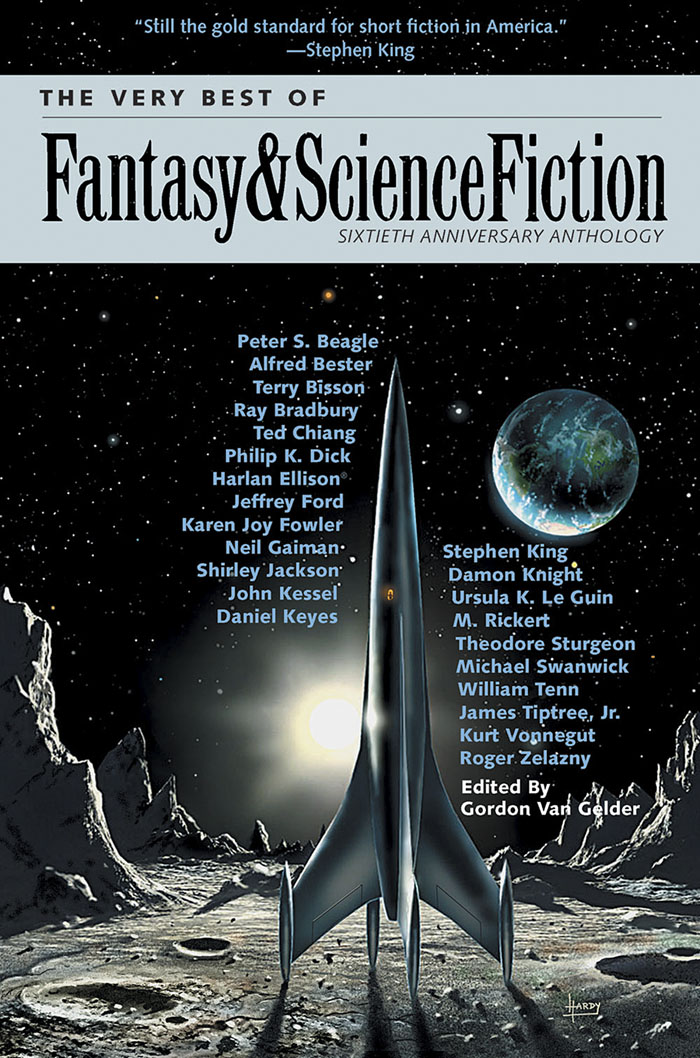
Cover design by Bryan Cholfin.

My own Hawkwind covers make very poor comparisons to Hardy’s meticulous renderings but we do have a further connection via The Very Best of Fantasy and Science Fiction, a collection of stories from the long-running magazine edited by Gordon Van Gelder. I designed the book’s interiors and Hardy contributed the cover art. Hardy painted many covers for F&SF throughout the 1970s and 80s, this shining rocket being a reworking of a cover he produced for the magazine’s 60th anniversary issue. The archetypal spacecraft of classic science fiction, and almost a definitive example. You might even call it a silver machine…

Previously on { feuilleton }
Silver machines
Notes from the Underground
Hawkwind: Days of the Underground
The artists of Future Life
Science Fiction Monthly
The Chronicle of the Cursed Sleeve
Rock shirts
The Cosmic Grill
Void City
Hawk things
The Sonic Assassins
New things for July
Barney Bubbles: artist and designer

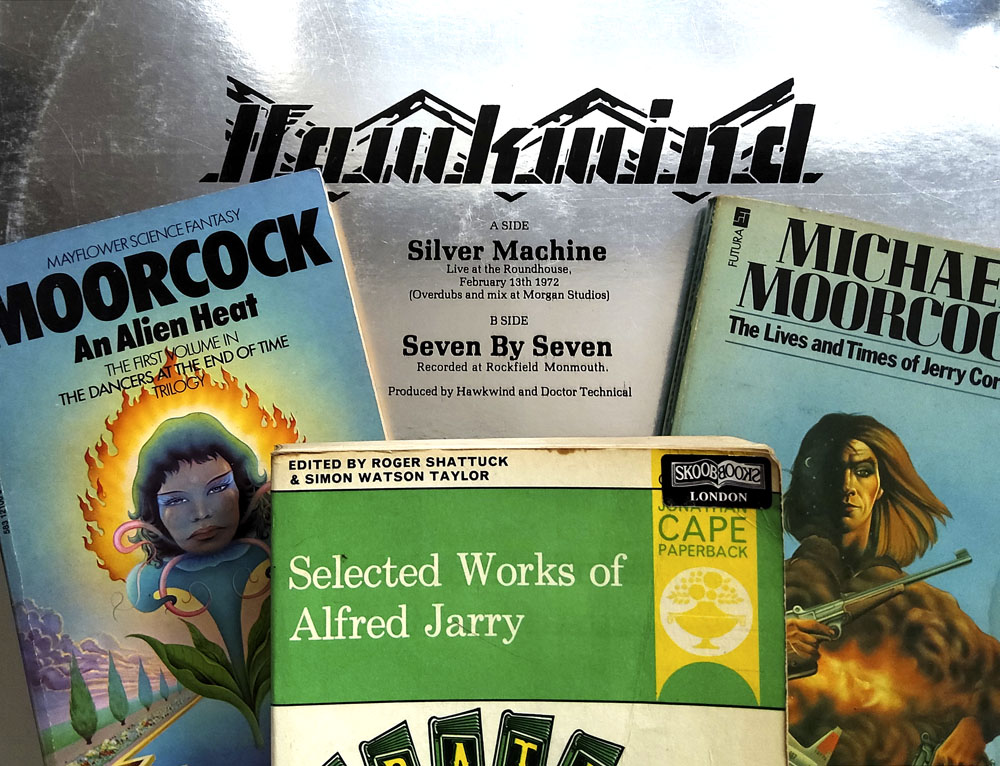
Silver Machines

silver1.jpg

1: How to Construct a Time Machine, 1899

III: Description of the Machine

The Machine consists of an ebony frame, similar to the steel frame of a bicycle. The ebony members are assembled with soldered copper mountings.

The gyrostats’ three tori (or flywheels), in the three perpendicular planes of Euclidean space, are made of ebony cased in copper, mounted on rods of tightly rolled quartz ribbons (quartz ribbons are made in the same way as quartz wire), and set in quartz sockets.

jarry.jpg

Alfred Jarry testing a time machine, 1898

The circular frames or the semicircular forks of the gyro stats are made of nickel. Under the seat and a little forward are located the batteries for the electric motor. There is no iron in the Machine other than the soft iron of the electromagnets.

Motion is transmitted to the three flywheels by ratchet-boxes and chain-drives of quartz wire, engaged in three cogwheels, each of which lies on the same plane as its corresponding fly wheel. The chain-drives are connected to the motor and to each other through bevel gears and driveshafts. A triple brake controls all three shafts simultaneously…

Alfred Jarry


2: Dead Singers (aka All the Dead Singers), 1971
ink.jpg

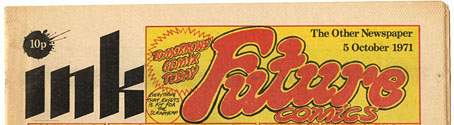
“That’s all in the past now.” Beesley waddled to the other the side of the tiled room and wheeled the black Royal Albert gent’s roadster across the clean floor. He paused to flip a switch on the wall. Belly Button Window flooded through the sound system. They were turning his own rituals against him. Now the devil had all the songs.

“All aboard, Mr C.” Reluctantly, Jerry mounted the bike. He was getting a bit too old for this sort of thing.

[…]

In London he slowed down, but by that time he’d blown it completely. Still, he’d got what Beesley wanted. Nothing stayed the same. Tiny snatches of music came from all sides, trying to take hold. Marie Lloyd. Harry Champion, George Formby, Noël Coward, Cole Porter, Billie Holliday, MJQ, Buddy Holly, The Beatles, Jimi Hendrix and Hawkwind. He hung on to Hawkwind, turning the car back and forth to try to home in, but then it was Gertrude Lawrence and then it was Tom Jones and then it was Cliff Richard and he knew he was absolutely lost. Buildings rose and fell like waves. Horses, trams and buses faded through each other. People grew and decayed. There were too many ghosts in the future. In Piccadilly Circus he brought the Mercedes to a bumping stop at the base of the Eros statue and, grabbing the Royal Albert, threw himself clear. He was screaming for help. They’d been fools to fuck about with Time again. Yet they’d known what they were getting him into.

Michael Moorcock, Ink Magazine


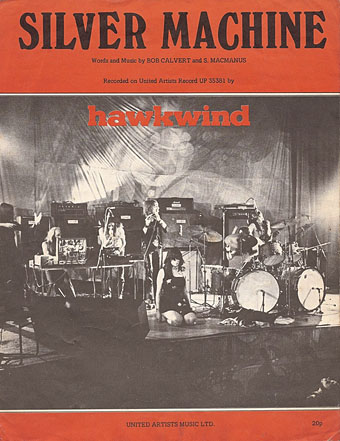
3: Silver Machine, 1972
silver2.jpg

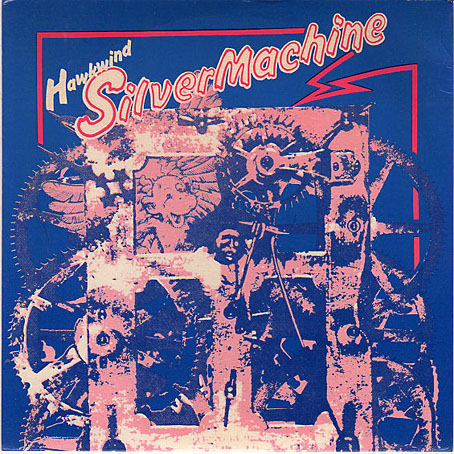
Cover design by Tony Vesely with Pennie Smith (not the work of Barney Bubbles as stated elsewhere).
lemmy.jpg

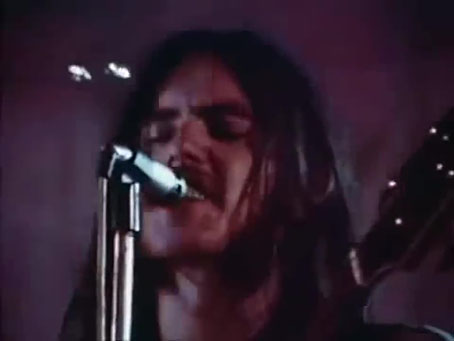
A dead singer.


4: The Dancers at the End of Time, 1974
dedication.jpg

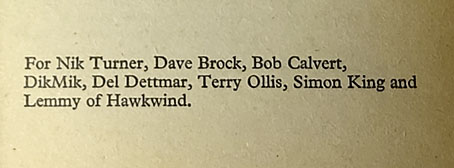
Dedication by Michael Moorcock in the 1974 Mayflower paperback of An Alien Heat—The First Volume in the Dancers at the End of Time Trilogy.

Outside the station they found themselves in the Strand and now Jherek saw something leaning against a wall on the corner of Villiers Street.

“Look!, Mrs Underwood—we are saved. A time machine!”

“That, Mr Carnelian, is a tandem bicycle.”

He already had his hands on it and was trying to straddle it as he had seen the others do.

“We would do better to hail a cab,” she said.

“Get aboard quickly. Can you see any controls?”

With a sigh, she took the remaining saddle, in the front. “We had best head for Regent Street. It is not far, happily. The other side of Piccadilly. At least this will prove to you, once and for all, that…”

Her voice was lost as they hurtled into the press of the traffic, weaving between trams and omnibuses, between horses and motor cars and causing both to come to sudden stops and stand stock still in the middle of the road, panting and shuddering.

Jherek, expecting to see the scene vanish at any moment, paid little attention to the confusion happening around them. He was having a great deal of trouble keeping his balance upon the time machine.

“It will be soon!” he cried into her ear, “it must be soon!” And he pedalled harder. All that happened was that the machine lurched onto the pavement, shot across Trafalgar Square at considerable speed, up the Haymarket, and was in Leicester Square almost before they had realized it. Here Jherek fell off the tandem, to the vast entertainment of a crowd of street urchins hanging about outside the doors of the Empire Theatre of Varieties.

“It doesn’t seem to work,” he said.

Michael Moorcock, The Hollow Lands—The Second Volume in the Dancers at the End of Time Trilogy


5: Machine music

sheet1.jpg

sheet2.jpg


6: “’Pataphysics is the science”, 1981
calvert.jpg

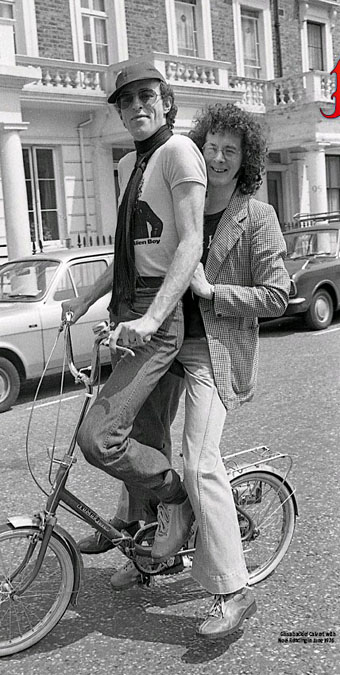
Robert Calvert and Noel Redding testing a time machine, 1976.

I read this essay by Alfred Jarry called, “How to Construct a Time Machine”, and I noticed something which I don’t think anyone else has thought of because I’ve never seen any criticism of the piece to suggest this. I seemed to suss out immediately that what he was describing was his bicycle. He did have that turn of mind. He was the kind of bloke who’d think it was a good joke to write this very informed sounding piece, full of really good physics (and it has got some proper physics in it), describing how to build a time machine, which is actually about how to build a bicycle, buried under this smoke-screen of physics that sounds authentic.

Jarry got into doing this thing called “’Pataphysics”, which is a sort of French joke science. A lot of notable French intellectuals formed an academy around the basic idea of coming up with theories to explain the exceptions to the Laws of the Universe, people like Ionesco the playwright.

The College of metaphysics. I thought it was a great idea for a song. At that time there were a lot of songs about space travel, and it was the time when NASA was actually, really doing it. They’d put a man on the moon and were planning to put parking lots and hamburger stalls and everything up there. I thought that it was about time to come up with a song that actually sent this all up, which was Silver Machine.

Silver Machine was just to say, I’ve got a silver bicycle, and nobody got it. I didn’t think they would. I thought that what they would think we were singing about some sort of cosmic space travel machine. I did actually have a silver racing bike when I was a boy. I’ve got one now, in fact.

Robert Calvert, Cheesecake fanzine no. 5

• Related: Marcus O’Dair on ’Pataphysics: Your Favourite Cult Artist’s Favourite Pseudoscience.

Previously on { feuilleton }
Notes from the Underground
Hawkwind: Days of the Underground
The Chronicle of the Cursed Sleeve
Rock shirts
The Cosmic Grill
Void City
Hawk things
The Sonic Assassins
New things for July
Barney Bubbles: artist and designer

Notes from the Underground

hawkwind1.jpg

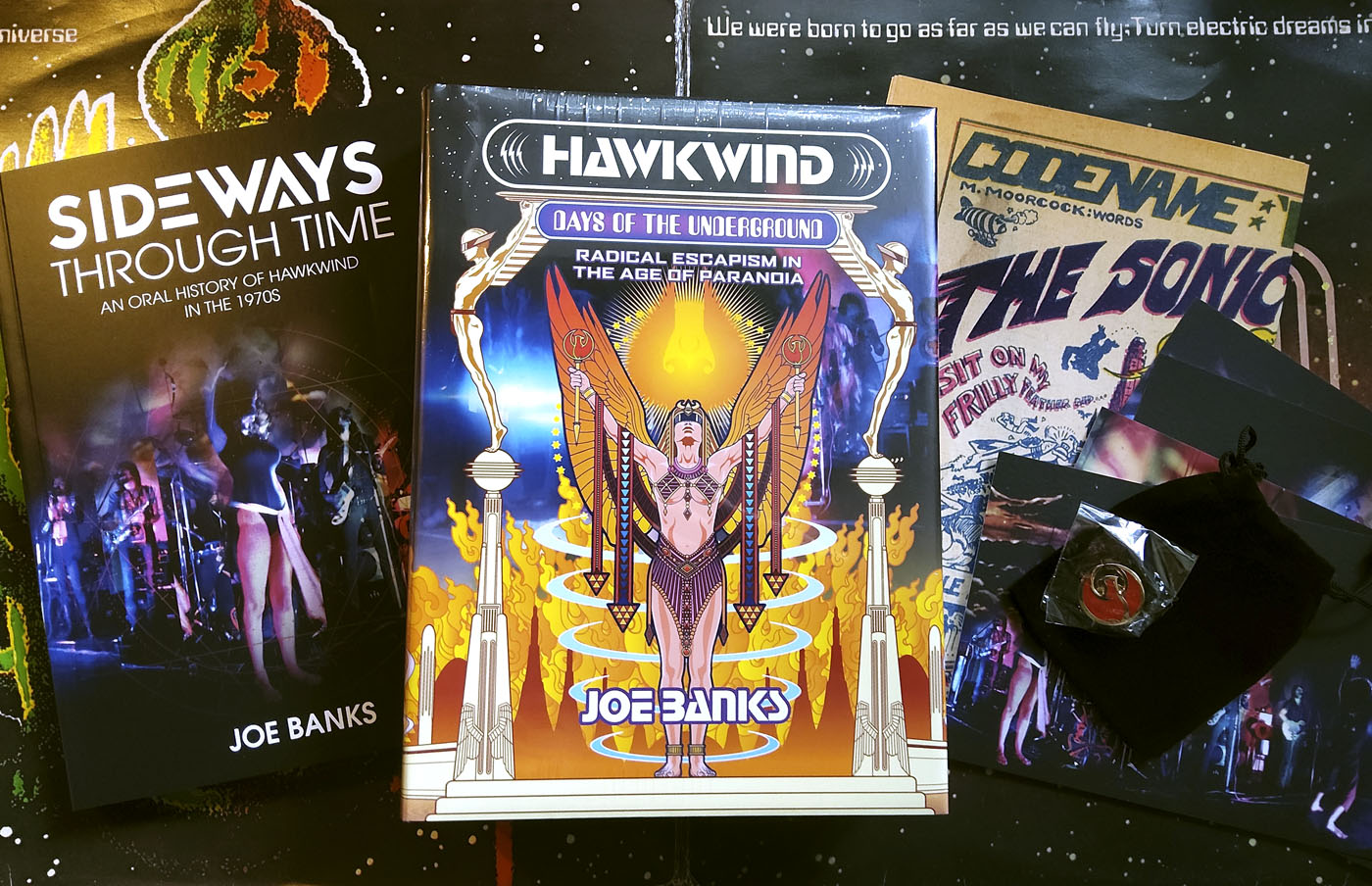
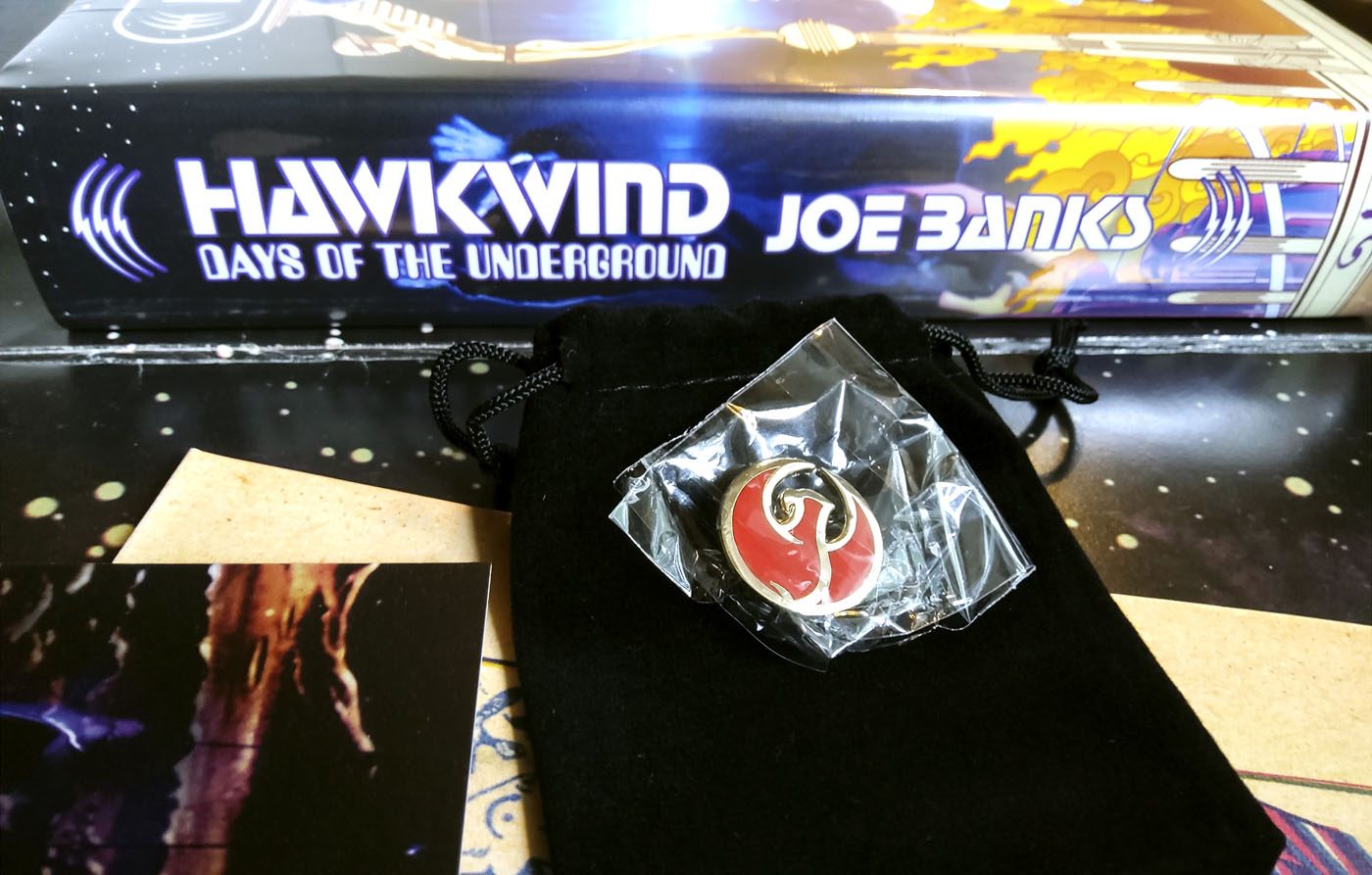
This time last year I was about to start working on the cover of Joe Banks’ Hawkwind book, and here it is at last, after a considerable delay. The special edition has been worth the wait since it comes with an additional 200-page volume, Sideways Through Time, containing the interviews that Joe used for his research. There’s also a set of cards with photos by Laurie Lewis from the session used for the cover of Space Ritual (we used some of the same photos on the book cover), and a print of the Moorcock/Cawthorn Hawklords comic strip from Frendz which further developed the group’s self-mythologising begun by the In Search Of Space “Hawklog”. And for people who pre-ordered the book last year then had to wait for months, there’s a bonus enamel pin based on the hawk design I supplied for the front board. I like badges, and I designed a few for Hawkwind in the past, but this is a better design and a nicer object than any of those I did in the 1980s.

hawkwind2.jpg

It’s a big book.

Now that the book is out I can show off the full cover wrap. As mentioned earlier, I followed Barney Bubbles’ preference for retro futurism by creating a cityscape based on the Deco-styled architecture that Frank R. Paul liked to use in his pulp illustrations. Some of the details refer obliquely to Hawkwind’s cover art or songs of the 1970s, so the speeding car can be taken as a reference to both Kerb Crawler and Death Trap, as well as the speeding Art Deco vehicle on the cover of Roadhawks. The flying saucers are a nod to those by Barney Bubbles on the inner sleeve of the Doremi album (and on one of his black-and-white posters from the same period), while the Philippe Druillet rocket refers to Barney’s own appropriation of a Druillet figure in his Hawk graphics. The combination of vehicles fleeing a burning city gives us the recurring theme in the group’s lyrics about the need to escape from a self-destructing society/planet. Welcome to the future.

Hawkwind: Days of the Underground is available now from Strange Attractor.

Previously on { feuilleton }
Hawkwind: Days of the Underground
The Chronicle of the Cursed Sleeve
Rock shirts
The Cosmic Grill
Void City
Hawk things
The Sonic Assassins
New things for July
Barney Bubbles: artist and designer
Interview with the vampire illustrator

illustration1.jpg

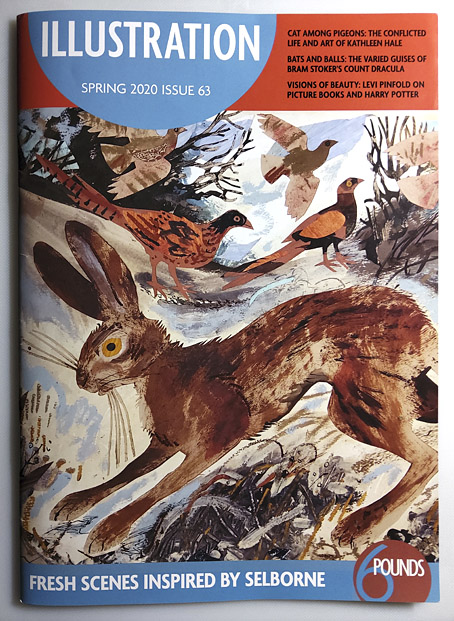
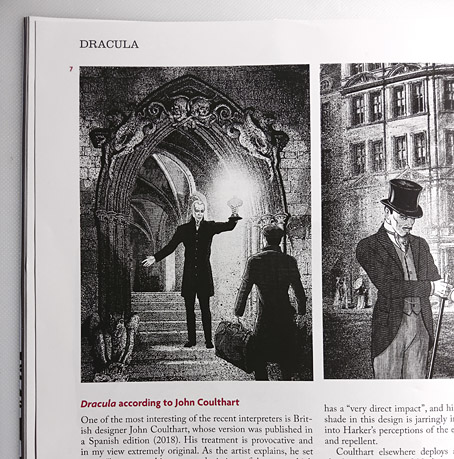
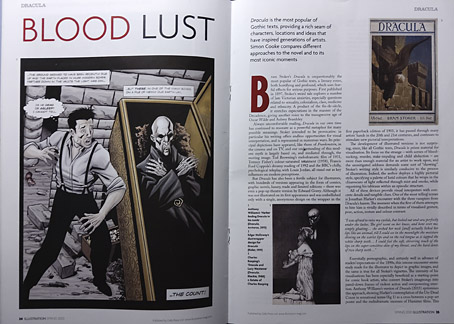
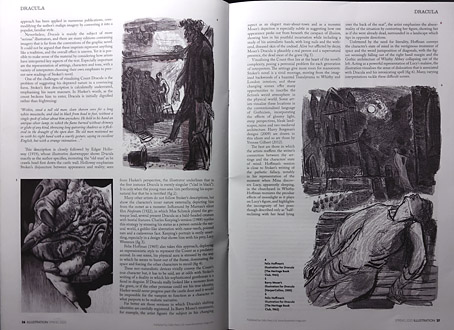
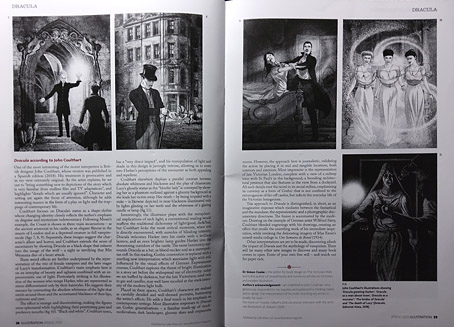
Some of the many illustrators of Bram Stoker’s Dracula are the subject of a six-page feature in the latest issue of Illustration magazine. The writer of the piece, Simon Cooke, asked me a few questions about the edition I worked on for Editorial Alma in 2018 (previously), and he devotes two pages to analysing my illustrations. I was a little unnerved by this since Alma asked me to produce 27 full-page pictures—one for each chapter—in five weeks, which isn’t the kind of deadline I prefer for work that requires so much historical research. Consequently, I still feel the book is compromised but people evidently like the end results so I should stop complaining. Illustration magazine is available from Cello Press.

illustration2.jpg

As for my work of the moment, the Joe Banks Hawkwind book will be published by Strange Attractor in the next few weeks, so everyone will finally get to see my Frank R. Paul-derived wraparound cover. And there’s more science fiction on the way with a new cover design featuring a robot as its centrepiece. Watch this space.

illustration3.jpg

illustration4.jpg

illustration5.jpg

Previously on { feuilleton }
Hawkwind: Days of the Underground
Illustrating Dracula

Weekend links 489

wyrding.jpg

Typhonic Neural Tantra by The Wyrding Module.

• November 2019, as many people have been noting, is the month in which Ridley Scott’s Blade Runner takes place. At Dangerous Minds Paul Gallagher writes about the unrelated William Burroughs script whose title was borrowed for Scott’s film.

• More Ridley Scott (sort of): disco was still a big thing when Alien was in the cinemas 40 years ago, so Kenny Denton reworked Jerry Goldsmith’s Alien score into a disco single which he released under the name Nostromo.

• “The Count of Monte Cristo is one of the most exciting novels ever written and on the other hand is one of the most badly written novels of all time and in any literature.” Umberto Eco on the cult of the imperfect.

• Jonathan Glazer has made a short film, The Fall, for the BBC but the corporation’s restrictions mean that (for the moment) it’s difficult to see if you live outside the UK.

• New albums at Bandcamp: Typhonic Neural Tantra by The Wyrding Module, and Emotional Freedom Techniques by Jon Brooks (aka The Advisory Circle).

• Hawkwind dancer Miss Stacia and the Barney Bubbles estate have made a line of T-shirts based on Barney Bubbles’ Space Ritual design.

Walter Murch and Midge Costin on the art of cinematic sound design.

Ivana Sekularac on the former Yugoslavia’s brutalist beauty.

• Congratulations to Strange Flowers on its 10th anniversary.

Geoff Manaugh on the witch houses of the Hudson Valley.

• At Dennis Cooper’s: 19 experimental horror films.

Fall (1968) by Miles Davis | The Fall (2011) by The Haxan Cloak | Fall (2014) by The Bug (feat. Copeland)