Steven Arnold: Heavenly Bodies

arnold01.jpg

One consequence of writing posts like this for the past 19 years is the blossoming into familiarity of previously unknown subjects. Such has been the case with the work of Steven Arnold (1943–1994), an American artist/photographer/film-maker whose photographs I hadn’t seen until I was pointed towards the Steven Arnold Archive by a reader in 2009. (Hi Thom, if you’re out there!) Since that brief post I’ve logged the occasional appearance of Arnold exhibitions and, more recently, the blu-ray release of Arnold’s sole feature film, Luminous Procuress.

arnold02.jpg

Steven Arnold: Heavenly Bodies is a feature-length documentary by Vishnu Dass about Arnold and the circle of friends and collaborators who helped create his films and photographic tableaux. The documentary was released by the Steven Arnold Archive in 2019, and is now freely available for viewing at Vimeo. (The “Mature” tag means you need to either log in or create an account to watch it.) Dass presents a collection of video interviews with Arnold and his associates, together with more recent interviews with surviving friends and enthusiasts, to supply the biographical detail behind Arnold’s extraordinary endeavours. Angelica Huston narrates the film which also includes poignant testimony from Arnold’s close friend, Ellen Burstyn.

arnold03.jpg

The interviews chart the artist’s progress: education in Oakland and San Francisco; his early experiments with film; his experience as a member of Salvador Dalí’s circle of hippy acolytes; the creation of all those beautiful black-and-white photographs in his Los Angeles studio. Arnold is revealed to have been a pioneer even by the elevated standards of San Francisco in the 1960s; he was taking acid in 1964, and at the height of the psychedelic era was cultivating with his friends an attitude of glamorous, polymorphous sexuality and gender play that went beyond the out-gay status of the Beats. In one of the interviews he talks eloquently about his concept of androgyny, which he regarded as an almost spiritual state, an attitude the alchemists of old would have endorsed. Arnold was the founder of San Francisco’s midnight movie shows in 1967, the same shows which saw the birth of the Cockettes, an anything-goes performing troupe who turn up later in Luminous Procuress. I didn’t know that Arnold’s midnight shows (for which he designed the posters) were taking place three years before the screening of El Topo in New York, the event which is usually cited as the origin of the nationwide Midnight Movie trend.

arnold04.jpg

Luminous Procuress was the culmination of his time in San Francisco, and the film that caught the attention of Salvador Dalí when it too was screened in New York. The film is a rare example of Arnold arranging his tableaux in full colour. When he moved to Los Angeles he was living among vividly coloured fabrics and decorations yet all his photographs are high-contrast black-and-white creations. I was hoping we might hear more about the reason for this. Arnold does refer at one point to enjoying the directness of the black-and-white image, and monochrome no doubt made his tableaux arrangement easier if he didn’t have to worry about harmonising colours. But he doesn’t explain the choice in any detail.

arnold05.jpg

This is an inspiring documentary, and a valuable record of a thread of San Francisco’s cultural history which is seldom acknowledged in recountings of the psychedelic era. It’s also a dispiriting portrait when you’re watching another creative life cut short by the AIDS pandemic. When considering histories like these it’s easy to fret over the loss of unrealised works. Better, I think, to appreciate anew the work that remains. (Thanks to Larry for the tip!)

arnold06.jpg

arnold07.jpg

arnold08.jpg

Previously on { feuilleton }
The Liberation of Mannique Mechanique
Luminous Procuress
Flamboyant excess: the art of Steven Arnold
Art on film: Providence

providence01.jpg

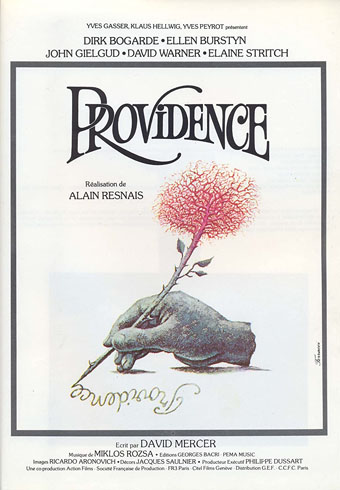
Art by René Ferracci.

Continuing an occasional series about artworks in feature films. Most people know HR Giger’s work via his production designs for the Alien films; a much smaller number of people also know about his designs for Jodorowsky’s unmade film of Dune, but hardly anyone knows that his art first appeared in a major film two years before Alien was released. This isn’t too surprising when the film in question, Providence, directed by Alain Resnais, has been increasingly difficult to see since 1977; the film isn’t mentioned in any of Giger’s books either, a curious omission for an artist who spent his career logging every public appearance of his work.

Providence began life as a collaboration between Resnais and British playwright David Mercer, with the resulting script leading to a Swiss/French co-production that was filmed in English. The film has an exceptional cast—Dirk Bogarde, Ellen Burstyn, John Gielgud, Elaine Stritch, David Warner—marvellous photography by Ricardo Aronovitch, and a sumptuous score by Miklós Rózsa. If you’re the kind of person who regards awards as designators of quality then it’s worth noting that Providence won 7 Cesar Awards in 1978, including the one for best picture. Yet despite all this, and despite being regularly described as a peak of its director’s career there’s only been a single DVD release which is now deleted. I’d been intending to write about the film for some time but first I had to acquire a decent copy to watch again; this wasn’t an easy task but I managed to “source” a version that was better than the VHS tape I used to own.

providence13.jpg

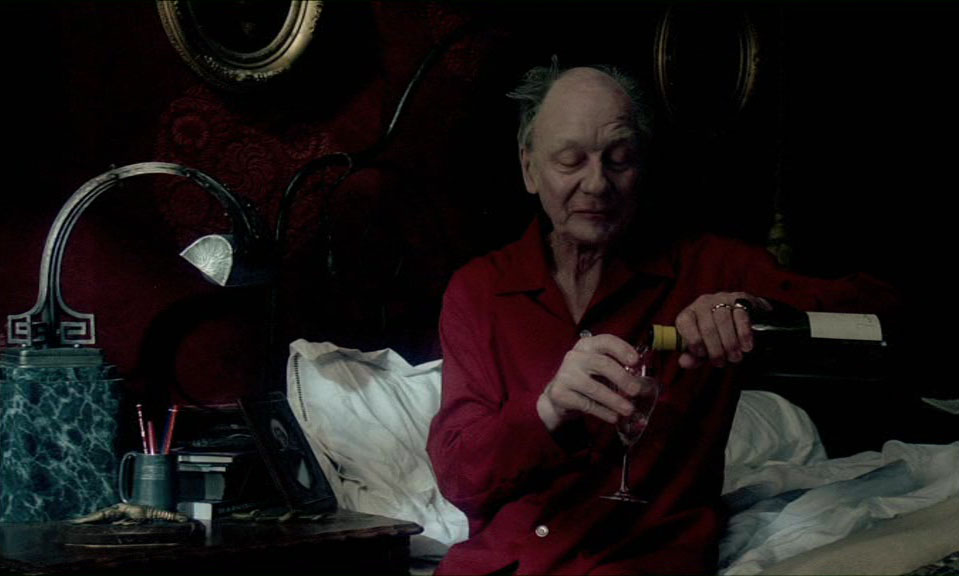
For most of its running time Providence is a film about artistic invention, more specifically about the process of writing. Clive Langham (John Gielgud) is an ailing author spending a sleepless night alone in his huge house, “Providence”, wracked by unspecified bowel problems, painful memories and fears of impending death. To distract himself from his troubles he drinks large quantities of wine while mentally sketching a scenario for a novel in which the people closest to him are the main characters. In this story-within-the-story Langham’s son, Claude (Dirk Bogarde), is a priggish barrister whose primary conflicts are with his absent father, his bored wife, Sonia (Ellen Burstyn), and a listless stranger, Kevin (David Warner), who Sonia has befriended and seems attracted to even though Kevin won’t reciprocate. While Claude cajoles and insults the pair he also conducts an affair of his own with Helen (Elaine Stritch), an older woman who resembles his dead mother. The scenario is elevated from being another mundane saga about middle-class infidelities by its persistently dream-like setting, and by the interventions and confusions of its cantankerous author. If you only know John Gielgud from his later cameos playing upper-class gentlemen then he’s a revelation here, boozing and cursing like the proprietor of Black Books. Between spasms of illness and self-pity Langham shuffles his playthings around like chess pieces, revising scenes while trying to keep minor characters from interfering; “Providence” isn’t only the house where Langham lives but also the watchful eye of its God-like author. Meanwhile, his characters bicker and chastise each other, paying little attention to the disturbing events taking place in the streets outside: terrorist bombings, outbreaks of lycanthropy, and elderly citizens being rounded up for extermination.

Continue reading “Art on film: Providence”

Weekend links 514

kircher.jpg

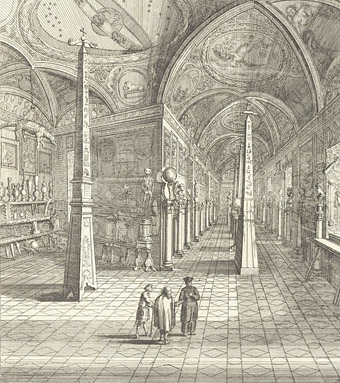
Athanasius Kircher welcoming two guests to the Collegio Romano, a detail from the frontispiece to his Romani Collegii Societatis Jesu Musaeum celeberrimum (1678).

Opium (1919) by Robert Reinert: “A Chinese opium dealer takes revenge on Westerners who have corrupted his wife.” With Werner Krauss and Conrad Veidt a year before their pairing in The Cabinet of Doctor Caligari.

Aubrey Beardsley at Tate Britain: in which the gallery thinks that 7 minutes is enough to give us a taste of a major exhibition that we can’t otherwise see.

Joe Pulver (RIP): His Highness in Yellow. A memorial piece that includes artist Michael Hutter talking about his paintings of Carcosa.

Court Mann on the strange history of Robert Smithson’s Spiral Jetty, 50 years old this month.

• “Invisible Little Worms”: Athanasius Kircher’s Study of the Plague by John Glassie.

Sophie Monks Kaufman on why literary lesbians are having a moment on screen.

• Photographer Ryan McGinley: “I was taught to believe in Satan. It scared me.”

• At Dennis Cooper’s: Ellen Burstyn Day, and the ghostly novels of WG Sebald.

Dorian Lynskey on where to start with Nina Simone’s back catalogue.

• Wie funktioniert ein Synthesizer? (1972). Bruno Spoerri explains.

• Banham avec Ballard: On style and violence by Mark Dorrian.

John Boardley on the most dangerous book in the world.

Improvisation for Sonic Cure by Ryuichi Sakamoto.

• The Strange World of…JG Thirlwell.

Diet Of Worms (1979) by This Heat | Stomach Worm (1992) by Stereolab | Heartworms (1998) by Coil