Carnacki’s first manifestation

carnacki1.jpg

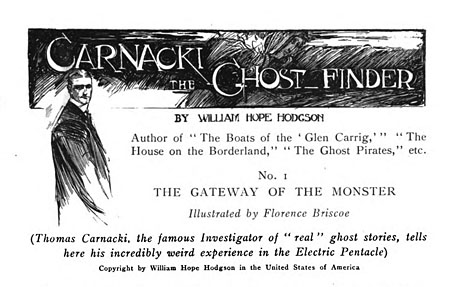
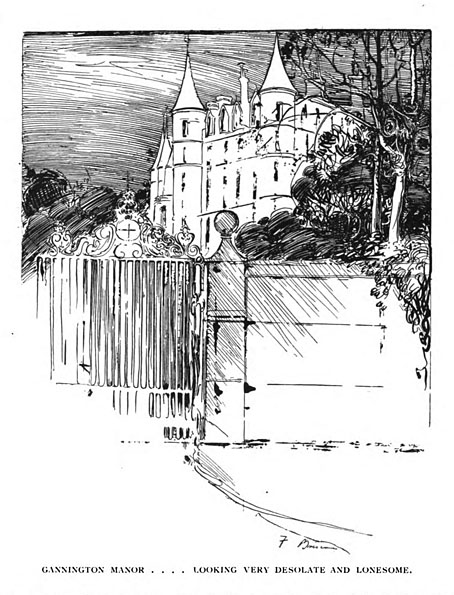
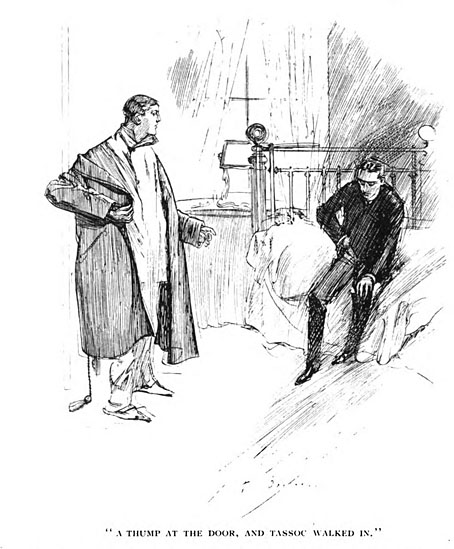
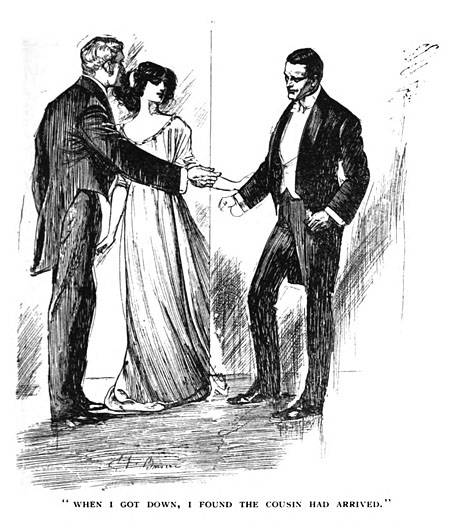
Visual manifestation, that is. The first Carnacki story to see print was The Thing Invisible, published in 1909 as a part of The Ghost Pirates, A Chaunty, and Another Story. The book wasn’t illustrated, nor was the Carnacki collection published by Eveleigh Nash in 1913. The five stories that ran in The Idler, however, were all decorated with sketchy illustrations by Florence Briscoe, all of which may be seen in this collection of extracted pages from the issues for 1910. (For the complete magazines, look here.)

carnacki2.jpg

The House Among the Laurels.

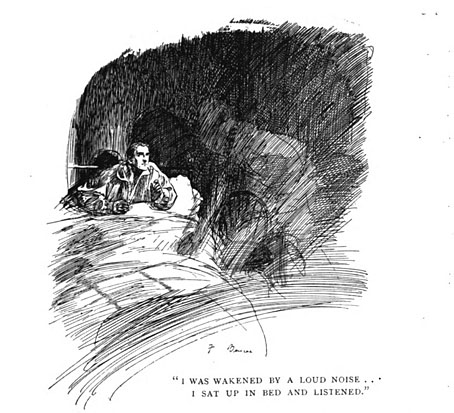
Miss Briscoe (and she does appear to have been a Miss at this point) has the distinction of being one of the first illustrators (possibly the first) of any of Hodgson’s fiction. She was also a friend of the author and may well have used him as a model for many of her illustrations. James Bojaciuk suggests as much in this piece of biographical research that I’d managed to miss when it was posted at Greydogtales. I think we can take Hodgson as a definite model for the portrait of Carnacki that illustrates the magazine header, the similarity between the drawing and one of the author’s photos is beyond doubt even if some of the other Carnacki drawings show less of a resemblance. Carnacki also seems to be quite tall, or at least of average male height, something that the diminutive Hodgson was not.

carnacki4.jpg

The Whistling Room.

Portraiture aside, Florence Briscoe’s illustrations tend to be of a type that I refer to as “people standing about in rooms”, a common form in the world of magazine illustration. Sidney Paget’s famous drawings of Sherlock Holmes are almost all of this type, stories of cerebral industry and ratiocination being rewarding for the reader, less so for the jobbing illustrator. (The Hound of the Baskervilles is a notable exception, with its dramatic locations and spectral atmosphere.) The most obvious difference between Carnacki and Holmes is that Carnacki encounters genuine manifestations of eldritch horror which he manages to keep at bay with his incantations and electrical devices. Miss Briscoe shows us none of this, unfortunately. But her figures are well-drawn, and as general illustration her work is of a higher standard than the often amateurish renderings you find in the early pulp magazines of the 1920s. The growing sphere of Hodgsonian illustration begins with these few stories.

carnacki3.jpg

The Horse of the Invisible.

carnacki5.jpg

The Searcher of the End House.

Elsewhere on { feuilleton }
The illustrators archive

Previously on { feuilleton }
The Whistling Room, 1952
The art of Jean-Michel Nicollet
Suspicion: The Voice in the Night
Hodgsonian vibrations
The Horse of the Invisible
Tentacles #2: The Lost Continent
Tentacles #1: The Boats of the ‘Glen Carrig’
Hodgson versus Houdini
Weekend links: Hodgson edition
Druillet meets Hodgson

The Whistling Room, 1952

whistling1.jpg

Coincidence time again: this ancient TV drama was posted to YouTube a few days ago just as I was finishing Timothy S. Murphy’s very commendable study of William Hope Hodgson’s fiction, William Hope Hodgson and the Rise of the Weird: Possibilities of the Dark. As drama or even basic entertainment, The Whistling Room is the opposite of commendable but it is notable for being the first screen adaptation of a Hodgson story. Hodgson’s fiction has never been popular with film or television dramatists. His two major weird novels, The Night Land and The House on the Borderland, would require lavish expenditure and special effects to do them justice, while the latter has a narrative shape and a lack of characterisation that would either repel any interest or incur considerable mangling of the story.

More appealing for screen adapters are Hodgson’s tales of Carnacki the Ghost Finder, a collection of short mysteries with a supernatural atmosphere and neat resolutions. The Whistling Room, a US production for Chevron Theatre in 1952, is the first of two Carnacki adaptations, the other appearing almost 20 years later when Thames TV included The Horse of the Invisible in their first series of The Rivals of Sherlock Holmes. The Carnacki character was Hodgson’s take on the occult detective or psychic investigator, a short-lived offshoot of the post-Sherlock Holmes detection boom of the 1890s, and the concurrent interest in Spiritualism (or “Spiritism”, as Aleister Crowley always insisted it should be called). Carnacki is as resourceful and energetic as Hodgson’s other protagonists, and as an investigator he’s happy to use modern technology (electricity, cameras, vacuum tubes) to combat incursions from other dimensions. Hodgson’s descriptions of these encounters are freighted with all the capitalised terminology that recurs throughout The Night Land: “Outer Monstrosities”, “a Force from Outside”, “the Ab-human”. Carnacki’s exploits, however, have often been dismissed as hack-work when compared to the author’s novels or his tales of the Sargasso Sea. (The one Carnacki story that even detractors favour, The Hog, was a longer piece that only turned up many years after Hodgson’s death.) The stories are at their best when the mystery is an authentically supernatural menace, instead of another Scooby-Doo-like fraud being perpetrated by a disgruntled minor character.

whistling2.jpg

The Whistling Room was the third Carnacki tale from an early series of five that ran in The Idler in 1910. The story is one of those that concern genuinely supernatural events, and is essentially a repetition of the first of the Idler episodes, The Gateway of the Monster, in which a room in an old house is haunted by an antique curse that plagues the present owners. The room in question isn’t as deadly as the menace in the first story, the mysterious whistling (or “hooning”) being more of a threat to the nerves of the household than to life or limb. But the whistling soon resolves into a more material manifestation.

whistling3.jpg

Whatever power the original story may possess is thoroughly absent from the TV adaptation, a mere sketch of a narrative that wasn’t very substantial to begin with. Alan Napier—Alfred the butler in the Batman TV series—is hopelessly miscast as Carnacki, being more of a bungling buffoon than any kind of serious investigator. There’s no mention here of Carnacki’s favourite occult tools, the “Saaamaaa Ritual” and the Sigsand Manuscript, while the closest we get to his Electric Pentacle is a ridiculous “Day-Ray”, a raygun-like emitter of captured sunlight that has no effect at all on the cursed room. The room itself and its mysterious whistling is more comical than frightening, with dancing furniture that wouldn’t be out of place in Pee-wee’s Playhouse, while the Irish setting of the story is signalled by terrible attempts at Irish accents from two of the actors. Nobody actually says “begorrah” or mentions leprechauns but much of the dialogue is pure stereotype. The adaptation by Howard J. Green even shunts the resolution into Scooby-Doo territory when one of the local lads is found to be partially responsible for the whistling noises, an explanation that Hodgson’s Carnacki goes to some trouble to rule from his investigation.

whistling4.jpg

I wouldn’t usually write so much about something that scarcely deserves the attention but this film is such an obscure item we’re fortunate to be able to see it at all. I’ve been wondering what prompted the producers to choose this particular story. The Whistling Room was first published in the US in 1947, in the expanded Carnacki collection from Myecroft and Moran, an imprint of Arkham House. If Howard J. Green (or whoever) had taken the story from there then we have to wonder why he favoured this one over the others. I think it’s more likely that Dennis Wheatley’s A Century of Horror Stories (1935) was the source, a British anthology but one which would have had wider distribution than an Arkham House limited edition. The only other option listed at ISFDB is a US magazine, the final (?) issue of The Mysterious Traveler Mystery Reader. But this was published in 1952 which puts it too close to the TV production given the time required to commission and schedule an adaptation, even a poor one such as this. Whatever the answer, I feel that thanks are due to the uploader for making The Whistling Room available. Now that my curiosity has been assuaged I’ll return to hoping that someone eventually gives us a better copy of The Voice in the Night.

Previously on { feuilleton }
The art of Jean-Michel Nicollet
Suspicion: The Voice in the Night
Hodgsonian vibrations
The Horse of the Invisible
Tentacles #2: The Lost Continent
Tentacles #1: The Boats of the ‘Glen Carrig’
Hodgson versus Houdini
Weekend links: Hodgson edition
Druillet meets Hodgson

Weekend links 410

hog.jpg

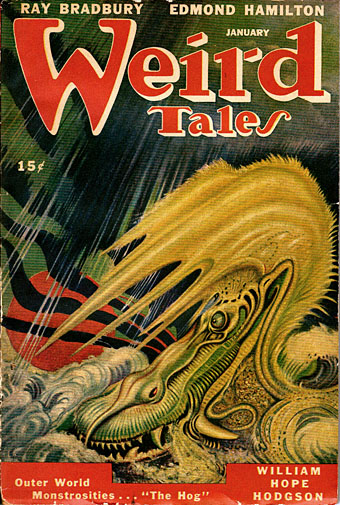
William Hope Hodgson’s final Carnacki mystery, The Hog, received its first magazine publication in January 1947. The cover art by AR Tilburne may not have been originally created for Hodgson’s tale but it complements the story’s atmosphere of febrile dread.

• It’s still April so that means it’s still the month that saw the 100th anniversary of the death of William Hope Hodgson, bodybuilder, manacler of Harry Houdini, and the author of several novels of weird fiction that continue to entrance new generations of readers. The edition of Hodgson’s The House on the Borderland that I illustrated for Swan River Press would have been on sale this month but print problems have caused delays with the run as a whole; anyone interested is advised to contact the publisher for news. • Meanwhile, Jon Mueller (composer of the book’s accompanying soundtrack CD) and myself talked to Swan River Press about the attractions of Hodgson’s novel. • More Hodgsoniana: Greydogtales acknowledged the Hodgson centenary via a discussion with Hodgson scholar Sam Gafford, while Michael Dirda reviewed the new edition of The House on the Borderland and another SRP title, The Scarlet Soul (whose cover I also designed), for The Washington Post.

• “From the ashes of countless decayed Modernities comes Neo-Decadence, a profaned cathedral whose broken stained glass windows still glitter irregularly in the harsh light of a Symbolist sun. Behind this marvellously vandalised edifice, a motley band of revellers picnic in the graveyard of the Real, leaving behind all manner of rotting delicacies and toxic baubles in their wake.” Drowning in Beauty: The Neo-Decadent Anthology edited by Daniel Corrick & Justin Isis is published this month by Snuggly Books, an imprint whose catalogue of new books and first-time translations will be of interest to anyone who comes here for Decadence, Symbolism or anything related. Related to the above: A Neo-Decadence Day at Dennis Cooper’s.

• “Witches are change-makers. They’re transgressive beings who dwell on the fringes of society, and so they’re the perfect icon for rebels, outsiders, and rabble-rousers, especially those of the female persuasion.” Pam Grossman talks to Grimoire about witchcraft and related arts.

• Mixes of the week: Resident Advisor Podcast 621 by Grouper, and Bacchus Beltane 5: The Owl Service by The Ephemeral Man.

• Back in black: Publisher/translator James Conway and designer Cara Schwartz on the cover designs of Rixdorf Editions.

• I was talking again this week at The Writer’s Corner where JKA Short asked me about working as an illustrator.

All Gates Open: The Story of Can by Rob Young is published next week. The Wire has an extract.

• Delusional Albion: Brad Stevens on how foreign directors saw Britain in the Swinging Sixties.

• “There’s no book I love more than Derek Jarman’s Modern Nature,” says Olivia Laing.

Eden Tizard on Soliloquy For Lilith, the drone album by Nurse With Wound.

Owls (1969) by Ruth White | Decadent & Symmetrical (1995) by ELpH vs Coil | The Owls (2013) by Félicia Atkinson

Weekend links 252

brizzi.jpg

Waiting by Liz Brizzi.

• “Music, politics, sex, and art were also widely represented by Evergreen. Gerald Ford famously maligned the magazine on the floor of Congress for printing the likeness of Richard Nixon next to a nude photo.” Jonathon Sturgeon on the return of an avant-garde institution.

• “The hallucinogenic properties of language are widely recognized by all repressive societies…which treat words like other tightly controlled substances.” Askold Melnyczuk reviews Where the Bird Sings Best, a novel by Alejandro Jodorowsky.

• Mixes of the week: A Mix For Thomas Carnacki by Jon Brooks whose Music for Thomas Carnacki has been reissued on vinyl; Solid Steel Radio Show 27/3/2015 by DJ Food.

One of the few vice-friendly cities left in the US, New Orleans remains his spiritual home, or whatever the atheist equivalent is. Waters’ supposed favourite bar in the world is here in the historic French Quarter. The Corner Pocket is a gay dive bar with tattooed strippers—filthy in exactly the way Waters likes.

“Trash and camp just don’t cut it any more,” he told a rapt audience at his interview panel on Friday. “Filth still has a punch to it. The right kind of people understand it and it frightens away the timid.”

John Waters growing older disgracefully

Songs of a Dead Dreamer and Grimscribe by Thomas Ligotti are being republished in a single edition by Penguin. Jeff VanderMeer wrote the foreword.

• “The film is brimming with Bacchanalian revelry, arcane mystery and mortal dread.” Robert Bright on The Saragossa Manuscript by Wojciech Has.

Alistair Livingston has posted page scans from When Darkness Dawns, volume two of his zine from the early 80s, The Encyclopedia of Ecstasy.

• “Without first understanding the flâneur we cannot understand the development of arcades,” says Aaron Coté.

• At A Journey Round My Skull: Jo Daemen cover designs; at 50 Watts: the art of Manuel Bujados.

• Vast spacecraft and megastructures: Jeff Love on the science-fiction art of Chris Foss.

• At Dangerous Minds: RE/Search’s Vale on JG Ballard and William Burroughs.

• RIP John Renbourn

Pentangling (1968) by Pentangle | Lyke-Wake Dirge (1969) by Pentangle | Lord Franklin (1970) by Pentangle

Haunted Corridors: The Temporal Enigmas of Sapphire and Steel

sands01.jpg

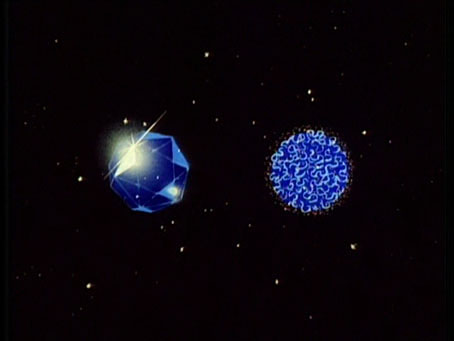
All irregularities will be handled by the forces controlling each dimension. Transuranic, heavy elements may not be used where there is life. Medium atomic weights are available: Gold, Lead, Copper, Jet, Diamond, Radium, Sapphire, Silver and Steel.

Sapphire and Steel have been assigned.

Voiceover at the beginning of each episode

Having revisited a fair amount of old television in the past few years I thought I was past being surprised, but this came as a revelation. Sapphire and Steel appeared at exactly the wrong moment for me to fully appreciate it the first time round. The six storylines ran on the ITV network from 1979 to 1982, a period when my home and personal life was so chaotic that I saw little television at all. At any other time a series featuring a pair of cosmic investigators immersed in mysteries involving haunted railway stations and people escaping from photographs would have been essential viewing. Sapphire and Steel was never repeated after those original screenings so watching the entire run recently has been like seeing it for the first time. In recent years the series has been included in discussion of the weirder British television of past decades; China Miéville in his interview in The Twilight Language of Nigel Kneale describes Sapphire and Steel as the strangest thing ever screened on British TV. After reading that, and a couple of other appraisals, I felt obliged to refresh my vague memories.

sands02.jpg

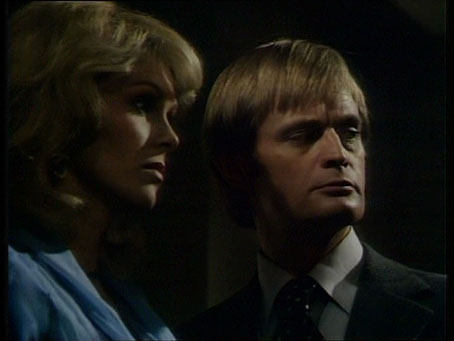
Assignment One: Sapphire (Joanna Lumley) and Steel (David McCallum).

Superficially, Sapphire and Steel belongs to the occult-detective subgenre, a minor category of weird fiction that in its early days included characters such as Sheridan Le Fanu’s Dr Martin Hesselius, Algernon Blackwood’s John Silence, William Hope Hodgson’s Thomas Carnacki and others. But several factors set Sapphire and Steel apart from their more staid predecessors: occult detectives are generally solitary figures whereas Sapphire and Steel operate as a pair; Sapphire is a woman in a field more commonly occupied by middle-aged men; and most striking of all, both Sapphire and Steel are supernatural beings themselves, dispatched to Earth by agencies we never see and learn nothing about, in order to mend ruptures in the flow of Time. Supernatural detectives had appeared in comic books before this but there’s no evidence that series creator PJ Hammond was considering such antecedents when he wrote The Time-Menders (as Sapphire and Steel was originally known). A few years earlier Hammond had been writing for Ace of Wands (1970–72), a mildly hippyish children’s TV series whose hero, Tarot, was a youthful stage magician with genuine occult powers. Between stage shows, Tarot and friends investigated supernatural events. Sapphire and Steel had originally been planned as a series for children but before the first script was finished it was moved to an early evening slot, thus allowing for darker and more adult-oriented material.

sands03.jpg

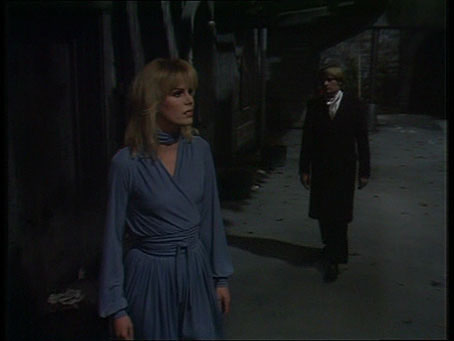
Assignment Two: the haunted railway station. The clothing worn by the pair changes with each assignment; on this occasion they’re in evening dress.

One of the attractions of Sapphire and Steel in a genre replete with origins and canonical histories is how little is explained about the two main characters, the source of their assignments, or even the true nature of the malevolent forces they have to face. Sapphire (Joanna Lumley) and Steel (David McCallum) embody the materials after which they’re named, the pair being part of a team of elemental operatives some of whose names are listed in the voiceover that introduces each episode. We only encounter two others: Lead (Val Pringle), a huge African-American man with superior strength; and Silver (David Collings), an effete and dandyish Englishman with the ability to mould metals, fix machines and replicate objects. Sapphire’s abilities are mainly psychometric—she reads the history and condition of people and places—but she can also rewind time for short periods; Steel is as cold and unyielding as his name; he’s fiercely analytical, often bad-tempered and also strong enough to tie a knot in a lift cable.

Continue reading “Haunted Corridors: The Temporal Enigmas of Sapphire and Steel”