Infinite reflections

fireflies.jpg

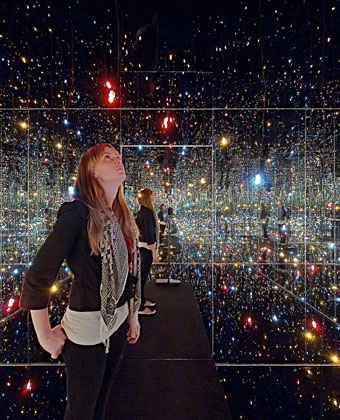
Fireflies on the Water by Yayoi Kusama (2002).

One of my favourite contemporary artworks, Fireflies on the Water by Yayoi Kusama, receives a new showing at Sydney’s Museum of Contemporary Art. Her mirrored room features 150 lights and a pool of water and while most photos show an impressive work, none of them can match this fantastic 360º panorama by Australian photographer Peter Murphy. Kusama isn’t the only artist to use mirrors this way but mirror rooms and reflective surfaces have become as much a recurrent feature of her work as her trademark spots.

Fireflies on the Water is being shown as part of the Yayoi Kusama: Mirrored Years exhibition and can be seen until June 8th, 2009. (Via Nevertheless.)

samaras.jpg

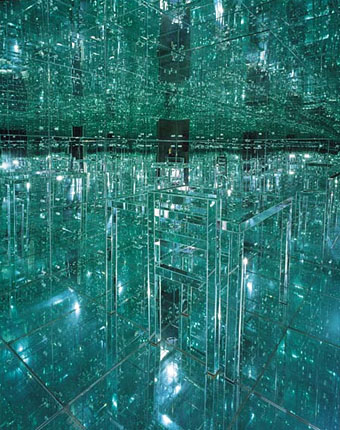
Mirrored Room by Lucas Samaras (1966).

I’ve often wondered how far back the invention of the fully-mirrored room can be traced. Halls of mirrors are historically common but the mirrors tend to be on the walls only. American artist Lucas Samaras produced his Mirrored Room (with mirrored chair and table) in 1966, something which fascinated me when I first encountered it in art books.

frippandeno.jpg

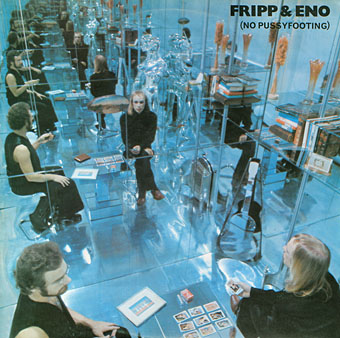
It evidently fascinated ex-art student Brian Eno who I’m sure must have borrowed the idea for the cover of his collaboration with Robert Fripp, (No Pussyfooting), in 1973. I’ve always assumed this was a room in Eno’s home at the time but never seen that confirmed. Anyone know whether this is the case?

Elsewhere on { feuilleton }
The panoramas archive

Previously on { feuilleton }
The art of Josiah McElheny
Yayoi Kusama
The art of Yayoi Kusama
Exposure by Robert Fripp

Designing Booklife

bl1.jpg

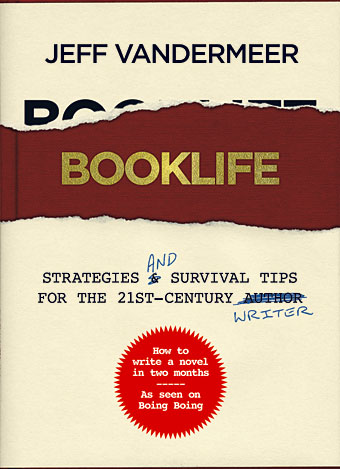
I created a cover design recently for Jeff VanderMeer‘s new novel, Finch, and shortly after completing that Jeff asked if I could put together some cover ideas for his forthcoming writer’s guide, Booklife, which Tachyon will be publishing later this year. Jeff is known as a fantasy writer but this book was intended to have a general appeal for any would-be or working writer. It also needed to look suitably contemporary and (possibly) reflect the discussion within which concerns the modern writer’s use of computers, the internet and social networks. Lastly, several lines of text needed to be placed on the cover without it looking confused or messy.

I agreed to this whilst busy with several other projects so the initial drafts were rather haphazard. (That’s my excuse, anyway.) The first version (above) came out of an idea to apply a kind of trompe l’oeil effect to the cover with a torn dustjacket and handwritten amendments. The red call-out/roundel highlights an important sub-section of the book. This was knocked up very quickly and, as well as not looking very contemporary, the title doesn’t look enough like gold blocking to be convincing. Jeff requested something more up-to-date.

Continue reading “Designing Booklife”

Brian Eno: Imaginary Landscapes

eno2.jpg

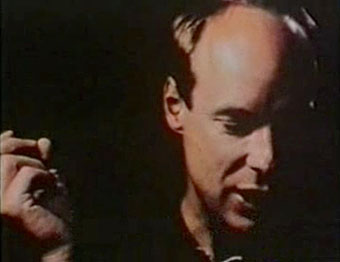
From Eonism back to Eno with Imaginary Landscapes, a 40-minute documentary from 1989, directed by Duncan Ward and Gabriella Cardazzo. As usual it’s good to see BE discussing his ideas about music and art although I’d have preferred less of the atmosphere shots and more talk. The film is available to view in a streaming version here.

Previously on { feuilleton }
Thursday Afternoon by Brian Eno
Moonlight in Glory
Tiger Mountain Strategies
Generative culture
My Life in the Bush of Ghosts

Thursday Afternoon by Brian Eno

thursday.jpg

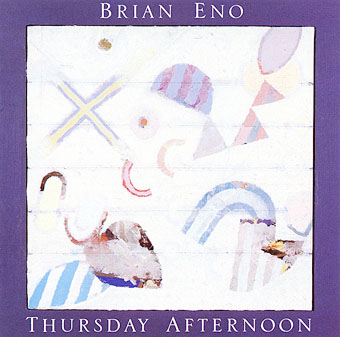
Cover painting by Tom Phillips, design by Russell Mills.

A post for a Thursday.

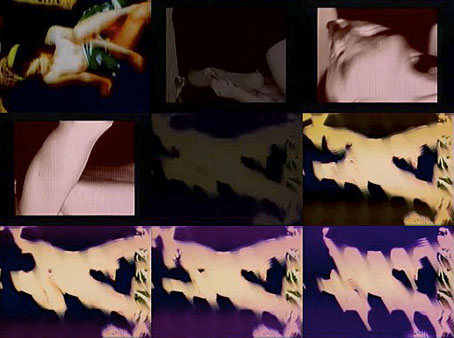
Brian Eno’s ambient music receives a lot of playing time here, especially Music for Airports, On Land, The Shutov Assembly and, when something really minimal is required, Neroli. But it’s Thursday Afternoon that receives the most attention. Recorded at the request of Sony Japan in 1984, Thursday Afternoon is a single piece that originally accompanied seven of Eno’s “video paintings”, each of them showing Christine Alicino warped and blurred by ultra-slow motion and video noise. Like his earlier static views of the New York skyline, Mistaken Memories of Medieval Manhattan, filming vertically means that proper viewing can only be achieved by turning the TV on its side. The soundtrack is a beautifully rendered composition which uses Eno’s customary process of letting a number of looped phrases form a shifting musical moiré.

Compositionally, Thursday Afternoon belongs to the family of works which also includes Discreet Music and Music for Airports. Like them it is an even-textured, spacious and contemplative piece in which several musical events appear and recur more or less regularly. Each event, however, recurs with a different cyclic frequency and thus the whole piece becomes an unfolding display of unique sonic clusters. Eno has characterised this style of composition as “holographic”, by which he means that any brief section of the music is representative of the whole piece, in the same way that any fragment of a hologram shows the whole of the holographic image but with a lower resolution. (From the album notes.)

Daniel Lanois, Roger Eno and Michael Brook were all involved in the creation and production of Thursday Afternoon and the piece works as well played very quietly as it does at louder volume. When played louder more of the background detail becomes apparent, including some very faint birdsong which is most discernible at the end when much of the music has faded away. Perfect for colouring the atmosphere of a room whilst reading, working or talking with friends. It’s also a favourite of mine for playing in the bedroom with someone special.

Thursday Afternoon was released on video cassette then appeared on CD in 1985. As a single track of 61 minutes, this was one of the first original recordings which made specific use of the extended running time of the CD format. The cover painting was by {feuilleton} favourite, artist Tom Phillips, with design by artist and designer Russell Mills. Ten years earlier, Eno had used a detail of Phillips’ painting After Raphael on the cover of Another Green World.
eno.jpg

All of which is a long-winded way of saying that you can now see the original sound and vision version of Thursday Afternoon at Ubuweb. Not ideal by any means but it gives you an idea of the complete work rather than the trunctated versions on YouTube. Eno’s video paintings, Thursday Afternoon included, are now available on DVD should you require them in higher quality. Just be prepared to turn your TV on its side.

Update: Eno’s ambient processes have now reached the iPhone with the Brian Eno and Peter Chilvers app, Bloom.

Elsewhere on { feuilleton }
The album covers archive

Previously on { feuilleton }
Tiger Mountain Strategies
20 Sites n Years by Tom Phillips
Generative culture
Exposure by Robert Fripp
My Life in the Bush of Ghosts