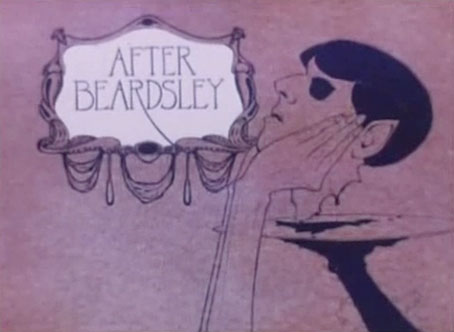
After Beardsley by Chris James

ab1.jpg

I have Greg Jarvis of Flowers of Hell to thank for prompting this discovery. Greg left a comment on an earlier post about Aubrey Beardsley’s influence in the musical world in which he drew my attention to some Flowers of Hell cover art and a video inspired by Beardsley’s Morte Darthur drawings. The video reminded me of a short animated film I’d known about for years but never seen, After Beardsley by Chris James. Sure enough it too is on YouTube, to my great surprise since I swear I’ve searched in vain for this in the past.
ab2.jpg

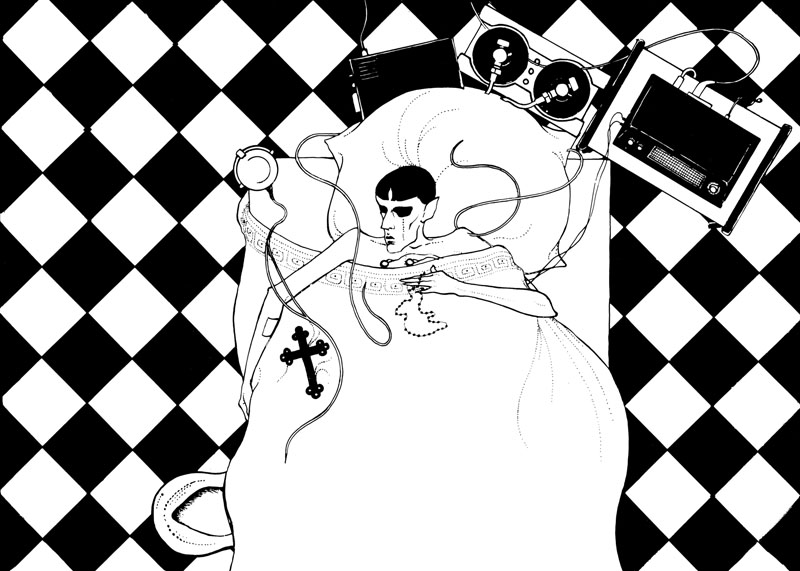
After Beardsley was made in 1981 and my knowledge of the film is a result of its being praised by V&A curator Stephen Calloway. The picture of Aubrey in a hospital bed featured in the 1993 V&A exhibition High Art and Low Life: The Studio and the fin de siècle, and is also the final picture in Calloway’s 1998 biography of the artist. Chris James describes the film thus:

The film After Beardsley attempts to depict today’s world through Beardsley’s eyes and in his drawing style…Beardsley is ‘resurrected’ from his death bed and begins to walk through time to the present. On his journey he witnesses the evolution of the car and of air and sea travel, then climbs a phallic mountain before descending into 20th century New York City. [The] ghost of Aubrey Beardsley explores the urban jungle of New York City where, amongst other things, he sees Bob Dylan as a satyr sitting by an iconic 1959 Chevy, and Lenny Bruce being injected with heroin. He is then beckoned by Patti Smith (as Beardsley’s Messalina) into a hospital room where he finds himself hooked up to life support equipment. His hospital persona shows his ghost the horrors of the present day—overpopulation, pestilence starvation, and death. Via John Lennon, he sees the horrors of a nuclear winter. The premise of the film is that, if Beardsley had been alive today instead of the 1890s, modern medicine would have kept him alive, but that, having had a glimpse of where the world was heading, he may have chosen to die anyway. Written and drawn by Chris James, after Aubrey Beardsley. Music by Ronnie Fowler.

As Beardsley pastiche the drawing is some of the best I’ve seen, it’s easy to see why Calloway would be impressed. The film is split into three parts here, here and here, and Chris James has more animation on his YT channel. I’d be tempted to ask for a better quality copy but for now seeing the film at all is good enough.

Elsewhere on { feuilleton }
The Aubrey Beardsley archive

The art of Marcus Behmer, 1879–1958

behmer05.jpg

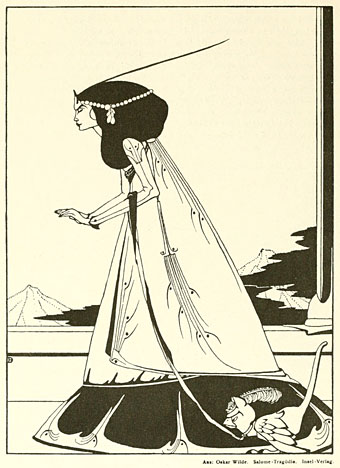
Salomé: Der Wunsch.

Back in March I wrote something about Alex Koch’s art periodical, Deutsche Kunst und Dekoration, a guide to German arts, crafts and architecture founded in Darmstadt in 1897. The Internet Archive has a nearly complete run of these and I’ve recently been working my way through their scans, a process which takes a while as there’s more than 10,000 pages to be looked at. When I find the time I’ll be posting some of the finds from this wonderful publication, the early issues of which are devoted to the best examples of the Art Nouveau style in Germany and elsewhere.

behmer06.jpg

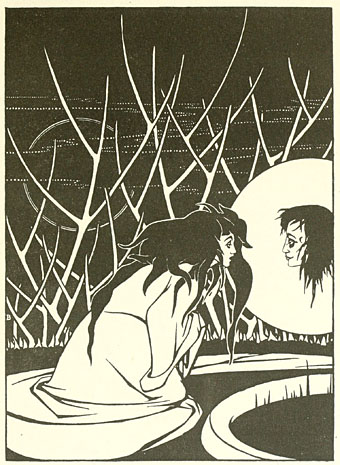
Salomé: Die Erfüllung.

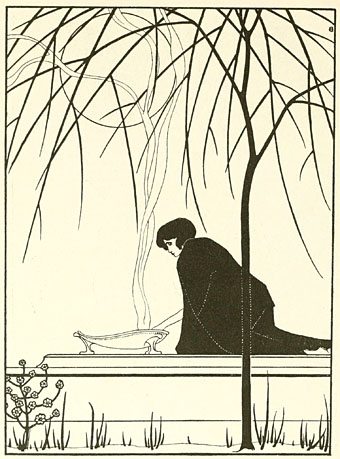
For now, however, I can’t resist posting these pictures from volume 18 (April–Spetember 1906) which form part of a feature about German illustrator Marcus Behmer. I’ve only seen one or two of Behmer’s drawings before and they didn’t really show him at his best. What’s immediately apparent is the great debt his work owed at this point to Aubrey Beardsley, right down to the treatment of foliage and a deliberately grotesque approach to character. It’s also good to find another treatment of the Salomé theme in black-and-white, and the pictures here are credited as being based on Wilde’s play.

behmer07.jpg

Salomé: Das Opfer.

Wikipedia has a page about the artist but it’s all in German, unfortunately, so a crude translation has to suffice. As with Beardsley, the grotesquerie extended to the sexual sphere and it would be nice to know more about the byways of Behmer’s career if only to see where his curious erotic drawings pieces come from. Wikipedia notes that “Behmer was already since 1903 member in the first homosexual organization of the world in Berlin” so I assume that means he was part of Adolf Brand’s circle, and may have contributed to Brand’s publication Der Eigene. A few examples of the erotic work can be found here and here. Further examples from Deutsche Kunst und Dekoration follow.
Continue reading “The art of Marcus Behmer, 1879–1958”

Several Salomés

fowler.jpg

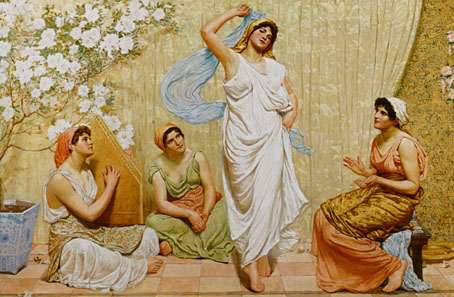
The Dance of Salomé (1885) by Robert Fowler.

There’s always more to find… Unfortunately, Robert Fowler’s academic tableaux is a prime example of bad Victorian art: carefully modelled but overlit, dull and lifeless. And worst of all for the subject at hand: deeply unerotic. We’re supposed to believe that this woman wrapped in a bedsheet would exude enough eros to drive her father to lustful recklessness. This was the bloodless “good taste” against which Oscar Wilde and the Aesthetes set themselves.

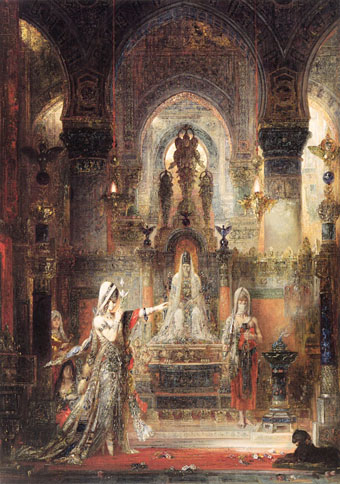
moreau.jpg

Salomé Dancing before Herod (1876) by Gustave Moreau.

Wilde’s idea of Salomé can be seen here in one of Gustave Moreau‘s many paintings on the theme. Wilde would have preferred Moreau’s paintings, or something similar, to adorn his published play but he ended up with Aubrey Beardsley instead. You only have to compare Beardsley’s Stomach Dance with Fowler’s painting to see why Aubrey’s art made such a dramatic impression in the 1890s.

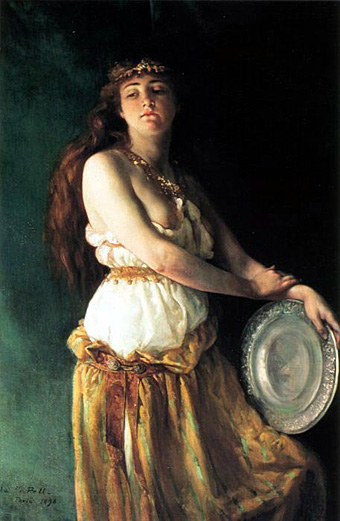
pell.jpg

Salomé (1890) by Ella Ferris Pell.

Ella Ferris Pell’s painting isn’t the only portrait of Salomé by a female artist of this period but it’s the one which Bram Dijkstra chose as the cover image for his excellent study Idols of Perversity: Fantasies of Feminine Evil in Fin-de-Siècle Culture (1986). Of this work Dijkstra writes:

In Pell’s painting a number of the most characteristic turn-of-the-century attributes of the biblical temptress are absent. She does not glare at us with a look of crazed sexual hunger; she does not have the wan, vampire features of the serpentine dancer; nor does she show herself to be a tubercular adolescent … Pell’s Salomé, a real life-woman, independent, confident, and assertive, was far more threatening, far more a visual declaration of defiance against the canons of male dominance than any of the celebrated viragoes and vampires created by turn-of-the-century intellectuals could ever have been. Such a woman could not be disposed of in as cavalier a fashion as the evil women in man’s mind. Her indomitable reality was this feminist Salomé’s most formidable weapon, far more dangerous than any imaginary decapitating sword.

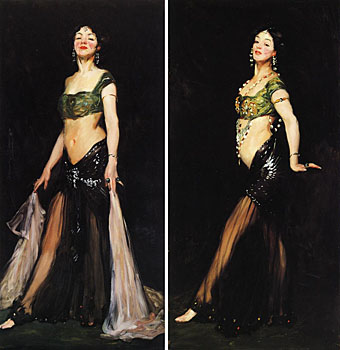
henri.jpg

Salomé (1909), two paintings by Robert Henri.

Finally, there’s this pair of paintings by American artist Robert Henri whose work resembles John Singer Sargent’s in its shadowed backgrounds and light brushstrokes. Salomé was no longer a perennial theme by this point but Maud Allan’s improvised dance performance, Vision of Salomé, was proving enormously popular at the time Henri painted these pictures which may explain his choice of subject. There’s little in the rest of his oeuvre along similar lines.

Elsewhere on { feuilleton }
The Salomé archive

Beardsley’s Rape of the Lock

pope1.jpg

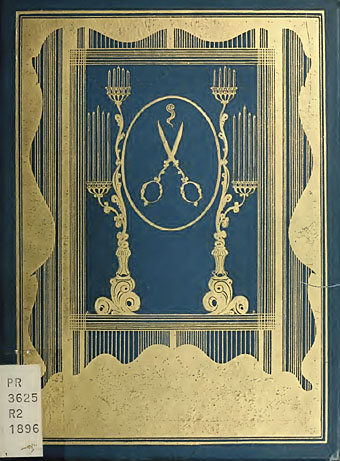
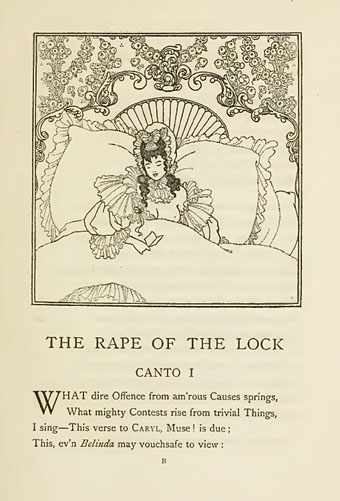
This week’s reading has been Virginia Woolf’s Orlando, a capricious novel which features in its 18th century scenes encounters with some of the great poets of the era, including Alexander Pope. A number of references are made to Pope’s satiric The Rape of the Lock (1717), one of his most notable works which received an equally notable set of illustrations in 1896 from Aubrey Beardsley. The pictures here are from a copy of the first edition published by Leonard Smithers which can be seen at the Internet Archive where the collection features a large number of books created by or written about the artist. Even though Beardsley’s illustrations are endlessly reprinted I do like to see how they were first presented to the world, how the pages were typeset and so on. One detail from this first edition is that we see the credit on the title page: “Embroidered with nine drawings by Aubrey Beardsley.” The cover design is often reproduced in its original black-and-white state which fails to convey the intended effect of those great slabs of gold, while the illustrations within are some of the finest and most detailed of the artist’s career. If the PDF doesn’t really do them justice there are better copies to be found, here and here, for example.

pope2.jpg

Leonard Smithers was notorious in Victorian London for his publishing of pornography but he tried to use the proceeds to occasionally produce works with a better reputation such as this. Beardsley had also been tarred as a pornographer, of course, but here he restrained himself in order to do justice to a book he admired. There is one possible exception in the cover design; I’m afraid I couldn’t find the reference but one of Beardsley’s critics asserts that the open scissors and fatal lock of hair shown in the mirror create a surreptitious image of the female pudenda. With many other artists this interpretation might be dismissed as fanciful but Aubrey filled his early drawings with phalluses and breast shapes, and his unfinished novel, the erotic fantasy Under the Hill, has a title referring to the mons pubis. No other artist of the time would be so daring even with a pornographer for a publisher; it was just this sort of impudence which infuriated his more staid contemporaries. Under the Hill is far more overt in its sexuality and its writing style owes something to Pope’s era which Aubrey adored. The posthumous edition of that book, containing other Beardsley ephemera, can be found here.

Elsewhere on { feuilleton }
The Aubrey Beardsley archive
The illustrators archive
The book covers archive

The Thief of Bagdad

thief2.jpg

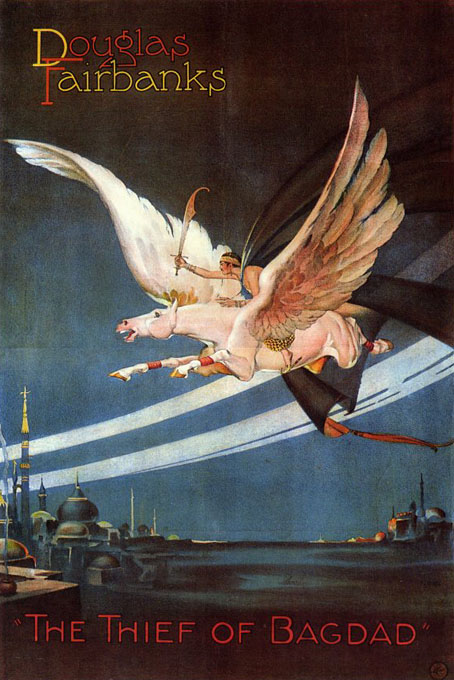
It’s the poster for the 1924 film version we’re concerning ourselves with here, not the more popular 1940 adaptation directed by Michael Powell. Both films are great but I have a special affection for Raoul Walsh’s silent version and this poster design has long been a favourite for the way it manages to condense the film’s blend of storybook graphics and Art Deco exotica. I’d wondered for years who was responsible for this design; according to various poster sites it’s the work of the film’s art director Anton Grot (1884–1974). This is one of several variations (there another here and one here) and there’s also a less interesting design which is far more typical of the period.

I often recommend the 1924 Thief of Bagdad as an introduction to silent cinema, especially if you can find a decent print. Fairbanks’ production had William Cameron Menzies as production designer and his sets are enormous Arabian Nights confections replete with minarets, onion domes and filigree screens like something from an Edmund Dulac illustration. Fairbanks gives a tremendously athletic performance and the marvellous Anna May Wong plays a Mongolian slave girl. There’s a lengthy description of the film’s production here while you can find a copy of the entire film at the Internet Archive although it really ought to be seen in a version which isn’t blighted by a company logo throughout.

Previously on { feuilleton }
More Arabian Nights
Edward William Lane’s Arabian Nights Entertainments
Alla Nazimova’s Salomé
Metropolis posters