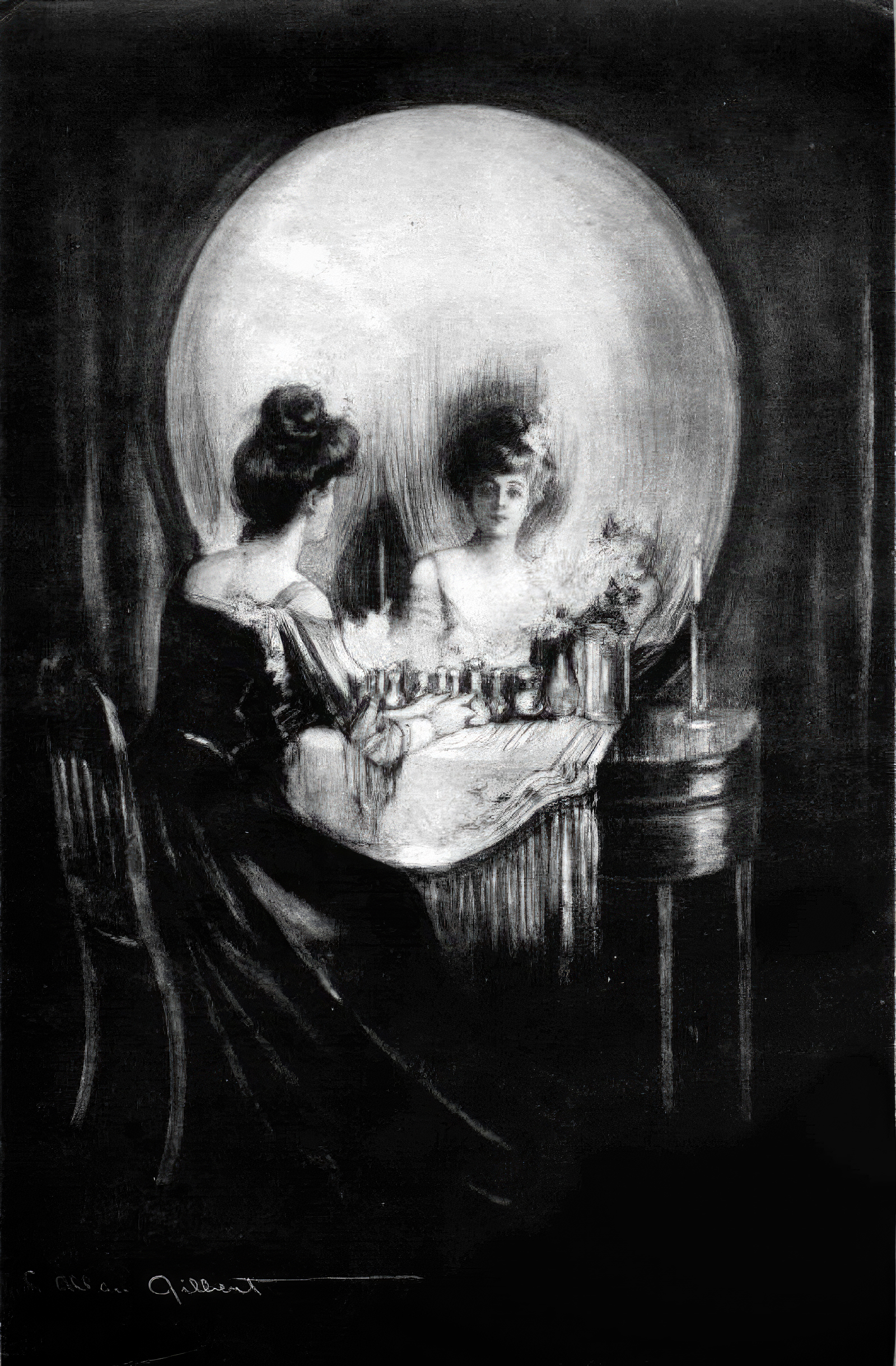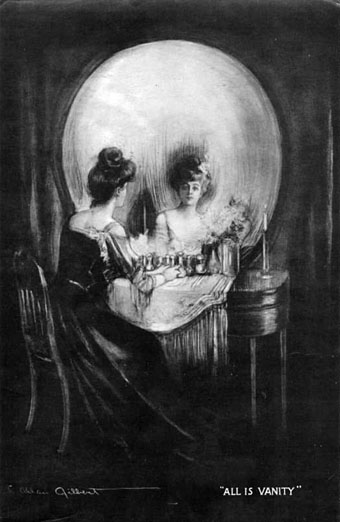
All Is Vanity by Charles Allan Gilbert (1892).
The subliminal skull is another of those perennial motifs that recur in art from time to time, and one which has become especially prevalent since the late 19th century. There seem to be a number of reasons for this, the most obvious being that if you’re going to show how clever you are by hiding one image inside another you may as well make the hidden thing something that everyone recognises. A secondary reason would seem to be the waning power of the vanitas theme. As painting became more pictorially sophisticated it wasn’t enough to simply show a skull and expect people to accept this with a stern moral as the principal content. Hence the development of death as a non-skeletal character in Symbolism and the reduction of skulls in pictures to a kind of playful game.
Holbein’s anamorphic skull in The Ambassadors is probably the grandfather of all the later versions but the more recent popularity of the hidden motif can be traced back to Charles Allan Gilbert whose 1892 picture, All is Vanity, drawn when he was just 18, was sold to Life Publishing in 1902, and subsequently spread all over the world in postcard form. Despite giving birth to a host of imitators, Gilbert’s picture is the one that still inspires artists and photographers up to the present day.
Continue reading “The skull beneath the skin”