Taking Woodstock

taking_woodstock.jpg

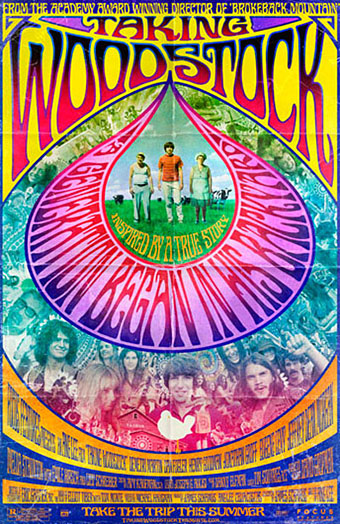
I mentioned Ang Lee’s forthcoming film, Taking Woodstock, last week and this poster by Mojo makes a decent fist of capturing some of the West Coast psychedelic style. I thought at first that the rainbow hues were garish in the wrong way, the San Francisco poster artists used bold colours but limited their palette since many of them were working for screenprinting. But since this film concerns the story of a gay man, Elliot Tiber, and his attempt to provide a home for the Woodstock festival in 1969—and since the rainbow flag is now a gay symbol—it makes sense even if the overall impression is of colour clash. I like the subtle touch of making the poster look worn, something I’ve done myself on a recent book cover design which is also styled as a cinema poster. I’ll be posting that here in due course.

woodstock.jpg

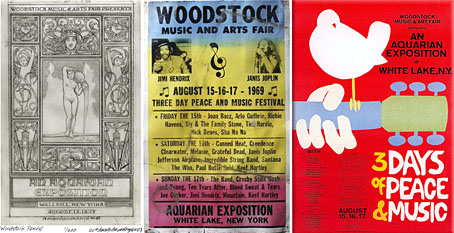
That’s the film promotion; the posters for the original event can be seen at Woodstock posters. The pencil sketch on the left is an elaborate Art Nouveau-styled design intended for the festival before the original choice of venue was refused. The sheet in the centre looks like a hasty promo piece for the new venue while the poster on the right is the final version with the famous dove graphic by Arnold Skolnick. That dove came to symbolise the whole event, hence its appearance on the Taking Woodstock one-sheet.

Taking Woodstock opens in the US on August 15th, 2009, the 40th anniversary of the festival.

Previously on { feuilleton }
Over the rainbow
Dutch psychedelia
Family Dog postcards

#Amazonfail

amazonfail.jpg

I haven’t been using Twitter for very long and until today hadn’t seen the way it can spur people to action with incredible speed. Among my circle of people it was Neil Gaiman who set things rolling with a link to this post by author Mark R Probst which describes how Amazon.com have been quietly removing the sales rankings from books with gay content. Writer Craig Seymour notes it happening to a book of his back in February. They claim this is done as part of their policy of removing sales ranking from anything deemed “adult” and is intended to help (ie: protect by blanking) customers who don’t want to see “adult” material turn up in their searches:

In consideration of our entire customer base, we exclude “adult” material from appearing in some searches and best seller lists. Since these lists are generated using sales ranks, adult materials must also be excluded from that feature.

It quickly became apparent that gay and lesbian titles are being penalised in a very scattershot manner. As Jezebel.com noted:

Queer theory books, books on coming out, and feminism books lose their rankings, but A Parent’s Guide To Preventing Homosexuality gets to keep its rank? WTF?!?

Other people noted that Mein Kampf gets to keep its sales rank. There’s a growing list of affected titles here. Examples of inconsistency can be found all over; an early title by William Burroughs, Queer, has no sales ranking while Cities of the Red Night does. The latter contains a lot more hardcore gay sex than the former but I guess it was the title which damned Queer rather than the content. I could go on listing and comparing but you can do that yourself, it’s a curious diversion wondering what gets hit and what doesn’t. I had a quick look through Amazon.co.uk and that seems affected in an equally haphazard manner with gay-themed academic titles being stripped of their rankings while other books with erotic scenes (Alan Hollinghurst’s novels, for example) are left alone. Plenty of non-gay erotic books have also been left alone.

As a consequence of this the obvious thing to do is to boycott Amazon until there’s a clear change of policy, and I say this as someone who has a book of his own on sale there. Buy it elsewhere, people. I’m changing the Amazon Associates links on this site so they point to publishers’ pages or other booksellers. I’ve never made much from the Associates scheme but in the two years I’ve been a part of it the various clicks and orders from visitors have generated Amazon nearly £1000 ($1800). Given their present policy towards gay and lesbian books—accidental or otherwise—I don’t see why I should be assisting them any further.

Update: A theory that this was caused by some clever trolling. Um, I think not. As noted above, it’s been going on for some time.

Update 2: Amazon says: “We recently discovered a glitch to our Amazon sales rank feature that is in the process of being fixed. We’re working to correct the problem as quickly as possible.” Gay news blogs remain unconvinced. A pertinent quote from Andy Towle at Towleroad:

It … brings up a wider issue. This kind of double-standard happens not only across the internet but across media. Towleroad, for example, although we carry no pornographic content, is widely blocked as “adult” by many corporate filters simply because we write about gay issues. It’s the same reason magazines like OUT and The Advocate are often placed among porn titles on newsstands when they clearly don’t belong there.

Update 3: Patrick Nielsen Hayden’s appraisal of the farrago. Best theory I’ve seen so far (Amazon’s “glitch” excuse isn’t enough for most people, hence the ongoing theorising). Note that he doesn’t rule out the trolling theory either.

Update 4: Finally…a more detailed admission of culpability from someone at Amazon.

Update 5: NYT “Amazon Says Error Removed Listings“.

Update 6: Last word on the whole business (maybe).

Previously on { feuilleton }
The art of Shinro Ohtake

Naked furniture

blazquez.jpg

Taking a break from the psychedelic overload today with a return to (what else?) black and white photographs of naked men. The subjects this time are from Mobilario Humano, fanciful suggestions for furniture designs by David Blázquez which use the photographer himself as the subject, collaged into a series of pliable clones. Allen Jones produced similar work with female figures in the 1960s—and Stanley Kubrick borrowed Jones’ idea for A Clockwork Orange—but this is the first time I’ve seen male figures used this way.

Thanks to Carmine for the tip!

Psychedelic vehicles

further.jpg

Further: the second version of Ken Kesey’s Merry Prankster bus.

The word psychedelic, like surreal before it, slipped from its original meaning through appropriation. Humphrey Osmond’s neologism was first coined in drug-related correspondence with Aldous Huxley in 1957 and was specifically intended to describe the “mind-manifesting” quality of the hallucinogenic drug experience. The drug-inspired art and music which came after the experiments of the Fifties quickly assumed a gaudy and chaotic aspect derived from the intense visual abstractions of LSD trips. Huxley in The Doors of Perception (1954) rejected these fractal visions as trivial and distracting—he was more concerned with the deeper spiritual revelations—but a new way of seeing in a new era required a new label. Art and design which is vivid, florid, multi-hued and quite often incoherent is where the term psychedelic is most commonly applied today.

Of the three vehicles here, only Ken Kesey’s bus can be regarded as psychedelic in Osmond’s sense, this being the renovated school bus which travelled the United States in the mid-Sixties dispensing free LSD to those it met along the way. These events were recounted in Tom Wolfe’s The Electric Kool-Aid Acid Test (1968) and the creators of last year’s Milk, Gus Van Sant and Dustin Lance Black, have a film in preparation based on Wolfe’s book. Milk was a film about gay rights campaigner Harvey Milk, and Ang Lee (director of Brokeback Mountain) has a new film of his own due shortly, Taking Woodstock, which concerns Elliot Tiber, the gay organizer of the Woodstock Festival of 1969. Both stories bracket the psychedelic era. Is this coincidence or do I detect something in the air? But I digress….

porsche.jpg

For the chaotic and decorative nature of the psychedelic style, look no further (so to speak) than Janis Joplin’s 1965 Porsche. I saw this in 2005 at Tate Liverpool when it was touring with the Summer of Love exhibition of psychedelic art. One of  Joplin’s very last recordings before her death in 1970 was a birthday song for John Lennon so it’s perhaps fitting that the third vehicle here is Lennon’s lavish Rolls-Royce. His 1965 limousine came originally in black livery but two years later he decided he wanted it painted like a gypsy caravan. There’s a great page about the car here including details of its decoration, created in consultation with Marijke Koger of Dutch design group The Fool.

rolls.jpg

In a small way these three vehicles encapsulate the psychedelic period, from optimistic, proselytising origins following the revelations of hallucinogenic drugs to decline into a mannered, highly-commercialised graphic style. Ken Kesey died in 2001 but his second bus is still active while the cars are now museum pieces. Perhaps the real psychedelic spirit prevails after all.

See also: George Harrison’s Mini Cooper

Previously on { feuilleton }
Dutch psychedelia
The art of LSD