The art of Robert R Bliss, 1925–1981

bliss1.jpg

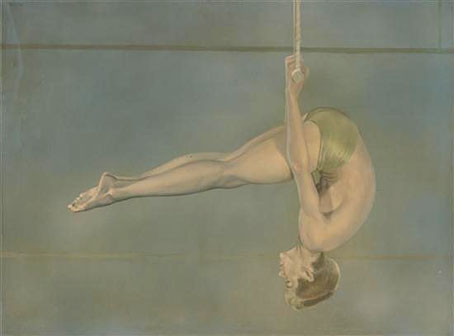
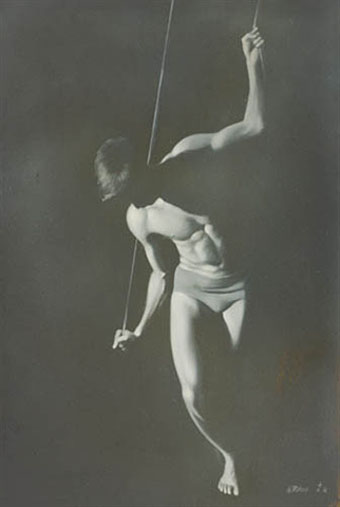
Standing boy pulling ropes (1962).

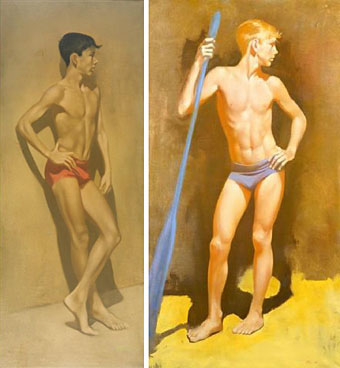
The chiaroscuro above looks like a photo print but is actually a painting. I’ve seen Bliss’s name mentioned a few times before but he remains rather difficult to track down online, most of the visible works being on auction sites. What there is consists mostly of young men in swim suits, to a degree which seems like an idée fixe given the lack of nudes or variation in the poses.
bliss2.jpg

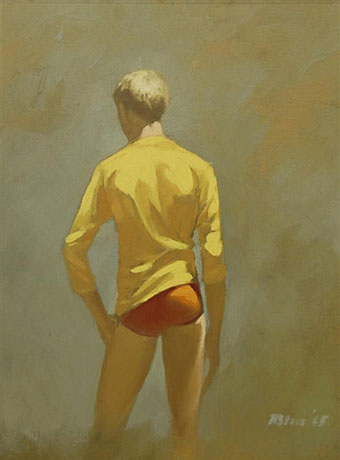
left: Standing boy with red trunks (1961); right: Boy with oar (no date).

In a career outline on the Leslie-Lohman site there’s this curious paragraph:

Bliss…after 20 years of alcoholism, discovered LSD. After that he completely stopped drinking. His work then completely shifted to colorful landscapes as well as psychedelic visionary paintings.

I’ve not been able to find any of this psychedelic work at all. If anyone knows of any, please leave a comment.

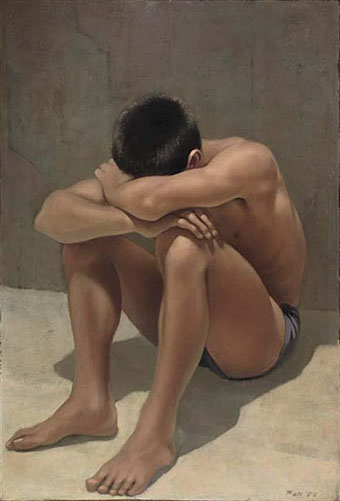
Update: Added a few more examples of his male studies.
bliss3.jpg

Seated Boy (1950).

bliss4.jpg

Swinging Boy (1959).

bliss5.jpg

Yellow Shirt (1963).

bliss6.jpg

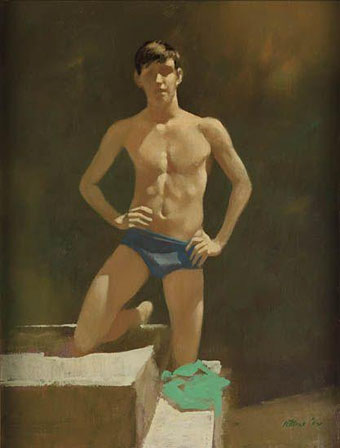
Kneeling Male Athlete (1964).

Elsewhere on { feuilleton }
The gay artists archive

Der Orchideengarten

orchideengarten.jpg

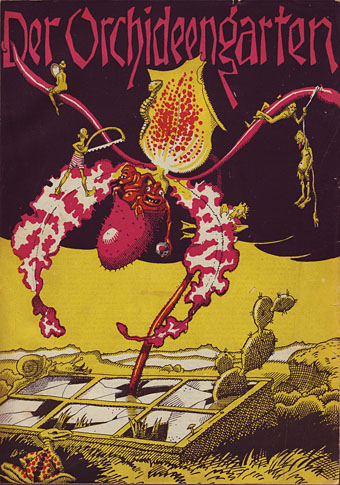
Will at A Journey Round My Skull turned up some gold this week in the form of several covers from a German periodical, Der Orchideengarten, which ran for 51 issues from 1919 to 1921. This is generally credited as being the world’s first fantasy magazine which makes its unaccountable obscurity all the more surprising. Both Will and I first encountered the magazine in Franz Rottensteiner’s essential history of fantasy, The Fantasy Book, published by Thames & Hudson in 1978, with a US edition produced by Collier Books. As well as being a wide-ranging history, Rottensteiner’s book is profusely illustrated throughout and includes two tantalising and distinctly weird covers from Der Orchideengarten, a magazine which Rottensteiner describes as “one of the most beautiful fantasy magazines ever published.” Over the years I’ve found myself becoming thoroughly acquainted with most of the book’s contents as authors were discovered and various gaps filled. One of the few points of obscurity left was that column which describes Der Orchideengarten and those two covers. So you can perhaps appreciate the excitement at seeing more of these rare specimens brought to light.

strobl.jpg

There’s no need to repeat the history when you can read it for yourself on Will’s page and see the covers. One of the magazine editors was author Karl Hans Strobl whose collection of weird tales, Lemuria, had been published two years earlier. This monochrome copy of the cover design is by Richard Teschner, taken from one of my Art Nouveau design books where it stands out like a rather grotesque sore thumb. I don’t know if Teschner was a contributor to Der Orchideengarten but on the strength of this he should have been.

Update: Will posts some interior illustrations.

Elsewhere on { feuilleton }
The illustrators archive

Previously on { feuilleton }
The Great God Pan
Jugend Magazine
Meggendorfer’s Blatter
Simplicissimus

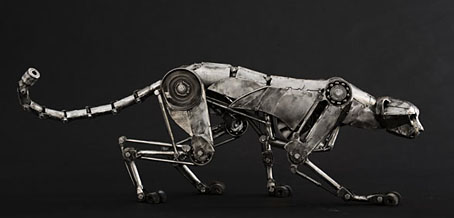
Andrew Chase’s steel cheetah

chase.jpg

From tiny metal animals to something a lot larger. Andrew Chase‘s fully-articulated cheetah is 61 cm (24 inches) high and 127 cm (50 inches) in length, and joins a similar mechanoid giraffe and elephant as part of Chase’s ongoing Timmy project. Lots more pictures of all the animals at Baekdal. Now if only these were fully-functioning robots…

Previously on { feuilleton }
The Corpus Clock
The Bowes Swan

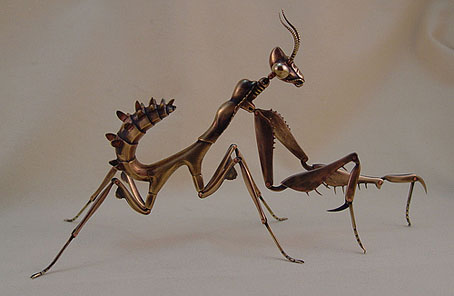
Geoffrey Haberman’s brass insects

haberman1

Blepharopsis mendica nymph.

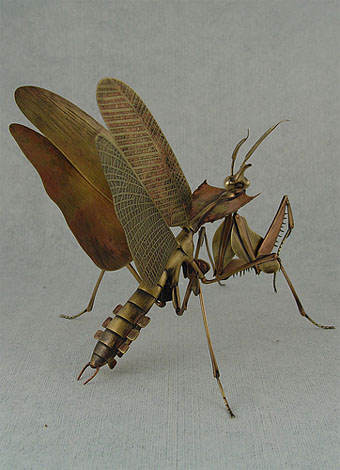
More insect art and some really gorgeous creations. Geoffrey Haberman also makes silver insects but I much prefer the brass ones. From four pages of Flickr photos including an incredible mantis horde.

haberman2

Idolomantis diabolica adult male.

Previously on { feuilleton }
Sipho Mabona’s origami insects
Kitchen insects
Elizabeth Goluch’s precious metal insects
Laura Zindel’s ceramics
The art of Philippe Wolfers, 1858–1929
Robert Lang’s origami insects
Lalique’s dragonflies
Lucien Gaillard

Design as virus 9: Mondrian fashions

mondrian1.jpg

Elly Jackson of La Roux in the recent video for Bulletproof. I’ve been enjoying La Roux’s debut album a great deal in the past week. The jacket she’s wearing is designed by Jean-Charles de Castelbajac and features the black stripes and primary colours used by Piet Mondrian (1874–1942) in his Neo-plasticist paintings of the 1920s.

Continue reading “Design as virus 9: Mondrian fashions”