Nicoletto Giganti’s naked duellists

fencers.jpg

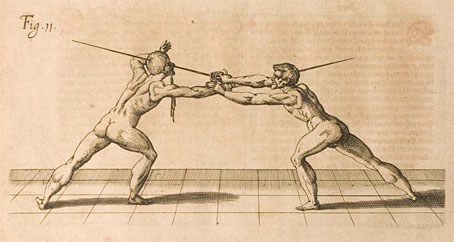
This is something you don’t generally see in swashbuckling films, a duellist being stabbed through the eye. To judge by the plates in Nicoletto Giganti’s sword-fighting manual it seems to have been a very common form of attack; duels with bare blades were a serious business. For some reason most of the combatants in these pictures also have bare bodies, possibly to better display the positioning of their limbs.

I found this 1644 book by accident last year while searching for something completely unrelated then forgot to bookmark the page. Good job, then, that the indispensable Mr Peacay at BibliOdyssey had come across the same pages. He also found plates from an older book dealing with different forms of hand combat.

Elsewhere on { feuilleton }
The men with swords archive
The etching and engraving archive

Previously on { feuilleton }
Battle of the Naked Men

The art of Warwick Goble, 1862–1943

goble1.jpg

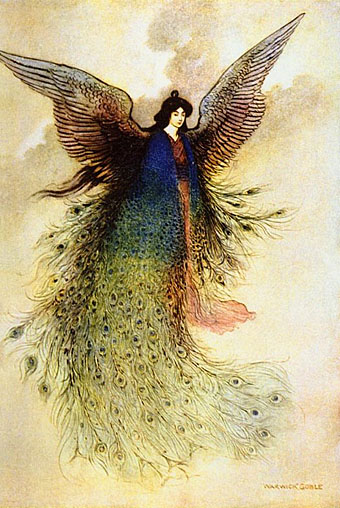
Moon Maiden (1910).

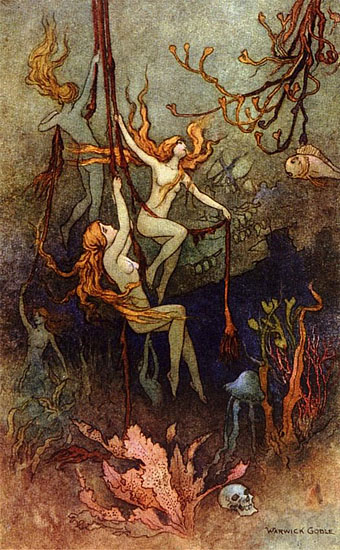
Goble’s Moon Maiden, an illustration from Green Willow and Other Japanese Fairy Tales, is proof that a peacock train needn’t be the sole preserve of masculine birds, but then Ruth St Denis had already shown us that. Art Passions has a decent selection of Goble’s fairy pictures although if you want to see the full complement of drawings made for these books you need to consult the Internet Archive. As usual with illustrators of this period, I find I prefer many of the black-and-white works over the paintings; Art Passions doesn’t have any of those, unfortunately, while the book scans are too low-res to do them justice. Once again, Bud Plant provides an overview of the artist’s career.

goble2.jpg

Sea-Nymphs – Ding-Dong, Bell (1920).

Elsewhere on { feuilleton }
The illustrators archive

Previously on { feuilleton }
Ruth St Denis

Fillmore sealife

fillmore1.jpg

Country Joe & the Fish by Wilfred Weisser (1968).

A pair of sea-themed psychedelic posters from a small collection here. Most of the examples are familiar faces but these two stood out for me, especially the octopus one by Wilfred Weisser which I hadn’t seen before. The figures in Bob Fried‘s poster below look like they may have been borrowed from Walter Crane or a later Victorian illustrator.

Update: For the record, Bob Fried’s figures are indeed by Crane, an illustration for Spenser’s Faerie Queene from The Studio magazine, 1896.

fillmore2.jpg

Canned Heat by Bob Fried (1967).

Previously on { feuilleton }
Max (The Birdman) Ernst
Taking Woodstock
Dutch psychedelia
Family Dog postcards
Octopulps

More book design

hotel.jpg

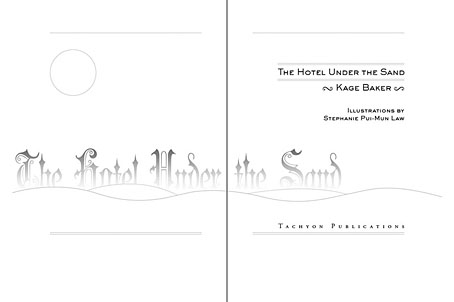
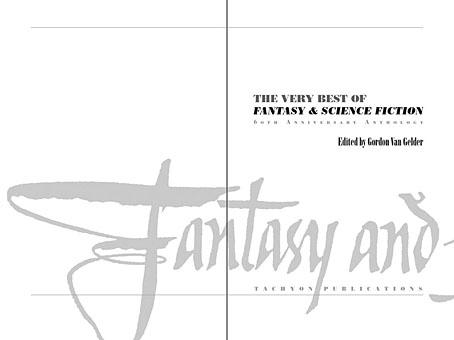
Yes, it’s been a busy year. These are books three and four respectively of the titles I’ve been designing for Tachyon Publications, and there are more on the way.

Kage Baker’s The Hotel Under the Sand is a charming fantasy for children concerning the hotel of the title and its curious inhabitants, which include a ghost bellboy and a pirate captain. The illustrations were by Stephanie Pui-Mun Law and I tried to complement these with the lettering design and graphic elements. I always enjoy working on illustrated books.

fandsf.jpg

The Very Best of Fantasy & Science Fiction is a very different beast, a big (480 pages) selection by Gordon Van Gelder of some of the many first-class stories from the sixty-year history of the fiction magazine. F&SF has published so many classic stories over the years the book could easily have been twice as big. As it is there are pieces by Alfred Bester, Ray Bradbury, Shirley Jackson, Philip K Dick, Harlan Ellison, Stephen King and Neil Gaiman, among others. The design in this case came from studying a copy of the magazine from 1967; I was already thinking of using Bodoni for the story titles and that choice was confirmed when I saw it used for the same purpose in the magazine. The calligraphic titles were also scanned from there, their design going back to the very first issue.

Both these books are on sale now, and Keith Brooke gave a glowing appraisal to the latter in The Guardian at the weekend.

Previously on { feuilleton }
Medicine Road by Charles De Lint
The Best of Michael Moorcock

Forbidden Colours

mishima1.jpg

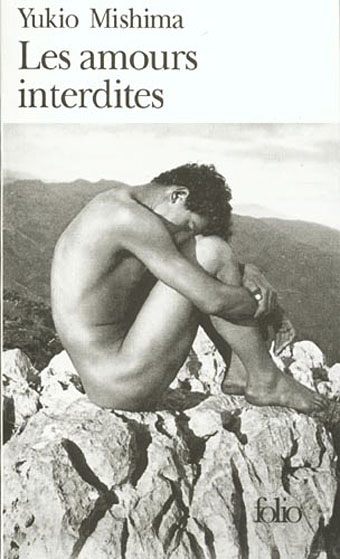
Wilhelm von Gloeden‘s version of the Flandrin pose as it appears on the cover of a 1989 Gallimard edition of Forbidden Colours by Yukio Mishima. I included this photograph in the very first posting which examines the recurrence of Flandrin’s Jeune Homme Assis au Bord de la Mer but this is the first time I’ve seen it used on a book cover. The French twist the title into “forbidden loves” and in so doing lose Mishima’s punning subtlety.

mishima2.jpg

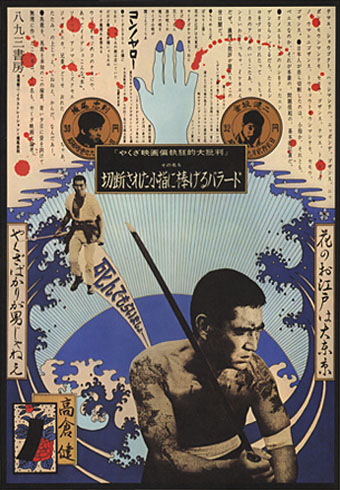
The Ballad To a Severed Little Finger (1966).

Searching around earlier turned up a nice collection of poster works by the great Japanese collage artist, Tadanori Yokoo. One of these from 1966 is dedicated to Mishima, while the one above shows actor Ken Takakura in one of his many yakuza roles. Yokoo regarded Mishima as a major influence and further cemented the relationship by making an appearance in Paul Schrader’s 1985 film, Mishima: A Life in Four Chapters. By convoluted coincidence, Schrader received his start in Hollywood ten years earlier with a co-written screenplay, The Yakuza, which Sidney Pollack directed. Ken Takakura reprised his gangster persona in that film, along with Robert Mitchum. It’s a good piece of neo-noir, worth seeking out.

For more Tadanori Yokoo, see some of the recent posts by Will at A Journey Round My Skull.

Elsewhere on { feuilleton }
The recurrent pose archive

Previously on { feuilleton }
The art of Goh Mishima, 1924–1989
The art of Hideki Koh
Mishima’s Rite of Love and Death
Secret Lives of the Samurai
Guido Reni’s Saint Sebastian
The art of Sadao Hasegawa, 1945–1999
The art of Takato Yamamoto