Aubrey Beardsley in The Studio

ab1.jpg

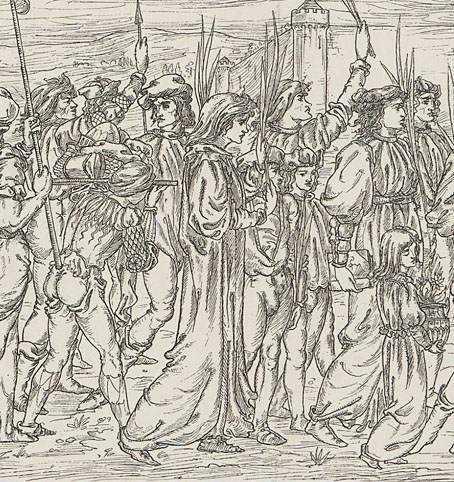
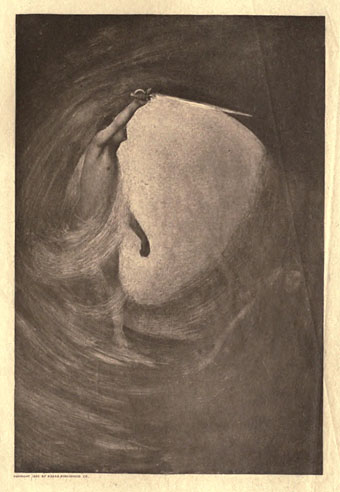
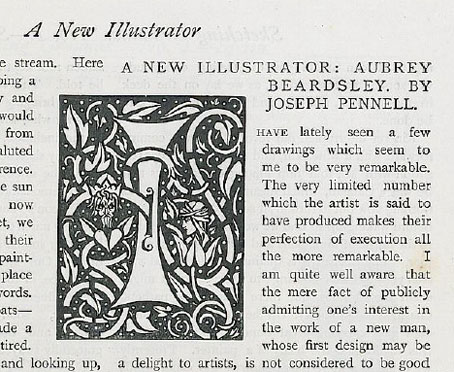
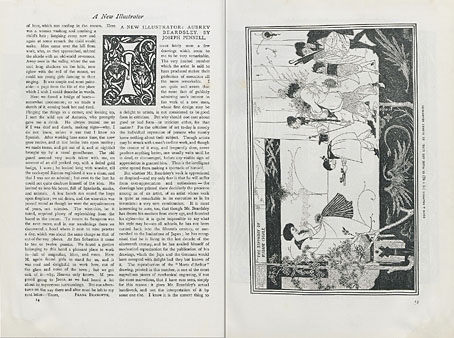
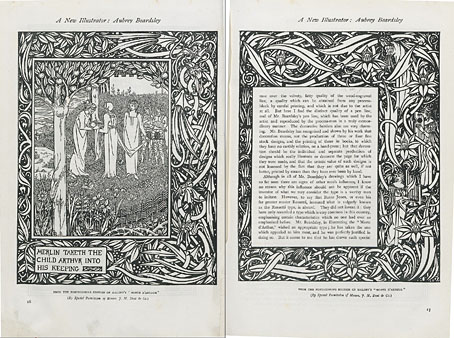
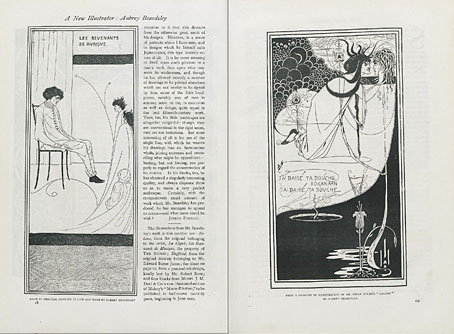
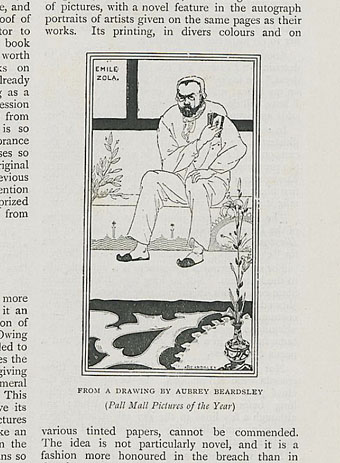
Aubrey Beardsley in the year 1893 was 21, and on the threshold of being catapulted to fame (and notoriety) via his illustrations for Oscar Wilde’s Salomé. Some of Beardsley’s drawings in the distinctive style he called “Japanesque” had already appeared in The Pall Mall Magazine, and he was hard at work on some 600 illustrations and embellishments for Dent’s Le Morte D’Arthur which began publication in 1894. Some of those illustrations are featured in the glowing introduction by Joseph Pennell which appeared in the first issue of The Studio magazine in April 1893 (when Beardsley was still only 20), a title that became the leading showcase for the British end of the Art Nouveau movement in the 1890s. Pennell’s appreciation also included Beardsley’s Joan of Arc’s Entry into Orleans, a piece which showed how much the artist’s early work owed to Mantegna, and the first drawing of Salomé which later helped secure the Wilde commission. The Joan of Arc picture was reproduced as a fold-out supplement in the magazine’s second issue.
ab2.jpg

All the major Beardsley books refer to Pennell’s article but I’ve never had the opportunity to see it in full until now, thanks to the excellent online archives at the University of Heidelberg. There are many volumes of the international editions of The Studio at the Internet Archive but for some reason these don’t include the early numbers; at Heidelberg we can now browse the missing issues. In the first volume in addition to Beardsley there’s a piece about Frederic Leighton’s clay studies for paintings and sculptures, illustrations by Walter Crane and Robert Anning Bell, and an article on whether nude photography can be considered art. In this last piece several of the examples happen to be provided by Frederick Rolfe aka Baron Corvo, and Wilhelm von Gloeden, two men who we now know had other things on their mind when they were photographing Italian youths.

The collected volumes of The Studio from 1893 to 1898 may be browsed or downloaded here. I’ve not had time to go through the rest of these so I’m looking forward to discovering what else they may contain.
ab3.jpg

ab4.jpg

ab5.jpg

Detail from Joan of Arc’s Entry into Orleans.
ab6.jpg

Elsewhere on { feuilleton }
The Aubrey Beardsley archive
Adelaide Hanscom’s Rubáiyát

hanscom01.jpg

(Apologies again for the downtime, the fourth outage this month.)

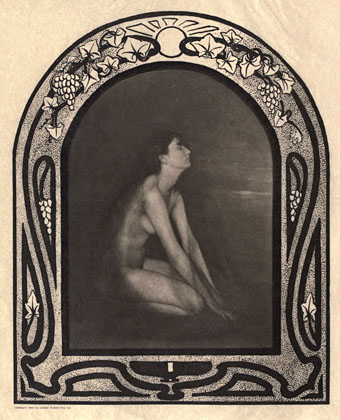
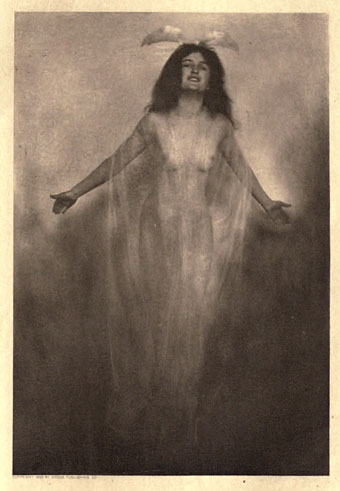
Thanks are due to Beautiful Century for drawing my attention to this 1905 edition of the Rubáiyát illustrated by Adelaide Hanscom (later Adelaide Hanscom Leeson). Hanscom (1875–1931) was an American artist and photographer whose work here is notable for the early use of photographs to illustrate a popular book, and for many of those photographs being nude portraits of her literary friends. No doubt the “exotic” theme enabled these to escape opprobrium at a time when male nudity (in photographs at least) was a very scarce commodity. The book was understandably popular, and a later edition featured tinted plates, an example of which can be seen below. A few of the plates look too much like what they were—friends of the artist posing in costumes—but the majority achieve that nebulous atmosphere, common to much photography of the time, that sought to imitate the effects of painting. Browse the rest of the book here or download it here.

hanscom02.jpg

hanscom03.jpg

hanscom04.jpg

hanscom05.jpg

Continue reading “Adelaide Hanscom’s Rubáiyát”

Weekend links 179

tomaselli.jpg

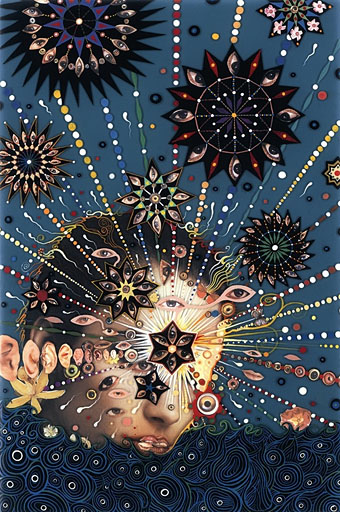
Summer Swell (2007) by Fred Tomaselli. The artist is interviewed at AnOther.

• Mixes of the week for the season of mists and mellow fruitfulness: Forever Autumn Mixtape by The Outer Church, and celebrating what would have been Trish Keenan’s 45th birthday: Trish’s Toys & Techniques Birthday Tape (with cover art by Julian House).

Jirí Kolár: His Life, Work and Cultural Significance to the Czech Republic. Leah Cowan looks into the life and work of this influential Czech artist. Related: Jirí Kolár: poet and collage artist, and collages, rollages and prollages by Jirí Kolár.

• “Name any well-known poet from any age, any country. He or she wrote at least one poem about death, most likely several poems.” Russ Kick introduces his new book, Death Poems.

[M]any pictures in the splendid exhibition at the British Museum show men having sex with men. One of the earliest erotic handscrolls, from the 15th century, shows a Buddhist priest casting longing glances at his young acolyte. Indeed, among some samurai, male love was considered superior to the heterosexual kind. Women were necessary to produce children, but male love was purer, more refined.

The question is why were Japanese – compared not just with Europeans, but other Asians, too – so much more open to depicting sex? One reason might be found in the nature of Japanese religion. The oldest native ritual tradition, Shinto, was, like most ancient cults, a form of nature worship, to do with fertility, mother goddesses, and so forth. This sometimes took the form of worshipping genitals, male as well as female.

Ian Buruma on The joy of art: why Japan embraced sex with a passion. Shunga: Sex and Pleasure in Japanese Art is a forthcoming exhibition at the British Museum.

Harold Offeh on how the cosmic life and music of Sun Ra inspired the artwork decorating the Bethnal Green, Notting Hill Gate and Ladbroke Grove Tube stations in London.

• Fearful symmetry: Roger Penrose’s tiling by Philip Ball. Related: Penrose Tiles Visualizer, and lots more Penrose tiling links at The Geometry Junkyard.

Masculine / Masculine. The Nude Man in Art from 1800 to the Present Day, a new exhibition at the Musée d’Orsay.

• Into the Croation Zone: more derives from Christina Scholz here, here, and here.

Stephen Eskilson on Heteronormative Design Discourse.

Applied Ballardianism

The Zero of the Signified (1980) by Robert Fripp | The League of Gentlemen (Fripp/Lee/Andrews/Toobad, 1981): Minor Man (with Danielle Dax) | Heptaparaparshinokh

More Art Nouveau

artnouveau01.jpg

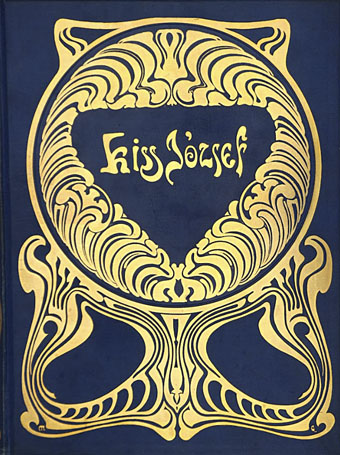
The Poetry of József Kiss (1897), design by Nándor Gottermayer.

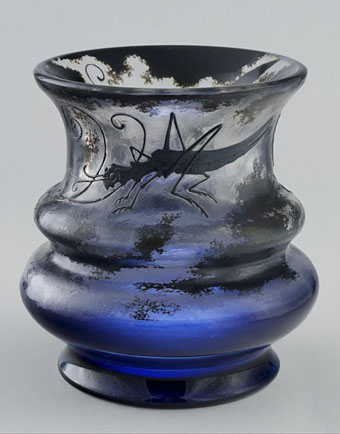
There’s always more Art Nouveau. Searching for term at the Google Art Project turns up a surprising number of paintings, drawings and other objects which are nothing of the sort, as well as many things which are, of course. These are a selection of the latter (mostly), and a reminder that it’s worth returning to the site every so often to look for new additions. Nándor Gottermayer’s book cover is a gorgeous design I’ve never seen before.

artnouveau02.jpg

Vase (before 1890) by Émile Gallé.

artnouveau03.jpg

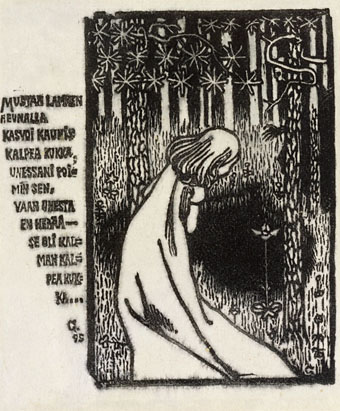
Flower of Death (1895) by Akseli Gallen-Kallela.

artnouveau04.jpg

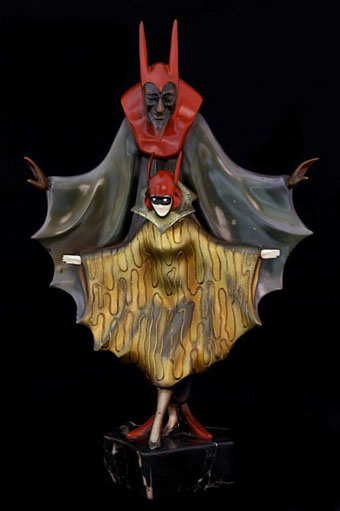
The Offering of Mephistopheles (c.1930) by Roland Paris.

Continue reading “More Art Nouveau”

Balanchine, Lynes and Orpheus

lynnes3.jpg

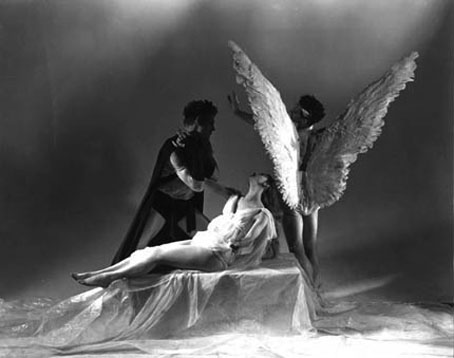
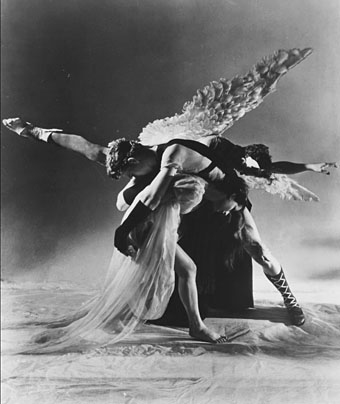
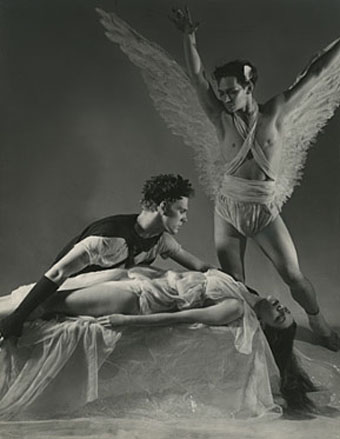
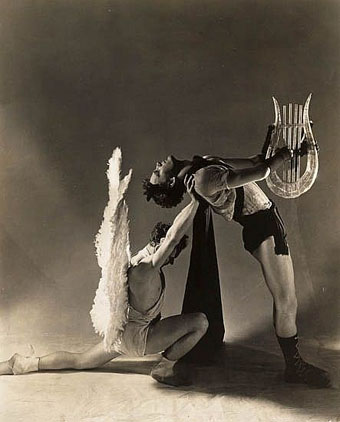
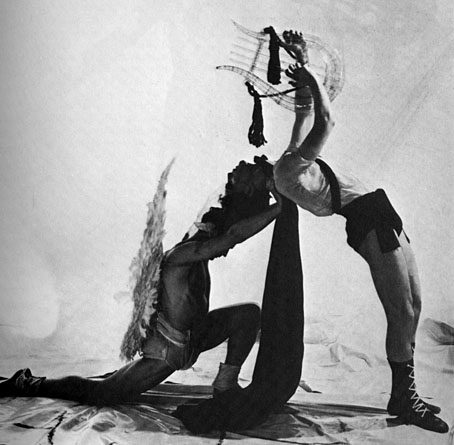
The photo above has appeared here before—it’s one of a number of dance photos taken by the great George Platt Lynes—but its subject has (for me at least) always been the source of some confusion. Since I dislike being nagged by petty conundrums I make a cursory search every so often to see if more details might be found. Five years ago all I knew was that the picture appeared in Philip Core’s Camp: The Lie that Tells the Truth (1984) where it was credited as showing dancers from Balanchine’s Icarus. Additional confusion was sown by a photo site showing the picture below with a statement that it was a) a Lynes photo (correct), and b) from Balanchine’s Die Fledermaus (wrong). No dates were given. The presence of a lyre made Orpheus seem a more likely subject: Balanchine wrote an Orpheus ballet for a Stravinsky score in 1948 but photos of that production showed very different dancers and costumes.

lynnes2.jpg

It turns out that these photos are indeed for a Balanchine ballet on the Orpheus theme, a short-lived production, Orpheus and Eurydice, from 1936 based on music from Gluck’s opera. The dancers are Lew Christensen, William Dollar and Daphne Vane. What’s most surprising now is having found a photo that’s almost but not quite the one from the Core book; photos from this session are elusive, with searches hampered by other photos taken by Lynes of Balanchine’s later ballets. There may be more in this series.

Pinterest is a good place to see more of Lynes’ photos which range from fashion shoots and celebrity portraits to moody, and occasionally surreal, homoerotica.

lynes1.jpg

lynes2.jpg

lynes3.jpg

Previously on { feuilleton }
The end of Orpheus
The recurrent pose 17
George Platt Lynes