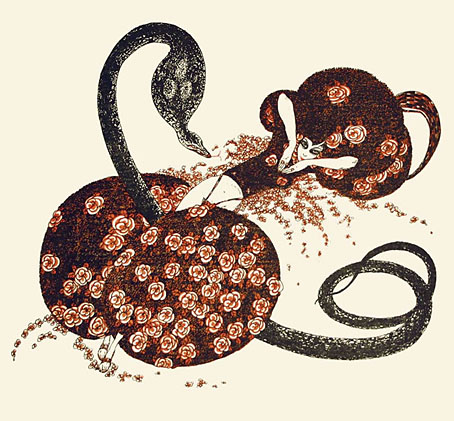
Ver Sacrum, 1899

vs-1899-14.jpg

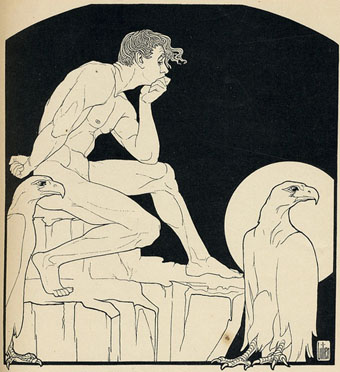
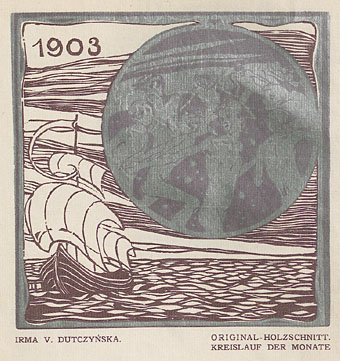
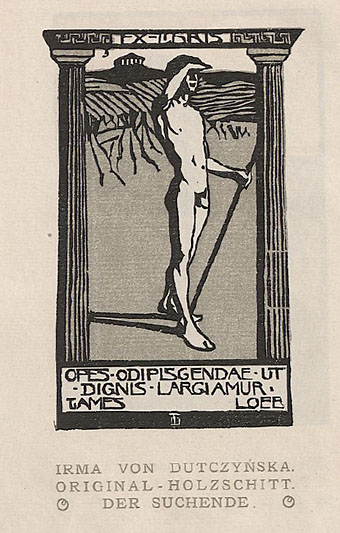
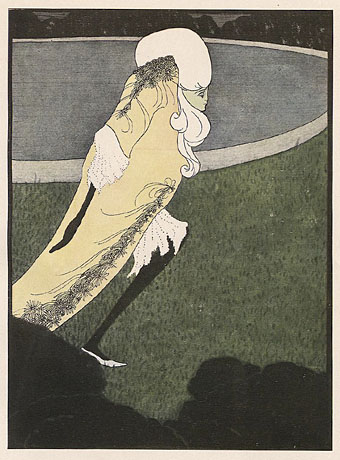
Another post about Ver Sacrum, the art journal of the Viennese Secession and one of the world’s major art magazines during its short run from 1898 on. This is another digitised edition from the University of Heidelberg’s archive and is the second volume of the journal’s monthly issues. It’s difficult to make a small selection from over 450 pages of high-quality Art Nouveau graphics and design so I’ve mostly chosen the covers again. Anyone wanting to see more is encouraged to download the whole volume or browse individual pages here.

vs-1899-01.jpg

vs-1899-02.jpg

Continue reading “Ver Sacrum, 1899”

Pas de Deux by Norman McLaren

pasdedeux.jpg

Norman McLaren’s 1968 film is not only one of the greatest ballet films ever made, it’s also an astonishing combination of high-contrast photography and optical printing. Choreography by Ludmilla Chiriaeff, dance by Margaret Mercier and Vincent Warren, music by Dobre Constantin and the Folk Orchestra of Romania. YouTube isn’t the ideal medium to watch anything like this but there’s now a quality copy here in all its 13-minute glory. If you’ve never seen it, do so before it vanishes.

Previously on { feuilleton }
Norman McLaren

The Classical alibi in physique photography

stowitts.jpg

Stowitts photographed by Nickolas Muray.

The title is from two gallery pages at the Queer Arts Resource which runs through a history of the old subterfuge whereby homoerotic pictures were decorated to look suitably Greek or Roman. This seldom fooled anyone, even in Oscar Wilde’s day, but it no doubt helped to keep the studios out of the law courts. Amid the plaster columns and antique props there’s a card I hadn’t seen before promoting dancer and artist Hubert Stowitts whose role as a satyr is one of the most memorable moments in Rex Ingram’s 1926 film of The Magician.

physique.jpg

Jim Galahad.

Also at Queer Arts is a copy of The Dying Gaul with a model who’s in the peak of health and a lot more well-hung than most Greek sculptures.

pose.jpg

This picture is something I found ages ago on a lost web page and now have a tenuous reason to post here. What looks like erotica is actually a fashion shoot (and he’s wearing swimming trunks) but it shows how the Classical mode persists. He looks like he wants to see more of Jim’s sword…

Elsewhere on { feuilleton }
The gay artists archive
The men with swords archive

The Frolie Grasshopper Circus

frolie1.jpg

For a taste of the unalloyed strangeness of the past you have to bypass the fine art and cultivated histories and look to the ephemera. The Frolie Grasshopper Circus (1898) is an uncredited booklet for American children made to promote Quaker Oats, and it does so in a manner far removed from today’s bland and focus-grouped campaigns. The combination of grasshoppers and oats brings to mind crop-devastating swarms of locusts. And who are these slit-eyed insect-wrangling imps? The one on the cover is wearing a pair of stilt shoes like Horrabin the evil clown in Tim Powers’ The Anubis Gates while one of his confederates bears the emblem of some sinister insect cult. There’s more to this grotesque parade than meets the eye. The Internet Archive has all 16 pages if you need to know more.

Update: I’ve been informed that the illustrations were by William Cheseborough Ostrander.

frolie2.jpg

frolie3.jpg

Continue reading “The Frolie Grasshopper Circus”

Soft Self-Portrait of Salvador Dalí

softdali.jpg

Yet another Dalí documentary, Soft Self-Portrait of Salvador Dalí is a welcome arrival at the splendid Ubuweb for its being the source of a number of sequences that turn up in later Dalí documentaries, notably the scenes of the artist and wife Gala emerging from giant eggs, and Dalí clattering away at a piano in which a number of unfortunate cats have been imprisoned. Jean-Christophe Averty is the director, and the narration for the English version is by Orson Welles. Ubuweb gives the date as 1967 but it’s listed as 1970 on IMDB. Whatever the year, it’s certainly the end of the 1960s with Dalí appearing a little more sprightly than in the Russell Harty film. He also appears wearing a shaggy wig out of sympathy for the youth of the day. (We know now that his sympathy for young men and women was more than a cultural interest.) Amid the usual boasting, tantrums and rather tiresome antics the filmmakers manage to come away with a couple of insights: at this point Gala was still appearing in public with Salvador, something she refused to do in later films. And there’s a trip by boat to a rocky coastline which Welles’ narration asserts was the inspiration for a number of the famous paintings. In all, it’s 52 minutes of craziness that’s recommended for anyone interested in Dalí’s art.

See also: Photographer David McCabe’s best shot in which that wig makes an appearance in the presence of another wig-wearing artist.

Previously on { feuilleton }
Mongolian impressions
Hello Dali!
Dalí and the City
Dalí’s Elephant
Dalí in Wonderland
Alejandro Jodorowsky’s Dune
Dirty Dalí
Impressions de la Haute Mongolie revisited
Dalí and Film
Salvador Dalí’s apocalyptic happening
Dalí Atomicus
Impressions de la Haute Mongolie