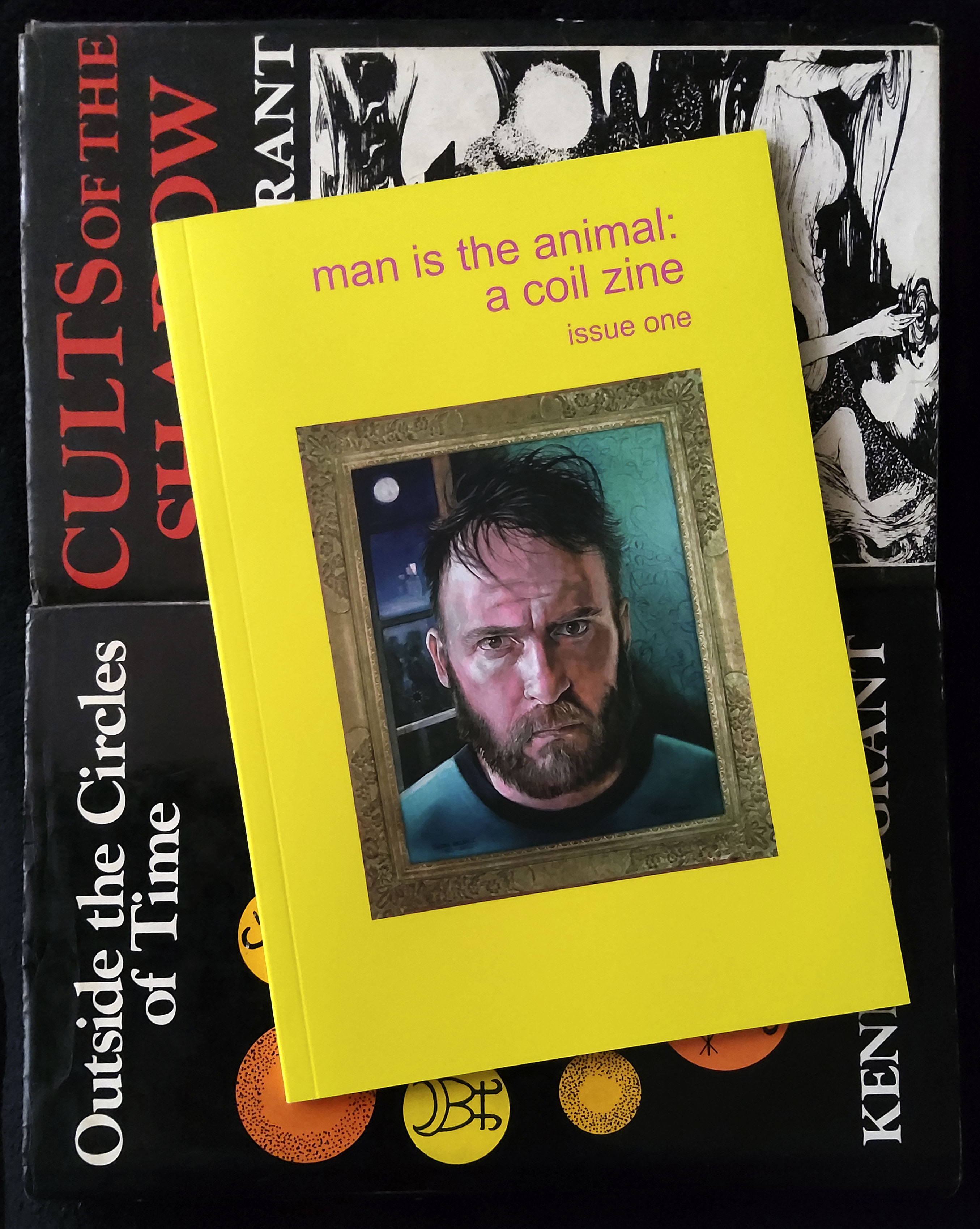
Man is the Animal: A Coil Zine

coil.jpg

Death is centrifugal / Solar and logical / Decadent and symmetrical / Angels are mathematical / Angels are bestial / Man is the animal —Fire Of The Mind by Coil

In the post this week from Temporal Boundary Press, issue 1 of Man is the Animal: A Coil Zine. A timely publication, given the persistent and increasing interest in Coil, and one whose essays are all of a quality belied by the “zine” label which usually suggests something more fannish and trivial. This is a pleasing object even before you look inside, a perfect-bound A5 booklet with full-colour printing throughout, and a cover painting by Val Denham, an artist with Coil associations that reach back through the Some Bizzare period to art for Marc Almond and Throbbing Gristle. Denham also contributes one of the written pieces, Jhonn is Unbalanced, a touching memoir of Geoff Rushton/John (Jhonn) Balance. Among the other entries is a piece by Benjamin Noys, a writer whose previous studies have included an examination of the connections between my own art for the Reverbstorm comic series and the weird fiction of HP Lovecraft. Noys takes a similar approach here, finding reflections of Coil obsessions in the symbolism of alchemical magic and the weird fiction of Arthur Machen.
grant.jpg

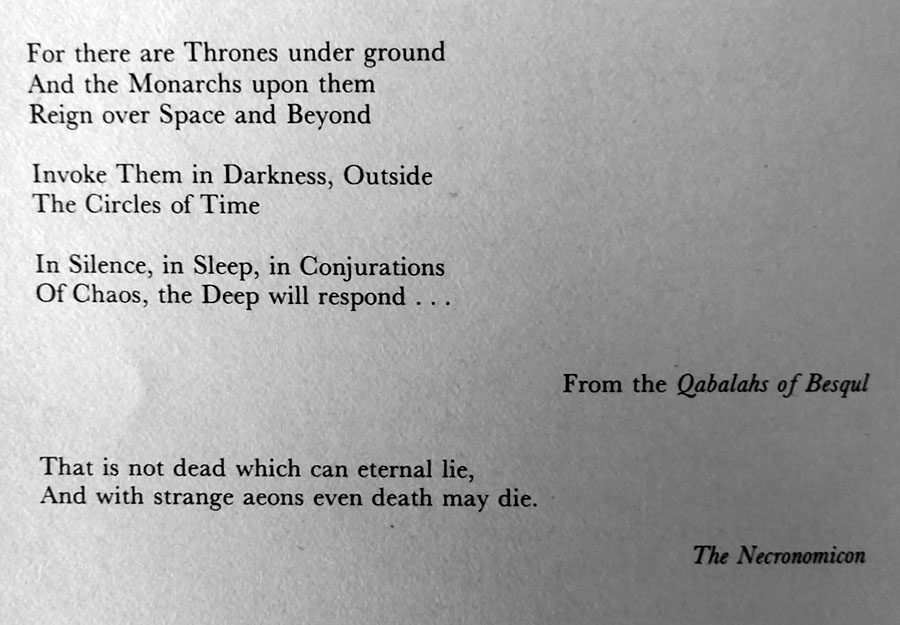
Epigraph from Outside the Circles of Time by Kenneth Grant.

The weird fiction of HP Lovecraft was a Coil obsession, and Lovecraft receives the most attention in a great piece by Andy Sharp which takes its cue from the appearance in Titan Arch of lines from the epigraph for Outside the Circles of Time, an occult study by magus and scholar Kenneth Grant. The latter was another Lovecraft obsessive—no doubt one of the first, given his age—whose books are littered with references to both Lovecraft and Machen. I spotted the Coil/Grant connection many years ago (although quite some time after Love’s Secret Domain was released), and acknowledged the link in two pages in The Haunter of the Dark, one of which reprints Grant’s epigraph, while the other is a picture with the title In Spaces Between, a line from Titan Arch which is also a reference to the Necronomicon extract in The Dunwich Horror: “The Old Ones were, the Old Ones are, and the Old Ones shall be. Not in the spaces we know, but between them, they walk serene and primal, undimensioned and to us unseen.” Sharp does more than merely acknowledge this web of connections, he delves into Grant’s dense treatise in search of further correspondences. I’ve not read Grant’s book for many years but this essay makes me think I ought to look at it again. By coincidence (or is it? etc), both Love’s Secret Domain and Outside the Circles of Time have been reissued this year, the Grant book by Starfire Publishing.

Contents:
The Vision and the Voice: Esoteric Dimensions of Coil’s Vocals by Hayes Hampton
A Hauntology of Coil by Sean Oscar
Are You Loathsome Tonight?: Coil’s Transformations by Benjamin Noys
The Horseman Betrays His Steed by Cormac Pentecost
The Spaces Between: Outside the Circles of Time and Love’s Secret Domain by Andy Sharp
Jhonn is Unbalanced by Val Denham

Previously on { feuilleton }
Dreaming Out of Space: Kenneth Grant on HP Lovecraft
Peter Christopherson Photography & The Art of John Balance Collected
The White People by Arthur Machen
Val Denham album covers
Kenneth Grant, 1924–2011
Peter Christopherson, 1955–2010
The Angelic Conversation

Jorgen Boberg’s Teresas

boberg1.jpg

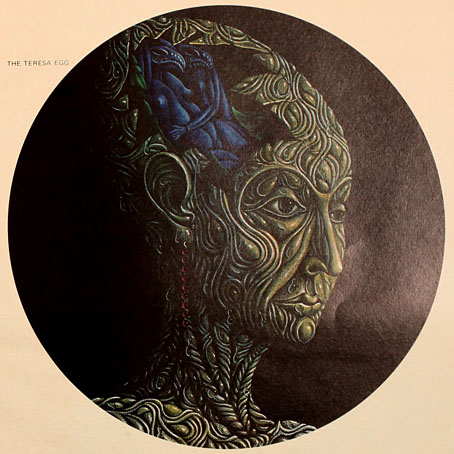
The Teresa Egg.

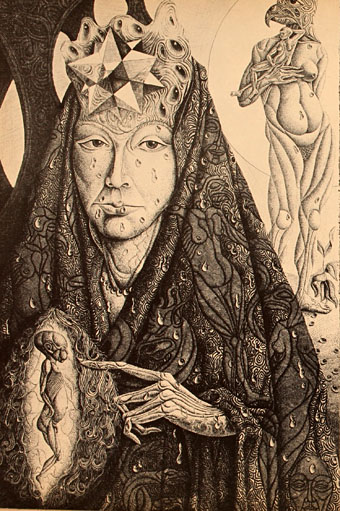
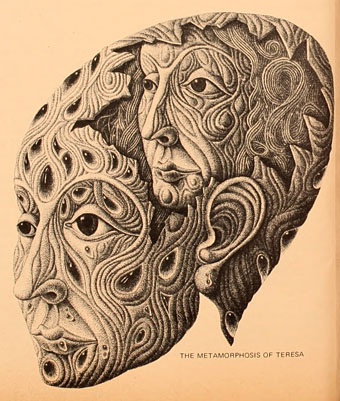
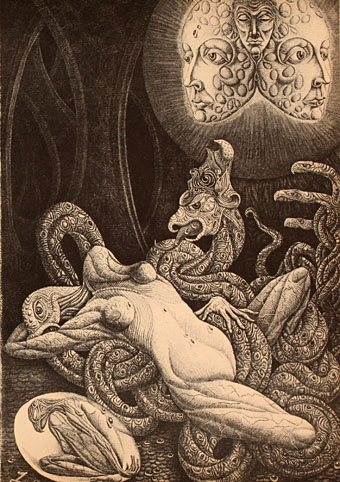
Danish artist Jorgen Boberg (1940–2009) described these early artworks as Surrealist, but if they have to be pigeonholed then Fantastic Realism may be as good a description. Everything here is from a feature in issue 12 of Avant Garde magazine for May 1970, and at first glance I thought the paintings and etchings might be the work of Ernst Fuchs, co-founder of the Vienna School of Fantastic Realism. (Fuchs’ art did appear in issue 9 of the same magazine.) Boberg at this stage in his career shared with Fuchs a preoccupation with bodily metamorphosis, jewelled forms and religious iconography. All the pictures in this feature have “Teresa” in their titles, although whether the name refers to Teresa of Ávila or to a private fixation of the artist isn’t clear.

boberg2.jpg

Teresa’s Dream of Birth.

boberg3.jpg

The Metamorphosis of Teresa.

boberg4.jpg

Teresa’s Dream of the Temple.

Previously on { feuilleton }
Ernst Fuchs, 1930–2015

Elsewhere on { feuilleton }
The etching and engraving archive
The fantastic art archive

Weekend links 577

preisler.jpg

Black Lake (1904) by Jan Preisler.

• Upcoming releases on the Ghost Box label will include a new album by {feuilleton} faves Pye Corner Audio, plus the surprising appearance of figures from Bruegel on a Ghost Box cover design.

Tilda Swinton and Olivier Saillard pay tribute to the films of Pier Paolo Pasolini. (Or to Pasolini’s costume designer, Danilo Donati.)

• New music: Spectral Corridor by The House In The Woods, and Re:Moving (Music for Choreographies by Yin Yue) by Machinefabriek.

• At Spoon & Tamago, Technopolis gets all the good things: “Giant kitty now greets commuters at Shinjuku Station.”

Anil Ananthaswamy on the ways in which psychedelics open a new window on the mechanisms of perception.

• Mixes of the week: Isolated Mix 112 by Suna, and GGHQ Mix #56, “An Unfortunate Kink”, by Abigail Ward.

• In this week’s impossible task, Alexis Petridis attempts to rank The Velvet Underground’s greatest songs.

• DJ Food unearths more flyers for London’s Middle Earth club, plus covers for the East Village Other.

• Global signals: Aki Onda on Holger Czukay and radio’s power to connect.

• At The Paris Review: Paintings and collages by Eileen Agar (1899–1991).

Will Sergeant’s favourite albums.

The Babel Tower Notice Board

Shaking Down The Tower Of Babel (1983) by Richard H. Kirk | Pärt: An Den Wassern Zu Babel (1991) by Estonian Philharmonic Chamber Choir conducted by Paul Hillier | The Black Meat (Deconstruction Of The Babel-Tower of Reason) (1994) by Automaton

The Art and Music Collection, 1976–77

am01.jpg

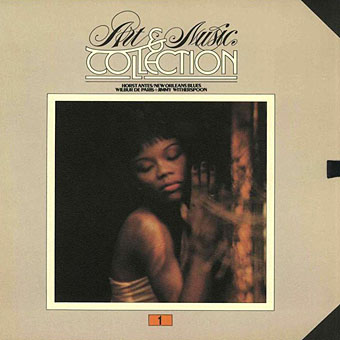
In the mid-1970s Dieter Brusberg and Siegfried E. Loch packaged a series of albums for the German division of Atlantic Records under the title The Art and Music Collection, a reissue scheme which paired each album with a print by a contemporary artist. This is an odd collection which I imagine was aimed at people like the father of one of my friends at school, the first person I met who owned a proper hi-fi system rather than a cheap stereogram. He liked to listen to progressive rock and jazz, and had a shelf of jazz records packaged in boxed editions that looked like they were ordered from an ad in a Sunday magazine.

am02.jpg

New Orleans Blues by Wilbur De Paris & Jimmy Witherspoon. Art by Horst Antes.

am03.jpg

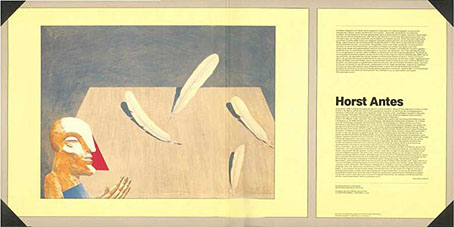
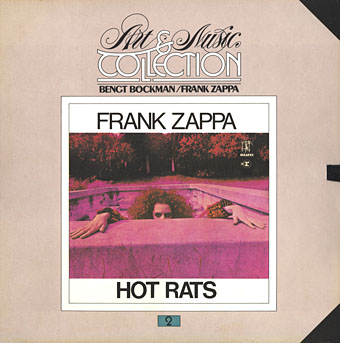
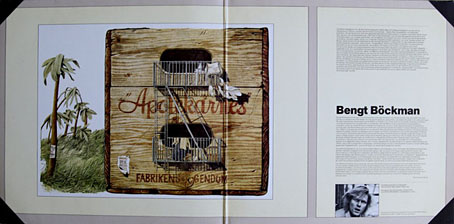
The Art and Music Collection had lower production values than the boxed records but each album was housed in a heavy gatefold sleeve, some of which came with ribbons attached to the front and back covers. Inside the gatefold there was a picture of the piece of art chosen to complement the release, together with a note about the artist and a paragraph of text which I’m guessing attempted to draw a parallel between the picture and the music. With the exception of a lone Briton, Joe Tilson, all the artists were German or Austrian. The series managed eight numbered releases—collect the set!—with albums that might have been chosen at random from the Atlantic back catalogue, a curious mix of jazz, rock and blues. Each artist shares billing with the musicians (the artist names are also on the disc labels), which makes me wonder if the series troubled any musical egos. After album no. 6 someone at the record company must have realised they were giving the wrong impression by listing the artists first so they revised the name of the series to The Music and Art Collection. The artworks seem as randomly chosen as the music, unless the sleeve notes have convincing explanations for their selection. The paintings of Rudolf Hausner—an artist I’d never think to connect with The Doors—became a lot more visible a couple of years later when OMNI magazine used his art for a cover and a number of interior illustrations.

am04.jpg

Hot Rats by Frank Zappa. Art by Bengt Böckman.

am05.jpg

Continue reading “The Art and Music Collection, 1976–77”

Gioconda of the Mausoleum

mona1.jpg

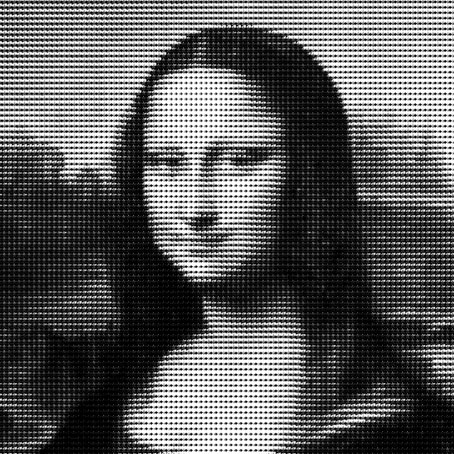
“MAGIC REALISM • Like the video technique of “keying in” where any background may be electronically inserted or deleted independently of foreground, the ability to bring the actual sound of musics of various epochs and geographical origins all together in the same compositional frame marks a unique point in history. • A trumpet, branched into a chorus of trumpets by computer, traces the motifs of the Indian raga DARBARI over Senegalese drumming recorded in Paris and a background mosaic of frozen moments from an exotic Hollywood orchestration of the 1950’s [a sonic texture like a “Mona Lisa” which, in close up, reveals itself to be made up of tiny reproductions of the Taj Mahal], while the ancient call of an AKA pygmy voice in the Central African Rainforest—transposed to move in sequences of chords unheard of until the 20th century—rises and falls among gamelan-like cascades, multiplications of a single “digital snapshot” of a traditional instrument played on the Indonesian island of JAVA, on the other side of the world.” — Jon Hassell

mona2.jpg

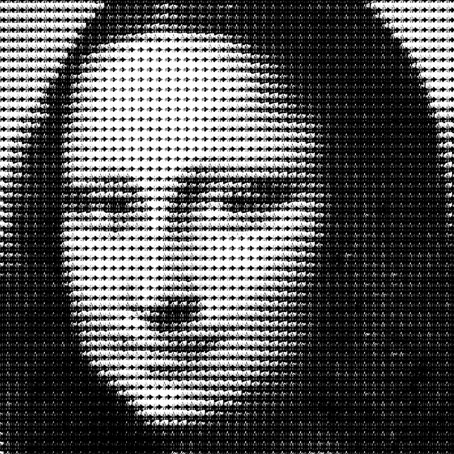
Jon Hassell’s text is part of the sleeve note for his Aka—Darbari—Java (Magic Realism) album which was released on Editions EG in 1983. The description of a picture of the Mona Lisa made from tiny reproductions of the Taj Mahal always intrigued me even though it’s only a shorthand metaphor for the sampling process, as well as being an encapsulation in miniature of one aspect of Hassell”s “Fourth World” concept: the blending of East and West, the sacred and the profane. Nevertheless, 20 years ago—17th May, 2001, according to the date on the file—after realising that Photoshop allowed the creation of just this kind of mosaic imagery, I decided to try and bring Hassell’s metaphor to digital life.

mona3.jpg

The end result in its full-size version looks at a distance like an ordinary halftone rendering of the painting but it really is made of tiny images of the Taj Mahal, albeit very rough ones since the process always resulted in a bitmap image. So much time has elapsed I’ve forgotten the procedural details although I do recall the involvement of one of those legacy features of Photoshop that most people ignore, possibly the Apply Image function. And I only did this at all because I’d found a tutorial somewhere that described how to create a mosaic image in this manner. The resulting picture wasn’t particularly satisfying but as a proof of concept it did at least work.

Continue reading “Gioconda of the Mausoleum”