The art of Jordan Belson

belson1.jpg

Target (Spectrum) (c.1953).

The static art, that is. When you read about Jordan Belson’s abstract films there’s occasionally some mention of his artworks but these haven’t always been easy to see. This situation has changed recently thanks to a dedicated Belson website which includes a gallery section for drawings, pastels, paintings and his collage landscapes. Landscapes aside, most of these are also abstract pieces, which doesn’t come as much of a surprise, and very good they are too. In addition, the site has seven of Belson’s films available for viewing which may not be everything but it’s an improvement on the sole Belson DVD which only features five films. This is all very positive, here’s hoping the site stays around. (Thanks to Stephen for the tip!)

belson2.jpg

Nebula (1965).

belson3.jpg

Thoughtform (2001).

Elsewhere on { feuilleton }
The abstract cinema archive

Weekend links 690

sosnowski.jpg

The Voice of St. Teresa (1928) by Oskar Sosnowski.

• The House is the Monster: Roger Corman’s Poe Cycle forms “a body of work not only deeply coherent but uniquely inspired,” says Geoffrey O’Brien.

• Steven Heller’s font of the month is Amberwood, while at The Daily Heller there’s a profile of Otto Bettmann, “an unsung visionary of commercial art”.

• At Public Domain review: The Works of Mars (1671), plans for military architecture by Allain Manesson Mallet.

The “underlying oneness of all things,” the conviction “that everything is connected” (Gravity’s Rainbow 703), is a thesis that appeals to many mystics and even to some scientists, but Fort complains that the latter too quickly dismiss unexplainable coincidences, or feebly explain them away. Scorning “scientific procedure” and inept police investigations, Fort turns for answers to denizens of the occult—poltergeists, invisible people, vampires, werewolves, miracle healers, fakirs, psychic criminals, dowsers—and to such notions as teleportation, human-animal metamorphoses, spontaneous combustion and pyrokinesis, “psychic bombardment,” telekinesis, animism, “secret rays,” telepathy, spirit-photography, clairvoyance, and modern instances of witchcraft.

Steven Moore in a perceptive essay about the overlooked connections between Thomas Pynchon, William Gaddis and Charles Fort. Having discussed Fort’s preoccupation with coincidences, the author notes that he shares a name with the late Steve Moore, former editor of Fortean Times magazine

• Pynchonesque headline of the week: The Paradox of the Radioactive Boars.

James Balmont’s guide to the masterworks of New Taiwanese Cinema.

• New music: Solo for Tamburium by Catherine Christer Hennix.

Winners of Bird Photographer of the Year 2023.

Idris Ackamoor’s favourite music.

Radio-Active (1984) by Steps Ahead | Radioactivity (William Orbit Remix) (1991) by Kraftwerk | Radioactivity (1998) by Hikasu

Oskar Fischinger: Visual Music

fischinger1.jpg

Every so often I go looking for more of the documentaries about avant-garde cinema that Keith Griffiths produced for Channel 4 (UK) in the 1980s and 1990s. Oskar Fischinger: Visual Music (1992) is one I’d been after for a while but it took some time to finally surface in searches as a result of the uploader misspelling the name of its subject. Film historian William Moritz describes Fischinger’s films as “visual music”, a term which has since become more widely applied to abstract cinema although not all abstract films have musical scores. Fischinger was a pioneer in this area, not necessarily the first but a film-maker who in the 1930s pushed his techniques to a peak of complexity far beyond anything being attempted elsewhere. The acclaim for his short films attracted the attention of Paramount, MGM and Disney but Hollywood typically didn’t allow him to do the things he was best at once he’d been hired. As I’ve said before, Fischinger’s tests for the Toccata and Fugue in D Minor section of Fantasia were rejected as “too dinky” by the creator of an anthropomorphic cartoon mouse.

fischinger2.jpg

Griffiths’ documentary ought have been twice as long as its 25 minutes but at least it was commissioned and broadcast. The interviewees are the aforementioned Moritz and Fischinger’s widow, Elfriede, who helped create some of the films and talks a little about her husband’s techniques. Half the running time is taken up with extracts from the films but the video quality does these no favours (and the picture is too damned dark…uploaders: adjust your gamma!), you’d be better off looking for copies of the complete films elsewhere. More from Moritz’s interview session turned up a year later in Griffiths’ Abstract Cinema, an excellent history of the form which, of course, included Fischinger’s films.

Elsewhere on { feuilleton }
The abstract cinema archive

Previously on { feuilleton }
An Optical Poem by Oskar Fischinger

Weekend links 689

cossard.jpg

Salammbô (1899) by Adolphe Cossard.

• At Unquiet Things: “A mystery that no longer exists: Wrinkle in Time cover artist revealed”. S. Elizabeth explains. I did a little research of my own into this enigma without success. Good to know that it’s been resolved.

• James Balmont’s latest guide to Japanese cinema is an examination of the transcendental oeuvre of Yasujiro Ozu.

• At Spoon & Tamago: Trains intersect with everyday life in nostalgic illustrations by Shinjiro Ogawa.

• DJ Food discovered a set of Zodiac posters by Bruce Krefting from 1969.

• At Wormwoodiana: John Howard on looking for misplaced Machens.

• At Vinyl Factory: Discovering Mort Garson with Hilary Wood.

• At Dennis Cooper’s: More Ozu in Yasujiro Ozu Day.

• New music: Multizonal Mindscramble by Polypores.

• Mix of the week is a mix for The Wire by Aho Ssan.

• Ioneye in conversation with Bill Laswell.

Train Song (1969) by Pentangle | Love On A Real Train (1984) by Tangerine Dream | Tokyosaka Train (2002) by Funki Porcini

Remedios Varo, 1967

varo1.jpg

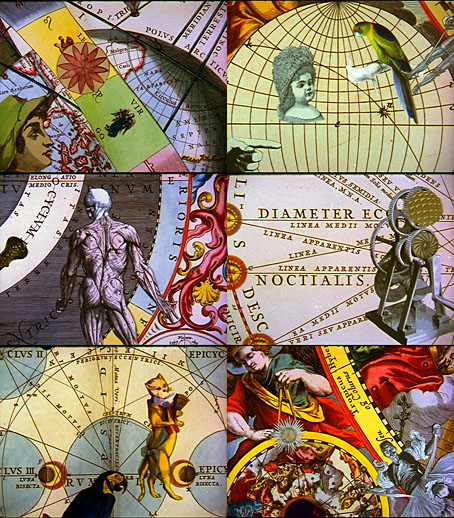
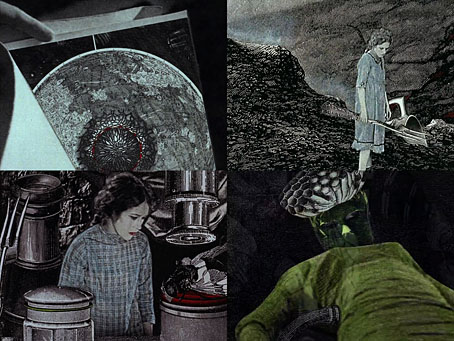
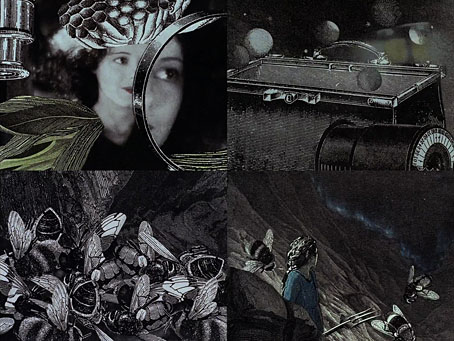
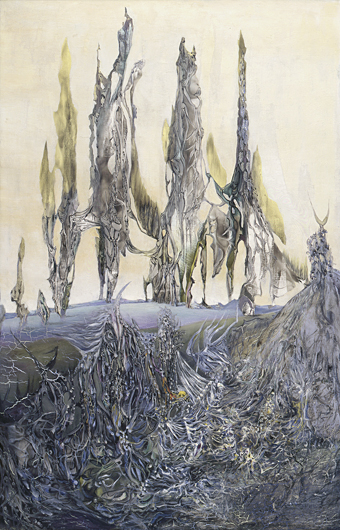
Online galleries have made profiles like this short Mexican film rather redundant, but it’s good to know that someone went to the trouble of presenting Varo’s paintings in this way at a time (1967) when you’d be lucky to see more than one of them in a book on Surrealist art. Jomí García Ascot’s camera roams among the details of Varo’s dreamworlds while Spanish voices read from a variety of Romantic and other texts. I hadn’t noticed before the amount of cats in Varo’s paintings. Look for the felines here.

varo2.jpg

Elsewhere on { feuilleton }
The Surrealism archive

Previously on { feuilleton }
Pynchon and Varo
Remedios Varo’s recipe for erotic dreams