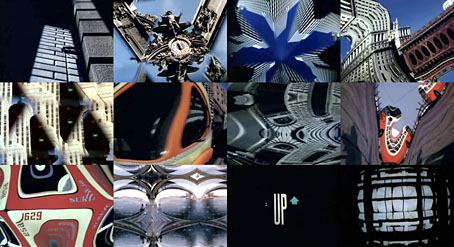
Carabosse, a film by Lawrence Jordan

carabosse.jpg

Collage animators may not be as plentiful as collage artists but this branch of filmmaking has attracted a number of heavyweight talents including Harry Smith, Jan Lenica, Walerian Borowczyk and Terry Gilliam. Lawrence Jordan worked for a time as an assistant to Joseph Cornell but he’s been making short films since the 1950s, many of which involve animated collage. Carabosse (1980) is a brief and distinctly Surreal piece set to Erik Satie’s Gnossienne No. 4. (An earlier film is titled Gymnopédies.) Watch it here. (Thanks to Erik Davis for the tip!)

Previously on { feuilleton }
Labirynt by Jan Lenica
Science Friction by Stan VanDerBeek
Heaven and Earth Magic by Harry Smith
Short films by Walerian Borowczyk

MMM in IT

mmm.jpg

“Are you your own master? Or are there forces beyond reason that shape your actions?”

This full-page ad appeared in issue 72 of International Times, Jan 28, 1970. The part-work encyclopedia, Man, Myth & Magic, was launched at the best possible moment, capitalising on the late-60s’ resurgence of interest in the occult and unorthodox spirituality. That bold declaration—”The most unusual magazine ever published”—might have seemed unconvincing to readers of the undergrounds, many of which made “unusual” their starting point, but there certainly hadn’t been a magazine/encyclopedia like MMM before, and none of the titles that followed could match its scope and authority. The ad also promises “From Adam and Eve to LSD, from lucky numbers to human sacrifice…” which its 112 issues went on to deliver.

This is the first press ad I’ve seen for MMM. A TV ad for the later American reprinting turned up recently, 30 seconds of film that sent Austin Osman Spare’s sinister goat-faced elemental into millions of Christian households in 1974. I keep hoping we might get to see the UK equivalent one day.

MMM.jpg

Previously on { feuilleton }
Wilfried Sätty: Artist of the occult
Owen Wood’s Zodiac
Austin Osman Spare

Donald Cammell and Kenneth Anger, 1972

cinema.jpg

Another resurrected article. Cinema Rising was a short-lived newsprint film magazine that ran for three issues in the UK in 1972. I have a few pages from the rare first issue that was part of a batch of old underground newspapers I was given a few years ago. (The Frendz Hawkwind strip is from the same haul.) Cinema Rising was edited by Simon Hartog and Tony Rayns, the latter being a long-time Kenneth Anger aficionado which would explain both the magazine title and the presence of a photo feature about Anger’s Lucifer Rising. The bulk of this post is a short interview with Donald Cammell that’s of interest for his comments about the gender roles in Performance and his opinion of Jorge Luis Borges whose recurrence as both signifying text and presiding magus in Performance is never really explained.

Cammell’s next film after Performance would have been Ishtar (no relation to the notorious Warren Beatty flop), the themes of which Cammell discusses at the end of the piece. The Cammell biography describes a script concerning a film star and Hollywood producer who want to make a film in Morocco. While there they get involved with a woman who embodies various mystical/mythological feminine attributes; there’s also a sub-plot about the pair kidnapping an American judge. Mick Jagger was down for the role of the film star while William Burroughs was slated to play the judge. Given how wayward Cammell’s later films became it’s difficult to say whether this would have been good or not. Performance could very easily have been terrible but that film also had Nicolas Roeg on board.

After the Cammell piece there are photos from Cinema Rising‘s Kenneth Anger feature which show the director at work on the new version of Lucifer Rising. I’ve not seen any of these stills or the two black actors before—what happened to their parts? Note that some of the captions are misspelled: the photos should be credited to Diarmid Cammell—Donald’s brother—while the Adept (not “Lucifer”) is Haydn Couts.

dc1.jpg

DONALD CAMMELL: PERFORMANCE TO ISHTAR, Cinema Rising, no. 1, April 1972

Donald Cammell’s first movie was Performance, made in collaboration with Nicolas Roeg; the most unexpected British movie of recent years, and one of the very few products of the British industry capable of holding its own in an international context. Cammell’s new script is Ishtar, originally written with Mick Jagger in mind for the lead again, but possibly to be made without him; Cammell is currently in America to raise the backing for the film.

In the following extracts from a conversation with John du Cane (recorded last year), Cammell speaks of his background and interests…matters that inform his new script at least as much Performance.

Collaboration

“In the recent past, reverence for the director of a film as sole creator has been vastly exaggerated, through critical efforts. I’m thinking particularly of the Cahiers du Cinema ‘author’ concept—I’ve been living in Paris, and have been quite aware of it for a long time. The kind of theory of creativity that’s arisen there (and in related worlds in New York) is, succinctly, crap. It’s a way of trying to demonstrate the view that cinema is an artform, and that therefore there must be a single creative mind controlling the artefact, through to its ultimate form. It’s a way of justifying movie-making, socially and culturally.

“But leaving aside the reasons for the concept, I think it’s contradicted by the facts. I think that many of the greatest artefacts things that have moved people most throughout history—have been collectively produced. You don’t even have to look for examples: the whole of Egyptian culture, arcane cultures generally. Today in tribal cultures, the vast majority of the products are collectively produced. The hangup is the concept of one ego necessarily controlling the production in order for that ego to be expressed; the notion that the expression of an ego is the final goal of any artwork, that this is what it’s for. I think that an artwork expresses itself, that the creators involved will all see in it their own egos, each one individually satisfied when looking at the final work. My analogy is with contemporary music, where people go into it collectively, and their egos are satisfied collectively and individually. Look at Mick and Keith and their confreres: they see in their work as The Rolling Stones what they each wanted to say. Working in the film medium is ideally suited to interaction of different heads; it’s the ideal medium for all the good functions of collective work.”

Continue reading “Donald Cammell and Kenneth Anger, 1972”

Gay slang from the 1970s

gay1.jpg

While browsing recently through the available back issues of Oz magazine I noticed a guide to gay slang that I didn’t recall seeing before. The underground magazines and newspapers of the 60s and 70s were a lot more tolerant of the nascent gay rights movement than their “straight” (ie: non-freak) counterparts. Oz magazine published pieces about gay rights, notably so in issue 23 which ran an extract from The Homosexual Handbook (1969) by Angelo d’Arcangelo among a couple of other features; the UK’s first gay magazine, Jeremy, advertised regularly in Oz and IT; later issues of Oz carried ads for another gay mag, Follow Up, and there’s a letter in one issue from a gay freak complaining about the state of the few gay pubs in London where the clientele was apparently not freaky enough. (His solution was to try and persuade them all to drop acid.) Arguments which still circulate today, between those who want to assimilate and those who prefer to remain separate from general society, go back a long way.

The gay slang guide was extracted from The Queens’ Vernacular: A Gay Lexicon by Bruce Rodgers (1942–2009), published in the US by Straight Arrow Books in 1972. Straight Arrow was affiliated with Rolling Stone magazine, later publishing two volumes of Wilfried Sätty’s art, and Kenneth Anger’s Hollywood Babylon. Rodgers’ book was reissued in 1979 as Gay Talk: A (Sometimes Outrageous) Dictionary of Gay Slang (Formerly entitled The Queens’ Vernacular) but has been out-of-print ever since, unsurprisingly since so much of it is now completely outmoded. That doesn’t make the content uninteresting, however. The phraseology may be ribald, obscene and offensive (misogynist, especially) but the book has been described as “the first serious dictionary of gay slang and the definitive gay American jargon resource”. Rodgers was a serious researcher with an interest in all forms of slang. Just as the Dictionary of the Vulgar Tongue (1811) by Francis Grose gives a more-or-less unmediated insight into the lives of the working and criminal classes of 18th-century London, so Rodgers’ dictionary tells us something about the way gay people, especially gay men in the US, were talking to each other for much of the 20th century. What’s striking now about this truncated list is the degree to which so much of the language is obsolete—nobody under the age of 60 would use the term “queen” with such frequency—while the wider acceptance of porn has made once-esoteric terms like “golden shower” much more common. Notable by its absence is “queer” as a purely positive description (not reclaimed until the 1980s), and no mention of “twink” (which goes back to the early 60s) or “bear” (another term from the 80s).

There’s a tendency when looking at lists such as this to imagine a group of people using most of the terms all the time, but as with any form of slang this would be unlikely. The same goes for Polari or the handkerchief codes of the 1970s. As you’d expect from a document that’s 42 years old, some of the language that Rodgers collected tramples over many current sensitivities.

gay2.jpg

Illustration by Rod Beddall.

THE QUEEN’S VERNACULAR, Oz 46, Jan–Feb 1973

Gay slang has been coined and used by those within the gay subculture who themselves feel the most oppressed—the flagrant wrist benders, the screaming queens, the men who look like women, the women who don’t shave their moustaches.

It is a form of social protest, aimed at the establishment; it is also self-protective and self-defeating. Gay militants would like to see it go, and argue rightly that gay jargon is yet another link in the chain which holds the homosexual enslaved and oppressed—yet its widespread use and complex vocabulary indicate that gay liberation has still along battle in front of it. The selections which follow are taken from a Straight Arrow publication, The Queens’ Vernacular by Bruce Rodgers. The words are mostly American. Even the classic English phrase, “queer basher” is not included.

* * *

advertising 1. to dress in a sexually provocative manner. Gay maxim: “It pays to advertise.” 2. (camp) to pluck and then paint the eyebrows.

army style (mid ’60s) beating the cocksucker after the act.

bumping pussies the embarrassment of two homosexual men who find themselves too passive, active, or in other ways too similar to create a sexual situation. “He thought you and I were carrying on together—what would we do, bump pussies?”

cash-ass (from cautious) cynically applied to hustler who feigns coyness until assured of material gain. “He’s not shy, he’s cash-ash. Mention money and watch his cheeks light up.”

catalogue queen homosexual who collects physique magazines for masturbation purposes.

cheesy having the foreskin lined with smegma. Stale and musky smelling. “The sailor was so cheesy that I felt like asking him where be hid his crackers.”

chic the latest craze. Cruising the busy streets after the bars close is chic. Getting invited to an orgy is chic. Sucking men off in a public lavatory is not chic. Wearing pearls with grey flannel is not chic either, unless one is serving tea in a closet.

Continue reading “Gay slang from the 1970s”

Walter Ruttmann’s abstract cinema

ruttmann1.jpg

Histories of abstract cinema often begin with Oskar Fischinger, a filmmaker and animator who was certainly a pioneer of the form. But these four silent shorts by Walter Ruttmann (1887–1941), Lichtspiel: Opus I, II, III & IV (1921–25) predate Fischinger’s work, and also prefigure Fischinger’s own animations of swooping shapes, blooming circles and stabbing triangles. Ruttmann’s abstractions are very sophisticated considering they’re such early examples of this type of experimental cinema. Some of the sequences in Opus IV resemble the kinds of graphics seen during title sequences in TV programmes of the 1960s.

ruttmann2.jpg

Elsewhere on { feuilleton }
The abstract cinema archive