Gustave Doré’s Fairy Tales of Charles Perrault

dore01.jpg

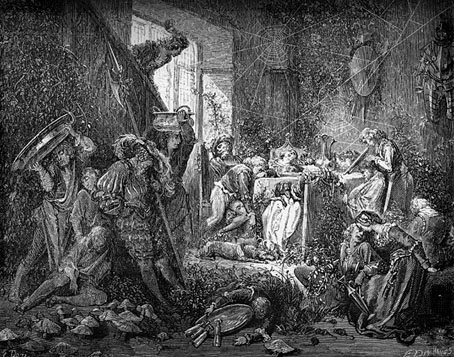
La Belle au bois dormant (The Sleeping Beauty in the Wood).

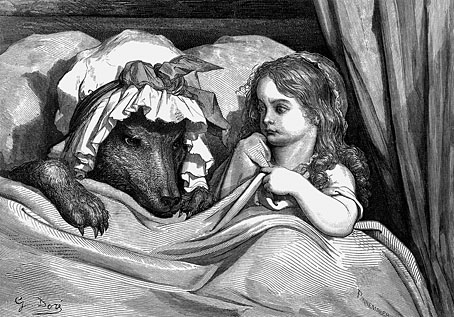
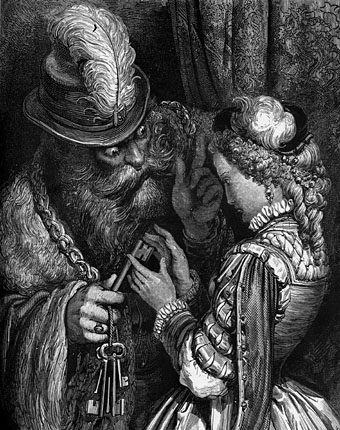
More illustrated Perrault. Gustave Doré’s intention to produce definitive illustrations for his editions certainly paid off when he turned his attention to the French fairy tales. Doré’s work may lack the light touch required for some of these stories but a couple of the engravings—Red Riding Hood in bed with the wolf, Puss-in-Boots—are reproduced endlessly whenever picture editors need a suitable illustration. Doré’s characters can be rather wooden at times but the expressions on the face of the wolf and the girl are perfect.
dore02.jpg

Le Petit Chaperon rouge (Little Red Riding Hood).

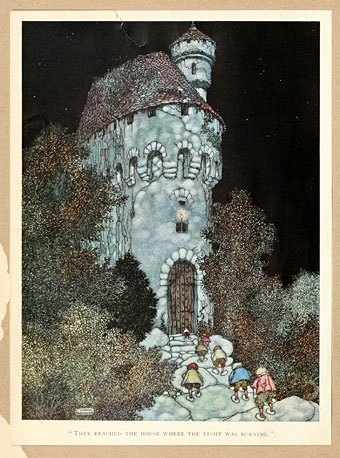
Elsewhere Doré contributes some original details: the court in Sleeping Beauty is usually shown besieged by thorns or bracken but Doré has giant fungi growing all over the floor; in Little Tom Thumb the children are described as knocking on the door of the ogre’s house then being let inside but Doré shows the ogre’s wife greeting them with a shaft of lamplight. These illustrations were published in several editions throughout the 1860s which makes that lamplight beam a very advanced pictorial effect. Incidentally, for those who read the Amon Düül II cover art post a couple of days ago, the figure of Tom Thumb stealing the ogre’s seven-league boots may be glimpsed outside the spacecraft window in the centrespread of Dance of the Lemmings.

Wikimedia Commons has more of the Doré illustrations; there’s also a set at Gallica although the quality of their scans isn’t always so good.
dore03.jpg

La Barbe bleue (Blue Beard).

Continue reading “Gustave Doré’s Fairy Tales of Charles Perrault”
Suspicion: The Voice in the Night

voice1.jpg

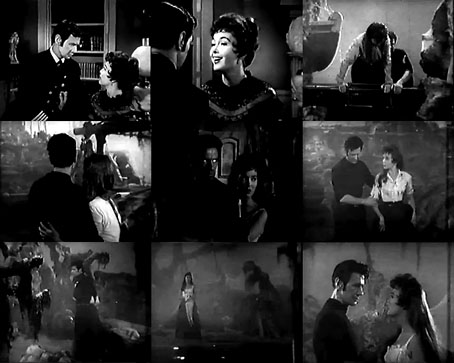
This isn’t the best quality at all but it’s worth noting for those of us intrigued by the very small number of film and television adaptations of William Hope Hodgson’s stories. The Voice in the Night (1907) is Hodgson’s most popular story with anthologists, a tale of fungal horror that features a number of the author’s familiar motifs: the derelict ship, the uncharted island, and the sea as a home of insidious menace. The story was filmed by Godzilla director Ishiro Honda in 1963 as Matango (aka Fungus of Terror, Curse of the Mushroom People and Attack of the Mushroom People) but I’ve never seen this so I can’t comment on it.

voice2.jpg

Hodgson aficionados evidently prefer the 1958 television film directed by Arthur Hiller and shown as part of NBC’s Suspicion series. The title on this copy is Alfred Hitchcock’s Voice in the Night although Hitchcock seems to have had nothing to do with the production. Stirling Silliphant adapted the story, and he does a good job of fleshing out the narrative without spoiling things. James Donald and Barbara Rush are the doomed shipwreck survivors who find a fungus-covered derelict, and beyond this, an uncharted and similarly fungus-covered island. Patrick Macnee and James Coburn play the two sailors to whom Thomason (Donald) narrates his tale, although their scenes in this copy are so murky and indistinct it might as well be a radio play. Quality aside, this is a very effective adaptation even if it does evade some of the more terrible details in the closing pages of the story. It’s closer to the spirit of Hodgson than The Horse of the Invisible or Dennis Wheatley’s Hodgsonian The Lost Continent. The Suspicion series doesn’t seem to have been released on DVD so for now YouTube is the only place you can see this film. (Big thanks to Ross for the tip!)

Previously on { feuilleton }
Hodgsonian vibrations
The Horse of the Invisible
Tentacles #2: The Lost Continent
Tentacles #1: The Boats of the ‘Glen Carrig’
Hodgson versus Houdini
Weekend links: Hodgson edition
Druillet meets Hodgson

Falk-Ulrich Rogner album covers

duul00.jpg

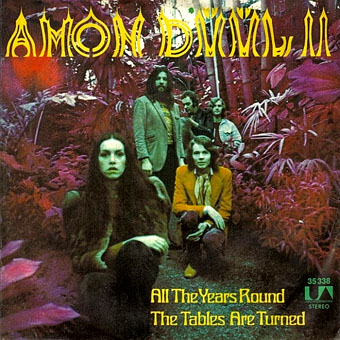
All The Years Round (7-inch single, 1972).

I mentioned earlier that Falk-Ulrich Rogner’s cover art for Amon Düül II was worthy of a post so here you are. Amon Düül II were slightly ahead of the pack in the German music scene of the 1970s, starting earlier and (arguably) finishing their prime period earlier. They were also closer in musical style and group ethos to the psychedelic/early prog groups in Britain and America, especially Hawkwind with whom they shared a record label and a bass player. Other German groups were often psychedelic to some degree but Amon Düül II went all-out for a German take on psych rock, with extended guitar-heavy jams played against oil-on-water projections.

Falk-Ulrich Rogner was one of the longer lasting members of the group’s shifting personnel, playing organ and electronics, writing lyrics and creating artwork that’s a perfect match for what I always think of as Amon Düül II’s Gothic Surrealism: a blend of lyrics and themes running through songs titled like Max Ernst paintings: Flesh-Coloured Anti-Aircraft Alarm, Archangel’s Thunderbird, Stumbling Over Melted Moonlight, Green Bubble Raincoated Man. The cover art is generally a collage of photographs, old paintings and other graphics, a familiar technique for psychedelic album covers. What gives Rogner’s work an edge is the way he blends multiple collages together by either photographic exposure or the photographing of projected transparencies. This has the effect of softening hard edges and transitions, and makes the resulting images all the more hallucinatory and dream-like. Effects like this are easy to achieve today with Photoshop but in the early 1970s they required a considerable effort.

duul01.jpg

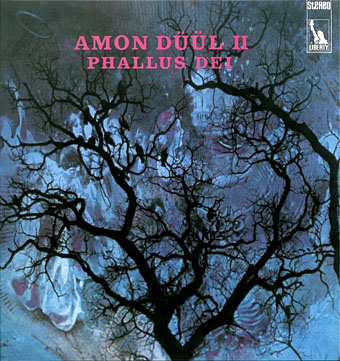
Phallus Dei (1969).

At first glance the cover of the gloriously titled debut album looks like a painting but it’s a photograph of a tree silhouette juxtaposed against some vague collage business. This doesn’t really communicate the lysergic intensity of the music within which may explain why the cover was changed to something more typically psychedelic for its UK release.

duul02.jpg

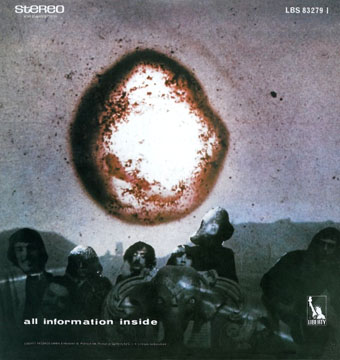
The back cover inaugurates a pattern of placing the band on the back of the album, a reversal of the usual state of affairs even today.

duul03.jpg

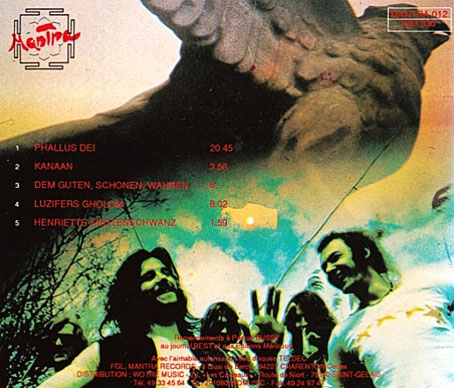
The first CD release of Phallus Dei on the Mantra label featured what may be another Rogner photomontage, one that I’ve not seen anywhere else.

Continue reading “Falk-Ulrich Rogner album covers”

Weekend links 248

baylay.jpg

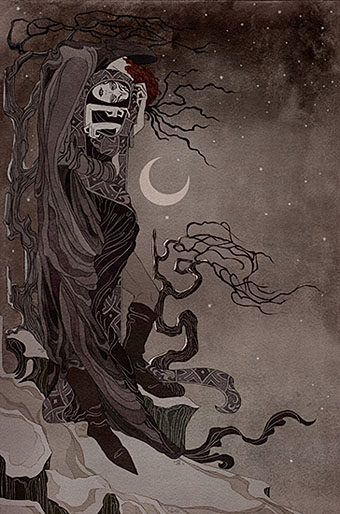
The Dreamers (2013) by Kate Baylay, from Seven Gothic Tales by Isak Dinesen.

• RIP composer and musique-concrète pioneer Tod Dockstader. “I didn’t have the money for electronic sounds…I had to have things like bottles, or anything that would make a noise. It didn’t matter what it was; if it sounded interesting, or I could make it interesting, I’d go for it.” Geeta Dayal talked to Dockstader for Wired in 2012. Dockstader’s film credits included Fellini’s Satyricon and Tom and Jerry cartoons. He also wrote the story for one of the latter, Mouse into Space, in 1962. Ubuweb has some early Dockstader recordings.

• “…anyone who has ever sat in a cafe, or in the bath, with a paperback owes a debt to Aldus and the small, cleanly designed editions of the secular classics he called libelli portatiles, or portable little books.” Jennifer Schuessler on Aldus Manutius, and the roots of the paperback.

• “At Chernobyl, we made ‘the world’s first radioactive nature preserve.’ We made black rain. We made the Red Forest, which was green when the day began, and is dead.” Mary Margaret Alvarado reviews The Long Shadow Of Chernobyl by Gerd Ludwig.

Prison was often the fate of those caught circulating samizdat in the Soviet Union—not only the “high” samizdat such as Solzhenitsyn, but the crude and lowly joke books as well. The official rationale for the prohibition was in context no less reasonable than the rationale given more recently for condemning Charlie Hebdo or R. Crumb. There is always a perception that the very serious project of perfecting society is being undermined. But society will not be perfected, and it is a last resort of desperate perfecters to go after the subtle-minded satirists who understand this.

Justin EH Smith on why satire matters

• “You have to do your research, and you’ll find treasures that you couldn’t even have begun to sit down and draw until you saw them in front of your eyes,” says Annie Atkins, graphic designer behind The Grand Budapest Hotel.

The Tales of Hoffmann: exclusive materials from the making of Powell and Pressburger’s masterpiece. The film will be released on Blu-ray by the BFI later this month.

• The illustrated score for Irma, the opera offshoot of Tom Phillips’ A Humument, is now available from Lulu.

Mellifluous Ichor From Sunless Regions, a free album of Hauntological electronica by The Wyrding Module.

Kraftwerk at the controls: what the group’s live instrument setup looks like today.

• Booze, Blood and Noise: The Violent Roots of Manchester Punk by Frank Owen.

• Mix of the week: 14th February 2015 by The Séance.

Vintage logo designs

Transmission (1979) by Joy Division | Radioactivity (William Orbit mix, 1991) by Kraftwerk | Bellstomp/Pond Dance (Mordant Music remix, 2012) by Tod Dockstader

William Heath Robinson’s Old-Time Stories

robinson01.jpg

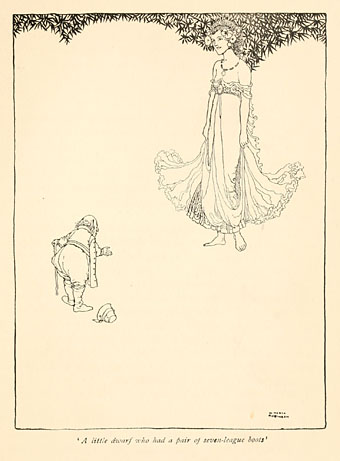
William Heath Robinson’s illustrated edition of Charles Perrault’s fairy tales, published in 1921, is a more substantial collection than the Dulac edition with eleven stories in all. The translator was AE Johnson who notes that three of the tales—Beauty and the Beast, The Friendly Frog, and Princess Rosette—aren’t from Perrault at all, but Beauty and the Beast by this time was part of the general canon.

Robinson’s illustrations in this particular volume are badly damaged in places but they maintain his high standard in their characterisation and use of space. A couple of the pieces are rather alarming in a book for small children: the giant crushing a village while pursuing the fleeing captives in Little Tom Thumb, and Blue Beard (again) threatening his wife with a cutlass. The imperious Puss-in-Boots is particularly good. Browse the rest of the book here or download it here.

robinson02.jpg

robinson03.jpg

Continue reading “William Heath Robinson’s Old-Time Stories”