Weekend links 292

splendor.jpg

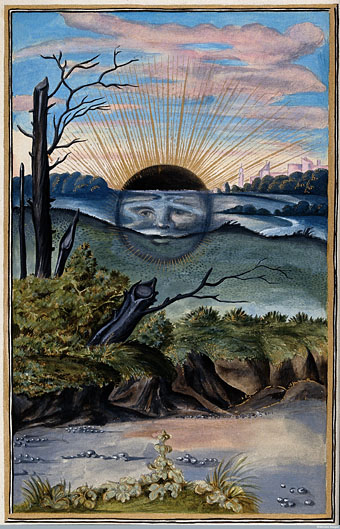
The Black Sun from Splendor Solis (1582) “attributed to the legendary figure Salomon Trismosin”.

Topic B predominates this week. The Black Sun of alchemy was the first thing I thought of when the title of David Bowie’s final album was announced late last year. The Black Sun symbolises the nigredo stage of the alchemical process when putrefaction or decomposition takes place; Carl Jung in Psychology and Alchemy equates the nigredo with the dark night of the soul. At the time I didn’t seriously think that the Bowie of 2015 would have had this in mind as a primary reference even though the Bowie of the early 1970s was immersed in Golden Dawn occultism, the Kabbalah, and a reader of Pauwels & Bergier’s The Morning of the Magicians, a book that informs the lyrics of the Hunky Dory album, and which contains a great deal of discussion about alchemy and other esoteric matters. And yet… Of all the outfits that Bowie might have worn in his final video the one that he chose for Lazarus is a match for the one he wore during the Station To Station Kabbalah-drawing photo session. At Sol Ascendans Alex Sumner and his commenters explored this twilight zone.

Back in the sublunary world, Jonathan Barnbrook’s cut-out sleeve design for the Blackstar album gained additional resonance this week: the black star as the hole that’s left when a more familiar star has been removed from its setting. Hindsight also makes poignant the observation that this was the only album without a picture of the artist on the cover. Elsewhere there were speculations about the title being a reference to Black Star by Elvis Presley (who shared a birthday with Bowie) or a term from oncology, two suggestions that fit so well they’re hard to ignore.

He began to develop a science fiction sensibility, drawing on the New Wave SF movement of Michael Moorcock and JG Ballard, other writers who used the genre such as Anthony Burgess and William S Burroughs, and an older fantasy tradition found in HP Lovecraft and Edward Bulwer-Lytton (whose The Coming Race is name-checked in Oh! You Pretty Things, 1971).

Jake Arnott on David Bowie’s literary influences

• In something-else-also-happened-this-week news, 2016 may see the long-awaited release of Andrei Tarkovsky’s films on Region B Blu-ray. Fingers crossed.

• International posters for The Man Who Fell To Earth. More Nicolas Roeg (and more shiny discs): Eureka (1983) will receive a Blu-ray release in March.

• Cracking the codes of Leena Krohn: Peter Bebergal on the Finnish writer of strange stories.

• Anthems for the Moon: Jason Heller examines David Bowie’s connections to science fiction.

• From 2013: Jon Savage on Bowie’s first meeting with William Burroughs in 1974.

• Mixes of the week: Bowie-esque Vol 1 and Bowie-esque Vol 2 by Abigail Ward.

David Bowie Doing Shit: a Tumblr

“Heroes” (1978) by Blondie & Robert Fripp | “Heroes” (2003) by King Crimson | “Helden” (2007) by Apocalyptica ft. Till Lindemann
The Image, a film by Michael Armstrong

image.jpg

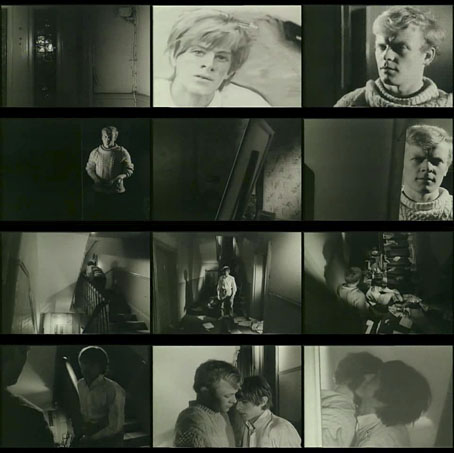
The image in question is a certain David Bowie making his first (non-speaking) film appearance as “The Boy”, a figure from a painting come to life. The only other character is an artist played by a young Michael Byrne, later a familiar face in many British film and TV productions. Bowie was 20 at the time, and Michael Armstrong’s short was made in 1967, the same year that David Bowie’s debut album was released to little acclaim. The film may be a little rough—it was obviously made with sound added later—but hindsight lends it multiple resonances: Bowie as an artwork come to life, the art theme in general (many of the paintings Bowie made public were self-portraits), a slight homoerotic subtext, and so on. There’s also a moment at the beginning where Bowie presses his face to the window, and his flattened nose looks the way it does on the cover of Lodger. A mere 12 years separates that album and this small film with a mountain range of tumultuous creativity in between. Watch The Image here.

Previously on { feuilleton }
Cracked Actor
Strange fascination

Language of the Birds: Occult and Art

laffoley.jpg

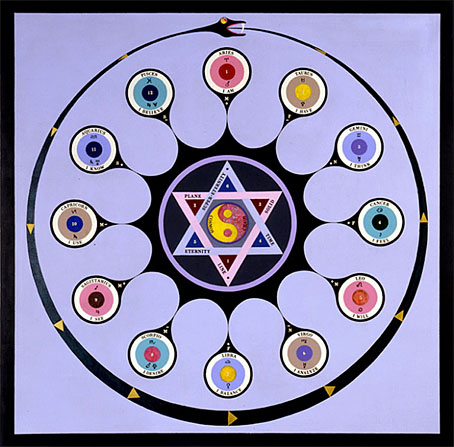
Astrological Ouroboros (1965) by Paul Laffoley.

Language of the Birds is an occult-themed art show at 80WSE, New York University, that opened this week and runs to 13 February, 2016. Curator Pam Grossman has assembled a stunning collection of work by artists, occultists, and occult-artists old and new:

Kenneth Anger * Anohni * Laura Battle * Jordan Belson * Alison Blickle * Carol Bove * Jesse Bransford * BREYER P-ORRIDGE * John Brill * Robert Buratti * Elijah Burgher * Cameron * Leonora Carrington * Francesco Clemente * Ira Cohen * Brian Cotnoir * Aleister Crowley * Enrico Donati * El Gato Chimney * Leonor Fini * JFC Fuller * Helen Rebekah Garber * Rik Garrett * Delia Gonzalez * Jonah Groeneboer * Juanita Guccione * Brion Gysin * Frank Haines * Barry William Hale * Valerie Hammond * Ken Henson * Bernard Hoffman * Nino Japaridze * Gerome Kamrowski * Leo Kenney * Paul Laffoley * Adela Leibowitz * Darcilio Lima * Angus MacLise * Ann McCoy * Rithika Merchant * William Mortensen * Rosaleen Norton * Micki Pellerano * Ryan M Pfeiffer & Rebecca Walz * Max Razdow * Ron Regé, Jr. * Rebecca Salmon * Kurt Seligmann * Harry Smith * Kiki Smith * Xul Solar * Austin Osman Spare * Charles Stein * Shannon Taggart * Gordon Terry * Scott Treleaven * Panos Tsagaris * Charmion von Wiegand * Robert Wang * Peter Lamborn Wilson * Lionel Ziprin

carrington.jpg

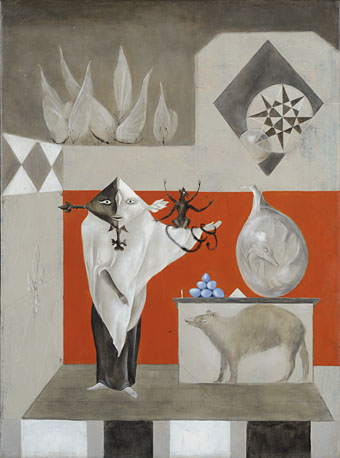
El Nigromante (1950) by Leonora Carrington.

More details for lucky New Yorkers may be found here. In addition, there’s an Occult Humanities Conference that runs through the weekend of February 5th.

Neutron designs

neutron2.jpg

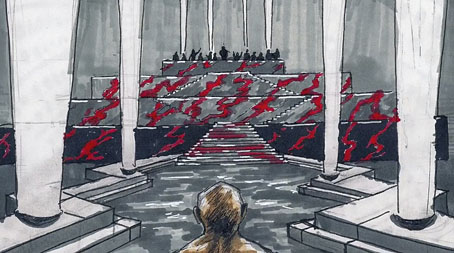
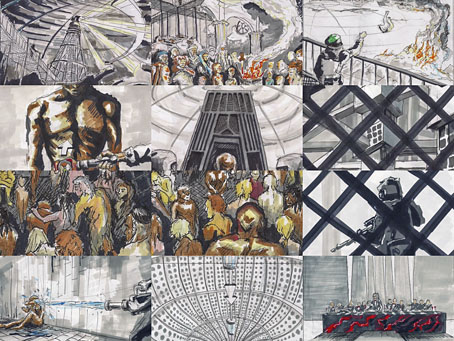
The Bowie overload this week had me thinking again about Derek Jarman’s unmade science-fiction film, Neutron, an apocalyptic work that would have starred David Bowie if the finance had been forthcoming. Jarman’s description in an earlier post about the film remains tantalising:

There are six published manuscripts of Neutron, which zig-zag their anti-heroes Aeon and Topaz across the horizon of a bleak and twilit post-nuclear landscape. ‘Artist’ and ‘activist’ in their respective former lives, they are caught up in the apocalypse, where the PA systems of Oblivion crackle with the revelations of John the Divine. Their duel is fought among the rusting technology and darkened catacombs of the Fallen civilization, until they reach the pink marble bunker of Him. The reel of time is looped—angels descend with flame-throwers and crazed religious sects prowl through the undergrowth. The Book of Revelations is worked as science fiction.

Lee [Drysdale] and I pored over every nuance of this film. We cast it with David Bowie and Steven Berkoff, set it in the huge junked-out power station at Nine Elms and in the wasteland around the Berlin Wall. Christopher Hobbs produced xeroxes of the pink marble halls of the bunker with their Speer lighting—that echo to ‘the muzak of the spheres’ which played even in the cannibal abattoirs, where the vampire orderlies sipped dark blood from crystal goblets.

neutron.jpg

This is one of those great what-if projects along with Jodorowsky’s film of Dune, Nicolas Roeg’s Flash Gordon, and others, so it was a surprise to discover a handful of recent designs for Neutron produced by students at the Wimbledon College of Art. The video here is a short collection of stills by Jonny Blackmore. There’s another of his pieces here, and further designs by Gabrielle Cole here and here. I’m guessing that these were part of a college assignment but if anyone knows otherwise please leave a comment. As to the original Neutron, some version of the script must still exist (Jon Savage was apparently involved in later stages) as must Christopher Hobbs’ designs. Maybe we’ll see them in a book one day.

Previously on { feuilleton }
Derek Jarman’s Neutron

Cracked Actor

cracked1.jpg

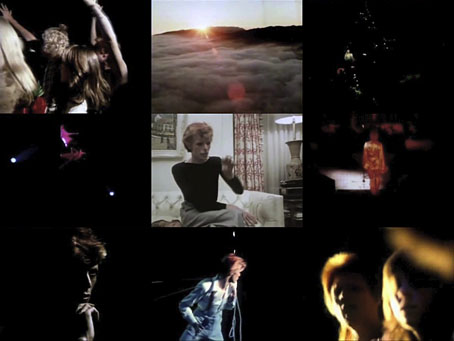
This is one of those TV documentaries that it’s tempting to think everyone must have seen by now, but if it’s over-familiar to me it’s undoubtedly new to others. Cracked Actor: A film about David Bowie was broadcast by the BBC in their Omnibus arts strand in January 1975. Director Alan Yentob followed David Bowie around the US during the Diamond Dogs tour, and while it’s good to see some of the numbers from that album being performed live, I’ve always found it odd that Bowie’s stage persona is that of the Young Americans album, all big hair and padded shoulders; it’s a look that doesn’t work with Diamond Dogs‘ theme of dystopian futurism. Despite Yentob’s directorial coup this was one of many BBC documentaries that were screened once then not shown again for a long time, so that viewers such as myself who saw the original broadcast would be left to reminisce about memorable moments.

cracked2.jpg

The most significant moment for me was Bowie demonstrating his own application of the cut-up method as he applied it to lyric writing, a sequence that was not only my first exposure to William Burroughs’ writing techniques but also my first introduction to Burroughs’ and Gysin’s names. Subsequent viewings confirmed that Bowie was as drug-addled as people claimed at the time (confirmed by the man himself in later years), especially in the limousine scenes which prefigure those in The Man Who Fell To Earth.

The amount of music in this film attracts the attentions of the YouTube copyright police so the upload linked here may not be around for long. Watch it while you can.

Previously on { feuilleton }
Strange fascination