Brecht and Bowie

baal2.jpg

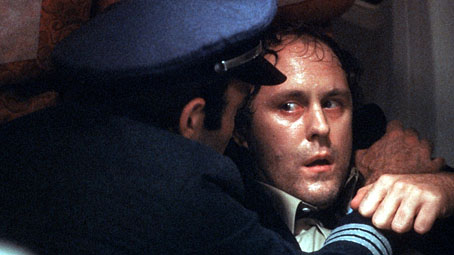
While David Bowie is still making the news it’s worth revisiting Baal, an hour-long BBC TV adaptation of the Bertolt Brecht play broadcast in 1981. Bowie stars as the title character, a thoroughly disagreeable poet and café singer who ruins the lives of those around him. This caused a stir at the time more for Bowie’s presence than for the content although Brecht wasn’t exactly a popular choice for evening entertainment. Prior to this most of Bowie’s acting had been in films, with his television appearances being limited to song performances or chat show discussions. The Man Who Fell to Earth aside, I’ve been somewhat dismissive of Bowie’s acting at times, his accent and the sheer weight of his musical persona overwhelm whatever role he’s given, but he’s good in this. He throws himself into the role, and is more convincing than I remember him being a couple of years later in Merry Christmas Mr Lawrence.

baal.jpg

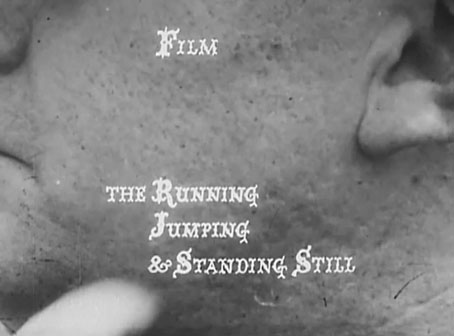
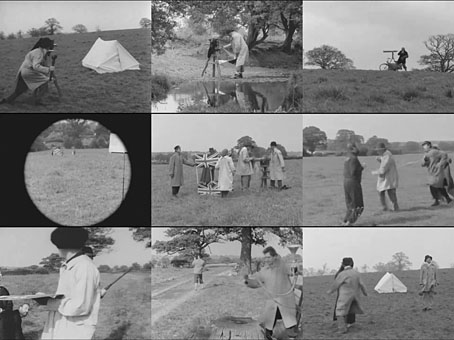
For many people Bowie will be the sole attraction in Baal but for me there’s also the presence of the great Alan Clarke as director and co-adaptor (with John Willett). Clarke directed the cult TV play Penda’s Fen in 1974, and was later responsible for a handful of other notable TV films including Scum, Made in Britain, Road, Elephant (1989), and The Firm, all of which are distinguished by a singular intensity and dramatic power the likes of which is usually only found in the best feature films. Compared to those plays Baal is a minor piece, filmed entirely in the studio, and made deliberately stagey to honour Brecht’s Verfremdungseffekt. The cameras keep their distance from the performers, and Brechtian distance is also achieved by the use of split-screen, title cards, and Bowie’s direct addresses to the viewer. If this seems like challenging material for a general audience (never mind the singer’s fans) consider that Baal was broadcast in primetime on BBC 1 when there were only three television channels in the UK. This would not happen today.

Previously on { feuilleton }
Penda’s Fen by David Rudkin

Maldoror

maldoror.jpg

Lautréamont’s Les Chants de Maldoror continues to provoke attempts at visual illustration. B. Oliver-White’s brief Super-8 film borrows some text from the Fourth Canto which is complemented by vague and grainy shots resembling outtakes from Eraserhead. Given the difficulties of fixing Maldoror‘s shifting terrain this seems a better approach than more literal depictions. Watch it here.

Previously on { feuilleton }
Books of blood
Magritte’s Maldoror
Frans De Geetere’s illustrated Maldoror
Maldoror illustrated

Brush of Baphomet by Kenneth Anger

anger2.jpg

Another recent piece of Angeriana, and another short video sketch, Brush of Baphomet (2009) is a kind of addendum to Anger’s The Man We Want to Hang (2002), being a further look at Aleister Crowley’s paintings. The title refers to one of Crowley’s many occult names. As a painter Crowley’s technical ability was almost nil but that never dissuaded him from trying, and I’m sure I’m not alone in finding his work to have a naive malevolence. Anger has had a lifelong interest in Crowley’s paintings, famously journeying in 1955 to the abandoned villa in Cefalù, Sicily, where he cleaned whitewash from the walls to reveal the remains of the murals Crowley had painted there.

anger3.jpg

The music in Brush of Baphomet is a surprising choice, an extract from the second part of Morton Subotnick’s Silver Apples of the Moon (1967). Anger’s musical selections have never been random ones so you have to wonder why this particular score. Was it because the electronics are reminiscent of the Moog drones Mick Jagger supplied for Invocation of My Demon Brother (1969)? Subotnick’s title is borrowed from The Song of Wandering Aengus by WB Yeats, a poet for whom Crowley (also a poet) had little affection. In Crowley’s occult novel Moonchild, Yeats appears as “Gates”, a mediocre painter (yes, well…), who ends up being killed in an act of magical revenge. Crowley must have been mortified a few years later when Yeats was awarded a Nobel Prize.

Previously on { feuilleton }
Anger Sees Red
Kenneth Anger’s Hollywood Babylon
Lucifer Rising posters
Externsteine panoramas
Missoni by Kenneth Anger
Anger in London
Arabesque for Kenneth Anger by Marie Menken
Edmund Teske
Kenneth Anger on DVD again
Mouse Heaven by Kenneth Anger
The Man We Want to Hang by Kenneth Anger
Relighting the Magick Lantern
Kenneth Anger on DVD…finally

Anger Sees Red

anger.jpg

A video sketch from 2004 in which Kenneth Anger manages to give us in four minutes some familiar preoccupations: Rudolph Valentino, occult symbolism, and a hunky guy in the form of the sunbathing gentleman named Red who provides the focus of the piece. The copy on YouTube is labelled “restricted work print” so this may not be its final state.

Previously on { feuilleton }
Kenneth Anger’s Hollywood Babylon
Lucifer Rising posters
Externsteine panoramas
Missoni by Kenneth Anger
Anger in London
Arabesque for Kenneth Anger by Marie Menken
Edmund Teske
Kenneth Anger on DVD again
Mouse Heaven by Kenneth Anger
The Man We Want to Hang by Kenneth Anger
Relighting the Magick Lantern
Kenneth Anger on DVD…finally

Wavelength

wavelength1.jpg

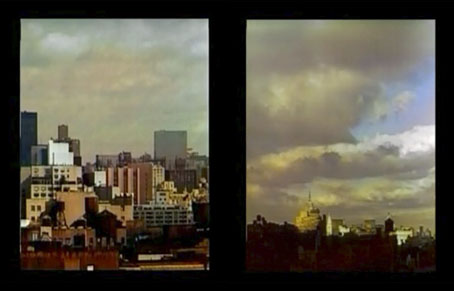
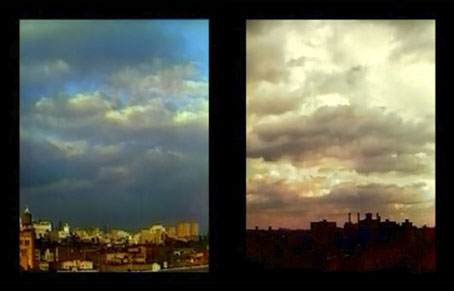
Thanks be to YouTube for once more resurrecting moments of underground cinema which would otherwise be very difficult to see. Wavelength (1967) is Michael Snow’s experimental masterwork, a 45-minute zoom across a New York loft that ends on a photograph of waves that fills the screen. This recipe for ennui is not without incident: we see a bookcase being installed, someone plays a Beatles record—Strawberry Fields Forever—a man breaks into the apartment and collapses. (He may be dead but we never find out.) Throughout this, the film is subject to flashes of colour filtering, moments of negative inversion and sudden flares of light. For at least half the running time the sound is replaced by a droning oscillator tone which rises inexorably the closer the camera brings us to its destination.

wavelength2.jpg

Between these events there’s plenty of time to meditate upon the meaning of the title: the various wavelengths of sound and light, the distance across the room to the view of the waves, the waves themselves. It’s a fascinating film which is linked for me (and may have influenced) two other takes on the long take: JG Ballard’s short story The 60 Minute Zoom (1976), in which a man monitors his wife’s infidelity from a hotel balcony, and the celebrated shot at the end of Antonioni’s The Passenger (1975) when Jack Nicholson’s character is assassinated off-screen in another hotel room while the camera floats miraculously through the iron bars of the window. You can see Wavelength in full here. I’d recommend watching it full-screen, it requires immersion.

Previously on { feuilleton }
() by Morgan Fisher
La Région Centrale
Downside Up